

What if the best way to discuss your parents’ finances is to start by listening, not asking for account details? If you’re concerned about their financial security or day-to-day needs, it’s understandable to feel unsure about how to talk to your parents about their finances without making them feel judged or pressured.
A calm conversation can begin with care and permission. You don’t need to solve everything at once or ask about every financial detail. Start by sharing what you’ve noticed, asking what matters most to them, and respecting what they’re ready to discuss.
This guide covers how to raise concerns respectfully, choose practical questions, and agree on a manageable next step. It also explains how to organise information without taking control away from your parent. If you want help sorting through planning questions, a financial consultant or financial planner may be an optional source of support. The goal is a more open conversation, one step at a time.
Key Takeaways
- Learn how to talk to your parents about their finances by expressing concern with care and asking permission before discussing private details.
- Prepare for a calmer conversation by choosing one concern and a private time when neither of you feels rushed.
- Explore everyday finances, future income, healthcare preferences, and important contacts without assuming what applies to your parent.
- If your parent feels criticised or resists, pause and ask what feels uncomfortable rather than pushing for answers.
- Choose one shared next step. If you want help organising questions, a financial consultant or financial planner may be an option.
Why talking to your parents about their finances can feel difficult
Money can feel deeply private, especially between parents and adult children. A question about savings or future plans may sound like criticism, even when it comes from care. Your concern matters, but it doesn’t automatically give you control over your parent’s choices. They can decide what to share and what decisions to make.
Life changes can create a natural opening for a conversation. Retirement, a move, changing household responsibilities, or the loss of someone who helped manage family matters may prompt practical questions. None of these changes proves that a parent can’t manage their finances. They may simply make it useful to understand what support, if any, your parent wants.
A respectful discussion begins with curiosity, consent, and listening. That principle can help you raise concerns without turning a conversation into an interrogation.
Separate your concern from assumptions about your parent
Before raising the topic, identify what prompted your concern. Perhaps you noticed an unopened bill, heard your parent say they were unsure about a payment, or received second-hand information from a relative. Separate what you observed from what you fear it might mean. One missed payment doesn’t establish a pattern, and a relative’s interpretation may not tell the whole story.
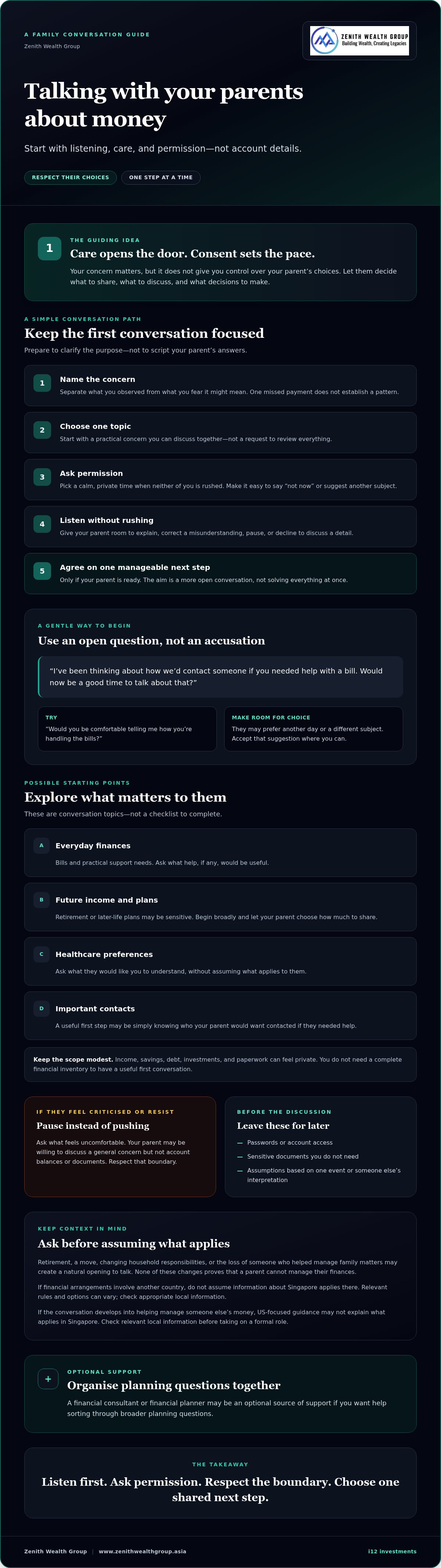
Use an open question, such as, “Would you be comfortable telling me how you’re handling the bills?” Avoid diagnosing the problem or leading with an accusation. Give your parent room to explain, correct a misunderstanding, or say they’d rather not discuss it now.
Recognise the topics that may feel personal
Income, savings, debt, investments, and plans for later life can all feel sensitive. Comfort with these subjects may be shaped by family roles, culture, or past experiences, including disagreements about money. Your parent may be willing to discuss a general concern but not account balances or paperwork. Respect that boundary.
You don’t need a complete financial inventory to have a useful first conversation. If future arrangements come up, a broad overview of estate planning can help explain the topic without assuming what your parent has arranged. If your parent has financial arrangements in another country, such as Indonesia, Malaysia, the Philippines, or Thailand, don’t assume that information about Singapore applies there. The relevant rules and options can vary, so check the appropriate local information.
Start with what they’re comfortable sharing. A thoughtful conversation can build trust without requiring every detail or document.
How to prepare for a conversation about your parents’ finances
A little preparation can help you stay focused without turning the conversation into an interview. The aim is to make it easier for your parent to share what they choose, not to arrive with a checklist they must complete.
Prepare to clarify the purpose, not script your parent’s answers. Before you speak, use this simple sequence:
- Clarify the specific concern behind the conversation.
- Choose one topic to start with.
- Ask permission to discuss it.
- Listen without rushing to fill pauses.
- Agree on one small action, if your parent is ready.
Choose a calm, private time when neither of you is distracted or under pressure to leave. Avoid raising a sensitive subject in the middle of an argument or while your parent is handling another task. Prepare a few open-ended questions, but leave room for them to decline or suggest another time. This keeps the exchange flexible and helps you stay focused on your parent’s needs.
Choose a useful first topic and opening line
Start with a practical concern you can discuss together, rather than asking to review everything. For example: “I’ve been thinking about how we’d contact someone if you needed help with a bill. Would now be a good time to talk about that?” Keep your tone warm and give your parent a choice. They might prefer another day or want to start with a different subject. Accept that suggestion where you can.
Decide what you do not need to ask yet
At first, it may be enough to know who your parent would want contacted if they needed help. Don’t open by requesting passwords, access to accounts, or sensitive documents. Those requests can feel intrusive and may not be necessary for the concern you’re trying to address.
If the discussion develops into helping manage someone else’s money, the Consumer Financial Protection Bureau’s Managing Someone Else’s Money guides offer general background. They’re US-focused, so don’t assume they explain what applies in Singapore. Check relevant local information before taking on a formal role.
If you’d like help organising broader financial planning questions, speaking with a financial consultant or financial planner is one option. You can find financial planning contact details when you’re ready.
What to ask about savings, CPF, healthcare, and future plans
You don’t need to cover every part of your parent’s finances in one sitting. Focus on what would help you understand their preferences and offer support, while letting them decide how much detail to share. Everyday bills, future income, healthcare choices, and important contacts are useful starting points.
In Singapore, CPF and CPF LIFE may be relevant topics to ask about, but don’t assume either applies in the same way to every parent. Ask what they understand about their own arrangements and what questions they still have. Verify current details with an appropriate Singapore source before relying on technical explanations. If your family is managing arrangements across Singapore and nearby countries, check the information for the country relevant to each arrangement. For general conversation ideas, PBS NewsHour shares tips for talking to your aging parents.
| Start with practical questions | Topics that can wait for permission |
|---|---|
| “If a bill or household task becomes difficult, how would you like me to help?” | “Would you be comfortable discussing your savings or investments?” |
| “Where do you keep the information someone would need to contact your doctor or another trusted person?” | “Have you thought about how your income needs may change in retirement?” |
| “Who would you want me to contact if you needed support?” | “Would you like to talk about healthcare preferences or legacy planning?” |
Start with practical information and support preferences
Ask how your parent wants family members to respond if a practical issue comes up. They might prefer a call to a particular person or want to handle the matter themselves. You can also ask where essential information is kept, without asking to see documents or access accounts. Let your parent name the trusted contacts they’d want involved, and respect their preferences.
Raise long-term planning without turning it into a demand
When the conversation feels comfortable, ask whether your parent has considered retirement income, healthcare, or legacy priorities. Estate planning and a Lasting Power of Attorney are topics to explore with qualified support, not assumptions to make on your parent’s behalf. A financial consultant or financial planner may help organise questions if your parent wants professional input. You can review financial planning contact details.
How to respond if your parent avoids the conversation or disagrees
A parent may hear a money question as criticism, or worry that sharing information means giving up independence. If they pull back, don’t push for an answer in the moment. Pause, acknowledge their reaction, and ask what feels uncomfortable. You might say, “I can see this feels personal. I’m not trying to take over. Is there a part of the conversation that would feel easier to discuss?”
That pause can help you understand whether the issue is the timing, the subject, or how the concern was raised. If your parent is open to revisiting it, ask whether they’d prefer another day or want to start with a more practical question. If they clearly say they don’t want to discuss it, respect that boundary. You can leave the door open without repeatedly asking.
When your parent says the subject is private
Try: “I understand, and I’ll respect that. I care about you, though. Would it feel easier to talk about who you’d like us to contact if you need help, without discussing amounts or documents?” Let your parent decline that, too. Avoid turning a smaller question into a route to account details. Respecting a clear limit is part of building trust, not a failure to make progress.
When siblings or family members disagree
Family members may interpret the same situation differently. Keep the discussion anchored in what someone actually observed and what your parent has said they want, rather than competing assumptions about what should happen. If your parent is willing, ask them directly about their preferences instead of speaking for them.
Where relatives have different views, agree on the shared purpose: understanding what support your parent wants. Don’t use a family conversation to pressure them into revealing figures, documents, or decisions. If your parent wants help structuring a planning discussion, a financial consultant or financial planner may be an optional source of support. The focus can be on organising questions and priorities, not choosing a specific investment or outcome.
If you’d like professional support with financial planning questions, you can contact the financial planning team.
Agree on one next step and keep the conversation open
A useful conversation doesn’t need to end with every question answered. Before wrapping up, agree on one action your parent is comfortable taking, who will handle it, and when you’ll check in. That turns a broad concern into a manageable plan without making your parent feel that decisions are being made for them.
The action can be simple: you write down questions they want answered, your parent locates a document they’re comfortable sharing, or you both decide whether to arrange a discussion with a professional. Keep the next step specific, but leave the wider plan open.
Create a follow-up that respects your parent’s choices
At the end, summarise what your parent agreed to do and what remains undecided. Check that you’ve understood correctly. Before passing details to siblings or other relatives, ask your parent what they’re comfortable sharing and with whom. Their preferences may change as circumstances change, so treat the plan as something to revisit, not a permanent instruction. This steady approach can make the conversation feel less like a one-time test and more like an ongoing discussion.
Know when a financial consultant or financial planner may help
Professional support is optional. A financial consultant or financial planner may help organise questions about retirement planning, investments, wealth protection, or legacy planning. Your family can prepare questions first, then decide whether a discussion would be useful. Before proceeding, ask what the support covers and confirm any applicable fees directly. You don’t need to make an appointment simply because the topic has come up.
If you’d like to explore professional support for financial planning questions, contact Zenith Wealth. Start with what you and your parent want to understand. The next step can be small, shared, and guided by your parent’s choices.
Take the next step together
Talking about money with a parent doesn’t have to mean covering every detail or making decisions on their behalf. Start with care, ask permission, and focus on what they’re comfortable discussing. A practical question about support or an important contact can be a useful beginning.
As you consider how to talk to your parents about their finances, listen to their preferences, respect a clear boundary, and agree on one manageable next step. You can always return to larger questions later, when your parent is ready.
Zenith Wealth Group is a Singapore-based financial advisory firm offering support with retirement planning, wealth protection, investment management, and legacy planning. If your family would like help organising its questions, discuss your family’s planning questions. Start a conversation with Zenith Wealth Group when you and your parent are ready to explore professional support.
Frequently Asked Questions
How do I start a conversation with my parents about money?
Start with one practical concern and ask permission to discuss it. You could say, “I’ve been thinking about how I can support you if a financial task becomes difficult. Is now a good time to talk?” Choose a calm moment, then listen to your parent’s response. Keep the first conversation focused. You don’t need to ask for account details or solve every concern at once.
What if my parents refuse to talk about their finances?
If your parents refuse, acknowledge their boundary and avoid pressing for details. You might say, “I understand this is private. I’m here if you’d like to talk another time.” If they seem open to a smaller topic, ask whether they’d prefer to discuss who to contact if help is needed. If they clearly don’t want to continue, respect that and leave the door open.
What financial questions should I ask my elderly parents?
Ask first about practical support: who they’d like contacted if they need help, where essential information is kept, and how they’d prefer family members to assist. If they’re comfortable, you can ask about everyday expenses, future income, healthcare preferences, or important planning priorities. Don’t assume age means they need help managing money.
How can I talk to my parents about retirement planning?
Ask what they want retirement to look like and whether they have questions about future income or expenses. In Singapore, CPF and CPF LIFE may be relevant subjects, but don’t assume they apply or suit every parent. Encourage them to check current information with official Singapore sources before relying on technical explanations. Keep the discussion focused on their goals and preferences, not on pushing a particular financial choice.
Should I involve my siblings in a conversation about my parents’ finances?
Involve siblings if your parent is comfortable with it, and ask permission before sharing personal information. Keep the discussion focused on what your parent has said they want and on specific practical concerns, rather than assumptions or competing opinions. If siblings disagree, consider first asking your parent how they’d like the family to communicate or help. Their preferences should guide what gets shared and with whom.
When should my family speak with a financial planner about a parent’s finances?
Consider speaking with a financial planner if your parent wants help organising questions across retirement, investments, wealth protection, or legacy planning. It’s optional, and your family can prepare questions before deciding whether professional support would be useful. Confirm the scope of support and any applicable fees directly. Zenith Wealth Group is based in Singapore and offers financial planning across these areas; no specific outcome should be assumed.


