

What if you could bypass the years of legal delays and public scrutiny that usually follow a will? Many families in Singapore worry that their hard-earned wealth will be frozen in probate or mismanaged by heirs who aren't quite ready for the responsibility. Learning how to set up a trust fund in Singapore is the first step toward solving these concerns. It's a common challenge, especially when you're trying to balance the costs of setup against the long-term benefits of protection. You want a solution that offers privacy and ensures your legacy planning actually works when it matters most.
This strategic guide provides the clarity you need to secure your family's future. We'll walk through the 2026 legal requirements, including the latest Trustees Act updates and the 65% ABSD rules for residential property. You'll learn how a financial consultant can help you integrate modern frameworks like i12 investments into your trust structure. From protecting generational wealth to maintaining absolute privacy in asset distribution, this roadmap offers a clear path to move forward with confidence.
Key Takeaways
- Understand the step-by-step process of how to set up a trust fund in Singapore to ensure immediate asset distribution and avoid the delays of probate.
- Identify which assets are best suited for your trust, from residential property to modern frameworks like i12 investments.
- Navigate the 2026 regulatory environment, including the 65% ABSD on property transfers and the latest Trustees Act requirements.
- Learn how to choose between Family and Discretionary trusts to maintain control over how your wealth is managed across generations.
- See how a financial consultant integrates your trust into a broader legacy planning strategy to protect your family's future and your own retirement.
The Essentials of Trust Funds: Why Singapore is a Global Hub
Understanding The Essentials of Trust Funds is the first step toward effective legacy planning. At its heart, a trust is a fiduciary arrangement. A Settlor (the person creating the trust) transfers assets to a Trustee, who then manages those assets for the Beneficiaries. This relationship is bound by a legal document called the Trust Deed. It's a private contract that keeps your family affairs out of the public eye. Unlike a will, which becomes a public record during the probate process, a trust offers a "Privacy Advantage" that many Singaporean families value. It ensures that the details of your wealth and who receives it stay confidential.
Singapore has become a global hub for these structures because of the legal certainty provided by the Trustees Act. The city-state offers significant tax efficiency. As of 2026, there's no capital gains tax, inheritance tax, or gift tax in Singapore. When you're looking at how to set up a trust fund in Singapore, these factors make it one of the most stable environments for wealth protection. It provides a reliable framework that protects both the settlor's intentions and the beneficiaries' rights through clear, modern regulations.
Trust vs. Will: Which Do You Need?
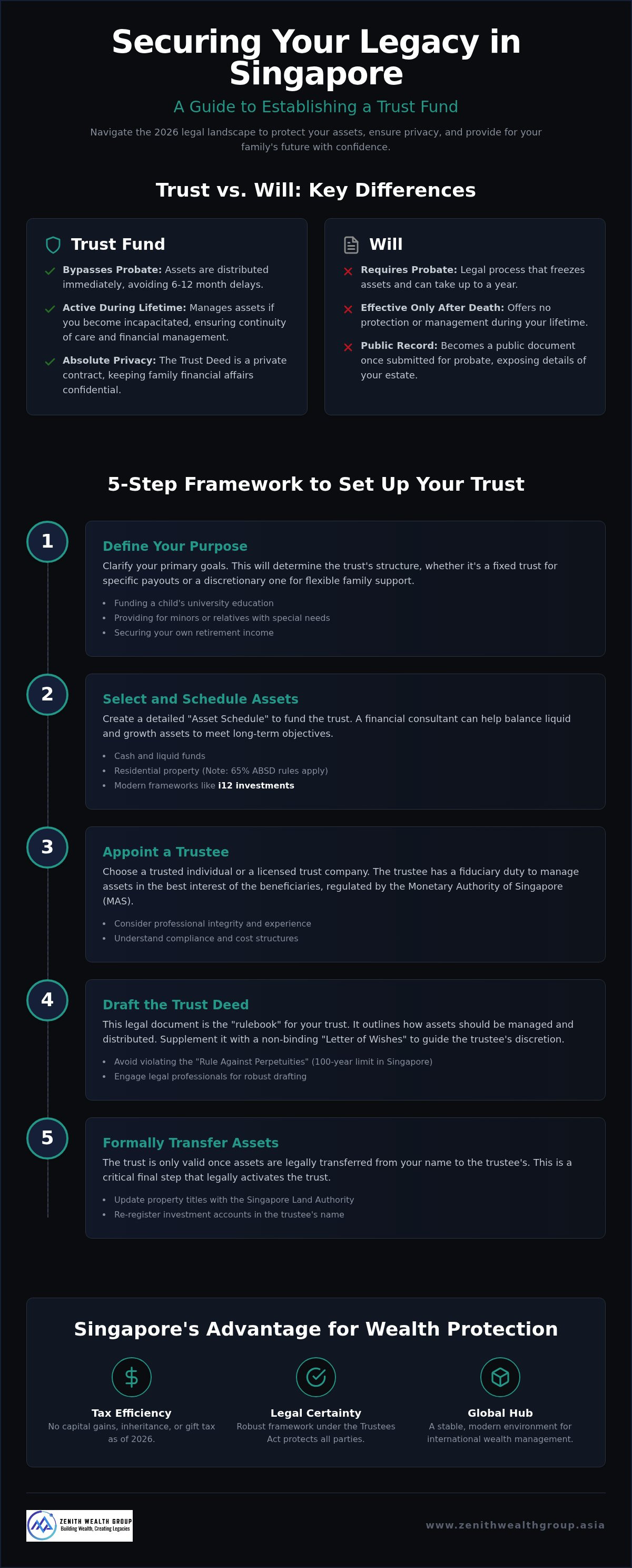
A will is a vital tool, but it only takes effect after you pass away. In contrast, a trust can manage your assets while you're still alive. This is particularly useful if you ever become incapacitated and need someone to manage your finances for your care. One of the biggest hurdles in Singapore is the probate process, which can delay asset distribution by 6 to 12 months. A trust bypasses this entirely. Your beneficiaries can receive support almost immediately. A financial consultant often recommends using both tools together. They ensure your legacy plan is robust and covers your needs during your lifetime and your family's needs after.
Common Reasons for Setting Up a Trust in 2026
When exploring how to set up a trust fund in Singapore, most parents prioritize long-term stability for their children. If you're managing complex assets like i12 investments, a trust ensures these continue to grow under professional oversight. Common motivations include:
- Asset Protection: Safeguarding wealth from potential creditors or legal claims. This is essential for business owners who face higher liability risks.
- Providing for Minors: Ensuring funds are available for education funding or special needs without giving a large lump sum to a child.
- Managing Spendthrift Behavior: Setting up structured distribution schedules. This prevents heirs from mismanaging their inheritance through impulsive spending.
A 5-Step Framework to Set Up Your Singapore Trust Fund
Establishing a trust requires a methodical approach. It transforms your vision for your family's future into a legally enforceable structure. If you're wondering how to set up a trust fund in Singapore, follow this five-step framework to ensure every detail is covered. This process ensures your legacy planning is both legally sound and strategically aligned with your financial goals.
Step 1 & 2: Purpose and Asset Selection
Your first task is defining the "why." Your specific goals, such as funding a child's university education or securing your own retirement, will dictate the trust's structure. For instance, a fixed trust specifies exactly what beneficiaries receive, while a discretionary trust gives the trustee flexibility to adapt to changing family needs. You must then create a detailed "Asset Schedule." This includes cash, property, and i12 investments. A financial consultant ensures your trust is funded with the right mix of liquid and growth assets to meet long-term goals. This phase is about aligning your wealth protection strategy with your current financial reality.
Step 3 & 4: Trustee Appointment and Drafting
Choosing a trustee is perhaps the most significant decision you'll make. You can appoint a trusted individual or a licensed company. Regardless of your choice, the trustee holds a fiduciary duty to act in the best interests of your beneficiaries. Understanding the legal framework for Costs, Compliance, and Choosing a Trustee is vital, as licensed trust companies in Singapore are strictly regulated by the Monetary Authority of Singapore to ensure professional integrity.
Once you've selected a trustee, you'll draft the Trust Deed. This is the "rulebook" for your assets. You should also prepare a "Letter of Wishes." While not legally binding, it provides essential guidance for the trustee's discretion when making future distributions. A common drafting pitfall to avoid is violating the "Rule Against Perpetuities," which in Singapore generally limits a trust's duration to 100 years. Professional drafting ensures your trust remains valid and effective for its intended lifespan.
Step 5: Transfer of Assets
The final step is the formal transfer of ownership. A trust isn't valid until the assets are legally moved from your name to the trustee's name. This is a critical legal requirement that many people overlook. It might involve updating property titles at the Singapore Land Authority or re-registering investment accounts. Each asset class has its own transfer protocol. It's a technical process that requires absolute precision to avoid future legal challenges. If you're ready to start this journey, you can connect with a financial planner to review your portfolio and ensure your assets are trust-ready.
Types of Trusts and Integrating i12 Investments
Choosing the right structure is a critical part of the process when you decide how to set up a trust fund in Singapore. Not all trusts are created equal. You must select a vehicle that aligns with your family's specific needs and your long-term vision. Family trusts are the most common choice for multi-generational wealth protection. They consolidate your assets into a single, manageable entity. This protects the core wealth while allowing different family branches to benefit from the returns. It's a strategic way to keep a legacy intact for decades.
You might also consider a discretionary trust if you want maximum flexibility. In this arrangement, the trustee has the power to decide the timing and amount of distributions. This is especially useful if you're concerned about beneficiaries who might not be ready to handle a large inheritance. Conversely, fixed trusts provide specific instructions for set milestones. You can mandate that funds are released only for university graduation or upon reaching a certain age. This level of control ensures your assets are used exactly as you intended.
Revocable vs. Irrevocable Trusts
You'll also need to decide between a revocable or irrevocable structure. A revocable trust allows you to maintain control and make changes as your life evolves. However, because you still "own" the assets in the eyes of the law, they offer less protection from creditors. An irrevocable trust is much harder to change once established. The trade-off is superior asset security and potential tax benefits. This choice is a cornerstone of any effective wealth protection strategy. It's about finding the right balance between personal control and total security.
Optimizing the Trust with i12 Investments
Understanding how to set up a trust fund in Singapore involves more than just legal paperwork; it requires a sophisticated investment strategy. Modern trust portfolios often leverage i12 investments to drive long-term growth. These frameworks are designed for the extended time horizons typical of trust funds. They allow you to balance the income needs of current beneficiaries with the capital growth required for future heirs. It's a delicate act that requires professional oversight.
The regulatory environment in Singapore supports this professional approach. The Securing Your Legacy: The Role of Professional Advisory framework from the Monetary Authority of Singapore ensures that licensed trustees operate with high integrity. A financial planner reviews these trust-held portfolios annually. They ensure the assets continue to grow and remain aligned with the trust deed's objectives. This active management is what transforms a simple legal document into a thriving engine for generational wealth.
Costs, Compliance, and Choosing a Trustee
Understanding the financial commitment is essential when learning how to set up a trust fund in Singapore. It's not just about the initial signature. You're establishing a long-term structure that requires both upfront investment and ongoing maintenance. Initial setup costs primarily include legal fees for drafting the Trust Deed and potential stamp duties. For example, transferring residential property into a trust now attracts an Additional Buyer's Stamp Duty (ABSD) of 65% if the beneficial interest is not clearly identifiable. These costs ensure your assets are legally fortified from day one.
Beyond the start-up, you must account for ongoing administration. This includes annual trustee fees, specialized accounting, and tax filing requirements. In 2026, compliance is more rigorous than ever. Trustees must navigate strict Anti-Money Laundering (AML) and Common Reporting Standard (CRS) rules. The "Guidelines to Notice TCA-N03" updated in June 2025 require detailed record-keeping and disclosure. Failing to meet these standards can lead to significant penalties, with some fines under the Trustees Act reaching S$25,000. Professional oversight is no longer optional for families wanting to avoid these risks.
The True Cost of a Trust in Singapore
Think of your trust as a living entity. You'll face one-time expenses like the initial legal draft, but recurring costs for professional management keep the structure healthy. Avoid the temptation of "cheap" DIY trust templates found online. These often lack the specific clauses needed to survive Singapore's unique legal landscape and can lead to expensive court challenges later. A financial consultant helps minimize "leakage" from your estate. They coordinate your trust with i12 investments to ensure portfolio growth outweighs administrative overhead. This efficient planning keeps more of your wealth intended for your heirs.
Selecting the Right Trustee for Your Family
Choosing between an individual or a corporate trustee is a balance of cost and security. Appointing a family member might save on annual fees. However, it places a heavy legal burden on someone who may lack the expertise to handle complex compliance or tax filings. Licensed trust companies, regulated by the Monetary Authority of Singapore (MAS), offer professional continuity and technical knowledge. They don't fall ill or have personal conflicts of interest. Many parents also appoint a "Protector." This is a trusted third party who oversees the trustee's actions, providing an extra layer of protection for your beneficiaries. If you're unsure which path fits your portfolio, reach out to a financial planner to discuss your family's specific needs.
Securing Your Legacy: The Role of Professional Advisory
A trust serves as a robust shield, but it shouldn't stand alone. It's just one pillar of a comprehensive legacy plan. To be truly effective, you must coordinate this structure with your retirement planning. Your own needs must be met first. If you over-fund a trust without retaining enough for your lifestyle, you risk your own financial independence. Liquidity is another vital factor often overlooked. Your estate needs enough cash to settle final debts, funeral expenses, or outstanding taxes without being forced to liquidate trust assets like family property at a discount. Mastering how to set up a trust fund in Singapore requires this holistic view to ensure your wealth truly lasts for generations.
How a Financial Consultant Enhances Your Trust
A financial consultant brings all these moving pieces together. They align your investment management with the trust's specific distribution goals. This ensures your i12 investments generate the right balance of growth and income for different beneficiary tiers. They also verify that your life insurance nominations are correctly integrated with the trust deed to avoid conflicting instructions. Regular stress-testing is mandatory. Family dynamics change, and tax laws evolve quickly. A structure that worked perfectly a few years ago might need adjustments to remain compliant with the latest 2026 regulations. This proactive approach prevents your legacy from becoming stagnant or legally vulnerable.
The Path Forward: From Idea to Implementation
Moving from the idea of a trust to a working reality requires organized action. Start by gathering your essential documents. This includes property titles, bank statements, and records of your i12 investments. Before legal drafting begins, you need a discovery meeting. This isn't about law; it's about values. You define what your legacy stands for. Do you prioritize education, or is business succession the focus? At Zenith Wealth, as representatives of finexis advisory, we guide you through this discovery process. When you are ready to learn how to set up a trust fund in Singapore, we help you build a bespoke roadmap before the first word of the trust deed is written. Contact Zenith Wealth today for a bespoke legacy review to secure your family's future with confidence.
Build a Lasting Legacy for Your Family
Establishing a trust is about more than just legal paperwork; it's about achieving ultimate peace of mind. You now have a strategic roadmap for how to set up a trust fund in Singapore. By following the five-step framework and selecting the right trustee, you can bypass the lengthy probate process and keep your family's financial affairs private. Integrating modern structures like i12 investments ensures your wealth continues to grow while staying protected from mismanagement or external claims. It's a proactive choice that transforms your current success into a permanent foundation for your children.
Expert coordination is the key to making these tools work together. As authorized representatives of finexis advisory Pte Ltd, the financial consultants at Zenith Wealth specialize in integrating i12 investments with legacy planning to create robust roadmaps. We help you balance your retirement needs with the desire to provide for future generations. Don't leave your family's future to chance. Secure your family's generational wealth with a professional legacy review from Zenith Wealth. We're ready to help you turn your vision into a reality. Let's start the conversation today.
Frequently Asked Questions
What is the minimum amount of money needed to set up a trust in Singapore?
There is no legal minimum amount required to establish a trust in Singapore. However, the practicalities of setup and maintenance costs mean most families start with at least S$500,000 to S$1 million in assets. For smaller amounts, the administrative and legal fees might outweigh the structural benefits. A financial consultant can help you determine if your current portfolio justifies the costs of a formal trust structure.
Can I be the trustee of my own trust fund?
You can legally act as the trustee of your own trust, a role often called a settlor-trustee. While this offers maximum control, it may weaken the asset protection benefits if a court views the trust as your personal alter ego. Most parents choose a professional trust company or a trusted third party to ensure a clear legal separation between ownership and control. This separation is vital for long-term wealth protection.
How long does it take to fully set up and fund a trust?
The timeline for how to set up a trust fund in Singapore generally ranges from four to eight weeks for the legal drafting phase. However, the funding process, where you legally transfer assets like property or i12 investments into the trust, can take several months. Property transfers involve the Singapore Land Authority and take longer than cash. Your financial planner coordinates these transfers to ensure the trust is operational.
Is a trust fund in Singapore taxable?
Trust income in Singapore is generally subject to the prevailing corporate tax rate, which is 17% as of 2026. However, Singapore does not impose capital gains tax, inheritance tax, or gift tax. This makes trusts a highly efficient vehicle for long-term wealth accumulation. Depending on the trust structure, certain tax transparency rules may apply where beneficiaries are taxed at their own personal rates instead. Professional advice ensures you optimize these benefits.
Can a trust fund protect my assets in a divorce?
A trust can protect assets in a divorce if it is structured as an irrevocable trust well before any matrimonial proceedings begin. If the assets are no longer considered part of your personal wealth, they may be excluded from the matrimonial pool. However, Singapore courts have the power to look through sham trusts created specifically to hide assets. A financial consultant ensures your trust is established with genuine intent to provide for heirs.
Can I change the terms of a trust after it has been created?
Whether you can change the terms depends on if the trust is revocable or irrevocable. A revocable trust gives you the flexibility to amend the deed or even cancel the trust entirely. Irrevocable trusts are much harder to change once signed, offering higher security but less flexibility. Many families use a Letter of Wishes to provide ongoing guidance to the trustee without needing to make formal, complex legal changes to the deed.
What happens to a trust if the trustee passes away?
If an individual trustee passes away, the trust does not end. The trust deed should specify successor trustees who will step in to manage the assets immediately. If you use a licensed trust company, the death of individual staff members doesn't affect the trust, as the corporate entity continues to exist. This corporate continuity is a major reason why many parents prefer professional trustees for multi-generational legacy planning over individual family members.
Is a trust fund better than a will for avoiding probate?
A trust is significantly better than a will for avoiding the probate process in Singapore. Assets held in a trust pass directly to beneficiaries according to the trust deed, often within days. A will must go through the courts for a Grant of Probate, which can take six months to a year. This speed ensures your family has immediate access to funds for daily needs and education without waiting for clearances.


