

A larger life insurance benefit is not automatically a better fit. If you’re wondering how much life insurance do I need in Singapore, start with what your family would need financially if your income stopped, not a generic income multiple. The aim is to protect the people who depend on you without paying for cover that doesn’t match your household’s needs.
This guide shows you how to estimate a needs-based amount: add income support, debts, housing commitments and future goals such as education funding, then subtract suitable resources and existing cover. It also explains how to consider CPF-related protection, including the Dependants’ Protection Scheme, and why it may not meet every family’s needs. You’ll learn how to review your estimate when circumstances change and how a financial consultant or financial planner can connect protection with wider priorities such as wealth protection, legacy planning and i12 investments.
Key Takeaways
- Estimate how much life insurance do I need in Singapore by focusing on your dependants’ likely needs and financial commitments, not a one-size-fits-all income multiple.
- Build a needs-based estimate by adding relevant obligations and subtracting suitable existing cover and resources.
- Compare your estimate with your policies’ actual benefits, terms and conditions to identify a potential shortfall.
- Consider how housing commitments, education plans and your life stage affect the protection your household may need.
- Review your assumptions as circumstances change, and consider how protection fits alongside wider goals such as legacy planning and i12 investments.
How Much Life Insurance Do You Need in Singapore?
Life cover is financial support intended for your beneficiaries if you die. It can help them manage household expenses, repay debts or continue working towards important goals. For a basic overview of what life insurance is, start by identifying what the cover is meant to do for your family.
So, how much life insurance do I need in Singapore? Begin with the people who rely on you and the commitments your income helps meet. An income multiple can offer a quick first estimate, but it cannot account for every household’s savings, existing policies, debts or plans. Treat it as a starting point, not a personalised recommendation.
Total protection need is the amount your household may need to meet its chosen financial responsibilities. The remaining cover gap is what remains after you account for suitable existing cover and resources. Keeping these figures separate helps you distinguish your total needs from the additional insurance you may require.
Which responsibilities might life cover help address?
List the obligations your beneficiaries could face if your income stopped. These may include regular household expenses, outstanding debts, housing commitments, children’s education goals and ongoing support for a financially dependent family member. Consider how long each responsibility may continue rather than assuming every need lasts for the same period.
Your estimate depends on your circumstances. A household with young children and a large housing commitment may have different priorities from one with fewer dependants, more savings or other sources of support. Income matters, but so do assets, existing protection and the length of time your family may need financial help.
Why is there no single right amount for every household?
A simple income-multiple estimate applies the same broad shortcut to people with very different circumstances. A household-specific assessment considers who depends on your income, what those dependants may need and which resources could help meet those needs. This makes the estimate more relevant, although it still relies on assumptions that should be reviewed when circumstances change.
For example, two people earning similar incomes may need different amounts of cover. One may have a partner, children and substantial housing commitments; the other may have no dependants and more savings. Existing policies can also affect the additional cover to consider, but their headline sums alone may not show how well the benefits match your family’s needs.
A financial consultant or financial planner can help review these moving parts as part of wider wealth protection and family planning. Protection decisions may also sit alongside education funding, legacy planning and broader financial goals, including those connected with i12 investments. The next step is to set out your responsibilities and available resources in a clear estimate.
How to calculate a life insurance shortfall in Singapore, step by step
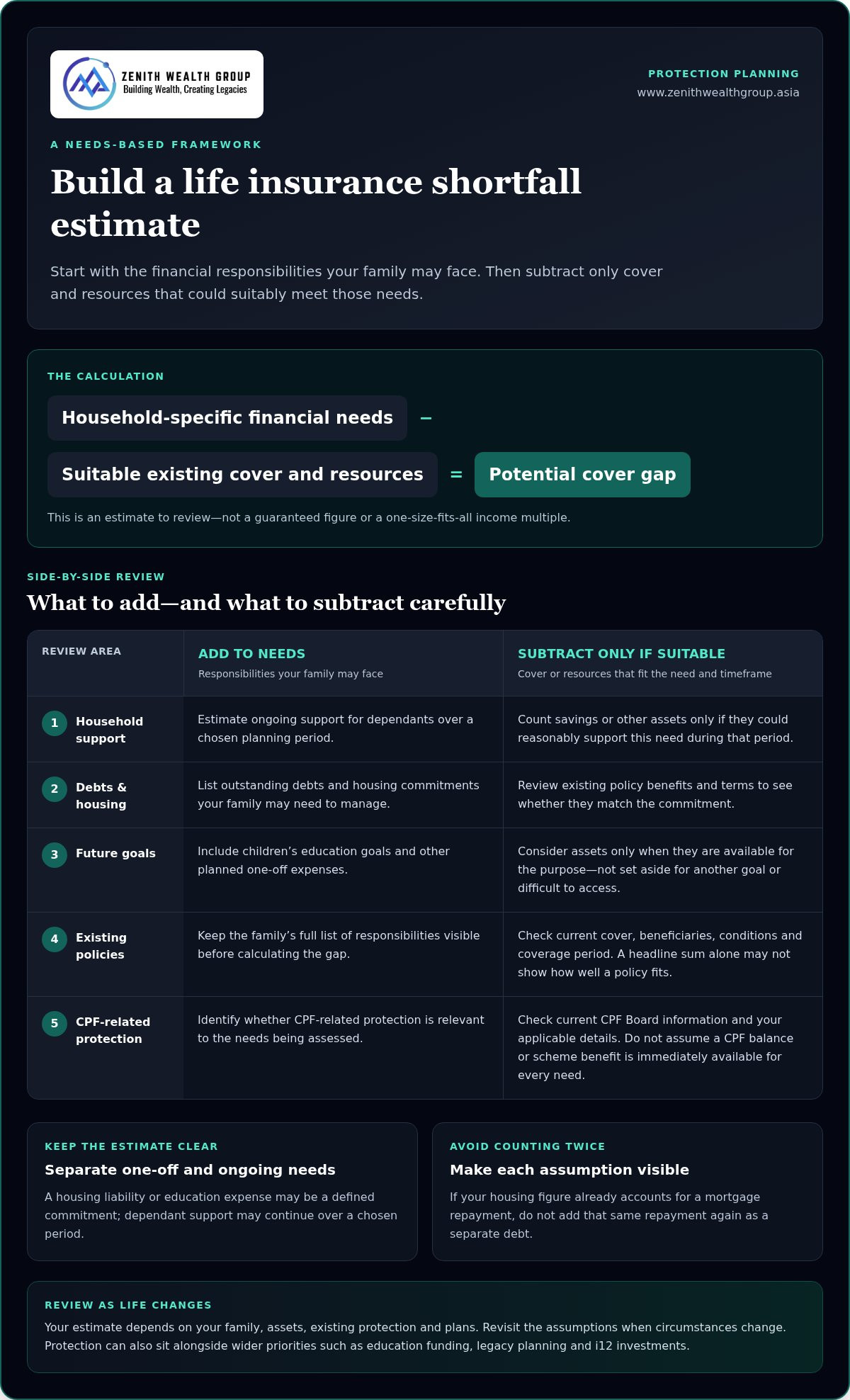
Use a simple framework: potential cover gap = household-specific financial needs − suitable existing cover and resources. Each input depends on your household, including the planning period, future expenses, available assets and policy benefits. The result is an estimate to review, not a guaranteed figure.
Keep one-off commitments separate from ongoing support. A housing debt or education expense may be a defined commitment, while living costs for a dependant may continue over a period you choose. Separating the two makes your assumptions easier to see and helps reduce the risk of counting the same need twice.
Step 1: Add the financial needs your family may face
Choose a planning period that reflects your family’s circumstances. Then list the needs that may arise during it, such as:
- Outstanding debts and housing commitments your family may need to manage.
- Children’s education goals and other planned one-off expenses.
- Household support for dependants, based on the period and level of support you want to provide.
Separate one-time amounts from recurring support. For example, record a housing liability once, then estimate household expenses over your chosen period. Do not add the same mortgage repayment again as a separate debt if your housing figure already accounts for it. Future costs cannot be known precisely, so note the assumptions behind each estimate and revise them if your plans change.
Step 2: Subtract resources that may already support your beneficiaries
Review each existing life policy. Note its current cover, who the beneficiaries are and the terms that affect whether the benefit would match the need you’ve listed. Do not rely only on a headline sum. A policy’s conditions or coverage period may affect how it fits your calculation.
Next, consider savings and other assets, but count only amounts that could reasonably be available for the purpose and timeframe you’re assessing. Funds set aside for another goal, or assets that may be difficult to access, should not automatically be treated as available cash. For CPF-related protection, consult current CPF Board information and your own applicable details before including an amount. Do not assume a CPF balance or scheme benefit is immediately available to meet every family need.
Once you’ve listed these inputs, subtract only resources that are suitable for the needs and timeframe. That gives you a clearer starting point for answering “how much life insurance do I need in Singapore?” A financial consultant or financial planner can help review your assumptions and connect protection with education funding, legacy planning and broader goals, including i12 investments. Zenith Wealth’s financial planning support includes these connected priorities.
How should you compare your life insurance needs with existing cover?
After estimating your household’s needs, compare them with protection and resources that could genuinely help meet those needs. Having a life policy does not automatically mean every family responsibility is covered. The benefit may be too small, may not last for the period you have in mind, or may not be intended for the person who needs support.
Use a working table to organise your own estimates and documents. Treat uncertain figures as unverified until you confirm them in the relevant records.
| Need or resource | Estimated need | Existing cover or resource | Potential gap and details to verify |
|---|---|---|---|
| Household support | Your estimate for the chosen period | Relevant life cover or available assets | Amount, duration and who benefits |
| Housing or other debt | Outstanding commitment to account for | Cover or resources intended for this need | Whether the full commitment is addressed |
| Education or other goals | Your planned funding amount | Existing cover or funds set aside | Whether funds are available for this purpose |
What details should you check in an existing policy?
Review the policy documents, not just a summary of the insured amount. Confirm who is insured, the current amount of cover, the policy term and the named beneficiaries. Read the conditions and exclusions, and look for changes that may affect the cover. If a detail is unclear, verify it against your policy documents before including the benefit in your calculation.
A policy’s headline amount is only one part of the comparison. Its term may not match the period your family needs support, and its conditions may affect when a benefit applies. Savings and CPF-related benefits are different types of resources, too. Do not assume they are interchangeable with insurance cover or fully available to beneficiaries. Check applicable CPF information and your own circumstances before counting an amount.
How can you avoid counting the same protection twice?
Make one inventory of personal policies and any employment-related benefits. For each item, note the insured person, benefit amount, duration, intended recipient and whether the benefit is confirmed or depends on eligibility or conditions. This gives you a clearer picture than simply adding every figure together.
Look for overlap. For example, if two entries relate to the same debt, do not count both as separate resources against different needs unless each benefit can genuinely be used that way. Recalculate the potential gap after removing duplication and excluding uncertain amounts. This gives you a more realistic basis for assessing how much life insurance do I need in Singapore and fitting protection into wider planning, alongside priorities such as i12 investments.
How do life stage and Singapore commitments change the amount you need?
Your life stage affects who may rely on you and which financial commitments matter. A single adult with no dependants may focus on debts and any support they provide to family. A couple may need to consider whether one income could cover shared expenses if the other stopped earning. For parents, childcare, household support and education plans can add to the picture. A pre-retiree may have fewer years of income to replace, but could still have dependants, housing commitments or legacy goals.
In Singapore, include your actual housing commitments, whether they involve an HDB flat or private property, rather than assuming every household has the same loan or ownership arrangement. If your household has financial ties to Indonesia, Malaysia, the Philippines or Thailand as well as Singapore, list relevant family support, debts and resources separately. Include only amounts that apply to your own circumstances and can reasonably be used for the needs you are assessing. CPF-related rules and protection details can change, so consult current CPF Board information before including a CPF benefit or resource in your estimate.
How might a new parent estimate protection needs?
Map the support your child may need, including childcare, everyday household expenses and education goals. Then consider how much the other caregiver’s income, savings or family support could contribute. The remaining need depends on the household’s circumstances, not simply on the number of children. Revisit your estimate as care arrangements, education plans, income or dependants’ needs change. Wealth protection and education funding are connected priorities to consider together.
What changes when you have a mortgage or fewer dependants?
Include the housing debt your family may need to manage, using your current details rather than a typical loan balance. Then consider other income, savings and whether dependants are likely to need support over the period you’ve chosen. As dependants become financially independent, some needs may reduce, while a remaining mortgage or legacy intention may still matter. If estate considerations are relevant, include them in your broader legacy planning.
How should you adapt the estimate at different stages?
Ask what would change for your household if your income stopped today. A single adult supporting a parent may have different priorities from a couple with shared income and no children. Parents may place more weight on ongoing support and education plans, while a pre-retiree may focus on remaining obligations and the resources already built up. There is no automatic direction for the cover amount to move: update the inputs and recalculate.
A tailored review can bring your household’s protection together with connected goals such as education funding, legacy planning and i12 investments. Zenith Wealth Group’s financial planning discussion can help put these priorities in context.
How to turn your life insurance estimate into a practical protection plan
A useful estimate becomes more practical when you document its assumptions and turn them into next steps. If you’re asking how much life insurance do I need in Singapore, use your household’s needs and existing resources as a working plan, not a figure to set once and forget.
Start with this short sequence:
- Gather documents: collect current policy details, relevant employment benefit information, debt records and details of savings or other resources.
- Estimate needs: note the commitments and support your household may need over a period that suits your circumstances.
- Review the gap: compare your estimate with suitable, verified cover and resources, taking care not to count uncertain benefits or duplicate amounts.
- Record assumptions: note what could change, such as income, dependants, housing commitments or education plans.
This gives you a clear reference point. Keep the documents and working figures together so you can update the estimate when your family’s situation changes.
When should you review your life cover estimate?
Reassess after a significant change to your dependants, debt, income or household goals. A new child, a changed housing commitment or a shift in who relies on your income may alter the balance between needs and available resources. There is no single review schedule that suits everyone. Before changing or replacing existing cover, verify the policy’s current terms, benefits and conditions so your decision reflects what you hold today.
How can a financial planner help connect protection to wider goals?
A financial consultant or financial planner can help you examine how life cover fits alongside wealth protection, education funding and legacy planning. These priorities can affect one another: resources directed towards one goal may not be available for another. A broader conversation can also include i12 investments as part of your overall financial picture, without treating investment planning as a substitute for protection.
Bring your documents and assumptions to the discussion. You’ll have a clearer basis for reviewing your estimate, identifying questions and deciding what to revisit as circumstances evolve. Zenith Wealth Group’s financial planning service can help you consider protection alongside your wider financial goals.
Make your next protection review count
The right amount of life cover starts with your household’s financial responsibilities, not a universal income multiple. Add up the support and commitments your family may need to manage, then compare that estimate with suitable existing cover and resources. Check policy details carefully, and revisit your assumptions when dependants, income, debts or goals change.
That gives you a practical way to answer how much life insurance do I need in Singapore while keeping protection connected to the rest of your financial plan. Education funding, legacy planning and broader investment considerations, including i12 investments, may all form part of that conversation.
Zenith Wealth Group supports financial planning across different life stages, with advice spanning insurance, investments and legacy planning. The group operates as authorised representatives of finexis advisory Pte Ltd. For a personalised review of your household’s needs and existing protection, discuss your financial planning needs.
Frequently Asked Questions
How much life insurance do I need in Singapore?
Estimate your family’s financial needs, then subtract suitable existing cover and resources. Include household support over a period you choose, outstanding debts, housing commitments and goals such as children’s education. The amount depends on your dependants, assets, income and current policies, so an income multiple is only a rough starting point. Review the estimate when your circumstances or financial commitments change.
Is an income multiple enough to calculate life insurance?
No. An income multiple can provide a quick reference, but it does not account for your household’s specific responsibilities, savings or existing protection. Two people with similar incomes may have different needs if one supports dependants or has housing debt and the other does not. Use any multiple as an initial estimate, then assess your family’s needs and potential resources to work out a more relevant cover gap.
What should I include when calculating life insurance needs?
List the financial responsibilities your beneficiaries may need to manage over a chosen planning period. These might include household living costs, outstanding debts, housing commitments, education goals and support for financially dependent family members. Separate one-off commitments from ongoing expenses, and avoid counting the same item twice. Note the assumptions behind future costs, since they are estimates rather than exact predictions.
Can I count CPF-related protection as life insurance?
You can include applicable CPF-related protection in your assessment, but verify the scheme, eligibility, current benefit and relevant conditions using official CPF information and your own records. Do not treat CPF LIFE retirement payouts as life insurance cover, or assume CPF savings are fully available to beneficiaries. Count a benefit only when you understand how it applies to your circumstances and the needs you’re assessing.
Should I subtract my savings from the life insurance amount I need?
Potentially, but count only savings and assets that could reasonably be available to support your beneficiaries for the needs and timeframe you’ve identified. Money set aside for another goal or assets that may not be readily accessible should not automatically reduce the cover estimate. Record which resources you include and why, then compare them with your household’s commitments to avoid overstating what’s available.
When should I review how much life insurance I need?
Review your estimate after a major change to your dependants, income, debt, housing commitments or household goals. A new child, a changed mortgage or a shift in family support responsibilities can alter your needs and available resources. There is no universal review schedule. Before changing or replacing a policy, check its current terms and benefits. You can also consider how protection fits with broader goals, including i12 investments.


