

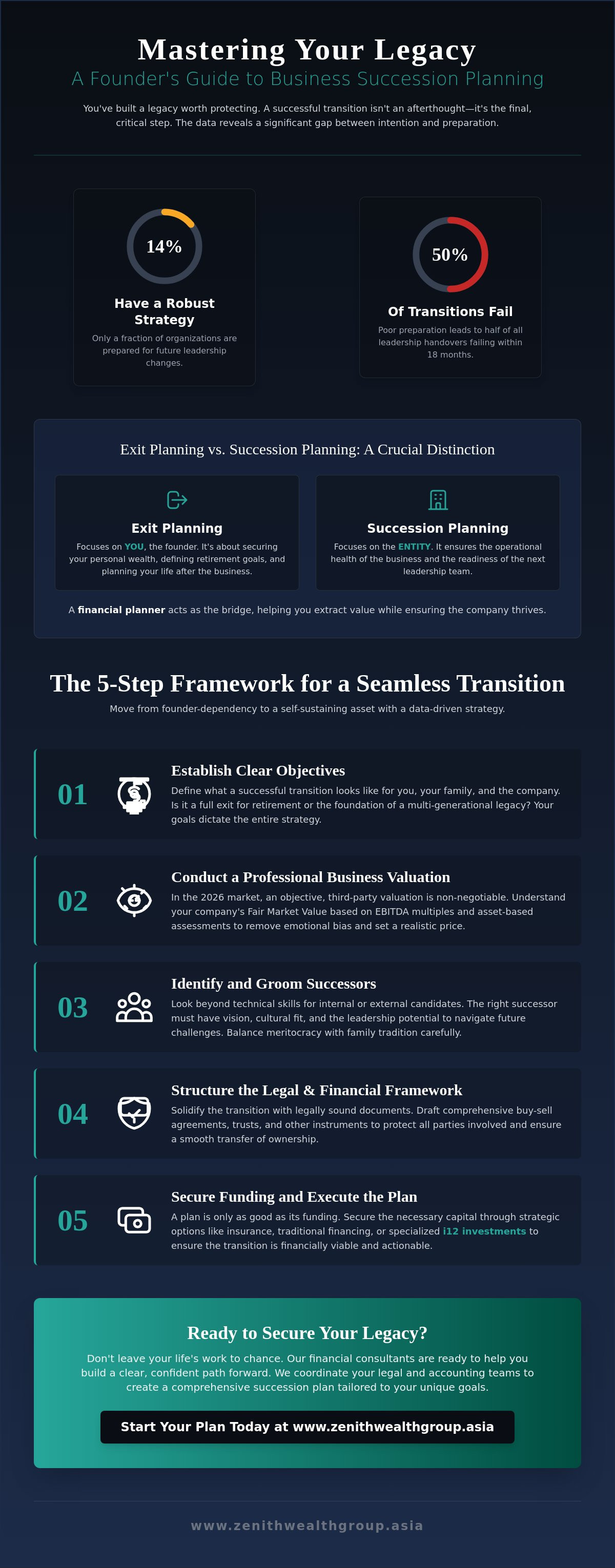
Only 14% of organizations have a robust strategy for their future leadership. It's a startling figure, especially since 50% of leadership transitions fail within the first 18 months because of poor preparation. For many founders, business succession planning feels like a task for another day, but the 2026 market moves fast. You've spent years building your legacy. It's time to ensure it survives your departure.
We agree that the process can feel overwhelming, especially when you're balancing family dynamics with the new $15 million federal estate tax exemption. You want a transition that is both profitable and peaceful. We believe your exit should be a celebration of your success, not a source of stress for your heirs. This guide will show you how to master a 5-step process to ensure your company thrives long after you step away. We'll walk you through everything from valuation to funding your exit with i12 investments. Our financial planners are ready to help you move from uncertainty to a clear, confident path forward.
Key Takeaways
- Learn why business succession planning is essential in a digital-first market and how to set clear objectives for your legacy.
- Follow our 5-step guide to professional valuation and understand how 2026 market multiples impact your final sale price.
- Secure your transition with robust funding strategies, including buy-sell agreements and specialized i12 investments.
- Resolve the "fair vs. equal" family dilemma and learn to navigate tax hurdles that often stall regional business transfers.
- Understand the role of a financial planner as the coordinator for your legal and accounting teams during the handover.
What is Business Succession Planning and Why Does it Matter in 2026?
At its core, What is Business Succession Planning? It's the strategic process of identifying and developing future leaders to ensure your company continues to thrive after you step down. It isn't just about picking a name. It's about securing the transfer of ownership and leadership while protecting the value you've built. In 2026, this process has become more urgent. Digital-first business models move at a pace that requires earlier, more agile planning. You can't wait until you're ready to retire to start the conversation.
Unplanned exits are a major threat to any founder. Whether it's sudden illness, death, or rapid market shifts, leaving things to chance is risky. Research shows that 50% of leadership transitions fail within 18 months due to poor planning. That’s a high price to pay for a lifetime of work. By proactively engaging in business succession planning, you protect your legacy from these sudden shocks. It gives your employees, clients, and family the certainty they need to stay committed to the brand.
The Difference Between Exit and Succession
Many founders confuse exit planning with succession planning. They're related but distinct. Exit planning focuses on you. It's about your personal wealth, your retirement goals, and your life after the business. Succession planning focuses on the entity. It ensures the operational health of the business and the readiness of the next leadership team. You need both for a clean break. A financial planner acts as the bridge between these two worlds. They help you extract your hard-earned value while ensuring the company doesn't crumble the moment you walk out the door. This often involves looking at diversified strategies like i12 investments to ensure your personal wealth isn't tied solely to the company's future performance.
The 2026 Economic Context for SG Business Owners
The economic environment in Singapore is shifting rapidly. Recent fed rate cuts are already impacting how businesses are valued. Lower rates can lead to higher multiples, but they also change the cost of funding a buyout. In a post-inflationary regional market, liquidity is king. You need to know how much cash is actually available to fund a transition without crippling the business. A financial consultant can help you analyze these market trends to time your transition perfectly. We want to ensure you get the best possible valuation while the successor has the capital needed to grow the brand.
A 5-Step How-To Guide for Business Succession
Effective business succession planning is a structured journey. It moves your company from being founder-dependent to being a self-sustaining asset. In 2026, this requires more than just a handshake; it requires a data-driven strategy. Start by establishing clear objectives. Do you want a total exit for retirement, or is your goal to build a multi-generational family legacy? Your answer changes every legal and financial step that follows. Once your goals are set, you can follow this proven five-step framework.
- Step 1: Establish Clear Objectives. Define what success looks like for you and the company.
- Step 2: Professional Business Valuation. Determine what the market will actually pay in the current 2026 economic climate.
- Step 3: Identify and Groom Successors. Look for leadership potential and cultural fit, whether internal or external.
- Step 4: Structure the Legal and Financial Framework. Draft the buy-sell agreements and trusts that protect all parties.
- Step 5: Funding and Execution. Secure the capital through i12 investments or insurance to ensure the plan is actionable.
As you move through these steps, you'll likely face complex choices regarding Navigating common Pitfalls: Family, Taxes, and Legal Hurdles. A financial planner can help you stay ahead of these challenges by aligning your business goals with your broader estate plan.
Valuing Your Business in Today's Market
Valuation in 2026 is no longer just about looking at last year's books. For most Singaporean SMEs, EBITDA multiples remain the gold standard, but asset-based valuations are vital for capital-heavy sectors. You need an objective third-party audit before you ever set a price. This removes emotional bias and gives you a realistic baseline for negotiations. In the context of Singaporean private limited companies, fair market value represents the estimated price at which a business would change hands between a willing buyer and a willing seller, both having reasonable knowledge of relevant facts and neither being under any compulsion to buy or sell. If you're unsure where your business stands, it's a good idea to speak with a consultant for a preliminary review.
Identifying the Right Successor
Choosing a successor is often the most emotional part of business succession planning. For internal candidates, look for more than just technical skill. They need vision and, ideally, some financial skin in the game. In Singapore, many founders struggle with the balance between meritocracy and family tradition. While legacy is important, the business's survival depends on competent leadership. If family members aren't ready, consider a professional manager or an external buyer to protect the wealth you've built.
Funding Your Succession: Buy-Sell Agreements and i12 investments
A plan without funding is just a piece of paper. It's a hard truth that many founders overlook. While 78% of family businesses expect a leadership transition within the next decade, only a fraction have the liquid capital ready to make it happen. Relying on traditional bank loans in May 2026 is risky. With SBA 7(a) variable rates currently ranging from 9.75% to 13.25%, the cost of debt can easily swallow a successor's profit margins. This financial pressure is why business succession planning must focus on creating internal liquidity long before the trigger is pulled.
Think of the Buy-Sell Agreement as a "pre-nuptial" for your business. It's a legally binding contract that dictates who can buy your shares, under what conditions, and at what price. It prevents unwanted outsiders from gaining control and ensures a fair payout for your family. To make this agreement work, you need a financial planner to align the legal terms with the actual cash flow. For a practical toolkit on how to structure these transitions, you can reference this A 5-Step How-To Guide for Business Succession. This ensures your legal and financial teams aren't working in silos.
The Role of i12 investments in Corporate Continuity
One of the most effective ways to fund a future buyout is by using i12 investments to manage corporate reserves. Instead of letting excess capital sit idle, you can build a dedicated "sinking fund." This specialized investment approach allows you to grow the business's retained earnings by diversifying into global assets. This isn't just about the exit; it's a vital part of wealth protection. By moving a portion of your profits into a diversified portfolio, you ensure that your personal retirement isn't entirely dependent on the company's local market performance at the time of sale.
Insurance as a Liquidity Tool
Insurance remains a cornerstone of the funding process because it provides immediate liquidity when it's needed most. You'll typically choose between a "Cross-Purchase" or an "Entity-Purchase" structure. In a cross-purchase, partners buy policies on each other. In an entity-purchase, the business itself owns the policies. Finding the best life insurance for retirement planning can often be the most cost-efficient way to fund a succession. It provides a tax-free cash injection that allows the remaining partners to buy out a departing founder's shares without draining the company's operating budget. Your financial consultant will help you determine which tax structure offers the most benefit for your specific corporate setup.
Navigating common Pitfalls: Family, Taxes, and Legal Hurdles
The "Fair vs. Equal" Dilemma is the most common emotional hurdle in business succession planning. Imagine you have two children. One has worked in the business for a decade. The other followed a different career path. Giving them both an equal 50% stake might seem fair on paper, but it often leads to gridlock. The child in the business feels burdened by a passive partner; the child outside feels excluded from key decisions. This friction can destroy a company faster than any market shift.
Communication is the real bridge here. While legal documents are vital, research suggests that 70% of successions fail because of a breakdown in family communication. It's rarely the lack of paperwork that kills the transition. It's the unspoken expectations and hidden resentments. A financial consultant does more than just crunch numbers. They act as a neutral facilitator to help your family reach an agreement before the lawyers get involved. This proactive approach keeps the focus on the business's survival rather than personal grievances.
Managing Family Dynamics in Singapore
Structuring your legacy planning correctly is the best way to avoid probate delays. In Singapore, these delays can freeze business operations for months, leaving the company leaderless during a vulnerable time. We often recommend using trusts to manage this transition. A trust allows you to separate management control from economic benefit. You can grant the active child the voting rights to run the company while the other child receives a fair share of the dividends. This keeps the peace and ensures the business remains functional and profitable for everyone involved.
Tax and Regulatory Compliance
Tax efficiency is another area where founders often trip up. Regional transfers involve complex calculations. You must account for stamp duties and potential capital gains issues if your business holds assets outside Singapore. Working within the compliant, regulated frameworks provided by finexis advisory ensures your plan meets all current legal standards. This protection is vital for maintaining the integrity of your transfer.
Your personal assets must also be part of the conversation. Your CPF retirement planning should integrate seamlessly with your business exit. If most of your wealth is tied up in the company, you need a strategy to diversify your holdings. Using i12 investments can help manage the proceeds from a sale or a buy-out. This ensures your retirement is funded by a global portfolio rather than a single local entity. Finally, every business owner needs a Lasting Power of Attorney (LPA). If you lose mental capacity suddenly, your business could grind to a halt without a designated decision-maker. If you're ready to protect your business from these pitfalls, reach out to our financial planners today to start your strategy session.
Why a Financial Consultant is Your Best Partner for Continuity
You've done the hard work of building your business. Now comes the delicate task of letting it go. A financial planner is essential for this transition. Think of them as the quarterback of your professional team. They don't just manage money; they coordinate the efforts of your lawyers, accountants, and bankers. Without this central guide, your plan might have legal merit but lack financial feasibility. We ensure that every piece of the puzzle fits together perfectly.
At Zenith Wealth Group, we don't believe in one-size-fits-all templates. We tailor business succession planning to your specific retirement vision. Our relationship with finexis advisory allows us to offer advice grounded in a robust, regulated framework. This partnership provides the independence needed to focus entirely on your best interests. We help you move through the transition with quiet confidence and clarity. You deserve a partner who is as invested in your legacy as you are.
Don't wait for an emergency to start this conversation. A sudden health crisis or a rapid market shift shouldn't be the reason you step away. By starting now, you control the narrative. You ensure that your employees, clients, and family remain protected. This isn't just a business deal. It's the culmination of your life's work. We're here to make sure that work continues to grow long after you've moved on to your next chapter.
Building a Holistic Wealth Roadmap
Your business is often your most significant asset. It needs a sophisticated retirement payout strategy that accounts for more than just a lump sum sale. We look at the big picture for your future. This includes integrating i12 investments into your personal wealth portfolio to create a truly diversified income stream. We want to ensure that once you step away, your lifestyle remains as vibrant and secure as it was when you were at the helm. Our goal is to turn your business success into personal financial freedom.
Taking the First Step
There is immense peace of mind in having a documented, funded plan. You can focus on the daily wins of your company knowing the future is secure. It's time to move from "maybe one day" to a concrete roadmap. A clear plan is the greatest gift you can give to your successors and your family. We invite you to book a consultation with a Zenith financial planner. Let's start building your continuity plan together today.
Secure Your Legacy for the Next Generation
Your business is the result of years of dedication. Ensuring its survival requires more than just a talented successor. It demands a funded transition and a clear roadmap that balances family dynamics with financial reality. We've explored how business succession planning integrates professional valuation with strategic funding mechanisms like buy-sell agreements and i12 investments. These tools provide the liquidity needed to protect your personal wealth while keeping the company's operations steady.
As authorized representatives of finexis advisory, our team takes a holistic approach to legacy and wealth protection. We don't just look at the business; we look at your entire financial future. This ensures your exit is as profitable for you as it is sustainable for the brand. Don't leave your life's work to chance. Start the conversation early to avoid the stress of an unplanned departure.
Ready to secure your business legacy? Contact a Zenith financial consultant today. We're excited to help you build a future that thrives long after you step away.
Frequently Asked Questions
When is the best time to start business succession planning?
You should ideally start the process five to ten years before your anticipated exit. This timeframe gives you enough room to groom a successor and improve your business valuation for a better payout. Early business succession planning also protects you against "forced" exits due to sudden illness or market shifts. It's about being proactive rather than reacting to a crisis.
What is the difference between a financial consultant and a lawyer in this process?
A financial consultant acts as the strategist who ensures the plan is funded and aligned with your retirement goals. They look at your overall wealth and cash flow needs. A lawyer is responsible for drafting the legal documents, such as buy-sell agreements or trusts, to make the plan legally binding. Both are essential, but the financial planner often coordinates the entire team.
How do I fund a business buyout if my successor has no cash?
You can use strategies like vendor financing, life insurance, or sinking funds built through i12 investments. Vendor financing allows the successor to pay you over time using the company's future profits. Alternatively, specialized investment structures can help the business accumulate the necessary capital over several years. This ensures the money is ready when it's time for you to step away.
Can I use my CPF savings to help with business succession?
CPF savings are meant for personal retirement and cannot be used directly to fund business buyouts or operational costs. However, your CPF Life payouts provide a guaranteed income floor that may allow you to be more flexible with your business exit terms. A financial planner can help you integrate your business sale proceeds with your CPF strategy for a seamless retirement income.
What happens to my business if I pass away without a succession plan?
Your business will likely enter a state of uncertainty and may face operational paralysis during the probate process. Without a clear plan, the court or intestate succession laws determine who inherits your shares. This often leads to family conflict, the loss of key employees, and a rapid decline in company value. It puts your entire legacy at risk.
How often should I review my business succession plan?
Review your plan every two to three years or whenever a significant milestone occurs. Changes in Singapore's tax regulations, shifts in your family's needs, or a rise in business valuation can change your requirements. Regular updates ensure your strategy stays relevant to the 2026 economic environment. It's a living document that must grow alongside your company.
Is business succession planning only for large corporations?
Succession planning is vital for businesses of all sizes, especially small SMEs where the founder is the primary driver of value. Small firms are often more vulnerable to the sudden loss of a leader. A clear plan ensures that your business can continue to operate and that your family receives the full value of the asset you built.
What are the tax implications of transferring my business to my children in Singapore?
Singapore is generally tax-friendly for business transfers because there is no capital gains tax or estate duty. However, you must still account for stamp duties on the transfer of shares and ensure compliance with the latest ACRA requirements. Structuring the transfer through a trust or specialized investment group can help manage these costs. We recommend consulting a professional to handle these regional hurdles.


