

Your bank’s fixed deposit rate is no longer the safe haven it was just two years ago. With Singapore’s fixed home loan rates plunging to between 1.4% and 1.8% in early 2026, the era of "easy" interest on cash has ended. You probably feel a sense of relief about your mortgage, but that’s likely paired with growing anxiety about your retirement returns. It’s difficult to stay confident when the fed rate cut cycle in the US seems to dictate your financial future here in Singapore. We know you want clarity on whether to lock in a new loan or pivot your investments.
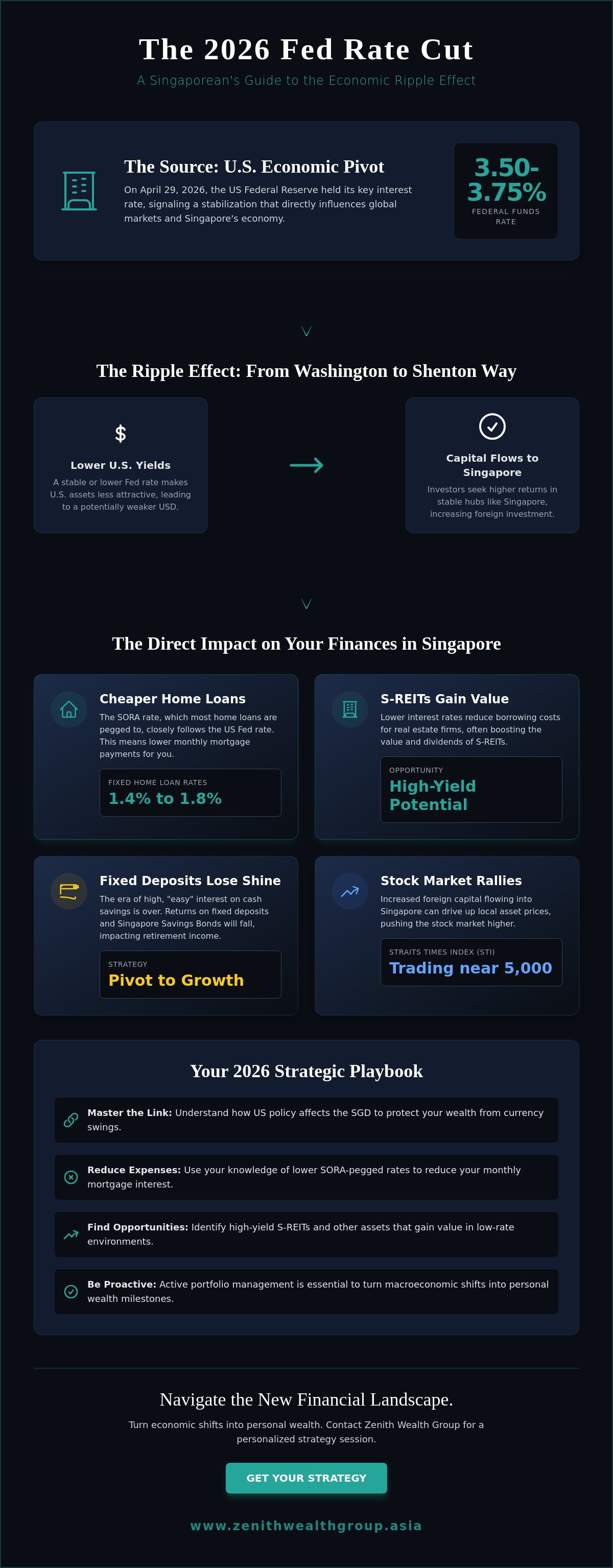
This guide clarifies the direct link between US policy and your local bank account. You’ll learn how the Federal Reserve’s April 29, 2026 decision to hold rates at 3.50% to 3.75% affects your monthly cash flow and long term wealth. We provide a clear roadmap for managing S-REITs, navigating a Straits Times Index at 5,000 points, and optimizing your retirement income. By the end, you’ll have a proactive plan for 2026. If you have questions about your specific portfolio, drop us a line!
Key Takeaways
- Master the link between US policy and the Singapore Dollar. Ensure your local wealth stays resilient against global currency fluctuations.
- Learn how a fed rate cut lowers SORA-pegged mortgage rates. Use this knowledge to reduce your monthly S$ interest expenses.
- Identify high-yield opportunities in S-REITs. These assets often gain value when borrowing costs fall for Singaporean firms.
- Protect your retirement income from falling fixed deposit yields. Pivot toward growth-oriented strategies that thrive in low-rate environments.
- Discover why active portfolio management is essential in 2026. Turn macro economic shifts into personal wealth milestones with a professional guide.
What is a Fed Rate Cut? Understanding the 2026 Economic Pivot
A fed rate cut is the central bank reducing the cost of borrowing to stimulate economic growth. It's the primary tool used by the Federal Open Market Committee (FOMC) to steer the global financial ship. When the Fed acts, the world watches. On April 29, 2026, the Fed confirmed a target range of 3.50% to 3.75% for the federal funds rate. This marked a significant stabilization point after the volatility of 2025. By adjusting this rate, the Fed influences everything from your personal credit card interest to the yields on your Singapore Savings Bonds.
The Fed operates under a "Dual Mandate" that requires balancing stable prices with maximum employment. In early 2026, US PCE inflation was projected to hit 2.7%. This is slightly above the ideal 2% target, which explains why the FOMC hasn't rushed into deeper cuts just yet. They're moving away from the aggressive hikes of the past to find a neutral ground. This balance is crucial for Singapore’s economy, which saw a 4.6% advance GDP growth estimate in Q1 2026. A stable US rate environment helps maintain our local economic momentum.
The Role of the New Fed Chair in 2026
Kevin Warsh’s leadership brings a fresh perspective to the FOMC. He’s moved away from the previous administration's style by prioritizing immediate transparency and "data-dependency." This means the Fed won't commit to a set schedule of cuts. Instead, they react to monthly reports on inflation and labor. The April 2026 voting patterns revealed a 10-2 split. While the majority favored a pause, two members expressed a more hawkish stance. This internal debate keeps markets expectant but ensures that policy remains grounded in current realities.
How Rate Cuts Stimulate the Global Economy
When the Fed lowers the cost of money, corporate spending usually climbs. Companies find it cheaper to finance new projects or refinance existing debt. This creates a ripple effect that reaches Singapore’s shores quite quickly. Lower US rates often lead to capital flows into higher-growth regions like Southeast Asia. This improves consumer confidence and fuels the "wealth effect" in local markets. With Singapore's retail sales up 4.8% in March 2026, a supportive global rate environment acts as a tailwind for local businesses and retirees seeking better returns. A fed rate cut effectively keeps the global trade lanes well-funded and active.
The Economic Ripple Effect: From Washington to Southeast Asia
The US Dollar remains the world’s undisputed reserve currency. This means every decision made in Washington echoes through the streets of Shenton Way. When you look at the Federal Funds Rate explained, it’s clear that even small shifts change how global capital moves. A fed rate cut signals that US assets offer lower yields. Consequently, institutional investors move their S$ billions into emerging markets and stable financial hubs like Singapore. This influx of capital can drive up local asset prices. We’ve seen this recently with the Straits Times Index (STI) trading near the 5,000 mark in March 2026.
This movement also impacts the US trade balance. A weaker Greenback makes US exports cheaper, but it also alters the valuation of global commodities usually priced in dollars. For Singapore, being hypersensitive to FOMC announcements isn't a choice; it’s a byproduct of being a top-tier financial hub. The world watches the Fed, but Singapore reacts. We aren't just observers. We're active participants in a system where a single policy shift in the US can recalibrate your entire retirement nest egg overnight.
The SGD vs. USD Exchange Rate Dynamics
MAS manages the S$NEER rather than using domestic interest rates. They manage the S$ against a secret basket of currencies. If a fed rate cut happens, the USD often softens against the S$. This increases your purchasing power for holiday travel or imported luxury goods. However, if you hold S$500,000 in US tech stocks, your portfolio's value in local terms might dip even if the stock price stays flat. Currency risk is a silent partner in your investment journey.
Regional Impact on Malaysia, Philippines, and Thailand
Our neighbors in Malaysia, the Philippines, and Thailand often mirror the Fed's stance. They do this to maintain currency stability and attract Foreign Direct Investment (FDI). Lower regional bond yields can boost local corporate spending but might hurt exporters who rely on a weaker local currency to stay competitive. It’s a delicate balance for the ASEAN trade corridor. If these global shifts feel overwhelming, feel free to chat with our team for a quick strategy check. We're here to help you make sense of the noise!
How Fed Rate Cuts Impact Singaporean Investors and Homeowners
Singapore does not set its own interest rates but instead manages the exchange rate, making US Fed moves the primary driver of local borrowing costs. This unique monetary position means that when a fed rate cut occurs, the impact on your wallet is almost immediate. The Singapore Overnight Rate Average (SORA), which underpins most modern home loans here, tracks the US federal funds rate with high correlation. As the Fed confirmed a pause at 3.50% to 3.75% in April 2026, local markets have already priced in the downward trend. For many Singaporeans, this translates to lower monthly mortgage installments and a shift in how they view their "safe" cash.
The ripple effect extends to government-backed securities. Yields on Singapore Savings Bonds (SSB) and T-bills, which were highly attractive in 2024, have begun to soften in 2026. When US rates drop, the opportunity cost of holding cash changes. You might notice that your latest SSB tranches offer lower first-year coupons than the ones you bought eighteen months ago. This environment requires a more proactive approach to wealth management. Relying on passive cash returns is no longer a viable strategy for those looking to outpace inflation, which sat at 1.8% in March 2026.
Mortgage Strategy: Fixed vs. Floating Rates in 2026
Is it time to refinance? Fixed home loan rates in Singapore fell to between 1.4% and 1.8% by early 2026, a sharp drop from the 3.1% seen at the start of 2025. With the transition from SIBOR to SORA now complete, your loan is more transparent but also more sensitive to global shifts. Don't wait for the absolute "bottom" of the cycle to act. Banks often adjust their spreads before the Fed even speaks. If your lock-in period is ending, securing a rate under 2% now provides certainty for your household budget. If you're unsure about the math, drop us a line for a quick chat.
Savings and Fixed Deposits: The End of High Yields?
The days of 3.5% or 4% fixed deposit (FD) rates are fading. Banks in Singapore typically lower their FD promotional rates weeks before an official fed rate cut is announced. This proactive move protects their margins but leaves your savings lagging. Consider moving excess liquidity into money market funds or short-duration bond funds. These alternatives often capture better yields than traditional savings accounts while maintaining the liquidity you need for emergencies. It’s about being smarter with your S$ cash flow as the high-interest era takes a breather.
Strategic Portfolio Adjustments in a Falling Rate Environment
In 2026, the old mantra that "cash is king" has lost its crown. As the fed rate cut momentum builds, your idle S$ in savings accounts is effectively losing its edge. Investors must pivot now. While high interest rates were a headwind for growth stocks, a lower rate environment acts like a tailwind. This shift requires a total rethink of your wealth protection strategy. Instead of hiding in cash, you need assets that appreciate as borrowing costs fall. It’s about moving from a defensive crouch into a position of growth.
The relationship between interest rates and bond prices is inverse. When rates drop, existing bonds with higher coupons become more valuable. If you hold quality fixed income, you're likely seeing capital gains right now. However, the challenge for those in the middle of retirement planning is reinvestment risk. When your current T-bills or FDs mature, you'll be forced to reinvest at lower 2026 rates. This can create a shortfall in your projected monthly income if you don't adjust your duration strategy today.
The Case for Singapore REITs (S-REITs)
Lower interest rates are a massive win for REIT managers. Most S-REITs carry significant debt to fund property acquisitions. As a fed rate cut filters through to local lending, these trusts pay less interest, leaving more distributable income for you. In 2026, dividend yields from S-REITs look increasingly attractive compared to the 1.7% core inflation rate. Watch the industrial sector for stability. Meanwhile, retail REITs may benefit from the 4.8% rise in local retail sales we saw in March 2026. These assets provide a natural hedge against falling cash yields.
Fixed Income and the "Lock-in" Strategy
Pre-retirees should act fast. Locking in yields on longer-duration corporate bonds now is better than waiting for further cuts. A diversified 2026 portfolio should balance high-grade government securities with selected corporate bonds for a yield pick-up. Don't ignore the risk. High-yield bonds offer better returns but require careful credit analysis to avoid defaults. It’s about finding the sweet spot between safety and income growth. Diversification remains your best tool for navigating these shifts.
Ready to recalibrate your holdings? Book a portfolio review with our advisors to stay ahead of the next rate move!
Navigating the 2026 Interest Rate Cycle with Zenith Wealth Group
Economic pivots like the current 2026 cycle are not times for passive management. A "set and forget" mentality fails when the macro environment shifts as significantly as it has this year. As discussed, the April 29, 2026 FOMC decision to pause rates at 3.50% to 3.75% was a signal, not a conclusion. Staying static while the fed rate cut momentum evolves could mean missing out on lower borrowing costs or better yield-generating assets. You need a proactive strategy that translates global headlines into local action. Markets move fast. Your strategy should move faster.
This is where professional guidance becomes essential. Choosing the right financial consultant in Singapore is about finding a partner who can interpret complex data. We don't just look at the numbers. We look at how they impact your life in Singapore. Whether it'
Secure Your 2026 Wealth Strategy
The 2026 economic landscape is shifting fast. With the April 29 rate pause, the window to refinance your mortgage at 1.4% to 1.8% or lock in bond yields is narrowing. You've seen how the fed rate cut trajectory directly influences SORA and your monthly S$ cash flow. Don't let global shifts erode your retirement nest egg. It's time to move from uncertainty to action.
Zenith Wealth Group specializes in Singaporean retirement planning through a modern, fee-based transparent advisory model. As authorised representatives of finexis advisory Pte Ltd, we prioritize your long term security over market noise. We translate complex macro data into actionable local steps. We're here to help you navigate these changes with quiet confidence and clarity. Ready to optimize your portfolio for the 2026 rate cycle? Drop us a line! Let's build a resilient financial future together.
Frequently Asked Questions
How soon after a Fed rate cut do Singapore mortgage rates drop?
SORA-pegged floating rates usually adjust within one to three months, depending on your loan's reset cycle. Banks often update their fixed rate packages even faster, sometimes adjusting their promotional offers weeks before an official announcement is made. If you're on a floating rate, you'll see the impact on your monthly S$ installment quite quickly as the market prices in the new reality.
Will a Fed rate cut make the Singapore Dollar (SGD) stronger or weaker?
A cut typically makes the Singapore Dollar stronger against the US Greenback. Lower interest rates in the US reduce the demand for the USD, causing its value to soften globally. Since the MAS manages the S$ against a basket of currencies, a weaker USD often leads to a higher exchange rate for the S$, giving you more purchasing power for overseas travel or imported goods.
Is it better to buy a house now or wait for more Fed rate cuts in 2026?
Focus on your personal financial readiness rather than trying to time the absolute bottom of the interest rate cycle. While waiting might save you a small percentage in interest, Singapore's property prices are also driven by supply and cooling measures. If you find a home that fits your budget now, securing a mortgage with a 1.4% to 1.8% fixed rate provides immediate stability for your household cash flow.
How do interest rate cuts affect my CPF Ordinary Account (OA) and Special Account (SA) rates?
There is minimal immediate impact on your CPF OA rate, which remains at the 2.5% floor. The SA rate is pegged to the 10-year Singapore Government Securities plus 1%, with a 4% floor. Unless global long-term yields drop so significantly that the peg falls below 4%, your SA returns will stay protected. These floors provide a vital safety net for your retirement planning when market rates soften.
Which stocks usually perform best when the Fed cuts interest rates?
Yield-sensitive assets like Singapore REITs (S-REITs) and growth-oriented technology companies often lead the market. Lower borrowing costs improve the profit margins for REITs, allowing for higher dividend distributions to you. Conversely, local banks might see their net interest margins compressed, which can sometimes lead to a more cautious performance in the financial sector during a fed rate cut cycle.
What happens to my fixed deposit if the Fed cuts rates tomorrow?
Your existing fixed deposit is a legal contract, so your interest rate is locked until the maturity date. However, if you have a placement maturing soon, you'll likely find that the new promotional rates offered by banks have dropped. It's often wise to lock in current rates for a longer tenure if you anticipate further downward movement in the global interest rate environment.
Should I switch from a fixed-rate to a floating-rate mortgage during a cut cycle?
Switching to a SORA-pegged floating rate allows you to benefit immediately from every downward move in interest rates. This is a proactive strategy if you believe the Fed will continue to ease policy throughout 2026. However, if you prefer a "set and forget" approach for your monthly budgeting, a low fixed-rate package might still be the more comfortable choice for your family.
How does a Fed rate cut impact the price of gold in Singapore?
Gold prices generally rise when interest rates fall because the opportunity cost of holding a non-yielding asset decreases. When the USD weakens following a fed rate cut, gold becomes cheaper for international buyers, driving up demand. While a stronger S$ might offset some of the price surge for local investors, gold remains a popular hedge for wealth protection during periods of policy transition.


