

What if your "I do" in Bangkok inadvertently triggers a legal "who owns what" battle in Singapore? Marriage is a beautiful milestone. For expats and cross-border couples, it's also a significant financial merger that spans two different legal systems. You've worked hard to build your assets. It's natural to feel uncertain about how a new life in Southeast Asia affects your long-term security. Managing joint investments while protecting pre-marital wealth requires more than just good intentions.
This 2026 financial checklist for getting married in Thailand gives you a clear roadmap to protect your estate and grow your future together. We'll show you how to master cross-border complexities, from meeting the 400,000 THB bank deposit for your marriage visa to leveraging i12 investments for strategic growth. You'll gain legal clarity on asset ownership and learn how a dedicated financial consultant can help you synchronize your global portfolio. From the latest inheritance tax thresholds to 2026 same-sex marriage equality updates, we've mapped out the path to a secure dual-country lifestyle.
Key Takeaways
- Learn to distinguish between personal and marital assets under the Thai Civil and Commercial Code to protect your pre-existing wealth.
- Follow our financial checklist for getting married in Thailand to ensure your prenuptial agreement is registered correctly for maximum legal protection.
- Discover how a financial consultant can help you manage multi-currency cash flows and grow joint wealth using i12 investments.
- Align your health insurance with 2026 visa requirements to ensure continuous coverage across both Singapore and Thailand.
- Secure your family's future by establishing separate wills that respect the unique legacy and inheritance laws of each country.
The Financial Foundation of a Thai Marriage in 2026
A Thai marriage is more than a romantic union. It's a cross-border financial merger. Legal registration at the district office is just the start. The real work lies in financial synchronization. Understanding the Thai legal framework is essential for your security. A comprehensive financial checklist for getting married in Thailand is non-negotiable for expats. You're merging two lives and two distinct regulatory environments simultaneously. This requires a clear plan to protect what you've built in Singapore while establishing a new base in the Kingdom.
Cross-border couples face specific risks. Currency fluctuations between the SGD and THB can erode your purchasing power quickly. Asset commingling is another danger. Your pre-marital wealth could become legally entangled with marital property without proper shields. You might also face unexpected tax liabilities in both Singapore and Thailand. A financial consultant guides you through these complexities. They help you look beyond wedding costs to focus on wealth protection. This includes strategic options like i12 investments. These vehicles ensure your capital stays productive across borders. Proactive planning prevents future disputes and keeps your long-term goals on track.
Budgeting for the Ceremony vs. the Marriage
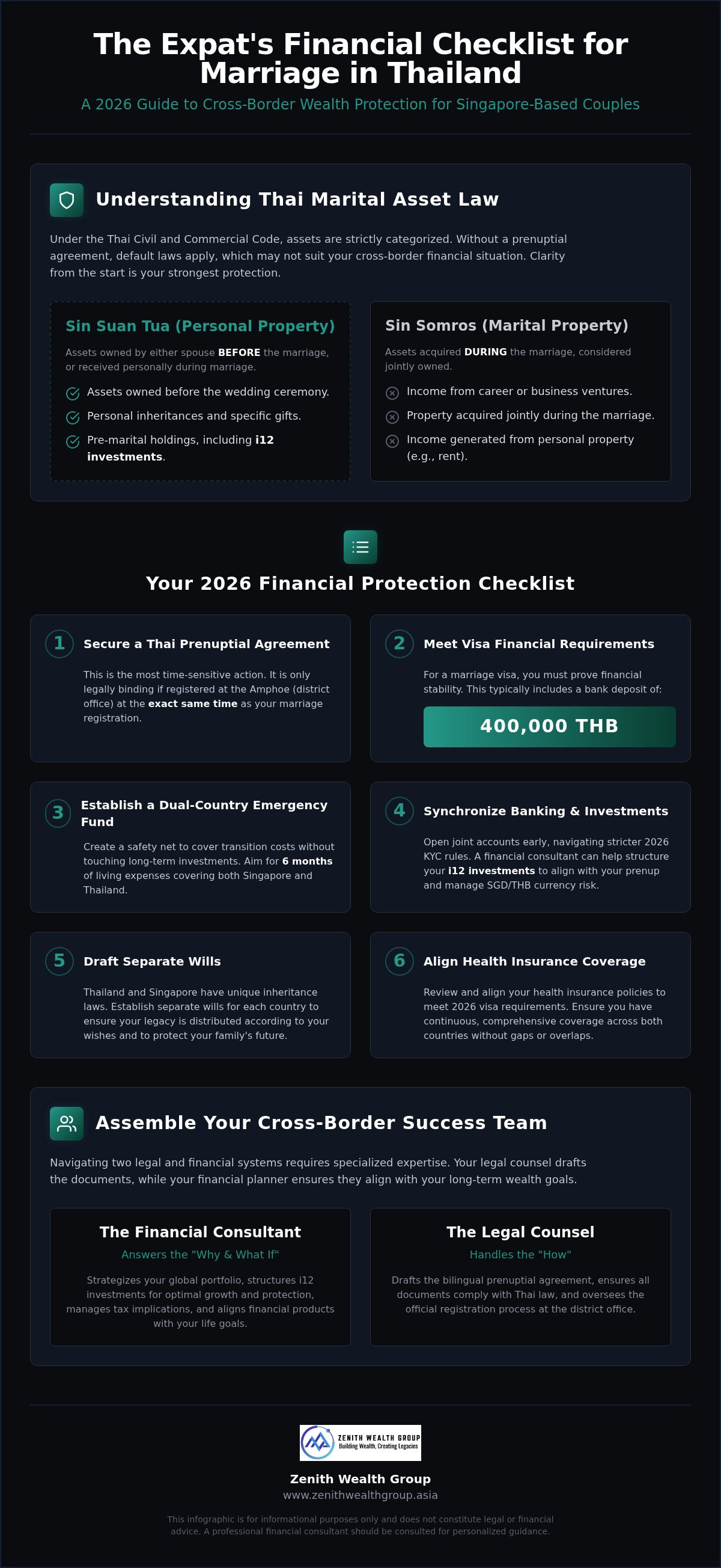
Don't let the destination wedding spectacle overshadow your stability. A high-end wedding in Singapore can easily exceed 80,000 SGD. Thai celebrations add unique customs like "Sin Sod" (dowry). Separate these one-time cultural gifts from long-term marital expenses. Build a "Marriage Emergency Fund" early. It should cover six months of dual-country living costs to handle the transition. This fund provides a safety net while you align your global banking and investment strategies. It ensures you aren't dipping into retirement savings to cover initial relocation costs.
Legal vs. Financial Residency Status
Your tax status changes when you move. Thailand uses a 180-day rule for tax residency. Spending more than half the year in the Kingdom may subject your global income to local taxes. This impacts your Singaporean tax filings and requires careful attention to the 2026 tax treaty updates. Start synchronizing bank accounts now. Thai banks implemented stricter KYC procedures in 2026. Opening a joint account requires specific visas and documentation. Put this at the top of your financial checklist for getting married in Thailand to avoid administrative delays during your first year of marriage.
Protecting Your Assets: Thai Prenuptial Agreements
Protecting your hard earned wealth isn't about a lack of trust. It's about creating a foundation of clarity. Section 1465 of the Thai Civil and Commercial Code is the bedrock of this process. If you don't register a formal agreement, Thai law defaults to a standard regime that might not suit your cross-border needs. In Thailand, a prenuptial agreement is only legally binding if you register it at the local district office (Amphoe) at the exact same time as your marriage registration. This is perhaps the most time sensitive item on your financial checklist for getting married in Thailand.
You must understand the distinction between Sin Suan Tua (personal property) and Sin Somros (marital property). Personal property covers assets you owned before the wedding, including inheritances and specific gifts. Marital property includes all assets acquired during the marriage, including income from your career or investments. While Singaporean courts generally respect foreign prenups if they're fair and transparent, the Thai registration provides the primary shield for assets held within the Kingdom. Failing to register at the start means you're left with postnuptial options, which either spouse can revoke at any time.
Defining Personal vs. Marital Property
A clear, bilingual inventory is your best defense against asset commingling. You should list every major asset, including Singaporean real estate, corporate shares, and your i12 investments. When you document these holdings before the ceremony, you ensure that capital growth on pre-marital wealth isn't accidentally reclassified as joint property. This transparency is vital for protecting your legacy and ensuring that future family gifts remain within your personal estate. It's a proactive step that simplifies your financial life across both jurisdictions.
The Role of a Financial Planner in Legal Protection
Your legal counsel handles the "how," but your financial planner handles the "why." They ensure the agreement reflects your long-term wealth protection goals and 2026 tax realities. A financial planner reviews your global portfolio to see how cross-border treaties might impact your marital assets. They help you structure your i12 investments so they remain clearly defined as personal or joint property from day one. If you're unsure how to start this conversation with your partner, connecting with a professional can provide the neutral, expert perspective needed to secure your future. This collaboration ensures your financial checklist for getting married in Thailand is both legally sound and strategically optimized.
Synchronising Wealth: Managing Joint Accounts and i12 Investments
Merging your financial lives across the Singapore-Thailand corridor requires more than just a shared bank account. It's a strategic alignment of two different economies. While your prenuptial agreement protects what you've already built, synchronising your future wealth ensures you grow together. Adding multi-currency management to your financial checklist for getting married in Thailand ensures you don't lose value to exchange rates or stagnant interest. Savings rates in Thai banks often hover around 1-2%, which rarely beats inflation. You need a more proactive approach to keep your joint capital productive.
Deciding between joint and separate portfolios is a key step. Joint accounts offer transparency for daily Thai living expenses, but separate investment structures often provide better tax efficiency for Singaporean residents. Repatriating investment gains to Singapore requires a clear understanding of the 2026 tax treaty updates. A financial planner can help you structure these flows to avoid double taxation. By maintaining this balance, you protect your individual interests while building a robust marital estate. This dual-track strategy is the hallmark of a well-prepared cross-border couple.
Optimising i12 Investments for Couples
i12 investments offer a structured way to capture regional growth without the stress of managing individual stocks. For couples, this vehicle provides a unified strategy that accounts for both spouses' risk profiles. It's common for one partner to be more conservative than the other. Your financial planner can help you find a middle ground within the i12 framework to ensure long-term harmony. Leveraging professional management is particularly vital in 2026 to navigate regional market volatility. This ensures your marital wealth isn't just sitting idle but is actively working toward your shared retirement goals.
Cross-Border Banking Logistics
Efficient banking is the engine of your dual-country lifestyle. While many Thai banks have strict KYC rules, Bangkok Bank remains a foreigner-friendly option for opening accounts with a marriage visa. You'll also need to manage your CPF contributions if you're a Singaporean living in Thailand. Don't let your retirement foundation in Singapore crumble while you focus on your new life abroad. Digital banking solutions in 2026 now offer lower fees for SGD-THB transfers than traditional wire services. Integrating these tools into your financial checklist for getting married in Thailand will save you thousands in transaction costs over the coming years.
Safeguarding Your Future: Insurance and Health Coverage
Protecting your partner is the ultimate expression of commitment. However, your existing Singaporean policies might not offer the same security once you relocate. Many standard plans have territorial limits or "out of country" clauses that reduce benefits after 90 days abroad. Adding a thorough insurance audit to your financial checklist for getting married in Thailand ensures your safety net remains intact. Medical costs in Thai private hospitals can escalate quickly. A serious incident can easily cost between 200,000 to 2,000,000 THB. Without the right coverage, these expenses can derail your long-term growth plans and your i12 investments.
Portability is your primary goal. You need policies that recognize your new residency without penalizing you. This is especially true for critical illness and life insurance. These plans should provide a lump sum that supports your lifestyle in either country. Integrating this protection into your marital plan prevents a medical crisis from becoming a financial one. It's about ensuring that your wealth protection strategy evolves alongside your geography. A financial consultant can help you identify gaps where your Singaporean coverage ends and your Thai requirements begin.
Health and Critical Illness Coverage in Thailand
You have two main paths: local Thai health plans or International Private Medical Insurance (IPMI). Local plans are often more affordable but may have lower caps on inpatient treatment. IPMI offers higher limits and covers regional specialists in Singapore or Bangkok. For 2026, ensure your plan includes medical evacuation. This is vital if you're living in more remote parts of the Kingdom. Don't forget to update your beneficiaries. Your new legal status as a spouse should be reflected on every international policy to avoid probate delays later. This administrative step is a critical part of your financial checklist for getting married in Thailand.
Protecting the Non-Working Spouse
If one spouse isn't working, insurance becomes their primary safety net. You must calculate the "human life value" of the breadwinner to ensure the family can maintain their standard of living in Thailand. This includes covering housing, visa maintenance, and future relocation costs. You can explore more about these foundational strategies in our guide on Wealth Protection in Singapore. Securing this protection now allows you to focus on building your future together with confidence. If you're ready to align your global coverage, you can request a coverage review with our team today.
Legacy and Retirement Planning for Cross-Border Couples
Marriage in Thailand is a legal milestone that automatically triggers a review of your global estate. Your existing Singaporean legacy plan won't cover your Thai assets effectively. Thai probate laws move at a different pace than those in Singapore. Without a specific strategy for the Kingdom, your spouse could face significant administrative hurdles during an already difficult time. Adding estate coordination to your financial checklist for getting married in Thailand ensures your global legacy remains intact across both jurisdictions.
Zenith Wealth acts as your long-term partner in this journey. We don't just look at the wedding day. We look at the decades that follow. Our role is to ensure your wealth protection and legacy goals stay synchronized. This involves more than just picking the right funds. It's about understanding how your marital status in Thailand interacts with your financial foundations in Singapore. By aligning these two worlds now, you prevent future legal friction and ensure your partner is fully protected under both sets of laws.
Cross-Border Estate Planning
You need separate wills for Singapore and Thailand. A Singaporean will is often difficult to execute in a Thai court. It requires expensive translations and lengthy certification processes. Thai law also has specific rules regarding land. If a foreigner inherits land through a spouse, they cannot keep it. They must sell the property within one year. Legally registered spouses are fully exempt from Thai inheritance tax on estates valued up to 100 million THB. For amounts exceeding this, the tax rate for direct heirs is 5%. You can explore how to structure these protections in our guide to Legacy Planning in Singapore. This coordination is a vital part of your financial checklist for getting married in Thailand.
Planning for a Sustainable Retirement
Retiring in Thailand requires meeting specific 2026 visa requirements. For a Non-Immigrant O marriage visa, you must maintain a 400,000 THB deposit or prove a monthly income of 40,000 THB. If you transition to the O-A or O-X retirement visas later, mandatory health insurance coverage of 400,000 THB for inpatient treatment is required. These figures should be the baseline for your retirement targets. We use i12 investments to help you generate the passive income needed to meet these thresholds without depleting your capital. This approach allows you to enjoy the Thai cost of living while keeping your wealth growing. Consulting a financial consultant allows you to build a bespoke roadmap that accounts for currency shifts and regional tax updates. We're ready to help you start that conversation.
Securing Your Shared Future Across Borders
Starting a new chapter in Thailand is an exciting journey. It's also a significant financial commitment that requires precision. By following this financial checklist for getting married in Thailand, you've taken the first step toward long term security. You now understand the importance of registering prenuptial agreements under Section 1465 and the power of synchronizing your global assets. From protecting your pre-marital wealth to leveraging i12 investments for regional growth, your roadmap is clear. You can move forward with quiet confidence.
Success in a cross-border marriage depends on proactive planning. As authorized representatives of finexis advisory, we specialize in Singapore-Thailand wealth protection. We help you navigate complex tax treaties and build bespoke strategies for your dual-country life. Don't leave your legacy to chance. Secure your cross-border future with a professional financial consultant today. We're ready to help you build a life that's as financially sound as it is rewarding. Your adventure is just beginning. We're here to ensure it stays on track.
Frequently Asked Questions
Do I need a separate will for my assets in Thailand after marriage?
Yes, you definitely need a separate Thai will to cover assets like local bank accounts or property. Thai courts often struggle with foreign wills, which leads to lengthy delays and high legal fees. Having a localized document ensures your spouse can access funds quickly. It's a vital part of your financial checklist for getting married in Thailand to prevent your estate from entering a complex probate battle.
How does a Thai marriage affect my CPF contributions and withdrawals?
Marriage in Thailand doesn't directly change your CPF contribution requirements, but your residency status might. If you remain a Singapore citizen or PR, your CPF accounts stay active. However, you must update your CPF nomination to include your new spouse. A financial planner can help you review how your CPF fits into your broader retirement strategy while you're living abroad.
Can I include my i12 investments in a Thai prenuptial agreement?
Yes, you should specifically list your i12 investments in your Thai prenuptial agreement. By documenting these as personal property before the wedding, you protect the initial capital and its future growth from being classified as joint marital property. This clarity is essential for long-term wealth protection. It ensures your strategic investments remain under your sole control regardless of your marital status.
What are the financial requirements for a Thai Marriage Visa in 2026?
To qualify for a Non-Immigrant O marriage visa in 2026, you must show 400,000 THB in a Thai bank account or a monthly income of 40,000 THB. If using the deposit method, the funds must be seasoned in the account for at least two months before your first application. These figures are the baseline for your financial checklist for getting married in Thailand.
How do I manage taxes if I live in Thailand but work for a Singaporean company?
You'll likely be considered a Thai tax resident if you stay in the Kingdom for 180 days or more in a calendar year. This means your global income brought into Thailand could be subject to local tax. You must review the 2026 Singapore-Thailand tax treaty to avoid double taxation. A financial consultant can help you structure your income transfers and reporting requirements efficiently.
Is it better to keep my investments in Singapore or move them to Thailand?
Most expats prefer keeping the bulk of their wealth in Singapore due to the stable legal environment and tax-free capital gains. However, you'll need local THB liquidity for daily life and visa requirements. Using i12 investments allows you to maintain a regional growth strategy while keeping your capital in a secure jurisdiction. This balance provides both local convenience and global security.
What happens to marital property if we divorce under Thai law?
Under Thai law, all property acquired during the marriage is generally divided 50/50 upon divorce. This includes income, interest, and assets bought together. Personal property held before the marriage remains with the original owner if it's clearly documented. Without a registered prenuptial agreement, distinguishing between these two categories becomes difficult. This is why legal clarity is a top priority for cross-border couples.
How can a financial planner help with a cross-border marriage?
A financial planner acts as your coordinator for complex cross-border logistics. They align your Singaporean foundations with your Thai lifestyle by navigating tax residency, insurance portability, and legacy planning. By working with a professional, you ensure your i12 investments and wealth protection strategies are optimized for a dual-country marriage. They help you build a future based on transparency and proactive growth.


