

Imagine working for decades to build a legacy, only to watch a single business setback or unforeseen lawsuit put your family home at risk. It's a nightmare scenario that keeps many Singaporean business owners and families awake at night. Learning how to protect my assets from creditors in Singapore isn't just about crisis management. It's about smart, proactive planning that starts long before a problem arises.
You've likely felt that nagging anxiety about whether your personal savings are truly secure. It's natural to worry about how business liabilities might spill over into your private life or if your hard-earned CPF is actually safe from legal claims. We understand these fears. This guide will show you how to build a legal fortress around your wealth. We'll explore the specific frameworks and financial strategies, including the i12 investments approach, that can safeguard your future before any clouds appear on the horizon.
We'll break down the 2026 updates to the Insolvency, Restructuring and Dissolution Act, clarify exactly which assets like HDB flats and insurance policies are protected, and help you design a proactive plan for lasting peace of mind. Let's secure what matters most.
Key Takeaways
- Identify the legal boundaries between wealth shielding and illegal concealment to ensure your strategy remains compliant with Singapore law.
- Learn how to protect my assets from creditors in Singapore by leveraging the specific statutory protections offered to your CPF savings and HDB property.
- Discover how a strategic portfolio, including i12 investments, can create a layer of defense for your personal wealth and business succession planning.
- Avoid the "clawback" trap by understanding the 2026 look-back periods for transactions at an undervalue and unfair preferences.
- Gain a clear roadmap for conducting an Asset Stress Test to proactively secure your family's financial future before liabilities arise.
Understanding Asset Protection Laws in Singapore
Asset protection is the proactive legal process of organizing your wealth to limit its exposure to future claims. It's not about hiding money or evading taxes. Instead, it involves using legitimate legal tools to ensure your family's future stays intact. In Singapore, the primary framework for this is the Insolvency, Restructuring and Dissolution Act (IRDA). Understanding how to protect my assets from creditors in Singapore begins with recognizing the line between legal shielding and fraudulent transfers. True protection happens long before a creditor knocks on your door.
The Concept of "Solvency" and Protection
Timing is everything. If you wait until you're already facing a lawsuit, it's often too late. Asset protection strategies usually fail if they're implemented during financial distress because they can be flagged as "voidable transactions." In the context of Singapore bankruptcy law, solvency is the ability to pay all your debts in full as and when they become due. If you transfer assets while insolvent, or if the transfer itself makes you insolvent, the court can reverse it.
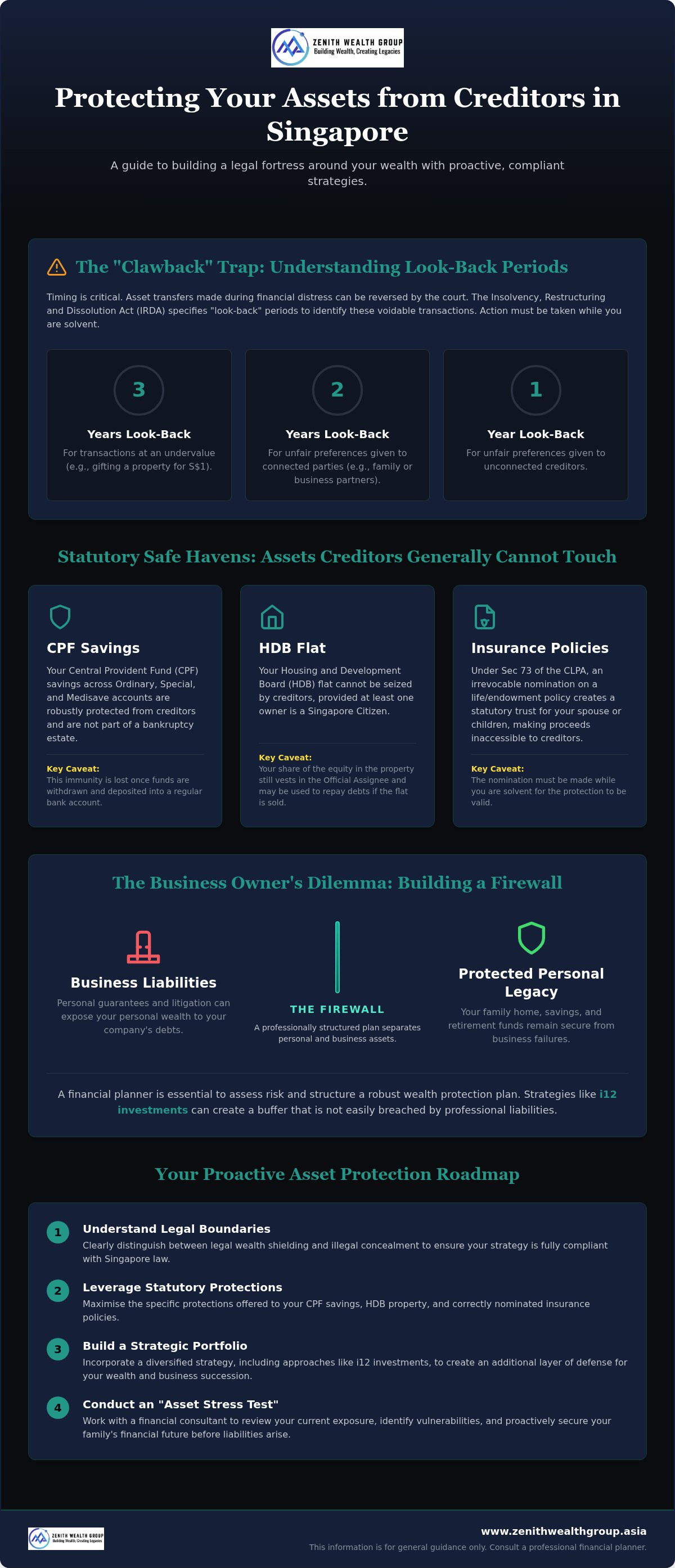
The 2026 regulations are strict about "look-back periods." For instance, transactions at an undervalue have a three-year look-back period. If you gift a property to a relative for S$1 and file for bankruptcy two years later, the Official Assignee can claw that asset back. Similarly, unfair preferences given to unconnected creditors have a one-year look-back, while connected parties face a two-year window. You must act while your financial health is strong.
Why Business Owners Need Separate Protection
Business owners face unique risks. Many entrepreneurs sign personal guarantees for business loans without realizing they're effectively merging their personal wealth with their company's debt. Litigation can quickly bridge the gap between your corporate entity and your private bank account. This is a common pitfall that puts family homes and savings at risk. You need a clear "firewall" between your business liabilities and your personal legacy.
A professional financial planner is essential for this risk assessment. They help you identify where your personal wealth is exposed to your business activities. By integrating strategies like i12 investments into your wealth protection plan, you create a buffer that isn't easily breached by professional liabilities. This proactive approach ensures that a business failure doesn't mean a family catastrophe. If you're ready to start building your shield, you can connect with our team to evaluate your current exposure.
Statutory Safe Havens: Assets Creditors Generally Cannot Touch
Singapore law provides several "safety nets" designed to ensure that individuals aren't left destitute even during financial failure. Understanding how to protect my assets from creditors in Singapore starts with identifying these statutory safe havens. Certain assets are explicitly protected against creditors by law, meaning they don't form part of your bankruptcy estate. These protections exist to preserve basic living standards and long term retirement security for you and your family.
CPF Savings and Creditor Immunity
Your Central Provident Fund (CPF) savings are perhaps the most robustly protected assets in the country. By law, these monies cannot be seized by creditors or the Official Assignee in the event of bankruptcy. This protection covers your Ordinary, Special, and Medisave accounts. It's a foundational pillar of wealth protection. However, once CPF funds are withdrawn and deposited into a regular bank account, they lose this immunity. You should also be aware that CPF savings can still be subject to claims for maintenance orders or certain government charges. Using your CPF strategically for retirement is a reliable way to ensure a portion of your wealth remains untouchable.
Insurance as a Shield
Life insurance policies can be powerful tools for shielding wealth if structured correctly. Under Section 73 of the Conveyancing and Law of Property Act (CLPA), a policy owner can create a statutory trust for their spouse or children through an "irrevocable nomination." This effectively moves the policy proceeds out of your estate and into a trust, making them inaccessible to your creditors. To qualify, the policy must be a life or endowment plan, and the nomination must be made while you are solvent. It's a proactive move that turns a standard financial product into a legal fortress for your loved ones.
Your family home also enjoys significant protection. If at least one owner is a Singapore Citizen, a Housing and Development Board (HDB) flat cannot be seized by creditors. While the flat itself is safe, your share of the equity in the property does vest in the Official Assignee. This means if the flat is eventually sold, that equity may be used to repay debts. Beyond property, protected pension schemes and annuities also provide long term security. Integrating these tools with a broader strategy, such as i12 investments, allows you to build a diversified portfolio that prioritizes safety. If you're unsure how your current policies are nominated, you can chat with a financial planner to review your protection levels.
Strategic Portfolios and i12 investments for Wealth Preservation
Proactive wealth management often focuses on the upside. But for those asking how to protect my assets from creditors in Singapore, the downside protection is equally vital. A well-constructed portfolio does more than grow wealth; it acts as a strategic buffer. By diversifying across asset classes and jurisdictions, you reduce concentration risk. This is critical because if all your wealth is tied to a single business or local property, a legal process involving an individual or firm could potentially jeopardize your entire estate. Strategic diversification ensures that even if one area of your life faces a claim, the rest of your portfolio remains insulated and accessible when you need it most.
The i12 investments Framework
The i12 investments framework is built on the philosophy of stable, resilient growth. It's designed to take the emotion out of financial planning. During a financial crisis, it's easy to make rash decisions that expose your assets to unnecessary risk. i12 investments provides a structured approach that keeps your long-term legacy goals at the forefront. This framework helps you balance the need for immediate liquidity with the necessity of long-term asset shielding. By aligning your investment strategy with your wealth protection needs, you ensure that your capital isn't just growing. It's also positioned behind layers of professional management that focus on risk mitigation as much as returns. This disciplined approach prevents the kind of concentration risk that often leaves business owners vulnerable during lean years.
Using Private Trusts for Enhanced Security
While a will only takes effect after death, a living trust provides protection during your lifetime. In Singapore, a trust separates legal ownership from beneficial interest. This means the assets held in the trust are technically owned by the trustees, making them much harder for personal creditors to reach. It’s a sophisticated layer of defense that complements your statutory protections like CPF and HDB equity. A qualified financial consultant can help you navigate these structures to ensure they meet MAS regulatory standards while serving your specific family needs. This boutique approach to complex financial problems ensures your plan is as unique as your family. It's about creating a proactive plan that moves beyond basic insurance and looks at your total wealth. If you're ready to explore these frameworks, feel free to reach out to our team for a personal conversation about your legacy.
Common Mistakes: Avoiding Fraudulent Preference and Undervalue Transactions
Transferring your family home to your spouse for S$1 the moment you receive a letter of demand is a classic mistake. It's often the first thing people think of when researching how to protect my assets from creditors in Singapore, but it's also the easiest for the court to dismantle. Asset protection is a shield, not a hiding spot. If your actions look like a last minute attempt to cheat creditors, the law provides the Official Assignee with powerful tools to reverse those moves. Understanding the legal definitions of undervalue transactions and unfair preferences is the only way to ensure your wealth preservation strategy actually holds up under scrutiny.
The Danger of Last-Minute Transfers
A "transaction at an undervalue" occurs when you gift an asset or sell it for significantly less than its market worth. Many people mistakenly believe that "gifting" wealth to family members will place it out of reach. However, under the Insolvency, Restructuring and Dissolution Act (IRDA), there is a three-year look-back period for transactions at an undervalue. If you were insolvent at the time or became insolvent because of the transfer, the court can claw back that asset to repay your creditors. This applies to cash, property, and even shares in a business.
Unfair preference is equally risky. This happens when you choose to pay off one creditor, such as a business partner or a relative, while leaving others unpaid. For connected parties, the look-back period for unfair preference is two years. For unconnected parties, it's one year. If you're already in financial distress, these payments can be declared void. The goal is to act while you are solvent so that your financial moves are seen as legitimate estate planning rather than a desperate attempt to evade liabilities.
Maintaining Transparent Financial Records
The best defense against a clawback claim is a clear audit trail. When you implement a strategy like i12 investments, you're establishing a pattern of disciplined, long term wealth management. This helps document the intent behind your financial moves. A professional financial planner can help you maintain these records, ensuring that every transfer or investment is backed by a clear, non-evasive purpose. This transparency distinguishes legitimate wealth protection from illegal concealment. It's about building your fortress during the sunny days, not when the storm is already hitting. If you want to ensure your current strategy is robust and compliant, you should schedule a session with our team to review your asset structure.
Next Steps: Designing Your 2026 Protection Roadmap
You've explored the legal frameworks and the specific assets shielded by Singapore law. Now, the focus shifts to implementation. A robust strategy begins with a comprehensive "Asset Stress Test." This process goes beyond a simple balance sheet review; it identifies hidden vulnerabilities in personal guarantees, joint accounts, and business ownership structures. Understanding how to protect my assets from creditors in Singapore is not a one-time event but a continuous commitment to financial health. By identifying these gaps today, you ensure that your insurance nominations and CPF protections are fully optimized before any professional or personal liabilities arise.
The Annual Wealth Protection Review
Singapore’s financial regulations are dynamic, and a strategy that worked three years ago may not offer the same security today. The 2026 updates to the Insolvency, Restructuring and Dissolution Act highlight the need for agility in your legacy planning. An annual review allows you to adjust your strategy as your wealth grows and as look-back periods for your previous transfers expire. This is where we refine your use of the i12 investments framework to ensure your portfolio remains resilient against both legal risks and market shifts. For a deeper look at staying ahead of these regulatory changes, visit our Wealth Protection in Singapore: The 2026 Guide. Regular updates are the only way to keep your shield effective.
Start Your Conversation with Zenith Wealth
Zenith Wealth operates with a boutique mindset that prioritizes personal connection over institutional distance. We believe that complex financial problems require a human-centric approach. Our financial planners work closely with you to tailor a protection roadmap that reflects your specific risk profile and family goals. Through our partnership with finexis advisory, we provide professional advisory services that are grounded in transparency and safety. Whether you are a business owner navigating succession or a parent securing a home, our team is ready to guide you through the nuances of MAS-regulated products. We're here to start the conversation whenever you're ready to secure your future. Secure your assets today-contact a Zenith Wealth financial consultant to take the first step toward lasting peace of mind.
Secure Your Financial Legacy Today
Building wealth takes a lifetime, but losing it to an unforeseen liability can happen in an instant. You've learned that understanding how to protect my assets from creditors in Singapore is about far more than just crisis management. It requires a proactive blend of statutory protections, like your CPF and HDB equity, and private structures like irrevocable insurance nominations. Acting while you are solvent ensures your wealth preservation strategy remains legally sound and resistant to future clawbacks.
As authorized representatives of finexis advisory, we specialize in navigating these complex legal frameworks. We help you integrate the i12 investments framework into a holistic plan that prioritizes safety alongside growth. Our team brings deep expertise in Singapore legacy and estate planning to every conversation, ensuring your family's future is never left to chance. Don't wait for a legal dispute to test your defenses. Book a consultation with a Zenith Wealth financial planner to start building your fortress. We're ready to help you grow with confidence and peace of mind.
Frequently Asked Questions
Is my HDB flat protected from creditors if I go bankrupt in Singapore?
Yes, your HDB flat is generally protected from creditors if at least one owner is a Singapore Citizen. While the flat itself cannot be seized, your share of the equity in the property vests in the Official Assignee. This means if the flat is eventually sold, those proceeds may be used to settle outstanding debts. Additionally, bankrupts are typically restricted to purchasing HDB flats no larger than a 5-room model.
Can creditors take money from my CPF account?
No, creditors generally cannot touch your CPF savings because they are protected by law from being seized in bankruptcy. This immunity covers your Ordinary, Special, and Medisave accounts. However, once you withdraw these funds and deposit them into a standard bank account, they lose this legal protection. It's vital to understand how to protect my assets from creditors in Singapore by keeping protected funds separate from liquid cash.
How long does a creditor have to claim assets after a transfer?
Creditors and the Official Assignee can look back up to three years for transactions at an undervalue. For unfair preferences, the period is one year for unconnected parties and two years for connected parties like relatives or business partners. These "clawback" rules prevent individuals from hiding wealth just before declaring bankruptcy. Acting while you are solvent is the only way to ensure these transfers remain valid and beyond reach.
Does an irrevocable trust protect my assets from future lawsuits?
Yes, an irrevocable trust can provide significant protection because it separates legal ownership from beneficial interest. Once assets are moved into the trust, you no longer technically own them, making it difficult for personal creditors to reach them. However, these structures must be set up while you are solvent and well before any legal claims arise. A financial planner can help you integrate these trusts into your broader legacy planning strategy.
Can my spouse’s assets be seized for my personal debts?
No, your spouse’s personal assets generally cannot be seized to pay for your individual debts. Singapore law treats individuals as separate legal entities regarding debt liability. However, any joint bank accounts or properties held in joint names may be at risk during legal proceedings. If your spouse has signed a personal guarantee for your business loans, their assets would then be exposed to those specific creditor claims.
What is the difference between a financial consultant and a lawyer in asset protection?
A lawyer focuses on drafting legal documents and representing you in court, while a financial consultant provides strategic planning for MAS-regulated products. A financial planner helps you identify gaps in your wealth protection and retirement strategy before a crisis occurs. They work to ensure your financial structures, like i12 investments, align with the legal frameworks your lawyer establishes. Both roles are essential for building a complete defense.
Are insurance payouts protected from creditors under Singapore law?
Yes, insurance payouts are protected if you have made an irrevocable nomination under Section 73 of the Conveyancing and Law of Property Act. This creates a statutory trust for your spouse or children, placing the funds beyond the reach of your creditors. Without this specific nomination, the payouts may simply form part of your estate and become available to satisfy outstanding debts during bankruptcy or other legal proceedings.
How does i12 investments help in wealth protection?
i12 investments helps in wealth protection by reducing concentration risk through a disciplined and diversified framework. By moving away from emotional decision making, this strategy ensures your portfolio remains resilient during market or personal financial crises. It allows you to grow your wealth while maintaining the liquidity needed for long term legacy planning. Integrating this approach is a key step in how to protect my assets from creditors in Singapore effectively.


