

Did you know that up to 1.0% of your portfolio's value could be quietly disappearing every year through hidden trailer fees? It's frustrating to feel like you're working hard for your money, only to have a significant chunk of your returns eroded by costs you didn't even know existed. Comparing the various wealth management fees Singapore firms charge often feels like trying to solve a puzzle without all the pieces. You aren't alone in feeling confused by the choice between commission-based models and transparent fee-based structures.
We're here to help you strip back the layers of industry jargon to see exactly what you're paying for. This guide ensures your financial plan remains cost-effective while staying perfectly aligned with your long-term legacy goals. We'll break down the 2026 fee benchmarks, explain how specialized options like i12 investments fit into a modern portfolio, and give you the framework needed to choose a financial planner with complete confidence. By the end, you'll know how to maximize your net returns and build a transparent partnership with your financial consultant.
Key Takeaways
- Learn how the latest MAS Fair Dealing guidelines ensure your financial planner provides clear, upfront disclosures on all fee components.
- Compare the primary models for wealth management fees Singapore firms use to determine which structure aligns best with your long-term legacy planning.
- Discover how to identify hidden costs like trailer fees and wrap charges that can quietly erode your investment management returns.
- Gain a step-by-step framework for calculating your Total Cost of Investment (TCI) to ensure your portfolio remains cost-effective.
- Understand how i12 investments can be utilized by your financial consultant to create a strategic, transparent, and high-value financial plan.
Understanding the Wealth Management Fee Landscape in Singapore (2026)
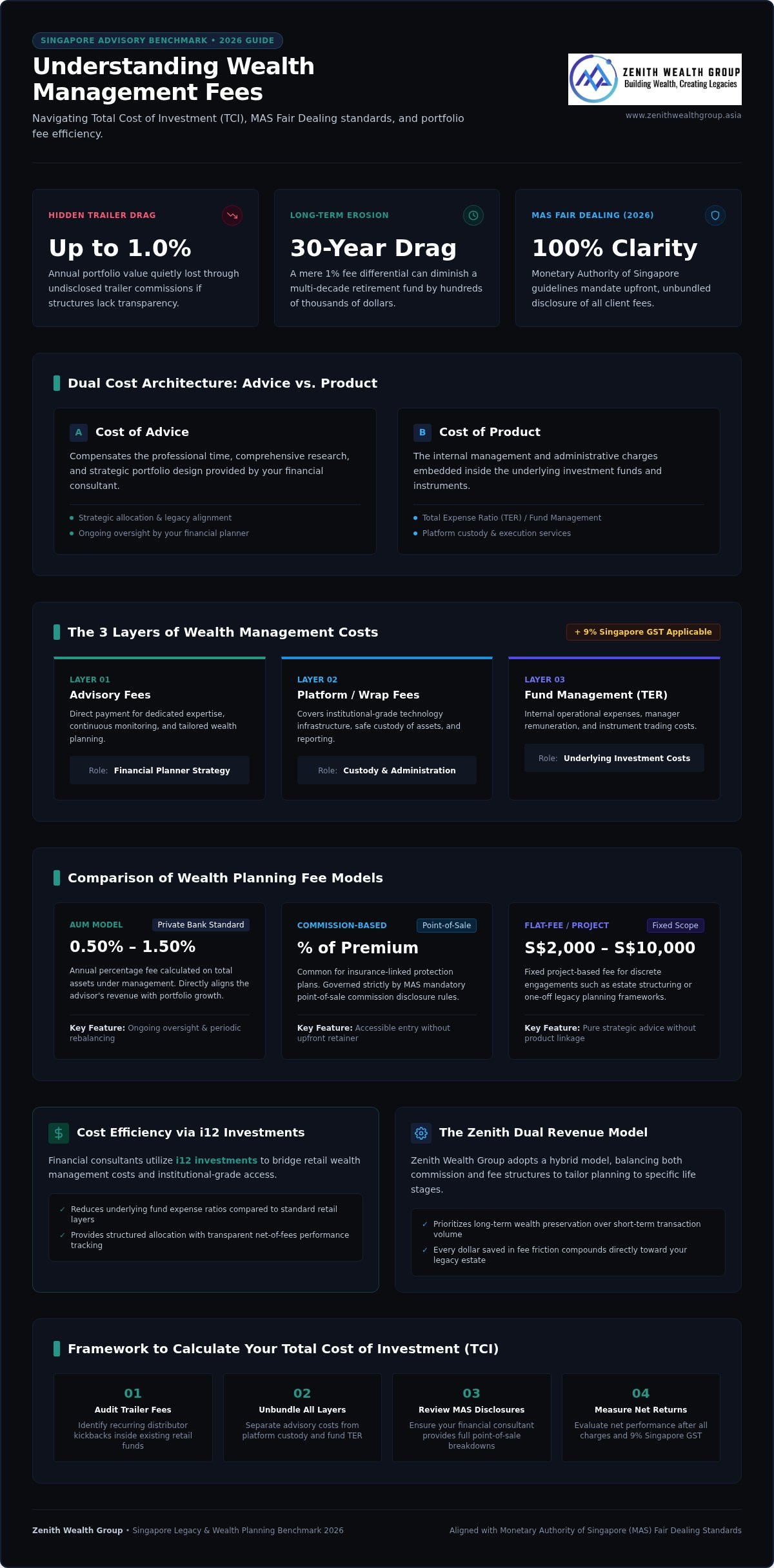
Wealth management fees in Singapore represent the total cost you pay for professional guidance and the administration of your assets. These costs aren't just administrative overhead. They're the price of expertise. In 2026, the landscape is more transparent than ever. This clarity is largely due to the Monetary Authority of Singapore (MAS) updating its Fair Dealing Guidelines. Under these standards, every financial planner must provide a clear breakdown of how fees impact your net returns. You no longer have to guess how much of your profit is being siphoned off by hidden charges. Understanding these wealth management advisory services ensures you remain in control of your financial trajectory.
It's vital to distinguish between the cost of advice and the cost of the product. The cost of advice covers the time, research, and strategic planning provided by your financial consultant. The cost of the product refers to the internal management fees of the funds or instruments you hold. At Zenith Wealth Group, we believe in a dual revenue model. This flexibility allows us to offer both commission-based and fee-based options. By focusing on net-of-fees performance, we help you prioritize long-term wealth preservation over short-term gains. Every dollar saved in fees is a dollar that continues to compound in your portfolio.
Why Fees Matter for Your Retirement and Legacy
Small percentages lead to massive differences over decades. A 1% difference in annual wealth management fees Singapore investors pay can reduce a 30-year retirement fund by hundreds of thousands of dollars. This erosion directly threatens your goals for Legacy Planning. High costs act as a drag on compounding. They effectively reduce the amount of generational wealth you can eventually transfer. Managing these costs is a proactive way to protect your family's future. It ensures that the majority of your market gains stay within your estate rather than being lost to distribution costs.
Common Fee Components in Singapore
You'll typically see three main layers of costs. First, advisory fees pay for your financial planner's ongoing expertise and portfolio oversight. Second, platform or wrap fees cover the technology and custody services required to hold your assets securely. Finally, Fund Management Fees, or the Total Expense Ratio (TER), represent the internal costs of underlying investments. Don't forget the 9% GST applied to these services for Singapore residents. We often utilize strategic vehicles like i12 investments to manage these layers efficiently. This approach ensures your portfolio remains cost-aware while pursuing robust growth. Clear communication about these components is the foundation of a reliable advisory relationship.
Comparing the Three Primary Fee Models for Wealth Planning
Choosing how you pay for advice is just as important as the advice itself. The Assets Under Management (AUM) model is the standard for private banks. Here, you pay a percentage of your total portfolio, usually ranging from 0.50% to 1.50% annually. It's popular because it aligns your financial planner's success with your own. If your wealth grows, they earn more. This model covers ongoing oversight and periodic rebalancing to keep your goals on track.
Commission-based models remain common for insurance-linked wealth protection. Instead of an ongoing fee, the financial consultant receives a percentage of the premium or product price. This model is governed by MAS point-of-sale commission disclosure rules, ensuring you see exactly what's being paid to the intermediary. Some prefer flat-fee or hourly models for specific projects like estate planning. This involves a fixed sum, typically between S$2,000 and S$10,000, providing purely strategic guidance without product-linked incentives.
Modern firms like Zenith Wealth Group often adopt a hybrid approach. This combines the best of both worlds, offering flexibility based on your specific needs. If you're unsure which model fits your current stage, feel free to reach out for a clear breakdown of how these structures apply to your situation.
Commission-based vs. Fee-based: Which is Better?
Young professionals often find commission-based models accessible. They allow for wealth protection without high upfront advisory retainers. However, as portfolios grow and estates become complex, fee-based planning offers superior transparency. The conflict of interest debate usually centers on whether a consultant is incentivized to sell specific products. A professional financial planner avoids this by focusing on your net returns rather than transaction volume. Transparency is the key to alignment.
The Role of i12 Investments in Cost Efficiency
Managing the wealth management fees Singapore investors face requires a structured approach. We use i12 investments to help bridge the gap between retail costs and institutional-grade access. These groups allow for sophisticated allocations while keeping underlying expenses lower than traditional retail funds. i12 investments are a core component of strategic Investment Management. By pooling resources and utilizing efficient structures, we ensure more of your capital stays invested and works harder for your future.
Hidden Costs and Regulatory Standards: What MAS Guidelines Say
Transparency isn't just a buzzword in 2026. It's a regulatory mandate. The Monetary Authority of Singapore (MAS) expanded its Fair Dealing Guidelines to ensure every investor receives a fair shake. Under Outcome 4, your financial planner must provide a clear Fee Disclosure Document before any transaction. This document must break down all components, including platform charges and the wealth management fees Singapore residents pay for specialized advisory. You shouldn't have to hunt for this information. It should be presented upfront, clearly, and without jargon.
Trailer fees are a specific area of focus for MAS. These are recurring commissions, typically between 0.25% and 1.0% per year, paid by fund managers to distributors. In the past, these were often hidden within a fund's internal costs. Now, your financial consultant must explicitly explain how these retrocessions impact your net returns. We often use i12 investments to help clients access institutional-grade structures that minimize these retail-focused distribution costs. Conflict-free advice starts with knowing exactly who is paying your consultant and why.
Be mindful of switching costs and exit penalties. Some insurance-linked wealth products can absorb up to 20% to 40% of your first-year premiums in distribution costs. Exiting these early can lead to significant capital loss. Always ask for a projection that shows your "break-even" point after all costs are factored in. A professional relationship should be built on long-term value, not high-pressure entry fees.
Identifying Indirect Costs in Your Portfolio
Indirect costs are the silent killers of compounding. Bid-offer spreads act as a hidden entry tax every time you buy or sell an asset. If you're invested in global markets, foreign exchange (FX) spreads can further erode your purchasing power. You must also look at the Total Expense Ratio (TER) of your unit trusts. These internal management costs, combined with the 9% GST on advisory services, add up quickly. It's vital to understand how ongoing fees reduce long-term portfolio returns to keep your plan on track.
Regulatory Protections for Singaporean Investors
Recourse exists if your fees aren't disclosed. Zenith Wealth Group serves as an authorized representative of finexis advisory, ensuring we meet the highest standards of compliance and transparency. If a financial consultant isn't being clear about their revenue model, it's a red flag. True Wealth Protection involves more than just market strategy. It requires protecting your capital from excessive fee erosion. We prioritize human interaction and clear communication to ensure you feel secure in every financial decision.
How to Evaluate If Your Wealth Management Fees Are Worth It
Evaluating your wealth management fees in Singapore requires a cold, hard look at the numbers. Start by calculating your Total Cost of Investment (TCI). This isn't just the advisory fee. It includes platform charges, fund management costs, and the 9% GST. Once you have this total, benchmark it. For most portfolios, a recurring annual fee between 0.50% and 1.50% is the standard for holistic oversight. If your costs sit significantly higher without a clear reason, it's time to ask why.
Value isn't always found in the lowest price. It's found in the "Alpha" or value-add your financial planner provides. High-quality advice often pays for itself through strategic tax savings or more efficient estate structures. Review your portfolio frequency. A consultant who only calls once a year might not be providing the value you deserve. We use i12 investments to ensure our clients receive institutional-grade access that justifies the cost through improved efficiency and strategic allocation.
Five Questions to Ask Your Financial Consultant
Transparency is non-negotiable. Use these questions to ensure your interests are aligned with your consultant's compensation structure. A professional should answer these without hesitation.
- "Can you provide a breakdown of all direct and indirect fees I will pay?"
- "How are you compensated for recommending this specific investment group or product?"
- "Are there cheaper alternatives to this portfolio structure that achieve the same goal?"
- "Does this fee include comprehensive legacy and retirement planning?"
- "How often will we review the cost efficiency of my portfolio?"
The Value of Comprehensive Planning Beyond Investments
A great financial plan looks beyond market returns. Managing your cash flow and restructuring debt can often "pay for" the advisory fee by freeing up capital. Utilizing tax efficiency strategies, such as SRS Accounts, can significantly offset management costs. These small adjustments compound over time, potentially adding more to your net worth than market timing ever could.
Ultimately, the goal of Retirement Planning is peace of mind. Knowing your assets are protected and your fees are fair provides a level of confidence that generic retail platforms can't match. You deserve a partner who prioritizes your net returns. Ready to see how your current costs stack up? Book a transparent fee review with us today.
The Zenith Wealth Group Approach: Transparent Planning and i12 Investments
We reject the traditional, opaque approach to professional advisory services. At Zenith Wealth Group, we dedicate our first meeting to a clear, action-oriented discussion about costs. You will never have to search for hidden retrocessions or wonder how your financial consultant is compensated. As authorized representatives of finexis advisory, we operate within a strict compliance framework that guarantees full disclosure. This structural integrity gives you the confidence that your portfolio is built on a foundation of trust and alignment.
Managing the wealth management fees Singapore investors face requires innovative portfolio construction. We utilize i12 investments to provide our clients with a distinct advantage. These specialized investment groups unlock institutional-grade opportunities that typically carry lower internal management costs than common retail funds. This strategic choice keeps your Total Cost of Investment low, ensuring that more of your capital benefits from long-term market growth. We believe that cost-aware management is the cornerstone of protecting your hard-earned wealth.
Every portfolio can benefit from a regular checkup. We invite you to experience a comprehensive Fee Audit with our team. We will review your current statements, identify any hidden trailer fees or layered wrap charges, and show you exactly how much you could save by switching to an unbundled structure. It's a straightforward way to ensure your financial plan remains efficient as you look toward the future.
A Boutique Experience with Institutional Support
We combine personal connection with the robust resources of finexis advisory. This partnership allows us to offer the vast product access of a major institution alongside the flexible fee structures of a boutique practice. We focus heavily on human interaction, completely avoiding the cold, distant corporate atmosphere often found in traditional banking. Your financial planner is a long-term partner who grows alongside you, tailoring every solution to your unique family dynamic.
Next Steps for Your Wealth Journey
Optimizing your fee structure is one of the most immediate ways to improve your portfolio's long-term trajectory. Waiting even a few months can allow unnecessary costs to continue chipping away at your compounding returns. Take a proactive approach to your financial health in 2026. We are ready to start the conversation whenever you are. Book a consultation with a Zenith financial planner today to take full control of your investment costs.
Take Control of Your Financial Trajectory
Optimizing your portfolio costs is a continuous process that requires vigilance and clear communication. The 2026 MAS regulatory updates have made it much easier to spot layered charges, giving you the power to demand complete transparency from your advisory team. Remember that small adjustments in your fee structure can save hundreds of thousands of dollars over a multi-decade timeline. By understanding the direct and indirect wealth management fees Singapore firms charge, you ensure more of your returns compound safely for your family's future.
Zenith Wealth Group serves as an authorized representative of finexis advisory, providing a boutique experience backed by robust institutional support. We specialize in tailored planning for all life stages, utilizing strategic options like i12 investments to build cost-aware portfolios that maximize your net returns. You don't have to navigate these complex structures alone. Let's start a transparent conversation about your wealth journey. Get a transparent fee audit for your portfolio today and move forward with total confidence.
Frequently Asked Questions
What is the average wealth management fee in Singapore?
The average wealth management fees Singapore investors pay for ongoing AUM-based oversight typically range from 0.50% to 1.50% per year. This rate often scales downward as your total portfolio size increases. Beyond the advisory fee, you should also account for the 9% GST and internal fund management costs. Understanding these benchmarks helps you determine if your current service level matches the industry standard for professional wealth management and portfolio administration.
Can I negotiate fees with my financial consultant?
Yes, you can often negotiate fees, especially if you have a larger portfolio or require a long-term advisory relationship. A professional financial consultant is usually open to discussing tiered AUM fees or fixed project rates for comprehensive planning. It's best to have this conversation during your initial meeting to ensure alignment. Transparency about your expectations helps build a sustainable partnership that focuses on your long-term legacy and retirement goals without hidden surprises.
Is a fee-based model always cheaper than a commission-based one?
Not necessarily. A fee-based model provides clarity for high-value portfolios, but a commission-based structure might be more accessible for young professionals starting their wealth journey. The most cost-effective option depends on your transaction frequency and the complexity of your estate. Your financial planner can help you model different scenarios to see which structure maximizes your net returns after all costs are factored in over a 5 or 10-year period.
What are trailer fees and how do they affect my returns?
Trailer fees are recurring commissions paid by fund managers to distributors for as long as you hold an investment. These typically range from 0.25% to 1.0% annually and are often embedded within the fund's Total Expense Ratio. Because they are deducted directly from the fund's value, they can quietly erode your long-term compounding returns. Modern MAS guidelines now require your financial consultant to disclose these retrocessions clearly in your fee disclosure documents.
Are wealth management fees tax-deductible in Singapore?
Wealth management fees for personal investment and retirement planning are generally not tax-deductible for individuals in Singapore. However, you can offset the impact of these costs by utilizing tax-efficient vehicles like the Supplementary Retirement Scheme (SRS). Your financial planner can help you integrate these strategies to lower your overall tax burden, effectively recouping some of the costs associated with professional advisory services and the ongoing administration of your investment portfolio.
How does i12 investments help in lowering overall costs?
We use i12 investments to give clients access to institutional-grade structures that aren't typically available to retail investors. These groups pool resources to negotiate lower internal management fees and minimize distribution costs like trailer fees. By utilizing i12 investments, your financial consultant can build a sophisticated portfolio that remains highly cost-effective. This approach ensures more of your capital stays invested, significantly improving your net-of-fees performance and long-term wealth preservation outcomes.
What happens if I want to switch my financial planner due to high fees?
You have the right to switch your financial planner if you feel the current fee structure doesn't provide sufficient value. Before moving, check for exit penalties or switching costs in your current products, which can sometimes be significant in insurance-linked plans. A new financial consultant can perform a fee audit to identify these risks. They will help you transition your assets into a more transparent, cost-aware structure that better aligns with your future financial goals.


