

What if the Singapore wealth safety net you spent years building quietly turns into a cross-border tax headache the moment your plane takes off? Packing your bags for a new life overseas is exhilarating, but solid financial planning for Singaporeans moving abroad requires far more than simply converting currency and opening an overseas bank account.
It's completely normal to feel uncertain about what happens next. You might wonder whether to keep your funds in CPF accounts earning up to 4% interest, how to manage SRS contributions, or whether your domestic health insurance still protects you. Managing money across borders can feel overwhelming when tax definitions, residency rules, and foreign reporting requirements shift under your feet.
This guide shows you how to protect your domestic assets, optimize your CPF and SRS accounts, and accumulate resilient wealth while living overseas. Together, we'll walk through a clear pre-departure checklist, unpack common foreign tax traps, and explore disciplined, rule-based portfolio solutions like i12 investments alongside your dedicated financial consultant so you can relocate with total confidence.
Key Takeaways
- Understand the legal rules governing your CPF and SRS accounts to keep your balances compounding efficiently without triggering unwanted penalties.
- Execute essential pre-departure milestones, from IRAS Form IR21 tax clearance to foreign reporting compliance, through proactive financial planning for Singaporeans moving abroad.
- Identify coverage gaps between domestic Integrated Shield Plans and international private medical policies to safeguard your family's health worldwide.
- Structure a resilient global portfolio by combining stable Singapore banking facilities with disciplined, rule-based strategies like i12 investments.
- Partner with a dedicated financial planner to build a clear repatriation roadmap that ensures continuous growth across all your wealth streams.
Managing CPF, SRS, and Domestic Banking Before Moving Abroad
Most wealth literature focuses on expats arriving in Singapore, completely overlooking outbound citizens who leave the island. As a result, members of the growing Singaporean diaspora often struggle to find clear answers about their home assets. Sound financial planning for Singaporeans moving abroad starts by restructuring your existing domestic foundation rather than abandoning it.
What Happens to Your CPF Accounts When Relocating?
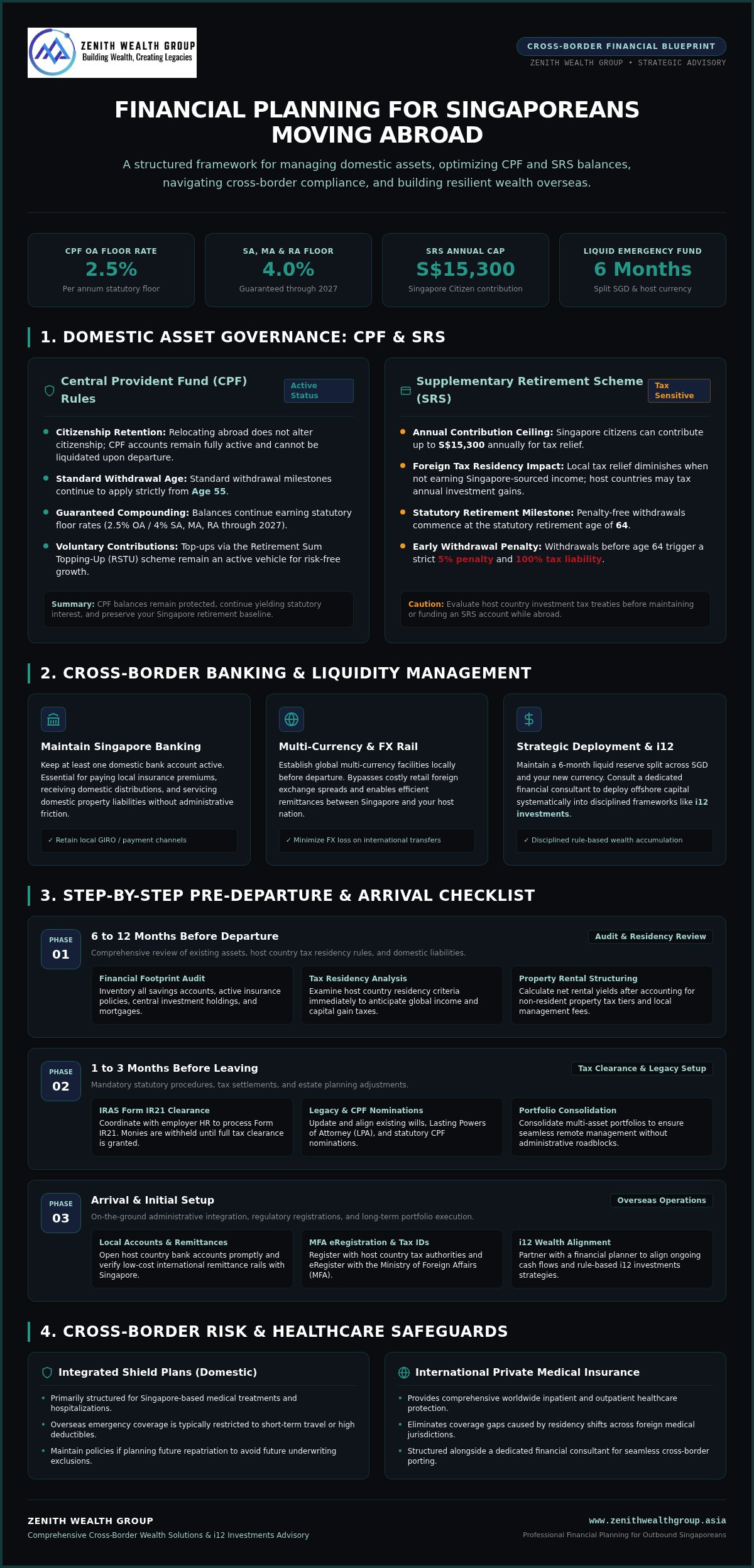
Moving overseas doesn't change your citizenship status, so your Central Provident Fund (CPF) remains fully active. You cannot liquidate your CPF savings simply because you relocate abroad. Standard withdrawal rules still apply from age 55. Your balances continue compounding at statutory floor rates: 2.5% per annum in your Ordinary Account and 4% per annum in your Special, MediSave, and Retirement Accounts through 2027. If you want risk-free compounding, voluntary top-ups via the Retirement Sum Topping-Up scheme remain viable. Review your milestones alongside The Complete Guide to Retirement Planning in Singapore (2026 Edition).
Strategic Handling of the Supplementary Retirement Scheme (SRS)
Your Supplementary Retirement Scheme (SRS) account stays open, but moving abroad alters the underlying advantages. Citizens can contribute up to S$15,300 annually to offset taxable income in Singapore. However, once you become a foreign tax resident, local tax relief becomes less useful, and certain host countries may tax annual investment gains within the account. Early withdrawals before the statutory retirement age of 64 incur a 5% penalty and 100% tax liability. Discover smart mitigation tactics in our guide to Mastering the SRS Account: A 2026 Strategic Guide to Tax Savings.
Optimizing Local Bank Accounts and Cash Reserves
Keep at least one Singapore bank account active before boarding your flight. You will need local accounts to manage insurance premiums, receive domestic distributions, and service property liabilities without friction.
- Establish multi-currency facilities: Open global multi-currency accounts locally to bypass costly retail foreign exchange spreads during remittances.
- Split liquid emergency funds: Maintain a six-month reserve split between Singapore dollars and your new local currency to protect against currency volatility.
- Deploy capital efficiently: Consult a qualified financial planner to assess whether disciplined wealth solutions like i12 investments suit your cross-border cash deployment strategy.
The Step-by-Step Relocation Financial Checklist for Singaporeans
Relocating involves dozens of moving parts. Without a structured timeline, administrative oversights can quickly derail your hard-earned assets. Comprehensive financial planning for Singaporeans moving abroad breaks down into three distinct phases to ensure nothing slips through the cracks.
Phase 1: 6 to 12 Months Before Departure
Audit your entire financial footprint before booking flights. List all domestic savings accounts, central investment holdings, active insurance policies, and outstanding property mortgages. Examine the tax residency rules of your host country immediately. If you plan to rent out your local property while overseas, calculate your net rental yields after accounting for non-resident property tax tiers and local property management fees.
Phase 2: 1 to 3 Months Before Leaving
Mandatory regulatory steps happen during this tight window. Work closely with your human resources department to process Inland Revenue Authority of Singapore (IRAS) tax clearance through Form IR21. Your employer must withhold all monies due to you until clearance is granted.
- Clear domestic taxes: Ensure all outstanding income tax liabilities are settled before your final paycheck is released.
- Update legacy documents: Re-examine existing wills, lasting powers of attorney, and CPF nominations using our guide to Legacy Planning in Singapore: The 2026 Guide to Protecting Generational Wealth.
- Consolidate investments: Review multi-asset portfolios to confirm they can be managed remotely without triggering unnecessary administrative friction.
Phase 3: Arrival and Initial Setup
Establish local accounts promptly upon landing. Verify international remittance rails so you can transfer funds between Singapore and your host nation without high bank charges. Update your official records, register for host country tax identification numbers, and take a moment to eRegister with the Ministry of Foreign Affairs so consular officers can assist you during unexpected overseas emergencies.
Aligning ongoing cash flows, offshore wealth accumulation strategies, and systematic platforms like i12 investments takes dedicated focus. If you want tailored guidance for your relocation journey, connect with a dedicated financial planner through Zenith Wealth to build a confident, tax-efficient cross-border path.
Navigating International Taxation and Dual-Residency Risks
Leaving Singapore's low-tax environment often creates an immediate financial shock. Singapore operates on a territorial tax basis, meaning foreign-sourced income is generally exempt from domestic personal tax. Many destination countries, however, tax your worldwide income the moment you qualify as a tax resident. Comprehensive financial planning for Singaporeans moving abroad ensures you don't surrender unnecessary wealth to foreign revenue authorities through poor timing or overlooked treaties.
Territorial Tax vs Worldwide Taxation Systems
Singapore taxes personal income on a progressive scale up to 24%, leaving capital gains and foreign investment income completely untouched. Popular destinations such as Australia, the United Kingdom, and the United States follow worldwide taxation models. Once you land and meet local residency tests, those governments tax your global earnings, foreign dividends, and offshore savings interest. Fortunately, Singapore maintains Double Taxation Agreements with nearly 100 jurisdictions. These treaties clarify taxing rights, reduce withholding taxes, and prevent identical income from being taxed twice.
Capital Gains Tax Traps for Singapore Assets
Singapore does not tax capital gains, but your new destination almost certainly does. Liquidating a Singapore residential property or selling equity portfolios after establishing foreign tax residency can trigger massive local capital gains bills abroad.
- Time asset sales before moving: Crystallize capital gains while you're still exclusively a Singapore tax resident to lock in tax-free profits legally.
- Audit investment structures: Foreign authorities often penalize foreign collective investment schemes and certain offshore wrappers with punitive income tax rates.
- Rebalance systematically: Work with an experienced financial consultant to shift your assets into globally tax-efficient vehicles, such as i12 investments, before your departure date.
Reporting Under the Common Reporting Standard (CRS)
Assuming your Singapore bank balances will stay private overseas is a critical mistake. Under the Common Reporting Standard (CRS), local banks and financial institutions automatically exchange account balances, dividend payments, and interest data with your host country's revenue service. Full transparency is essential. Unreported foreign accounts bring harsh penalties, back taxes, and potential legal scrutiny. Partnering early with a qualified financial planner helps you align your domestic assets with foreign disclosure rules seamlessly.
Cross-Border Wealth Protection and Global Investment Allocation
Physical relocation changes your risk profile overnight. Many professionals discover too late that domestic safety nets provide limited relief once settled in a new country. Robust financial planning for Singaporeans moving abroad requires combining worldwide healthcare protection with an investment framework designed to withstand currency volatility and international inflation.
Auditing Your Singapore Insurance Policies
MediShield Life and domestic Integrated Shield Plans focus almost entirely on treatments received within Singapore. While MediShield Life provides basic claim limits pegged to Singapore public hospital charges for emergencies abroad, it leaves substantial out-of-pocket gaps in high-cost medical markets. Term life and critical illness plans generally maintain global protection, though insurers must be notified of your residency change. To eliminate coverage shortfalls, transition toward International Private Medical Insurance (IPMI). Strengthen your personal risk framework using Wealth Protection in Singapore: The 2026 Guide to Safeguarding Your Future.
Managing Foreign Currency and Exchange Rate Volatility
Earning in foreign currency while servicing Singapore-dollar obligations creates ongoing exchange rate friction. Unexpected currency dips can inflate domestic mortgage payments or shrink your offshore purchasing power.
- Match currencies to liabilities: Maintain sufficient Singapore-dollar balances to cover domestic mortgages, insurance premiums, and family commitments without constant conversions.
- Automate scheduled transfers: Use scheduled foreign exchange transfers to dollar-cost average exchange rates over time instead of trying to time volatile currency pairs.
- Avoid idle cash: Holding excess cash in low-yield operational accounts invites steady inflation decay across multiple currencies.
Strategic Growth Opportunities with i12 Investments
Managing an investment portfolio across time zones requires structure and emotional discipline. Incorporating rule-based vehicles such as i12 investments provides outbound Singaporeans with an objective methodology that removes emotional bias from asset allocation. Through strategies like the Wealth Accumulation Plan (WAP) for disciplined long-term compounding and the Tactical Opportunities Plan (TOP) for dynamic adjustments, you can systematically grow global wealth wherever your career takes you. Discover practical asset allocation techniques in Strategic Investment Management in 2026: A Guide to Growing Wealth in Singapore.
Ready to structure your overseas portfolio with confidence? Schedule a consultation with a dedicated financial consultant at Zenith Wealth Group today.
Long-Term Repatriation and Retirement Structuring with Zenith Wealth Group
Most Singaporeans heading overseas eventually plan to return. Moving back, however, requires as much foresight as departing. Without strategic repatriation structuring, transferring accumulated foreign wealth back home can expose your gains to unexpected departure levies or foreign exit taxes. Proactive financial planning for Singaporeans moving abroad ensures your international earnings translate into lifelong retirement security back home.
Preparing for Eventual Repatriation to Singapore
Begin mapping out your return 6 to 18 months before landing back at Changi. This runway gives you time to unwind foreign assets without incurring heavy penalties. You will want to re-establish domestic residential arrangements, transfer overseas investment gains before foreign tax years close, and coordinate education funding if your children are moving into local or international schools. Returning smoothly also means slotting your retirement roadmap back into CPF LIFE alongside existing private pension streams.
Coordinating Cross-Border Estate and Legacy Plans
Holding property, cash, and portfolios across multiple jurisdictions complicates estate administration. A standard Singapore will may not cover assets situated under foreign legal codes, which can trap your family in protracted probate proceedings abroad.
- Harmonize cross-border wills: Work with your advisory team to establish complementary wills that respect legal requirements in each relevant jurisdiction.
- Protect family succession: Structure multi-jurisdictional estate planning solutions so business succession and legacy goals continue without court delays.
- Consolidate global accounts: Direct your overseas accounts into cohesive structures to simplify asset transfers to your designated beneficiaries.
Start Your Expat Financial Journey with Confidence
Zenith Wealth Group brings deep institutional expertise to outbound professionals. As authorized representatives under finexis advisory Pte Ltd (established in 2005), Zenith's advisory team delivers tailored retirement planning, wealth protection, and estate planning tailored to outbound Singaporeans. By integrating systematic platforms like i12 investments, our advisors help you bridge local statutory schemes with global multi-asset opportunities.
You don't have to tackle cross-border complexities alone. Connect with a dedicated financial consultant who understands both Singapore frameworks and global requirements. Take control of your international move today and schedule your advisory consultation with Zenith Wealth Group.
Step Into Your Global Chapter with Total Financial Clarity
Relocating internationally opens remarkable opportunities for your career and family. Protecting what you've built requires proactive coordination before your flight departs. From optimizing your compounding CPF balances to insulating your portfolio against foreign tax rules, deliberate planning keeps your long-term roadmap intact.
Thorough financial planning for Singaporeans moving abroad turns disconnected cross-border assets into a cohesive wealth engine. Combining disciplined frameworks like i12 investments with comprehensive wealth protection guarantees that your capital continues to compound, no matter where your career leads.
Zenith Wealth Group is an authorized representative group under finexis advisory Pte Ltd, established in 2005. Our team specializes in bespoke fee-based advisory and cross-border retirement structuring tailored directly to outbound Singaporeans. Don't leave your global finances to chance. Connect with a Zenith Wealth Group financial planner today to start your overseas transition with complete confidence.
Frequently Asked Questions
Can Singaporeans keep their CPF accounts while living permanently abroad?
Yes, Singapore citizens retain their CPF accounts indefinitely regardless of where they live. Your balances continue to compound safely at statutory interest rates, earning 2.5% in your Ordinary Account and 4% across your special and retirement balances. You cannot withdraw your savings early simply by relocating. Standard withdrawal rules apply from age 55 unless you officially renounce your Singapore citizenship.
Do I need to pay Singapore income tax on money earned while working overseas?
No, Singapore taxes income strictly on a territorial basis, meaning personal income earned from employment overseas is generally exempt from domestic tax. You can remit those earnings into a Singapore bank account without incurring local income tax. However, you must ensure your Singapore employer processes your final tax clearance via Form IR21 before your departure date.
What happens to my Supplementary Retirement Scheme (SRS) account if I relocate?
Your SRS account remains completely active, allowing your existing cash or investments to stay in place. Further contributions provide little benefit once you stop paying Singapore income tax, as there's no domestic liability to offset. Liquidating balances before the statutory retirement age of 64 triggers a 5% penalty and taxes the entire withdrawal, making preservation usually the best strategy.
Will my Singapore Integrated Shield Plan cover medical treatments in my new country?
No, standard Singapore Integrated Shield Plans do not provide adequate long-term medical coverage while you reside overseas. MediShield Life and private shield plans focus on hospital care in Singapore, restricting overseas claims to acute emergencies pegged to local public ward rates. Outbound citizens should transition to comprehensive International Private Medical Insurance to ensure seamless worldwide clinical coverage.
Should I sell my Singapore property or rent it out before moving abroad?
The right decision depends on your repatriation timeline, local mortgage commitments, and foreign tax exposure. Renting out your home generates passive Singapore-dollar income, though higher non-owner-occupier property taxes apply. Selling before departing lets you crystallize capital gains completely tax-free. Proactive financial planning for Singaporeans moving abroad helps you model both options against host-country tax rules.
How do I avoid double taxation on my investments when moving out of Singapore?
You can mitigate double taxation by utilizing Singapore's network of nearly 100 tax treaties and timing asset sales strategically. Selling appreciated assets before establishing foreign residency prevents your new host country from taxing those historical gains. Integrating disciplined, rule-based vehicles like i12 investments helps you preserve global growth while remaining fully aligned with international reporting guidelines.
Why should I work with a financial planner before relocating overseas?
Partnering with a financial planner bridges the complex gap between Singapore statutory schemes and foreign financial rules. Comprehensive financial planning for Singaporeans moving abroad coordinates asset structuring, cross-border health insurance, and legacy administration. A dedicated financial consultant helps you avoid costly administrative traps, ensuring your domestic foundation keeps working efficiently while you establish your career abroad.


