

True location independence isn't about hopping borders to outpace local bureaucracy; it requires a rock-solid financial anchor. While splitting your time between Bali, Bangkok, and Kuala Lumpur offers incredible flexibility, comprehensive financial planning for digital nomads in Southeast Asia quickly becomes complicated without a centralized strategy. Juggling fragmented bank accounts, shifting visa thresholds, and ongoing currency conversion fees can drain both your energy and your savings.
You already know the frustration of navigating unclear tax rules across different borders, worrying about compliance penalties, and wondering whether your emergency medical cover will actually protect you abroad. A mobile lifestyle shouldn't force you to sacrifice your future retirement security or settle for makeshift money management.
In this guide, you'll learn how to structure your cross-border wealth, optimize regional tax obligations, safeguard your health with portable coverage, and build resilient, long-term investments through proven frameworks like i12 investments. Here is your practical roadmap to transforming scattered earnings into an enduring, multi-currency financial base anchored right here in Singapore.
Key Takeaways
- Master effective financial planning for digital nomads in Southeast Asia by replacing fragmented regional accounts with a centralized, multi-currency treasury hub.
- Establish clear tax domicile and structured compliance strategies to manage physical presence thresholds and avoid unexpected cross-border penalties.
- Secure continuous wealth protection by swapping restrictive travel policies for portable international medical coverage that travels with you.
- Overcome the nomad pension gap through disciplined global portfolios, including i12 investments, designed for steady long-term accumulation.
- Learn why ongoing collaboration with a professional financial planner keeps your wealth strategy resilient against shifting regional immigration and tax laws.
The Financial Realities of Nomadic Life in Southeast Asia
Living across Southeast Asia delivers an exceptional lifestyle, but it introduces distinct financial friction. True financial planning for digital nomads in Southeast Asia goes far beyond tracking travel expenses; it requires deliberate cross-border cash flow, multi-jurisdiction tax structuring, and disciplined investment management. Many professionals embrace the digital nomad lifestyle drawn by affordable daily living in regional hubs like Bali, Bangkok, or Penang. Yet, unmonitored currency conversions, transfer fees, and rapid regulatory updates can quietly erode those lifestyle savings.
Relying solely on consumer fintech apps exposes your capital to sudden operational risks. While app-based debit cards work well for settling daily meals and co-working passes, they are not full replacements for established banking relationships. Automated compliance algorithms frequently flag and freeze retail mobile accounts when substantial cross-border transfers land without prior notice. Modern mobility requires institutional-grade structure, not temporary workarounds.
Navigating Tax Residency and Local Compliance Traps
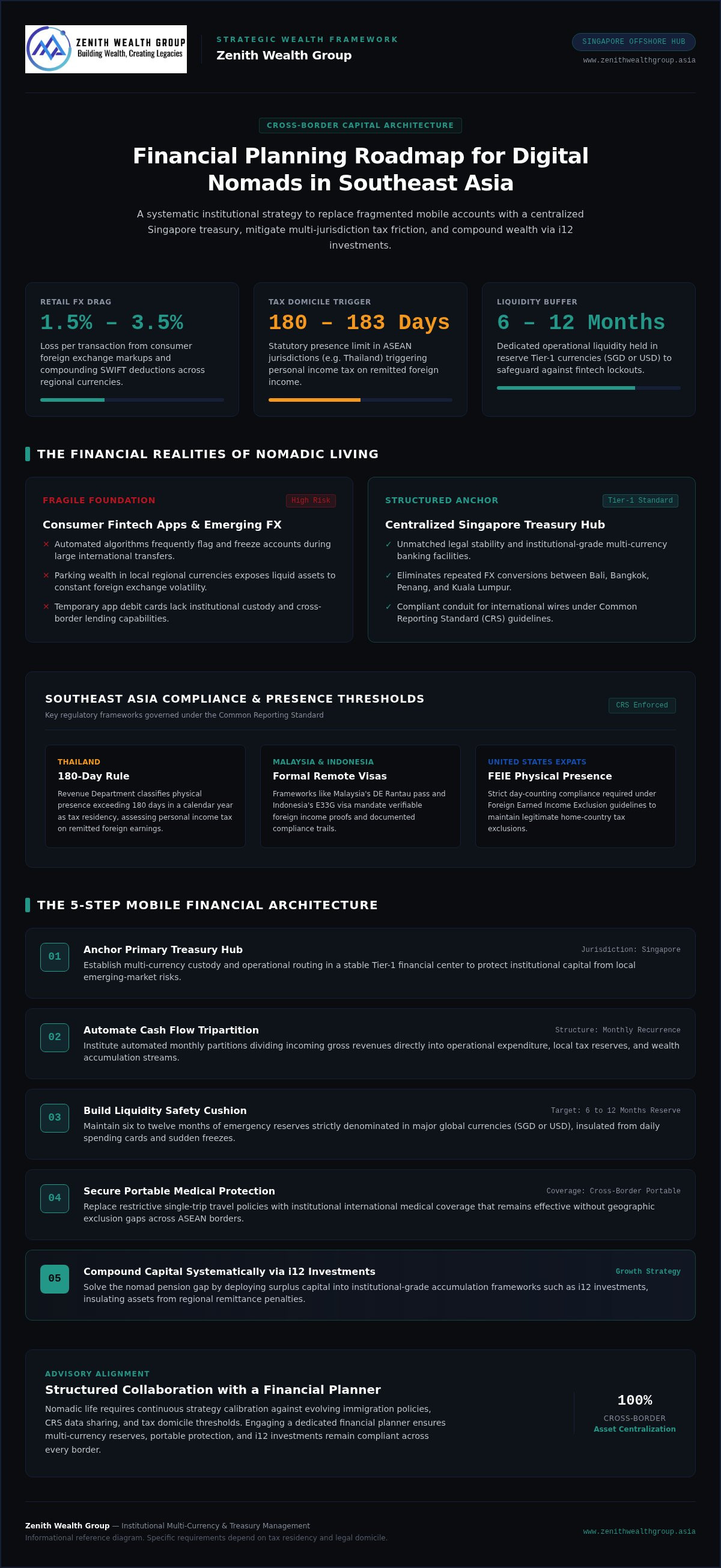
Regional governments have intensified tax transparency under the Common Reporting Standard. Most ASEAN nations enforce statutory residency based on physical presence, typically triggered between 180 and 183 days within a calendar year. In Thailand, crossing the 180-day threshold classifies you as a tax resident under Revenue Department regulations, subjecting remitted foreign earnings to personal income tax. Similarly, formal remote visas, such as Malaysia's DE Rantau pass or Indonesia's E33G visa, mandate strict foreign income proofs and clean compliance trails. Crossing borders without monitoring your physical calendar can trigger unexpected double taxation and severe local penalties.
Managing Multi-Currency Volatility and Banking Friction
Parking long-term reserves in regional emerging currencies exposes your liquid wealth to persistent foreign exchange swings. Converting funds between multiple local currencies repeatedly incurs retail conversion penalties, often costing 1.5% to 3.5% per transaction alongside compounding SWIFT transfer deductions. For genuine wealth preservation, comprehensive financial planning for digital nomads in Southeast Asia prioritizes an offshore anchor in a Tier-1 jurisdiction. By anchoring your primary treasury in Singapore, you gain political stability, robust legal protection, and access to sophisticated multi-currency facilities that keep your capital safe and accessible anywhere you land.
How to Build a Mobile Financial Foundation: A Step-by-Step Blueprint
Creating lasting wealth on the road requires an orderly sequence. Without a structured foundation, long-term investments often get disrupted by sudden tax reassessments or cash crunches. True financial planning for digital nomads in Southeast Asia treats your money like an international corporate balance sheet, establishing legal clarity and cash reserves before allocating growth capital.
Before buying funds or building investment portfolios, clarify your legal domicile and home-country tax exposure. For instance, American expatriates must carefully manage the physical presence test under official Foreign Earned Income Exclusion guidelines to maintain compliance. Once your baseline domicile strategy is set, deploy this step-by-step blueprint to organize your cross-border wealth.
Step 1 to 3: Anchoring Accounts, Cash Flow, and Emergency Funds
- Step 1: Anchor your primary treasury. Establish accounts in a stable Tier-1 hub like Singapore. This ensures reliable international wire routing, strong institutional safety, and multi-currency custody.
- Step 2: Automate your cash flow. Set up recurring monthly transfers dividing revenue into operational expenditure, tax reserves, and wealth accumulation. Separate business earnings from personal drawings immediately.
- Step 3: Secure an emergency liquidity buffer. Build a six to twelve-month liquid reserve held in major reserve currencies such as SGD or USD. Keep this separate from daily spending cards to guard against sudden account locks or travel disruptions.
Step 4 and 5: Risk Mitigation and Wealth Accumulation
- Step 4: Protect against catastrophic health events. Secure fully portable medical coverage that remains active across all Southeast Asian jurisdictions without geographic exclusion gaps.
- Step 5: Compound wealth systematically. Direct surplus capital into institutional-grade structures, including diversified options like i12 investments. This avoids fragmented retail trading accounts and insulates your assets from regional remittance traps.
Coordinating multiple legal jurisdictions, bank hubs, and cross-border assets isn't something you have to figure out alone. An experienced financial planner can review your nomadic trajectory, align your multi-currency accounts, and craft a bespoke wealth blueprint tailored to your mobile goals.
Cross-Border Wealth Protection: Portable Insurance and Health Coverage
A sudden medical emergency abroad can erase years of disciplined compounding in days. Standard travel insurance policies look convenient at first glance, but they fail remote workers living abroad long-term. Basic trip policies usually cap coverage at 30 to 90 consecutive days away from your home country, demand return ticket proof, and exclude routine or ongoing treatment. Incorporating comprehensive wealth protection is essential when handling financial planning for digital nomads in Southeast Asia.
Without an institutional protection plan, unexpected health complications force you to drain emergency reserves or liquidate growth investments prematurely. Protecting your earning power is just as vital as growing it.
International Private Medical Insurance (IPMI) vs Local Plans
Single-country domestic policies bind your healthcare to local hospital networks in places like Thailand or Bali. If you move to Malaysia or require complex medical care in Singapore, those domestic plans become invalid. International Private Medical Insurance (IPMI) solves this by delivering uninterrupted regional or global portability. Key advantages include:
- Direct-billing hospital networks: Access top-tier private medical facilities across ASEAN without paying large upfront cash deposits.
- High coverage ceilings: Protect yourself against catastrophic medical costs, major surgeries, and cancer treatments that would easily exhaust retail travel caps.
- Emergency evacuation and repatriation: Secure rapid air-ambulance transfers to Singapore or regional centers when living on remote islands like Koh Samui, Siargao, or Lombok where specialized trauma care is unavailable.
Income Protection and Disability Safeguards for Nomads
Location-independent contractors, agency owners, and freelancers operate without corporate sick leave or government disability benefits. If a severe accident or prolonged illness halts your work capacity, your cash flow stops instantly. International disability coverage and critical illness policies replace monthly income, ensuring your living expenses and ongoing savings commitments stay fully funded during recovery. Working alongside a qualified financial planner allows you to structure these portable safety nets properly, guaranteeing your protection travels seamlessly with you from country to country.
Long-Term Wealth Accumulation and Retirement Strategies
Opting out of corporate employment means stepping outside state-mandated safety nets. Digital nomads rarely contribute to centralized retirement schemes like Singapore's Central Provident Fund (CPF), UK National Insurance, or US Social Security. Without mandatory employer matching, you face a compounding savings gap that can derail your later years. Long-term financial planning for digital nomads in Southeast Asia requires self-directed wealth creation, replacing default state plans with an intentional global portfolio.
A successful nomadic career should fund decades of personal independence, not just immediate travel freedom. Reviewing your trajectory through structured retirement planning helps clarify your exact capital requirements long before you decide to hang up your passport.
Overcoming the Absence of Mandatory Pension Plans
Relying on informal savings or volatile speculative assets leaves you dangerously exposed to inflation and market cycles. Sustaining a borderless lifestyle past sixty demands a reliable capital base capable of generating steady multi-currency cash flow. Overcoming this structural gap requires automated, disciplined habits:
- Automated dollar-cost averaging: Commit a fixed percentage of foreign monthly billings directly into broad-market vehicles, removing emotion from market timing.
- Currency diversification: Hold core retirement assets in globally recognized reserve currencies like SGD, USD, or EUR to hedge against long-term purchasing power erosion.
- Systematic distribution planning: Model future withdrawal rates to ensure your portfolio withstands market downturns without depleting principal prematurely.
Deploying Capital Through Structured Multi-Asset Portfolios
Randomly buying individual retail equities creates unexpected cross-border tax complications. For example, non-US domiciled professionals who hold US-situated assets directly face US estate tax liabilities on assets over USD 60,000, where tax rates climb to 40%. Sophisticated cross-border planning circumvents these tax traps through institutional structures, such as UCITS frameworks.
Applying rigorous principles of strategic investment management anchors your growth across uncorrelated asset classes, defensive cash-flow vehicles, and resilient allocations like i12 investments. This institutional framework protects your wealth from sudden regional market shocks while preserving upside growth across economic cycles.
Ready to structure your global retirement strategy? Reach out to consult a licensed financial planner today to build a sustainable, borderless wealth plan tailored to your future.
Why Partnering with a Regional Financial Planner Protects Your Future
Managing money across borders seems simple until a sudden regulatory shift disrupts your setup. A do-it-yourself approach often feels manageable with a spreadsheet and a few fintech wallets. Yet, international regulations move fast. Rules governing visas, foreign remittances, and cross-border bank reporting evolve rapidly across ASEAN nations. Executing cohesive financial planning for digital nomads in Southeast Asia requires localized regional insight, not just generic forum advice.
The Limits of Fragmented DIY Wealth Management
A piecemeal approach creates serious blind spots. An unexpected wire transfer can trigger an offshore compliance flag, freezing your operational funds for weeks. In addition, tracking multi-currency filings across jurisdictions with differing tax years creates a heavy administrative burden. Key risks of self-managing cross-border finances include:
- Unintended tax residency: Miscounting physical days in countries like Thailand or Malaysia can lead to severe back-taxes and compliance fines.
- Fragmented asset holdings: Maintaining isolated trading accounts in multiple countries complicates estate planning and generates punitive withholding taxes.
- Reactive risk management: Scrambling for emergency care coverage after an accident happens leaves your accumulated wealth vulnerable to medical debt.
A qualified financial consultant coordinates these moving pieces into a unified framework. This ensures your wealth protection, investment growth, and cross-border cash flows work in harmony rather than in conflict.
Begin Your Southeast Asian Financial Roadmap with Zenith Wealth
Zenith Wealth acts as your professional guide across the region. Operating as authorized representatives of finexis advisory Pte Ltd, established in Singapore since 2005, our advisory team specializes in cross-border wealth structures, retirement planning, and investment management. We help you anchor your capital securely within Singapore's world-class financial ecosystem while you travel.
During a personalized cross-border wealth review, we analyze your residency patterns, streamline your liquid accounts, and introduce resilient options like i12 investments into your portfolio. Sustainable financial planning for digital nomads in Southeast Asia unites your lifestyle aspirations with institutional discipline. Connect with an experienced financial planner today to take control of your mobile financial future.
Take Control of Your Borderless Financial Future
Living across borders shouldn't mean leaving your financial stability behind. Consolidating your cash flow in a secure Tier-1 financial hub, locking in portable regional healthcare, and systematically closing the pension gap transforms nomadic mobility into enduring personal freedom. That's the real goal of comprehensive financial planning for digital nomads in Southeast Asia.
You don't have to navigate changing international tax laws and cross-border portfolios by yourself. Zenith Wealth Group operates as authorized representatives of finexis advisory Pte Ltd, established in Singapore since 2005. Our advisory team delivers comprehensive wealth protection, risk management, and retirement planning designed specifically for globally mobile professionals. By integrating premier international solutions and disciplined allocations like i12 investments, we ensure your wealth compounds safely no matter where you wake up tomorrow.
Connect with a professional financial planner at Zenith Wealth Group today to design a clear, customized financial roadmap that supports your lifestyle for decades to come.
Frequently Asked Questions
Can digital nomads legally maintain tax residency in Southeast Asia?
Yes, digital nomads can establish legal tax residency in Southeast Asia by meeting statutory physical presence thresholds or qualifying for dedicated long-stay visa categories. In countries like Malaysia or Thailand, staying 182 or 180 days respectively triggers tax resident status. Holding passes such as Malaysia's DE Rantau or formal long-stay visas allows you to formalize residency legally, register with local tax authorities, and obtain proper tax identification certificates.
Do digital nomads pay taxes if working on tourist visas in Southeast Asia?
Working on a tourist visa doesn't legally exempt you from tax liabilities if you trigger local physical presence rules. While tourists technically lack local employment authorization, tax authorities determine liability by physical days spent in the country rather than visa classification. Spending over 180 days in jurisdictions like Thailand subjects remitted foreign income to local personal taxation, exposing unmonitored remote workers to audits, penalties, and back-taxes.
What happens to my retirement savings if I live outside my home country?
Your existing domestic retirement accounts generally remain intact, but you stop accruing government credits and employer contributions once you relocate. Without structured contributions into schemes like CPF or home-country pensions, your long-term compounding stalls. Sound financial planning for digital nomads in Southeast Asia replaces inactive state programs with private, multi-currency investment vehicles and institutional strategies like i12 investments, preserving growth across your nomadic career.
Why is local travel insurance insufficient for long-term nomads in Southeast Asia?
Standard travel insurance is designed for short vacations, not continuous cross-border residency. These retail policies usually enforce strict duration limits, mandate an active return ticket, and exclude coverage for routine care, pre-existing conditions, or ongoing treatments. Long-term remote professionals require comprehensive international private medical insurance to guarantee direct billing at premier hospitals, ongoing outpatient care, and cross-border medical evacuation.
How do I choose between international private health insurance and local medical plans?
Choose based on your relocation frequency, destination healthcare quality, and lifestyle flexibility. Local health insurance works well if you permanently settle in a single country, but it lapses the moment you cross borders. In contrast, international private medical insurance provides portable wealth protection across hubs like Singapore, Thailand, and Indonesia, granting uninterrupted access to private hospital networks without underwriting resets whenever you move.
Can a financial consultant help me manage assets across multiple Asian countries?
Yes, an experienced financial consultant helps streamline multi-jurisdiction assets into a unified wealth blueprint. Mobile professionals often struggle with scattered accounts, currency drag, and shifting tax rules across ASEAN. A Singapore-based advisor coordinates cross-border cash flow, secures portable insurance, and aligns your wealth under robust regulatory protections, ensuring your financial foundation stays compliant and organized as your travel itinerary changes.
How can I invest in global markets while constantly moving between countries?
You can invest seamlessly by anchoring your core capital within a secure, centralized financial hub like Singapore rather than opening fragmented retail accounts in every country. A disciplined strategy combines globally diversified funds, multi-currency accounts, and structured solutions like i12 investments. This institutional approach insulates your portfolio from emerging-market volatility, mitigates foreign withholding taxes, and delivers reliable financial planning for digital nomads in Southeast Asia.


