

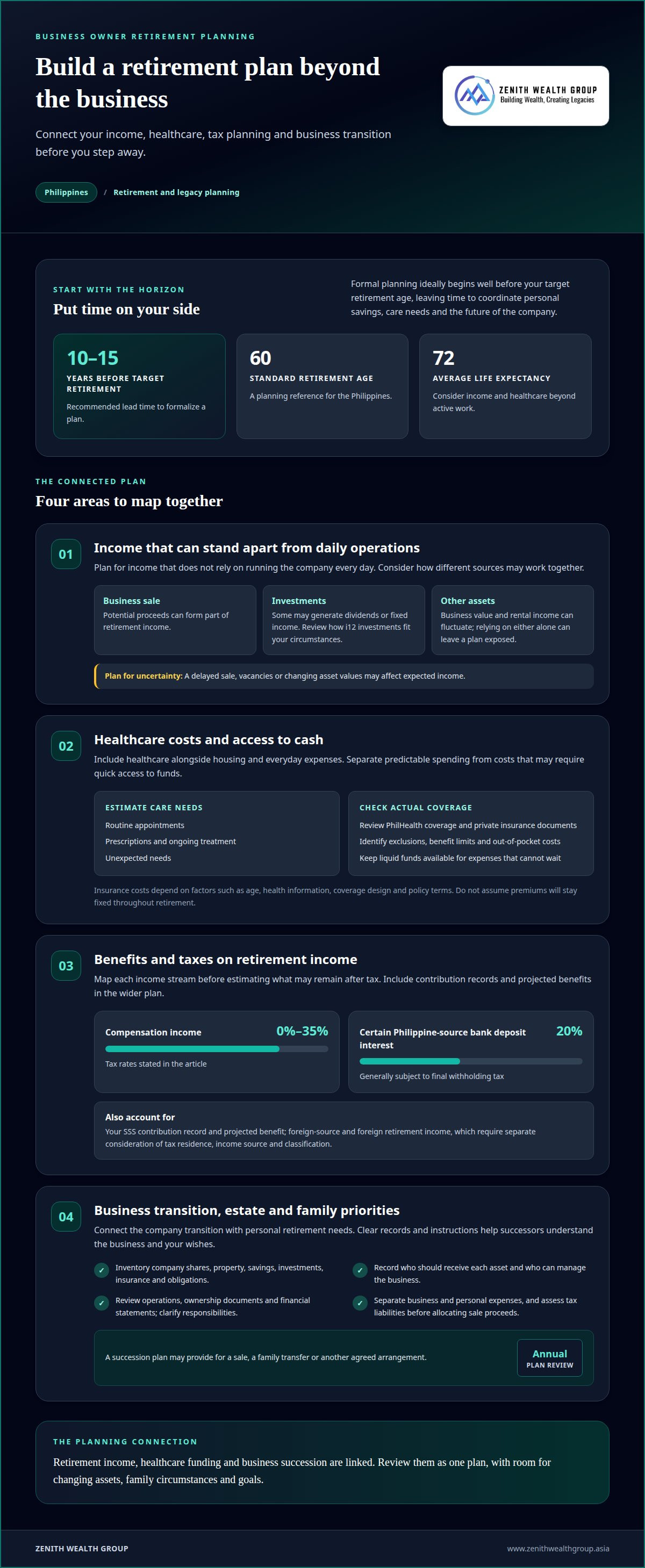
Your business may be your biggest asset, but it isn’t automatically a retirement plan. For business owners in the Philippines, retirement strategies should take shape well before stepping away: formal planning ideally begins 10 to 15 years before your target retirement age. That gives you time to consider how personal savings, healthcare needs and the future of the business fit together.
It’s easy to focus on growing your company and put retirement decisions off. But planning also means deciding how your wealth will support you when you stop working and how it may pass to the next generation. Those choices are closely connected.
This guide explains when to formalize a plan, how to prepare for healthcare expenses, and what to consider when transferring or succeeding a business. You’ll also see how retirement and legacy planning can work together, helping you shape next steps for life after business and the future of what you’ve built.
Key Takeaways
- Start formal retirement planning well before stepping away, and build income that can support you without relying on daily business operations.
- Include healthcare needs in your retirement outlook so they’re considered alongside savings and other expenses.
- Plan how business wealth could be transferred or the company succeeded, with your legacy goals in view.
- Review savings options and how investments, including i12 investments, fit into a retirement plan suited to your circumstances.
When is the best time to start formal retirement planning in the Philippines?
Start formal planning 10 to 15 years before your target retirement age. The Philippines’ standard retirement age is 60 years, while average life expectancy is 72 years. That gap makes it important to plan for income beyond the years you actively run your company. Include expected medical and travel spending when setting your retirement income target.
Build retirement income that doesn’t depend on daily operations. Your plan might combine proceeds from a business sale with investments that may generate dividends or fixed income. Business value and rental income can fluctuate, so relying on either alone may leave your plan exposed to a delayed sale, vacancies or changing asset values.
How can a financial planner compare Pag-IBIG MP2 with private retirement plans for Filipino business owners? They can compare each option’s investment approach, access terms, risks and role in your overall income plan. The right comparison considers when you may need funds and how each option fits alongside other investments.
How do SSS contributions and retirement benefits work for self-employed business owners in the Philippines? Include your contribution record and projected benefit in your plan, then assess how much additional income your business and investments need to provide.
Tax planning matters too. Compensation income in the Philippines is taxed at rates ranging from 0% to 35%, while certain Philippine-source bank deposit interest is generally subject to a 20% final withholding tax. Foreign-source income and foreign retirement income require separate consideration of tax residence, income source and classification. Map each income stream before estimating after-tax retirement income.
How can a financial planner help with succession and diversification? They can help assess operations, strengthen transparent financial records and plan a company transition or sale. How can they build a diversified retirement plan? They can align business assets with investments across risk levels. That can also clarify the risks of depending on company value or rental income alone.
Planning for healthcare expenses
Healthcare planning belongs in a Filipino business owner’s retirement plan, alongside housing and everyday expenses. Start with a clear estimate of the care and lifestyle you want to fund, including routine appointments, prescriptions, ongoing treatment and unexpected needs. The Philippines’ average life expectancy is 72 years, so healthcare costs deserve attention across a potentially lengthy retirement. A plan should distinguish predictable expenses from costs that could require quick access to cash.
Map healthcare access before deciding how to fund it. Review your PhilHealth coverage and private insurance documents, separating covered services, exclusions, benefit limits and out-of-pocket costs. Terms vary by policy, so base your plan on the actual documents rather than assuming every treatment is covered. If a policy excludes a service, for example, account for that expense through other available resources in your retirement forecast.
Insurance costs depend on factors such as age, health information, coverage design and policy terms. Don’t assume a current premium will stay fixed throughout retirement. Model how premiums and care needs could affect your income over time, while keeping enough liquid funds for expenses that cannot wait for an investment sale. This helps balance protection with other goals, such as travel or family support.
Protection also means avoiding overreliance on business assets. If a medical bill requires a fast payment, selling a business asset or delaying a purchase can disrupt the retirement plan. A financial planner can coordinate insurance, accessible accounts and investment assets, then show how each supports healthcare funding. Keep policy details and beneficiary registration information aligned with the wider estate plan. For help shaping a healthcare funding plan, connect this review with your broader retirement planning.
Estate planning and wealth transfer
An estate plan connects your personal assets, business ownership and family priorities. Inventory company shares, property, savings, investment accounts, insurance and outstanding obligations. Then record who should receive each asset and who can manage the business if you step back. Clear instructions help relatives understand how retirement income and company responsibilities fit together, rather than relying on informal arrangements.
For a sale or transfer, tax outcomes depend on the transaction structure, assets involved, seller’s tax residence and classification of the proceeds. Map these details before signing, and assess the likely tax treatment alongside the proposed terms. Tax obligations can affect the funds available for retirement, so include estimated liabilities when planning how sale proceeds will cover future expenses.
Prepare the business for transition with reliable records. Review operations, growth opportunities, ownership documents and financial statements, then resolve unclear responsibilities between family members or co-owners. A prospective buyer or successor needs a clear picture of the company’s finances and obligations. Separating business and personal expenses, for example, helps show which assets belong to the company and which form part of your personal estate.
Keep your plan current. An annual review can account for changes in family circumstances, ownership, assets and retirement goals. Ensure the people named to carry out your wishes understand their roles, and store key documents where they can be found. A succession plan need not assume that an heir wants to run the company. It can instead provide for a sale, transfer to a family member or another agreed arrangement.
For a Filipino business owner, estate planning should connect the company transition with personal retirement needs. Set aside expected tax liabilities before allocating proceeds to retirement income, family support or other goals. Clear records and coordinated instructions give successors a practical starting point while helping protect the wealth intended for your next stage.
What retirement plans and savings options are available to business owners in the Philippines?
Build retirement savings by setting aside part of your income regularly. Automated transfers can help maintain contributions when company cash flow varies. Keep personal retirement accounts separate from operating funds, so business expenses don’t quietly consume money intended for later. A financial planner can map these contributions against expected retirement income and the timing of future business decisions.
The Personal Equity and Retirement Account (PERA) programme offers a tax credit equal to five percent of annual contributions. PERA account holders can withdraw investments tax-free once they reach 55 years old. A planner can compare PERA with private retirement plans by reviewing contribution patterns, access terms, investment choices and how each supports your goals. These details help clarify whether an option suits funds you may need sooner or savings intended for retirement.
Social Security System (SSS) benefits can form one part of a wider plan, but business owners should consider how their contribution record relates to expected benefits. Republic Act Nos. 4917 and 7641 established a corporate pension system for the private sector. Employers aren’t required to establish a corporate retirement fund, and small businesses may use pay-as-you-go arrangements for employees’ retirement pay. Review any existing company commitments before allocating cash to your own retirement savings.
For investments, match risk and access to your time horizon rather than relying on one asset or income stream. A diversified portfolio can include high-, middle- and low-risk investments, with choices such as mutual funds or real estate. A planner can assess how i12 investments and other holdings fit your objectives, liquidity needs and tolerance for market changes. Regular reviews help keep the strategy aligned as business income and retirement timing change.
To connect savings, PERA, SSS and investment choices in one plan, discuss your retirement planning.
Zenith Wealth: Retirement Planning
Zenith Wealth helps business owners connect retirement planning with business succession, education funding and wealth protection. Its financial planning services can bring your personal retirement goals and your business’s future into one clear plan. This helps you consider how savings, investments and a potential business transition fit together without treating company value as your only source of retirement income.
As your circumstances change, revisit the plan so it continues to reflect your priorities, family needs and intended timing for stepping back. For a conversation about planning your next steps, contact Zenith Wealth.
Make your next decision part of the plan
Your next step doesn’t need to be a major business decision. Start by defining what you want life after ownership to look like. Retirement strategies for business owners in the Philippines work best when they connect that future with today’s business and personal priorities, while allowing those priorities to evolve.
Zenith Wealth’s Retirement Planning, Education Funding and Wealth Protection services can help you bring your goals together. A financial planner can shape retirement strategies for business owners in the Philippines around your family’s needs and the role you want your business to play in your next stage of life.
Take the next step at your own pace. Contact Zenith Wealth to discuss planning and start shaping a future that feels aligned with your goals.
Frequently Asked Questions
Who Needs Business Retirement Services?
Business owners whose future income depends heavily on company earnings can benefit from retirement planning, particularly if they expect to reduce their workload, sell or pass the business to family. Planning also helps when personal savings and company finances are closely connected. For example, a family business owner can map personal retirement goals separately from the funds needed to keep the company operating.
What happens to my retirement fund if the Philippine market is volatile?
Market volatility can change investment values, but the effect depends on what a fund holds and when you need to withdraw. A financial planner can assess your time horizon, income needs and investment mix, then consider whether adjustments fit your goals. Funds needed soon, for example, may need a different role from long-term investments. Avoid rushing into a decision based only on short-term market movements.
What are the tax rules for retirement savings, pensions, and insurance in the Philippines?
Tax treatment depends on the income or account type. PERA contributions receive a tax credit equal to five percent of annual contributions, and qualifying account withdrawals are tax-free at age 55. Compensation income is taxed at rates from 0% to 35%, while certain Philippine-source bank deposit interest is generally subject to a 20% final withholding tax. Insurance taxation depends on the policy and proceeds involved.
How can a financial planner help a business owner estimate retirement income needs and calculate a savings target?
A financial planner can estimate retirement income needs by reviewing expected living costs, healthcare needs, other income sources and the timing of your business exit. They can compare projected income with available savings and investments to identify a funding gap. Separating household spending from company expenses, for instance, can make your target clearer and easier to review as circumstances change.
What retirement investment options are available in the Philippines, including UITFs, mutual funds, stocks, and bonds?
Business owners may consider UITFs, mutual funds, stocks and bonds as part of a retirement portfolio. These options differ in structure, investment exposure and potential price movement, so assess each against your timeline and cash needs. A financial planner can explain how they fit together and whether the overall mix spreads risk across different investments. Don’t treat a single investment category as a complete retirement plan.


