

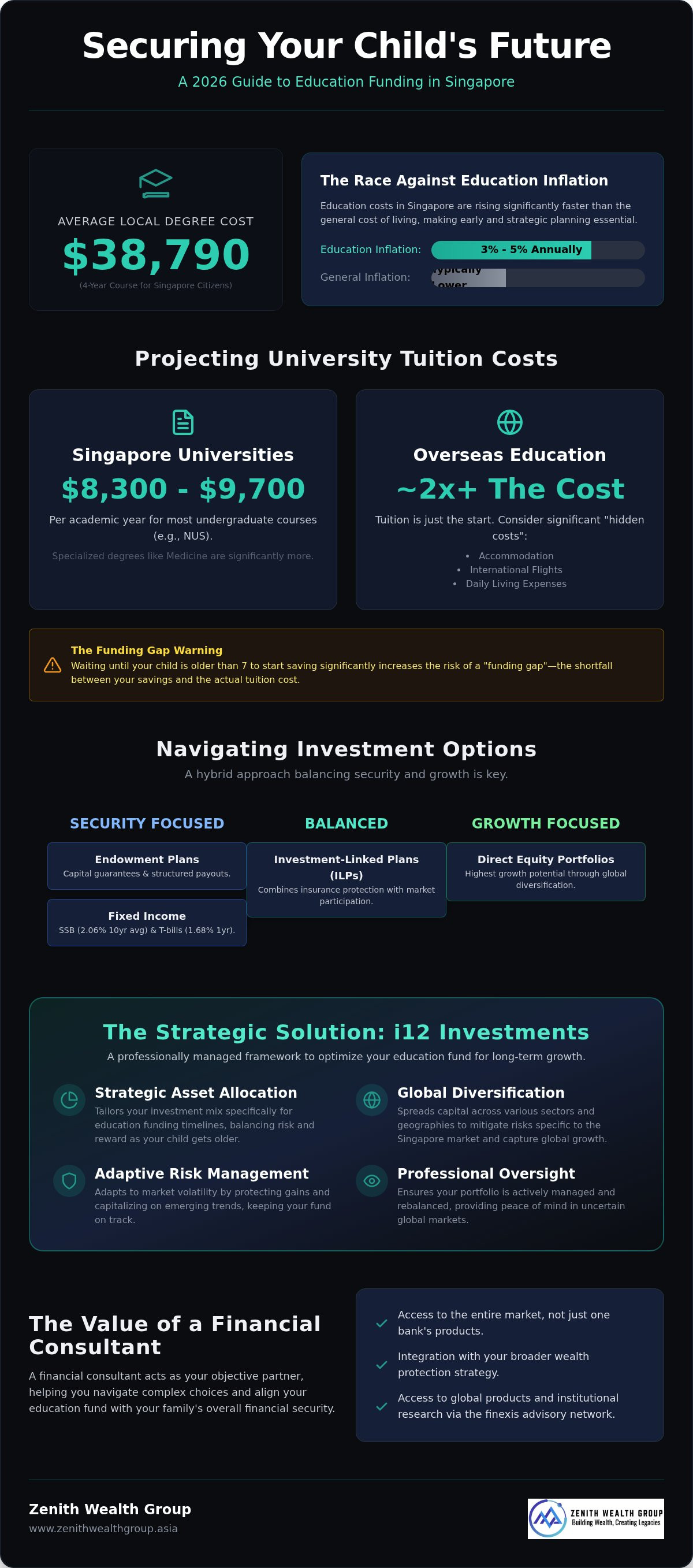
Did you know that a standard four-year degree at a local university now costs a Singapore Citizen an average of $38,790 in tuition fees? If you're a parent, you've likely noticed that education inflation is moving much faster than the general cost of living. It's natural to feel concerned about whether your current savings will be enough. You might be torn between the guaranteed safety of endowment plans and the higher growth potential of direct market exposure. Finding the right investment options for child education fund Singapore doesn't have to be a guessing game.
We believe in a hybrid approach that provides both security and performance. This 2026 guide reveals how to use i12 investments and other strategic tools to outpace rising costs. You'll learn the pros and cons of different products, from T-bills with yields around 1.68% to diversified growth portfolios. We'll provide a clear roadmap so you can stop worrying about market volatility. By the end, you'll understand how a financial planner can help you secure the peace of mind you deserve. Let's start building that future today.
Key Takeaways
- Understand why education inflation in Singapore outpaces the general economy and how to set a realistic, inflation-adjusted target for 2026.
- Explore the most effective investment options for child education fund Singapore, ranging from guaranteed endowment plans to high-growth i12 investments.
- Compare the risk-reward profiles of traditional insurance products versus managed portfolios to find the right balance for your family's timeline.
- Discover how to optimize your cash flow and CPF availability to build a robust fund without compromising your own retirement security.
- Learn how a financial planner can provide human-centric advice and access to global products through the finexis advisory network.
What is a Child Education Fund and Why Do You Need One in 2026?
A child education fund is a dedicated, tax-efficient pool of capital built specifically for tertiary education expenses. It's not just a standard savings account. It's a strategic tool designed to ensure your child has the resources they need for university without draining your personal savings. In 2026, the reality of rising costs makes this essential. Education inflation in Singapore typically hits between 3% and 5% annually. This rate consistently outpaces general inflation. Without a focused plan, the cost of a degree could be significantly higher by the time your child is ready to enroll.
Many parents assume they can simply rely on their CPF Ordinary Account (OA). While the CPF Education Loan Scheme exists, it comes with a high opportunity cost. Using these funds means your retirement savings aren't growing at their full potential. The student must also repay the loan with interest after graduation. It's a debt burden rather than a head start. By exploring various investment options for child education fund Singapore, you can protect your retirement while providing a gift for your child's future. Segregating these funds also offers a psychological benefit. It creates a disciplined boundary that prevents you from dipping into the education pot for other needs.
Projecting Tuition Costs: Singapore vs. Overseas
For the 2026/2027 academic year, tuition for Singapore Citizens at NUS ranges from $8,300 to $9,700 for most undergraduate courses. Specialized degrees like Medicine or Law are even more expensive. If you consider overseas education, the financial commitment grows. You must account for "hidden costs" like accommodation, international flights, and daily living expenses. These can easily double the total cost of the degree. If you wait until your child is older than 7 to start saving, you will likely face a "funding gap." This is the shortfall between your accumulated savings and the actual cost of tuition, which becomes much harder to close as the timeline shrinks.
The Role of a Financial Consultant in Education Planning
A financial consultant serves as an objective partner in your planning journey. Unlike agents tied to a single bank, a consultant can look at the whole market to find the best fit for your family. They help align your education goals with your broader wealth protection strategy. This ensures that your family remains financially secure even if life takes an unexpected turn. Through the finexis advisory network, the team at Zenith Wealth gains access to global product providers and institutional-grade research. This includes sophisticated strategies like i12 investments that focus on long-term growth. Often, an Endowment policy forms the foundation of these plans, providing the structure needed to hit your targets. We are ready to help you navigate these choices with clarity.
Top Investment Options for Child Education Fund Singapore
Selecting the right mix of products is the most critical step in your planning journey. There isn't a one-size-fits-all solution for every family. Traditional endowment plans remain a popular choice for their structured payouts and capital guarantees. These plans offer a sense of certainty that the money will be there when the first semester's bill arrives. While you build your private fund, your child's Edusave Account provides a helpful baseline for primary and secondary school expenses. For the tertiary stage, however, you need more robust investment options for child education fund Singapore to keep pace with rising costs.
Investment-Linked Insurance Plans (ILPs) offer a middle ground by combining protection with the ability to participate in market gains. If you have a longer time horizon, direct equity portfolios provide the highest potential for growth through global diversification. However, managing these individual components can be complex for busy parents. This is where professional management through the i12 investments framework becomes invaluable. It optimizes your asset allocation to ensure you aren't taking unnecessary risks as your child approaches university age. This framework bridges the gap between simple savings and sophisticated wealth management.
Understanding i12 investments for Long-Term Growth
The i12 investments methodology focuses on strategic asset allocation tailored specifically for education timelines. It diversifies your capital across various sectors and geographies. This approach mitigates risks specific to the Singapore market while capturing global growth opportunities. In a year defined by shifting economic signals, i12 investments adapts to 2026 market volatility by proactively rebalancing portfolios to protect gains and capitalize on emerging trends. This professional oversight ensures your fund remains on track even when global headlines are uncertain.
Fixed Income and Bonds in a Shifting Interest Rate Environment
Fixed income remains a vital component for risk management, especially as you get closer to your target date. In 2026, we've seen a shifting interest rate environment influenced by global Fed rate adjustments. The August 2026 issue of Singapore Savings Bonds (SSB) offered a 10-year average return of 2.06%, while the 1-year T-bill yield sat at 1.68% in July 2026. These government-backed options provide safety, but their declining yields mean they may not beat education inflation alone. High-quality corporate bonds and money market funds can offer slightly better returns for short-term tuition needs. A skilled financial planner can help you determine the right ratio of fixed income to growth assets for your specific goals.
Comparing Strategies: Endowments vs. Managed Portfolios
Choosing the right path often comes down to your personal comfort with market movement. In 2026, the landscape of investment options for child education fund Singapore has evolved. You're no longer limited to a simple binary choice. You can now blend the "floor" of an endowment with the "ceiling" of a managed portfolio. Endowments offer a guaranteed return, such as the 1.44% p.a. maturity yield seen in specific 2026 short-term plans. Managed portfolios, however, aim to capture the market-driven upside that historically outpaces inflation. This is a choice between certainty and growth potential.
Liquidity is another major differentiator. Endowments usually require a 10 to 15-year commitment. If you withdraw early, you might lose part of your capital. Managed portfolios offer flexible withdrawals, which is helpful if your child's plans change. On the cost side, managed portfolios typically charge 0.2% to 0.8% in annual management fees. Insurance-based plans wrap their costs into premiums but include a critical safety net: the "Waiver of Premium" benefit. This ensures the fund keeps growing even if the breadwinner can no longer contribute due to illness or disability. This protection element is something that standard investment platforms simply don't provide.
When to Choose an Education Endowment Plan
This strategy is best for risk-averse parents with a fixed 10 to 15-year horizon. Modern products often include "cashback" features. These allow you to receive annual payouts or reinvest them for higher potential returns. When you sit down with a financial consultant, focus on the Benefit Illustration (BI). Look at the "guaranteed" versus "non-guaranteed" columns. This clarity helps you understand the absolute minimum your child will receive at graduation. It's about securing a baseline you can count on regardless of market conditions.
The Case for Managed Investment Portfolios
If you are starting your journey while your child is still in diapers, you have time to weather market cycles. Leveraging professional investment management is often the most effective way to outpace education inflation. Within the i12 investments framework, your portfolio is actively monitored to capture growth while managing downside risk. This approach also provides the flexibility to pivot. If your child receives a full scholarship or chooses a different path, the funds remain accessible for your own retirement or legacy planning. You aren't locked into a single outcome.
Practical Steps to Build Your Child's Education Fund
Building a fund is a marathon, not a sprint. You need a structured approach to ensure you reach the finish line. Start by calculating a specific target. While we looked at the baseline tuition figures earlier, you must adjust these for the 3% to 5% annual inflation expected by 2026. Once you have a final number, assess your current cash flow. Don't overlook government incentives like the CDA matching caps, which reach up to $4,000 for your first child, or the $5,000 First Step Grant. These are essential building blocks for your investment options for child education fund Singapore.
We recommend a core-satellite approach to manage risk. Use a guaranteed endowment plan as your core to secure a baseline for tuition. Then, add i12 investments as a satellite to capture market growth and outpace rising costs. This balance protects your downside while giving your capital room to run. Automate your contributions through a monthly transfer. This allows you to benefit from Dollar Cost Averaging (DCA), which smooths out market entry prices over time. Finally, schedule an annual review to rebalance your portfolio as your child gets closer to university age.
The 'Age-Based' Allocation Strategy
Your strategy should evolve as your child grows. From birth to age 6, you're in the aggressive growth phase. Focus on global equities to maximize the power of compounding. Between ages 7 and 12, move into a balanced phase by introducing more fixed-income assets. From ages 13 to 18, shift to the preservation phase. Move your funds into liquid, low-volatility options. This ensures the cash is ready when the first semester's bill arrives.
Involving the Family: Ang Bao and Savings
Small contributions add up over 18 years. Consider funnelling "Ang Bao" money or birthday gifts into the investment fund. It's also a great opportunity to build financial literacy. Talk to your children about how their fund is growing to teach them the value of long-term planning. If you want a strategy tailored to your family's unique needs, contact a Zenith Wealth financial planner for a personalized roadmap. We'll help you integrate every available resource into a single, cohesive plan.
How Zenith Wealth Secures Your Child's Future
Zenith Wealth isn't just about managing numbers. We focus on human-centric advice. We back every recommendation with institutional-grade research. As authorized representatives of finexis advisory, we offer a distinct advantage. You gain access to a massive range of global product providers. This ensures your investment options for child education fund Singapore aren't limited to a single bank's shelf. We look at the big picture for your family. We link your education goals with legacy planning. This ensures your wealth protects your family for generations to come. We are your long-term partners. We grow as your child grows.
Our approach integrates sophisticated strategies like i12 investments into a holistic framework. We don't just pick products. We build resilient structures. This partnership involves regular check-ins and proactive adjustments. We stay ahead of shifting regulations and market trends so you don't have to. You get the peace of mind that comes from professional oversight. Your child's future is too important for a "set and forget" mentality. We are here to navigate the journey with you.
Customized Education Roadmaps
We move beyond generic online calculators. We perform deep personal cash flow analysis. Our team stress-tests your plan against various 2026 economic scenarios. This includes potential market shifts or sudden changes in tuition trends. We want to ensure your plan holds up under pressure. Zenith Wealth is fully committed to absolute transparency in all our fee structures. You'll always know exactly how your capital is working for you. There are no hidden costs or complex jargon here.
Start Your Journey Today
Time is your greatest asset in education planning. Delaying your plan by just two years can significantly increase your required monthly savings. Don't let inertia shrink your child's opportunities. We offer a complimentary initial consultation specifically for young parents. It's a chance to explore how i12 investments can fit into your life. You'll walk away with a clearer understanding of your path forward. Schedule a chat with a Zenith Wealth financial consultant. Let's start building that robust education fund together.
Build a Legacy of Opportunity
Education inflation in Singapore is a reality, but it doesn't have to be a barrier to your child's dreams. You now have a clear understanding of how to balance guaranteed returns with the growth potential of i12 investments. By starting early and using the core-satellite strategy we discussed, you can bridge the funding gap without sacrificing your own retirement. It's about creating a disciplined path that evolves as your child grows. This roadmap ensures that when the time comes, the focus remains on their potential rather than the price tag.
Choosing the right investment options for child education fund Singapore is easier with a partner who understands the 2026 landscape. As authorized representatives of finexis advisory, we specialize in generational wealth and education funding. Our team provides professional advice tailored to your family's unique goals, moving beyond generic products to find what truly works for you. We are ready to help you navigate these choices with quiet confidence and clarity.
Secure your child's future with a tailored education plan from Zenith Wealth.
Your child's future begins with the steps you take today. Let's make sure they're the right ones.
Frequently Asked Questions
Is it better to use CPF or cash for my child's education fund?
Using cash is generally better because the CPF Education Loan Scheme is a loan that your child must eventually repay with interest. Interest is pegged to the Ordinary Account rate, currently 2.5% per annum, and it starts accruing the moment funds are withdrawn. By using cash for investment options for child education fund Singapore, you avoid saddling your child with debt and keep your own retirement savings growing at their full potential.
How much should I save monthly for a university fund in Singapore?
The amount depends on your child's age and your target university. For a local degree costing roughly $38,790 today, a parent starting at birth might need to save approximately $150 to $250 monthly, assuming a moderate return. If you start when your child is ten, that monthly requirement could easily triple. A financial planner can help you run a precise cash flow analysis based on 2026 inflation-adjusted costs.
What happens to the education fund if my child gets a scholarship?
Your capital remains yours to reallocate if your child secures a scholarship. You can repurpose the funds for their postgraduate studies, a first home downpayment, or even your own retirement planning. Managed portfolios and i12 investments offer the flexibility to pivot your strategy without the rigid constraints found in some traditional education policies. It's a great way to ensure your family's wealth continues to work for you.
Can I use an SRS account to save for my child's education?
You can use SRS funds, but it's rarely the most efficient choice for education. Withdrawing SRS funds before the statutory retirement age usually triggers a 5% penalty and makes the full withdrawal amount taxable. It's better to treat SRS as a dedicated retirement tool and use specific education products for tertiary costs. This approach keeps your tax benefits secure while ensuring your child's tuition is covered through more flexible channels.
Are education endowment plans still worth it in 2026?
Yes, endowment plans remain worth it for parents who prioritize a guaranteed "floor" for their savings. While yields for short-term plans in 2026 range from 1.44% to 2.00% p.a., the primary value is the capital guarantee and the structured payout. They work best as a core component of a investment options for child education fund Singapore strategy, providing certainty alongside the higher growth potential of market-driven investments.
What is the impact of US trade policies on my child's investment portfolio?
US trade policies can create market volatility that affects global equity prices. Because many Singaporean education funds invest in international markets, these shifts can impact your fund's short-term value. This is why professional management is vital. A framework like i12 investments helps mitigate these risks through broad geographical diversification. This ensures your portfolio isn't overly exposed to the policy shifts or economic fluctuations of any single nation.
How does i12 investments differ from a standard unit trust?
The i12 investments framework is a strategic methodology, not just a single product like a unit trust. While a unit trust is a pool of money managed by a fund manager, i12 investments focuses on institutional-grade research and active asset allocation across multiple sectors. It provides a more holistic approach to managing risk and growth. This ensures your education fund stays aligned with your specific timeline and risk tolerance.
Should I buy an ILP for my child's education or just invest in ETFs?
The choice depends on whether you need a safety net. ETFs are cost-effective for pure growth but don't offer protection. An Investment-Linked Policy (ILP) includes a "Waiver of Premium" benefit, which ensures the fund continues if the parent can no longer contribute due to unforeseen events. A financial consultant can help you decide if the added security of an ILP outweighs the lower fees of an ETF for your family.


