

Did you know the U.S. held a massive $33.28 billion trade surplus with Singapore in 2025? This single figure does more than fill a government spreadsheet; it dictates the liquidity and pulse of your local stock portfolio. It's understandable if you feel anxious when a headline about the U.S. Federal Funds Rate, currently holding at 3.75%, causes your Singapore REITs to fluctuate. You want your retirement to feel secure, not like a gamble on overseas news you can't control.
This analysis will help you master the impact of US economy on Singapore investments so you can protect your long-term goals. We'll explain why the U.S. trade balance is your primary barometer for 2026 and how the new Nasdaq-SGX dual-listing laws change the game for local investors. You'll also see how a financial planner uses i12 investments to remove emotion from the equation. Let's turn that market noise into a clear, actionable strategy for your retirement planning and wealth protection.
Key Takeaways
- Understand why the U.S. trade balance serves as a vital indicator for market liquidity and global demand affecting your local stocks.
- Identify how U.S. interest rate trends act as the primary driver for S-REIT performance and dividend stability in 2026.
- Learn how to navigate the impact of US economy on Singapore investments using the objective, rule-based strategies of i12 investments.
- Discover the benefits of working with a financial consultant to translate complex global shifts into a secure strategy for retirement planning and wealth protection.
Why the US Trade Balance Matters to Your Singapore Portfolio
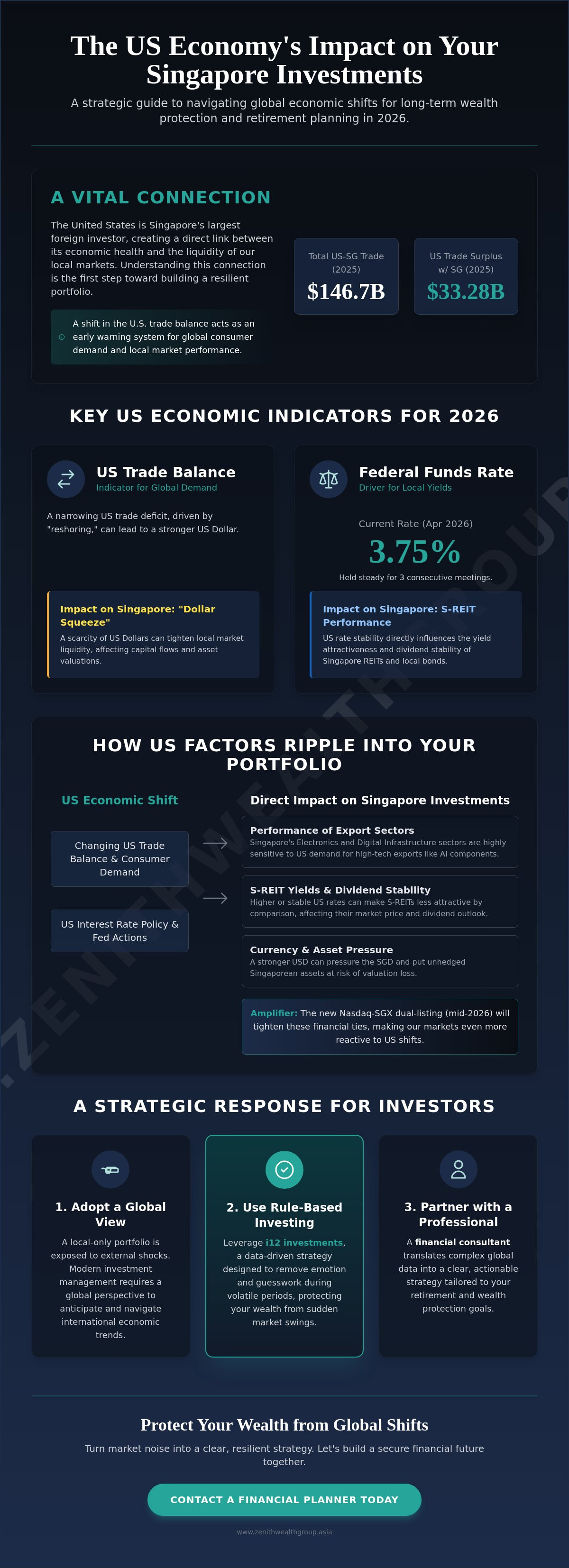
The United States isn't just a distant superpower. It's Singapore's largest foreign investor. Their economic health directly translates to the liquidity in our local markets. When the U.S. consumer buys more, Singaporean manufacturing exports usually surge. This direct link makes the impact of US economy on Singapore investments impossible to ignore for any serious local investor. In 2025, total trade between the two nations reached $146.7 billion. This massive scale means a shift in the U.S. trade balance acts as an early warning system for global consumer demand.
2026 represents a pivotal moment for your wealth. With the new dual-listing arrangement between SGX and Nasdaq coming into force mid-year, our financial ties are tightening. We're moving toward a harmonized set of rules that will make our markets even more reactive to U.S. economic shifts. Singapore's electronics and digital infrastructure sectors are particularly sensitive to these changes. As global demand for AI continues to grow, the U.S. appetite for our high-tech exports will determine the earnings of many SGX-listed firms. Understanding this "butterfly effect" is the first step toward securing your retirement.
The Interconnectedness of Global Markets
Capital flows from Wall Street to Raffles Place in real-time. A shifting U.S. trade balance often dictates the strength of the U.S. Dollar. While the Monetary Authority of Singapore (MAS) manages our currency against a basket of others to buffer volatility, we aren't immune. Strong Singapore-U.S. relations ensure a steady flow of goods. However, a widening trade gap can pressure the exchange rate. As of March 2026, the U.S. maintained a positive trade balance of $2.3 billion with Singapore. This data point is a signal. It tells us how much capital is moving across borders and where the next wave of liquidity might land.
Investment Management in a Globalized Era
Relying on a local-only portfolio is increasingly risky. It leaves you exposed to external shocks that you might not be monitoring. Modern investment management requires a wider perspective. You must track U.S. indicators, like the 3.75% Federal Funds Rate, to forecast the impact of US economy on Singapore investments. When U.S. rates hold steady, it changes the yield attractiveness of local bonds and REITs.
This complexity is why many turn to i12 investments. It's a rule-based approach designed to take the guesswork out of volatile periods. By focusing on data rather than fear, you can protect your wealth from sudden trade-related swings. A dedicated financial consultant can help you bridge this gap. They translate complex U.S. data into actionable steps for your local portfolio. It's about being proactive rather than reacting to every news alert.
Decoding the US Trade Balance: A Trend Analysis for 2026
The U.S. trade balance is the simple difference between what the country sells to the world and what it buys. In 2026, we're seeing a strategic shift as the U.S. prioritizes domestic production over global outsourcing. This trend toward "reshoring" reduces the U.S. trade deficit. While this might look like a domestic win for America, it creates a ripple effect across the globe. When the U.S. buys less from international partners, it reduces the global supply of U.S. Dollars. For investors in Southeast Asia, this often leads to a "dollar squeeze." This scarcity of greenbacks can tighten local liquidity and significantly change the impact of US economy on Singapore investments.
The scale of this relationship is massive. In 2025, the U.S. maintained a trade surplus of $33.28 billion with Singapore. This means Singapore is a critical destination for U.S. goods and services. However, as U.S. policies continue to favor domestic manufacturing, the flow of capital is changing. You need to watch these shifts closely. A narrowing U.S. deficit often signals a stronger U.S. Dollar, which can put pressure on Singaporean assets that aren't properly hedged. It's a complex dynamic that directly affects your wealth protection goals.
Deficit vs. Surplus: What Investors Need to Watch
Headlines about trade gaps often trigger emotional reactions in the market. You shouldn't let the noise distract you. The trade balance is a key input for the Federal Reserve. Currently, the Federal Funds Rate sits at 3.75% as of April 2026. The Fed has held this rate steady for three meetings, watching how trade data influences domestic growth. If you're monitoring the Fed rate cut cycles, you must also track the U.S. trade data with Singapore. A sudden drop in the U.S. deficit could give the Fed more room to keep rates higher for longer, which impacts local REIT yields.
US Trade Balance and Inflationary Pressures
Inflation doesn't stay within borders. When the U.S. moves production home, the cost of goods often rises. These higher prices are eventually "exported" to Singapore, affecting everything from your grocery bill to business overheads. This inflationary pressure can eat away at your retirement savings if your portfolio is stagnant. To stay ahead, many are utilizing the rule-based strategies of i12 investments. This approach helps remove the guesswork from your investment management, ensuring your capital stays productive even when trade trends shift. If you're concerned about how these global trends might affect your personal timeline, a quick chat with a financial consultant can help you realign your strategy for 2026.
How US Economic Shifts Ripple Through Singaporean Asset Classes
U.S. interest rates are the gravity that keeps Singaporean asset classes in orbit. With the U.S. Federal Funds Rate currently holding at 3.75%, the cost of capital remains a primary concern for local investors. This benchmark doesn't just affect Wall Street; it sets the tone for Singapore Government Securities (SGS) and corporate lending rates here at home. When we analyze the impact of US economy on Singapore investments, we see a clear chain reaction. U.S. Treasury yields rise, SGS yields follow, and suddenly, the "risk-free" rate in Singapore shifts, repricing everything from bonds to private property.
Export-oriented equities on the SGX are equally sensitive. Companies in the electronics and manufacturing sectors rely on a healthy U.S. consumer. If U.S. trade policy shifts toward protectionism, these firms face immediate headwinds. This is why the U.S. Department of State's 2025 Investment Climate Statement on Singapore highlights our nation as a regional hub for U.S. firms. Our stability attracts capital, but our openness means we're the first to feel a chill when the U.S. economy cools. Even our private property market reacts, as global economic confidence often dictates the appetite of foreign buyers for high-end Singaporean real estate.
The Sensitivity of Singapore REITs
REITs are the cornerstone of many local retirement plans, but they're currently in a tug-of-war. The yield spread between U.S. bonds and S-REITs has narrowed. With U.S. 30-year fixed mortgage rates averaging 6.53%, the global cost of debt is high. This pressures the distributable income of industrial and commercial REITs. However, the surge in Singapore's commercial real estate transaction volume to US$7.9 billion in Q1 2026 shows that institutional capital still sees value here. Strategic income-seekers are now looking at i12 investments to find a rule-based path through this volatility, ensuring their yield isn't swallowed by rising debt costs.
Impact on the Singapore Dollar and Cash Holdings
Your cash savings aren't a safe harbor if they're stagnant. Currently, Singapore fixed deposit rates are hovering between 1.00% and 1.60%. Compare that to the U.S. prime loan rate of 6.75%. If the U.S. economy outpaces our local growth, the Singapore Dollar can face depreciation pressure as capital flows toward higher yields. The MAS often intervenes to maintain stability, but you shouldn't rely on policy alone. Working with a financial consultant singapore can help you optimize your currency exposure. They can show you how to use i12 investments to maintain purchasing power, ensuring your retirement fund grows faster than inflation "exported" from U.S. shores.
Navigating Volatility: Strategic Asset Allocation with i12 Investments
Market swings are exhausting. You see headlines about U.S. trade probes or the Federal Reserve holding rates at 3.75%, and it's tempting to jump ship. However, reacting to every news alert is a quick way to erode your long-term returns. i12 investments offers a different path. It's a rule-based framework designed to remove the emotional weight of global headlines. By using a dual-strategy approach, you can stay proactive rather than reactive. This structure is specifically built to handle the impact of US economy on Singapore investments without the stress of constant manual rebalancing.
The i12 framework utilizes two main strategies: the Wealth Accumulation Plan (WAP) and the Tactical Opportunities Plan (TOP). The WAP focuses on your long-term growth, providing a steady foundation for retirement planning. Meanwhile, the TOP allows for adjustments based on short-term market movements. This balance is vital in 2026. As U.S. trade balances fluctuate, this system identifies where liquidity is flowing. It helps you stay invested in high-conviction areas while protecting your core capital from sudden downturns.
Resilience Through Diversification
The traditional 60/40 portfolio is no longer the gold standard in 2026. Modern markets move too fast for static allocations. i12 investments helps you move beyond basic diversification by identifying undervalued sectors during U.S. market corrections. For example, if U.S. consumer demand dips, the TOP might signal a shift toward Singapore's defensive electronics or digital infrastructure sectors. Incorporating these alternatives helps hedge against trade-related risks. It's about finding growth where others only see volatility. Data-driven decisions always beat gut feelings when global trade is in flux.
Protecting Your Retirement Nest Egg
Your retirement shouldn't be a casualty of a foreign trade war. Solid wealth protection is about staying power. Speculation is for hobbyists; planning is for retirees. i12 investments emphasizes this by prioritizing the preservation of your purchasing power. This is especially important as U.S. inflation can influence local costs. A financial planner can help you review these strategies regularly to ensure they still fit your lifestyle. They bridge the gap between complex U.S. economic data and your personal retirement security. Regular check-ins ensure your strategy remains resilient, even as the impact of US economy on Singapore investments creates new challenges.
Ready to build a more resilient strategy for your future? Connect with a financial planner to explore i12 investments today.
Proactive Planning: How a Financial Consultant Secures Your Future
Don't just watch the news. Use it. There's a massive difference between reacting to a headline and planning for a trend. When you react, you're often too late. When you plan, you're already positioned. A financial consultant helps you bridge this gap by interpreting complex data points like the 3.75% U.S. Federal Funds Rate or shifting trade balances. Understanding the impact of US economy on Singapore investments is only the first step. The real work begins when you translate those macro trends into your personal retirement roadmap.
Your journey is unique. Your retirement timeline shouldn't be a copy of someone else's. Professional guidance ensures that your strategy reflects your specific risk tolerance and family needs. It's about moving beyond general advice to find specific opportunities in a globalized market. By taking this proactive step, you turn economic uncertainty into a structured path for growth. It's the difference between feeling anxious about 2026 and feeling prepared for it.
Personalized Wealth Management
Your financial planner doesn't just look at numbers. They look at your life. They align the rule-based power of i12 investments with your long-term objectives. This ensures your Wealth Accumulation Plan (WAP) stays on track even when U.S. markets are volatile. Strategic advice is essential when you're looking at legacy planning in an unpredictable climate. You want to know that the wealth you build today will actually reach the next generation. A human touch makes all the difference in these high-stakes decisions.
Securing Your 2026 Retirement Goals
Confidence comes from clarity. You can use a cpf retirement payout calculator to stress-test your current plan against different economic scenarios. If the impact of US economy on Singapore investments leads to a period of local inflation, you'll want to know your monthly income remains sufficient. Professional guidance leads to higher emotional and financial confidence because you've accounted for the "what-ifs." It’s time to move from spectator to strategist. Connect with a Zenith Wealth Group financial consultant today to start your conversation.
Take Control of Your 2026 Investment Strategy
The global economy is moving fast. You've seen how the U.S. trade balance acts as a pulse for local liquidity and why U.S. interest rates remain the primary driver for S-REIT performance. Mastering the impact of US economy on Singapore investments isn't about predicting every single headline. It's about building a portfolio that can withstand them. By using the rule-based i12 investments framework, you move away from emotional guesswork and toward data-driven resilience.
Our team serves as authorized representatives of finexis advisory. We are specialists in the i12 investments framework and bring deep expertise in Singapore retirement and legacy planning. We're here to help you translate these global shifts into a secure, personal roadmap. Don't let market noise dictate your future. Start a conversation today to ensure your wealth protection remains robust through 2026 and beyond. We're ready to help you navigate these trends with quiet confidence and clear action.
Secure your retirement with a personalized consultation. We look forward to growing alongside you.
Frequently Asked Questions
How does the US trade balance affect my Singaporean bank interest rates?
Singaporean bank rates are closely tied to global dollar liquidity and the U.S. Federal Funds Rate, which sits at 3.75% as of May 2026. When the U.S. maintains a trade surplus, it often influences the Federal Reserve's decision to hold rates steady. Local banks then adjust their promotional fixed deposit rates, currently ranging from 1.00% to 1.60%, to stay competitive within this global environment.
Will a US trade deficit cause the Singapore Dollar to weaken in 2026?
Not necessarily. A U.S. trade deficit means more U.S. Dollars are flowing into the global market, which can sometimes lead to a stronger Singapore Dollar (SGD). However, the Monetary Authority of Singapore (MAS) manages the SGD against a basket of currencies. This policy helps buffer our local currency from extreme volatility, even when U.S. trade data fluctuates significantly.
Is it better to invest in US stocks or Singapore stocks during a trade war?
Diversification is your best defense. U.S. stocks offer high-growth opportunities in tech, while Singapore stocks provide stability and reliable dividends, especially in the REIT sector. Using a structured framework like i12 investments helps you manage the impact of US economy on Singapore investments by balancing exposure to both markets. This prevents you from being overly dependent on a single country's trade policy.
How do i12 investments help protect my portfolio from US market volatility?
i12 investments use a rule-based approach to remove emotional bias from your strategy. By splitting capital between a long-term Wealth Accumulation Plan and a Tactical Opportunities Plan, the system can react to market signals rather than scary headlines. This helps you navigate the impact of US economy on Singapore investments without the need for constant manual rebalancing or stressful market timing.
Should I change my retirement plan if the US economy enters a recession?
You shouldn't make impulsive changes to a long-term strategy. While a U.S. recession can slow global growth, your retirement planning should be built to weather multiple economic cycles. It's better to consult a financial planner to stress-test your wealth protection measures. They can help you determine if your current asset allocation still aligns with your original retirement timeline and goals.
How often should a financial consultant review my global asset allocation?
You should review your portfolio at least once a year. However, 2026 is a unique year due to the new dual-listing laws between the SGX and Nasdaq. These regulatory shifts might require an interim review with your financial consultant. Regular check-ins ensure that your investment management strategy remains proactive and takes advantage of new market links as they emerge.
Does the US trade balance impact my CPF Life payouts?
There is no direct link between U.S. trade data and your CPF Life payout amounts. Your payouts are determined by your Retirement Account balance and the interest rates set by the Singapore government. However, U.S. economic shifts can influence local inflation. This means that while your payout stays the same, its purchasing power for imported goods could change over time.
What are the best industries in Singapore to invest in when the US economy is strong?
Manufacturing and electronics typically lead the way. When U.S. consumer spending is robust, Singapore's export-oriented companies see a direct boost in orders. Additionally, digital infrastructure and AI-driven sectors are currently seeing high demand. These industries benefit from increased foreign direct investment, as Singapore remains a stable hub for U.S. firms looking to expand in Asia.


