

What if retirement readiness in your 50s is less about reaching one number and more about building a plan that works with the rest of your life? If you’re weighing financial goals for my 50s in Singapore, it’s understandable to wonder whether your savings and CPF arrangements are on track while housing, healthcare and family commitments still need attention.
Your 50s are a time to stress-test your plan, not chase a generic target. This checklist will help you review your priorities, identify possible gaps and choose practical next steps based on your circumstances.
We’ll look at how CPF and CPF LIFE may fit alongside SRS, personal investments and cash reserves, and what to consider as you plan for retirement income. You can also include existing holdings, such as i12 investments, in the wider review rather than assuming any option is right for everyone. Use the checklist to prepare for a clearer conversation with a financial planner or financial consultant about what comes next.
Key Takeaways
- Use the financial goals for my 50s in Singapore checklist to identify your priorities and gaps, rather than measuring yourself against one universal retirement number.
- Review CPF, CPF LIFE, SRS, other investments and cash reserves together, then verify how current rules and your personal circumstances apply.
- Compare retirement-first, protection-first and balanced approaches to see which trade-offs best fit your needs and family commitments.
- Turn your review into practical next steps: gather records, rank priorities, identify gaps and set dates to revisit your plan.
- If several goals compete, consider discussing your plan with a financial consultant. Ask how recommendations are selected, how fees or commissions work, and how holdings such as i12 investments fit into the review.
Financial goals for your 50s in Singapore: start with a clear snapshot
Your 50s may bring several important financial priorities together. You could be thinking about retirement while still managing housing decisions, family commitments or future healthcare needs. Before deciding what to tackle first, take stock of your finances. This checklist helps you identify priorities and possible gaps, but it won’t set one retirement number for everyone. Your next steps depend on your resources, plans and responsibilities.
What should you include in a 50s financial snapshot?
Gather the information you already have, then note anything you still need to confirm. A simple list is enough to begin:
- Assets: cash savings, investments, property interests and relevant insurance details. Include holdings such as i12 investments, but verify their details before relying on them in your planning.
- Debts: outstanding housing loans and other balances, along with repayment commitments.
- Household cash flow: income and regular spending, including ongoing support for family members where relevant.
- Future commitments: planned large expenses, such as education support or a housing change, if they apply to you.
- CPF information: your latest account details and records relevant to retirement planning.
Mark each figure as confirmed, estimated, assumed or intended. A current account balance may be confirmed, while a future income estimate or hoped-for sale price is not. Keeping those differences visible helps you see which decisions depend on information you still need to check.
Which life changes could affect your goals?
Consider how your priorities might shift if you change jobs, work for longer or retire earlier than planned. Think about dependants and possible caregiving responsibilities too. Education support, housing decisions and other family commitments may affect what you can set aside, so include the commitments that apply to your household. Your snapshot should reflect your life, not a template.
Check CPF account information against your latest records and current CPF Board guidance. For background, read this overview of the Central Provident Fund, then confirm personal details and applicable rules through official sources. If you have family, property or financial commitments in Indonesia, Malaysia, the Philippines or Thailand, list them separately and check which local rules may apply. Refresh your snapshot after a major change or at a regular review. With a clearer starting point, you can decide which financial goals for my 50s in Singapore need attention first.
A Singapore retirement checklist: review CPF, CPF LIFE and SRS together
To assess your financial goals for my 50s in Singapore, look at how each resource may support a different need. CPF-related income and SRS have scheme rules to check, while other investments and cash reserves may offer different levels of access and flexibility. Don’t judge any one resource in isolation. Eligibility, balances, payout choices and applicable rules depend on your circumstances, so confirm details through current official sources before making decisions.
| Resource | What to review | Questions to ask |
|---|---|---|
| CPF and CPF LIFE | Current CPF account information and retirement-income estimates | What do my latest records show? Which payout choices and rules apply to me? |
| SRS | Account balance, intended use and relevant withdrawal information | How do current tax and withdrawal rules affect my plans? |
| Other investments | Value, access, time horizon and intended purpose | Could the value fluctuate, and when might I need the money? |
| Cash reserves | Funds readily available for planned or unexpected needs | How much do I want accessible without relying on selling investments? |
How can CPF and CPF LIFE fit into your review?
Start with your own CPF account information, then check current guidance from the CPF Board. CPF LIFE is one Singapore retirement-income consideration, but don’t assume everyone has the same eligibility, payout choices or estimates. Review the options shown for your circumstances and how they may fit alongside other resources. For broader context, read the complete Singapore retirement planning guide.
When should you include SRS and other investments?
Compare each resource by liquidity, time horizon, risk and intended use. Cash may be accessible for near-term needs, while an investment’s value and access conditions can differ. Don’t treat projected returns as certain income. For SRS, check current treatment and withdrawal rules against official information, including the Ministry of Finance’s Supplementary Retirement Scheme (SRS) page. The SRS account strategic guide offers a deeper overview. Record i12 investments with your other holdings, and verify the details before relying on them in your plan.
Think of rule-based income and flexible assets as different parts of the picture, not interchangeable promises. If you want help coordinating these resources with retirement planning, you can discuss a retirement planning review with a financial consultant.
Compare three ways to prioritise financial goals in your 50s
There’s no single order that suits every household. The right approach depends on your retirement readiness, essential spending, family commitments, need for accessible funds and comfort with investment risk. Use this comparison to identify a starting point, not as a product recommendation or a reason to take more risk to “catch up.”
| Approach | May fit when | Potential advantage | Trade-off to consider |
|---|---|---|---|
| Retirement-first | Retirement preparation is the main unmet long-term priority, and near-term needs are accounted for. | Keeps attention on building resources for future income and reviewing when you expect to stop or reduce work. | Putting too much focus on retirement could leave less room for current family needs or accessible reserves. |
| Protection-first | Dependants, health needs or other family responsibilities could put pressure on household finances. | Brings potential financial vulnerabilities into the plan while there’s still time to review them. | Focusing only on protection may delay action on longer-term retirement needs. |
| Balanced | You’re managing several goals at once and want to make progress across them. | Allows retirement, protection and family commitments to be considered together. | Dividing attention and available resources may mean some goals progress more gradually. |
When might a retirement-first approach make sense?
Consider this route if your review shows retirement readiness is the clearest gap and your essential spending and near-term obligations are manageable. Before redirecting savings, account for planned expenses, debt repayments and any support you’ve committed to provide. A shortfall doesn’t automatically mean you need higher-risk investments. Review your timeline, available resources and assumptions first. The CPF Board’s complete guide to retirement planning can help you check CPF-related information against official guidance.
How do protection and family goals change the comparison?
Dependants, health needs, education support or caregiving responsibilities may make protection planning more urgent, but it doesn’t have to replace retirement planning. Look at how each commitment affects cash flow and what resources may be available if circumstances change. If you need a deeper review, see this Singapore wealth protection guide.
Apply the same questions to every asset or commitment, including i12 investments: what role is it intended to play, how accessible is it, and what risks or assumptions need checking? Your answers can help shape financial goals for my 50s in Singapore around your circumstances, rather than a generic target. A financial consultant can help you compare competing priorities. You can discuss retirement and wealth protection planning if you’d like support.
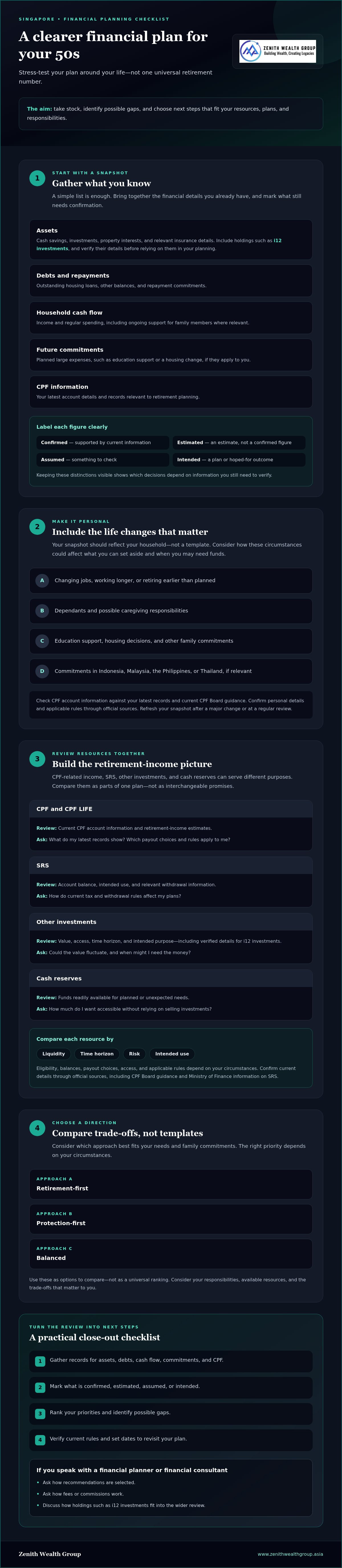
Use this 50s financial goals checklist to turn gaps into next steps
A financial review is useful when it leads to decisions, not just a longer list of figures. Use these steps to turn your snapshot into an action plan. For each item, note what you know, what still needs checking and who will follow up.
What should you review first?
- Gather records. Bring together recent account and investment statements, CPF and SRS information, insurance details, debt balances, household income and recurring expenses. Include holdings such as i12 investments, and verify their details rather than making assumptions about their role.
- List your goals. Write down what you want to fund, protect or prepare for. Include retirement timing, family commitments and foreseeable household expenses that apply to you.
- Rank immediate needs. Check cash flow, debt commitments, accessible savings and upcoming expenses first. Review insurance and protection arrangements in light of your dependants and current circumstances.
- Mark the gaps. Compare current resources with each goal. Separate practical next steps, such as locating a missing statement, from decisions that need research or professional input.
- Verify uncertain details. Confirm CPF, SRS and tax-related information against current official sources. If a rule or recommendation is unclear, identify the question and seek confirmation from an appropriate source or professional before acting.
How can you make the checklist useful over time?
Give each goal an owner, a next action and a review date. A goal might be to confirm a CPF detail, compare household spending with planned commitments, or clarify how an investment fits your intended time horizon. Write down the assumptions behind each decision, such as expected work duration or future family support. That way, a later review can test what has changed instead of relying on memory.
Set a date to revisit the plan, and record what would prompt an earlier review. A job change, new caregiving responsibility, housing decision or shift in retirement timing could affect several goals at once. Keep the action list manageable: distinguish what you can do now from longer-term questions that require more information or professional advice. This makes financial goals for my 50s in Singapore easier to review and act on without treating every item as urgent.
If you’d like help turning competing priorities into a coordinated plan, start a financial planning conversation with a financial consultant.
When a financial consultant can help refine your Singapore plan
A coordinated review can be useful when retirement planning overlaps with several investments, debt commitments, protection needs or family responsibilities. A financial consultant or financial planner can help organise these moving parts and clarify which questions need attention first. The aim is to understand your options and trade-offs, not to promise a particular investment result or retirement income.
What should you ask before working with a financial planner?
Start with the process. Ask how the review will consider your goals, cash flow, debt, protection needs and investments together. Then clarify the proposed scope and how the service model works. Zenith Wealth offers fee-based comprehensive financial planning and commission-based product intermediation. Ask which applies to the engagement, what fees or commissions may be relevant, and what ongoing servicing includes.
- How are recommendations selected? Ask what information they rely on and whether alternatives have been considered.
- What risks should I understand? Request a clear explanation of potential downsides, access to funds and assumptions behind any recommendation.
- What is included in the engagement? Confirm the areas covered and whether follow-up reviews or ongoing servicing form part of the proposed arrangement.
- How will my existing holdings be reviewed? If you have existing investments, ask what information is needed and how, if at all, they fit into the review. Don’t assume a connection, suitability or outcome without verified details.
How can a tailored review support your next decision?
A useful review can help you turn competing priorities into a clearer sequence: what to confirm now, what needs more research and what to revisit later. It should reflect your circumstances, not impose a standard target. Recommendations also involve assumptions and risks, so take time to understand them before deciding. No review can guarantee investment or retirement outcomes.
Zenith Wealth is based in Singapore and offers retirement planning, investment management, wealth protection and legacy planning. These areas may be relevant if they match the questions you want to address. Bring your current records and a short list of priorities, then ask what the discussion would cover and how recommendations would be explained. That can make a conversation about financial goals for my 50s in Singapore more focused and useful.
If you’re ready to talk through your circumstances, start a financial planning conversation. Share the decisions you’re weighing and ask how the planning process and applicable service model work before taking a next step.
Take your next step with a clearer plan
Your 50s don’t call for one universal retirement target. They call for a clear view of what you have, what you owe and which commitments matter most. Review CPF, CPF LIFE, SRS, investments and cash reserves together, then rank your priorities and turn any gaps into specific next steps. Check current rules and personal details through official sources, and revisit your plan when your circumstances change.
That’s a practical way to approach financial goals for my 50s in Singapore: focus on decisions that fit your situation, not someone else’s benchmark. If you’re reviewing i12 investments, include them in your records and confirm relevant details before relying on them in your plans.
Zenith Wealth Group is a Singapore-based financial advisory firm offering retirement planning and investment management. It operates as an authorised representative group under finexis advisory Pte Ltd. If you’d like to discuss your priorities and understand how a planning engagement works, start a conversation about your financial goals. A clearer next step can make the path ahead feel more manageable.
Frequently Asked Questions
What financial goals should I have in my 50s in Singapore?
Prioritise goals based on your resources, commitments and plans, not a generic retirement target. For financial goals for my 50s in Singapore, start by reviewing cash flow, debt, accessible savings, CPF information, CPF LIFE, SRS and other investments. Then consider retirement timing, protection needs and family responsibilities. Include holdings such as i12 investments in your records, and verify their details before factoring them into a plan.
Is it too late to start planning for retirement in my 50s?
No, your 50s can still be a useful time to clarify your retirement plans and take practical steps. Gather current records, estimate essential spending and identify resources you may draw on. Review when you hope to retire and whether that timing fits your circumstances. If there’s a gap, compare possible adjustments to your savings, spending or timeline. Avoid assuming that taking more investment risk is the only way to make progress.
How should I review CPF LIFE and my other retirement savings?
Review CPF LIFE alongside CPF account information, SRS, other investments and cash reserves. Check your own balances, eligibility and payout choices using current CPF Board guidance, as options and estimates depend on personal circumstances. Compare each resource by its intended use, access, time horizon and risk. Also confirm current SRS and tax-related rules through official sources before acting. Treat estimates as planning inputs, not guaranteed outcomes.
Should I prioritise paying off debt or saving for retirement in my 50s?
There isn’t one answer for every household. Compare debt repayments with essential spending, accessible savings, interest costs and your retirement timeline. Keeping funds available for near-term needs may matter, while high repayment commitments can limit the amount available for saving. List each debt and its terms, then consider how repayment choices affect your other goals. Seek qualified advice if the trade-offs or terms are unclear before making a major change.
Can I use my SRS account as part of my retirement plan?
Yes, SRS may form one part of a broader retirement plan, alongside CPF-related resources, investments and cash reserves. First review your account balance, intended use and likely time horizon. Check current contribution, tax treatment and withdrawal rules with official sources, as these can affect whether and how SRS fits your circumstances. Don’t treat potential tax benefits or investment returns as guaranteed, and consider whether you may need access to the funds sooner.
How often should I review my financial plan in my 50s?
Set a regular review date and revisit your plan sooner after a major change. A career move, change in retirement timing, new caregiving responsibility, housing decision or shift in family support could affect your priorities. Keep a record of assumptions, next actions and who is responsible for each goal. At each review, check whether those assumptions still hold and whether CPF, SRS or other account details need updating from current sources.
When should I speak with a financial consultant about retirement planning?
Consider speaking with a financial consultant if retirement planning overlaps with investments, debt, protection needs or family commitments and you’re unsure how to prioritise them. Ask how recommendations are chosen, what the planning scope includes, how fees or commissions apply, and what ongoing servicing involves. Zenith Wealth Group is Singapore-based and operates as an authorised representative group under finexis advisory Pte Ltd. If you also have commitments in Indonesia, Malaysia, the Philippines or Thailand, ask which local details need separate verification.


