

What if the best financial plan for your 30s isn’t a perfect checklist, but the right next step for your life? If you’re weighing housing, family commitments and future savings, it’s understandable to wonder which financial goals for my 30s in Malaysia should come first.
The answer depends on your cash flow and responsibilities, not someone else’s timeline. This practical 2026 checklist helps you set priorities, turn broad ambitions into monthly actions and adjust as your circumstances change. Start with income, spending and debt, then consider protection, housing, family needs and longer-term goals such as retirement and education funding.
You’ll also find guidance on when a financial planner may help connect goals across life stages. If i12 investments is part of your research, verify its role and offerings rather than assuming how it fits your plan. Start with the priorities that matter most to you, then build from there.
Key Takeaways
- Set financial goals for my 30s in Malaysia around your cash flow, responsibilities and personal circumstances, not someone else’s timeline.
- Review your income, regular spending, debt and commitments before deciding what you can put towards new goals.
- Compare housing, family needs and future savings by urgency, flexibility and time horizon. Buying a home or starting a family isn’t a requirement for everyone.
- Give each priority a timeframe and a realistic monthly action, then review your plan as your circumstances change.
- If considering i12 investments, verify its role and offerings rather than assuming how it fits your financial plan.
Financial goals for your 30s in Malaysia: start with a clear personal checklist
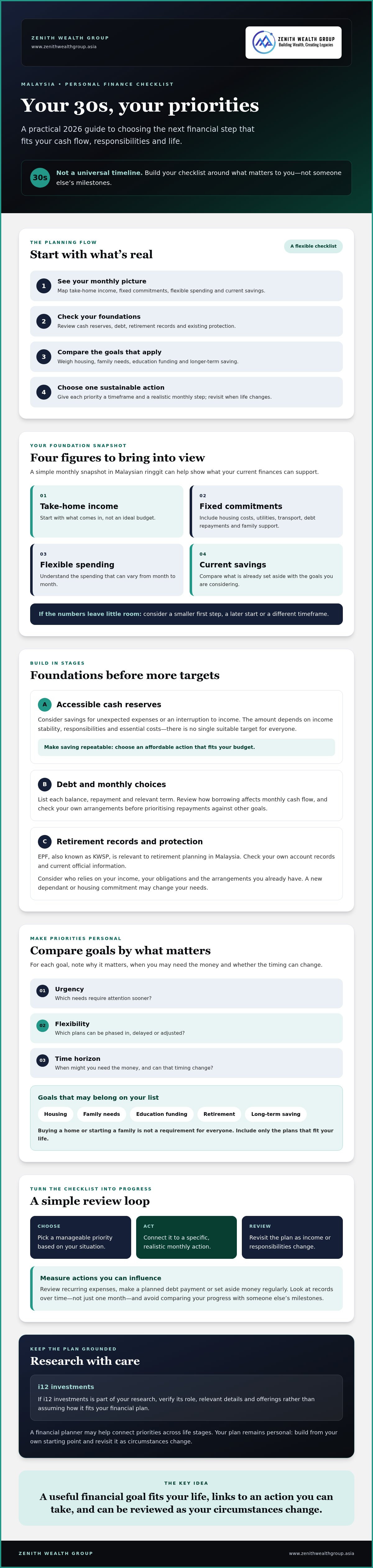
Career decisions, housing costs, family commitments and future plans can all compete for your attention in your 30s. Rather than trying to tackle everything at once, start with a clear view of your cash flow and responsibilities. Then decide which needs are urgent, which goals can wait and what action you can sustain now.
This checklist is a planning aid, not a universal order or a promise of a particular outcome. Your priorities may differ if you support family members, have debt to manage or are saving for a major expense. The sections ahead cover cash reserves and debt, protection, housing and family plans, long-term saving, and ways to turn priorities into actions you can review.
Which milestones belong on a 30s financial checklist?
Begin by checking where you stand, rather than assuming you should already have reached a particular milestone. Budgeting, saving and setting goals are part of the broader personal financial planning process. Use these areas to shape a checklist that reflects your life:
- Cash reserves: Consider what accessible savings could help you manage an unexpected expense or interruption to income.
- Debt: List each balance, repayment and relevant term so you can see how borrowing affects your monthly choices.
- Protection: Review who relies on your income and how your household could be affected if circumstances change.
- Major plans: Note goals such as housing, education funding or supporting family, if they apply to you.
- Long-term saving: Include retirement and other future goals, even if you begin with a modest, manageable action.
Separate essential needs from goals you can phase in. For each item, write down why it matters, when you may need the money and whether that timing can change. This makes it easier to compare priorities and decide what can wait without losing sight of it.
How can you define progress without comparing yourself?
Use your own starting point, not a friend’s home purchase, a colleague’s savings or an age-based checklist. Track actions you can influence, such as reviewing recurring expenses, making a planned debt payment or setting aside money regularly. Check your records over time, rather than judging your progress from a single month, and adjust when income or responsibilities change. If you’re considering options that mention i12 investments, verify the relevant details instead of assuming how they fit your circumstances.
A useful financial goal is specific to your life, connected to an action you can take, and reviewable as your circumstances change.
You don’t need to pursue every goal now. Choose a manageable next step, record it and revisit the checklist as your priorities develop.
Build your financial foundations in Malaysia before adding more goals
Before adding new targets, find out what your current finances can support. Take-home income is only part of the picture. Household spending, debt repayments and family commitments all affect how much room you have to save. A simple monthly snapshot in Malaysian ringgit can help you make decisions based on what’s available, rather than on an ideal budget that’s difficult to maintain.
Start with four figures: take-home income, fixed commitments, flexible spending and current savings. Include recurring items such as housing costs, utilities, transport, debt repayments and support for dependants. Compare what remains with your existing plans. If the numbers don’t leave room for a goal, consider a smaller first step, a later start or a different timeframe.
How do you organise cash flow and emergency savings?
Set aside an accessible reserve for unexpected expenses, with its size guided by your income stability, responsibilities and essential costs. There isn’t one suitable target for everyone. Choose a repeatable saving action that fits your budget, such as moving an affordable amount into savings after payday. Review the amount when your income or commitments change.
Review debt alongside savings, not in isolation. List each repayment, its terms and its effect on monthly cash flow. Borrowing arrangements differ, so check the details of your own commitments before deciding how to prioritise repayments against other goals. If unexpected spending would make repayments difficult, accessible savings may also need a place in your plan.
What should Malaysians know when reviewing EPF and protection?
EPF, also known as KWSP, is an important term to understand when considering retirement planning in Malaysia. Check your own account records and consult current official information to understand your position. A general example or someone else’s experience may not reflect your circumstances.
Protection needs also depend on your situation. Consider whether anyone relies on your income, what obligations you’ve taken on and what arrangements you already have. A new dependant or housing commitment may change the financial impact of an unexpected event. AKPK’s resource titled Starting and Raising a Family may be relevant if family responsibilities are part of your planning.
Build your plan in stages. First, make your cash flow visible. Then choose a sustainable saving habit and review your debt, retirement records and existing protection. If you’re weighing longer-term priorities, a financial planner may help connect them across life stages. If i12 investments appears in your research, check its role and details rather than assuming a relationship or particular offering. To learn about Zenith Wealth’s stated planning services, see financial planning contact information.
Prioritise housing, family, and future savings without losing balance
A home, family responsibilities and retirement savings can all matter, but they don’t have to move forward at the same pace. Being in your 30s doesn’t mean you must buy property or start a family. Prioritise based on urgency, flexibility, how long a goal can wait and how it affects the people who rely on you.
For example, a household planning a move soon may need to keep more money available for near-term costs. Someone without an immediate housing or family commitment may choose to focus more on longer-term saving. These are different circumstances, not better or worse choices. AKPK’s financial education resources can offer useful context for life-stage planning. Explore Agensi Kaunseling dan Pengurusan Kredit (AKPK) materials as you consider your priorities.
How should you compare a home goal with long-term savings?
Look beyond the goal itself. Consider when you may need the money, whether the timing can shift, how accessible your savings need to remain and what ongoing commitments could follow. Property ownership and investment approaches aren’t right for everyone. Use this comparison to identify questions and next steps, not to make an automatic choice.
| Goal | Timeframe | Flexibility | Next action |
|---|---|---|---|
| Housing | Near or medium term, based on your plans | Consider whether the timing can change | Review likely ongoing commitments and how they fit your budget |
| Family responsibilities | Based on household needs | Some costs may be difficult to defer | Identify who depends on your support and what needs planning |
| Retirement saving | Long term | Review the options and access conditions that apply | Check existing records and decide what information you need |
How do EPF, PRS, and other long-term goals fit together?
EPF, also called KWSP, and PRS are terms Malaysians may encounter while learning about retirement saving. Treat them as starting points for research, not as recommendations to contribute or invest in a particular way. Rules, eligibility, tax treatment and product details can change, so check current official information before acting. A financial planner can help connect long-term saving with goals such as education funding or family needs, while any recommendations should reflect your circumstances.
Keep general research separate from personal advice. If i12 investments appears in your research, verify its role and details rather than assuming it offers a particular option or is connected to Zenith Wealth Group. The right balance is one that fits your priorities, cash flow and responsibilities, and that you can review as those circumstances change.
Turn your Malaysia financial goals into a reviewable action plan
A goal becomes easier to act on when it’s tied to a decision you can make with your current cash flow. Use this five-step process to turn your priorities into a plan you can revisit, rather than a list that feels fixed or out of reach.
- List your goals. Include near-term needs and longer-term aims, such as preparing for a major household expense or building retirement savings.
- Set a timeframe. Note when you hope to work towards each goal and whether the timing can change.
- Assess affordability. Compare each goal with your income, regular commitments and existing savings. Don’t rely on a target your current budget can’t support.
- Choose a practical action. Decide what you can do next, such as reviewing a recurring expense or setting a manageable savings amount.
- Schedule a review. Choose a time to check your records, progress and priorities again.
Keep the next action clear and specific. Instead of writing “save more,” decide what amount you can set aside from available cash flow, when you’ll do it and which goal it supports. Choose an action you can sustain, rather than relying on a universal percentage or a promised investment outcome.
How can you make each financial goal measurable?
For every goal, record the outcome you want, why it matters, your timeframe and the next action. Track progress using records you can access and understand, such as account balances, spending notes or a simple monthly budget. Review the direction of change, not just a single snapshot. Your financial goals for my 30s in Malaysia should reflect your own starting point and priorities.
When could a financial planner help you review the plan?
Consider speaking with a financial planner if several goals depend on the same available cash, or if housing, family responsibilities and retirement saving feel difficult to balance. Before engaging a professional, ask about the scope and process, what information you’ll need to provide and whether any fees apply. If i12 investments comes up in your research, confirm its role and details rather than assuming how it relates to your plan.
Review your financial plan whenever your circumstances change. A job change, new dependant or shift in household commitments may affect which goal comes first. Update the timeframe and monthly action instead of treating an earlier decision as permanent. If you’d like to discuss how financial planning can connect goals across life stages, Speak with our team.
Keep your 30s financial plan adaptable as life and priorities change
A financial plan isn’t a one-time checklist. Changes in income, a new dependant, a job move or a shift in housing plans can affect what feels urgent and what’s affordable. Keep the core approach steady: understand your cash flow, protect essential needs, sequence your goals and review your choices as circumstances change. The right order can change too.
What should you revisit during a regular financial review?
Set aside time to check whether your goals and timeframes still fit. Compare your current cash flow and commitments with your earlier plan, then note what has progressed and what needs adjusting. A review doesn’t have to produce a major change. It may confirm that your current actions remain manageable, or show that a goal needs a new timeframe.
- Goals: Are they still relevant, and has their urgency changed?
- Cash flow: Do your income and regular commitments still leave room for planned actions?
- Progress: What do your accessible records show, and what’s the next practical step?
- Retirement information: Check current EPF or KWSP and PRS details through appropriate official sources before making decisions.
Review your plan after a material change, such as a new dependant, a shift in income or a different long-term plan. Revisit your financial plan when your circumstances change, so your next steps stay connected to the life you’re living now.
How can professional guidance support your next steps?
When retirement planning, wealth protection and investment considerations affect one another, a financial planner or financial consultant may help you organise questions and compare priorities. Guidance should start with your circumstances, not a promise of investment performance or a guaranteed outcome. Your financial goals for my 30s in Malaysia should remain personal, practical and open to review.
Before engaging a professional, clarify which services are included, how the process works, whether fees apply and what regulatory status is relevant to your circumstances and location. Rules differ across Singapore, Malaysia, Indonesia, the Philippines and Thailand, so don’t assume that a firm’s status in one jurisdiction means it is authorised to provide services in another. If i12 investments is part of your research, verify its role and details directly rather than assuming a connection or particular offering.
Zenith Wealth Group is a Singapore-based financial advisory firm. Its stated services include retirement planning, wealth protection and investment management. If you’d like to learn more about the firm and discuss whether its planning services match your needs, Contact Zenith Wealth Group.
Take the next step with a plan that fits your life
Your 30s don’t come with a single financial timeline. Start by understanding your cash flow, then consider essential needs and decide which goals deserve attention first. A home, family plans and long-term savings can each have a place, but the right balance depends on your circumstances. Review your plan when income, commitments or priorities change.
The practical value of setting financial goals for my 30s in Malaysia is turning broad intentions into clear actions you can revisit. Keep your next step manageable, and check reliable information before making decisions about retirement or investments. If i12 investments is part of your research, confirm its role and details rather than assuming how it relates to your plan.
Zenith Wealth Group provides financial planning for individuals across different life stages, with stated planning areas that include retirement, wealth protection and investment management. If you’d like to discuss your priorities, talk with our team about your financial goals. Build a thoughtful plan one practical step at a time.
Frequently Asked Questions
Is 30 too late to start saving for retirement in Malaysia?
No, 30 isn’t too late to review your retirement savings and take a manageable next step. Start with your current savings, income and intended timeframe, then choose an action that fits your budget. Check your EPF or KWSP records and current official information before making decisions. If you’re unsure how retirement saving fits alongside housing, family or other priorities, a financial planner may help you assess how the goals connect.
How much should I save in my 30s in Malaysia?
There’s no single suitable amount for everyone. Your income, essential spending, debt, dependants and the timing of your goals all affect what’s realistic. First, review your cash flow in Malaysian ringgit and see what remains after regular commitments. Then choose a manageable contribution you can maintain and review it as your circumstances change. Avoid relying on a fixed percentage or target that doesn’t reflect your budget.
What financial goals should I prioritise in my 30s?
Start by assessing immediate stability, existing commitments, protection needs, planned expenses and long-term saving. The right order depends on your circumstances, not a universal age-based checklist. Write down each goal, why it matters, its timeframe and one practical next step. For example, a planned household expense may need attention sooner than a flexible long-term goal. Revisit the order when your income, responsibilities or plans change.
Should I focus on buying a house or saving for retirement first?
It’s a trade-off, not a universal either-or decision. Compare the timing and affordability of a home goal with household obligations, your need for accessible savings and your retirement priorities. Consider how each choice affects your other commitments before deciding. Review current EPF or KWSP information as part of your retirement picture. If the decision involves several linked goals or feels difficult to weigh, consider discussing your circumstances with a financial planner.
How do EPF and KWSP fit into retirement planning in Malaysia?
EPF, also known as KWSP, is Malaysia’s retirement-savings institution, so its records can help you understand part of your retirement position. Check your own account information and consult current official sources before making decisions about contributions or withdrawals. Rules, eligibility and account details can change, so don’t rely on old examples or another person’s experience. Consider how this information fits with your other savings and future plans.
Can I set financial goals if my income changes from month to month?
Yes. Start by identifying essential commitments, then choose flexible actions that can adjust as income changes. Review your cash flow regularly and avoid setting a contribution that makes necessary expenses difficult to manage. You might use stronger-income months to progress a goal while keeping other months focused on essentials. If variable income affects several priorities at once, a financial planner may help you organise the choices.
When should I speak with a financial planner about my goals?
Consider speaking with a financial planner when goals compete, family responsibilities change or you’re unsure how retirement planning, protection and investments fit together. Ask about the planner’s role, services, fees and applicable regulatory status for your circumstances and location. Zenith Wealth Group is Singapore-based, so don’t assume its status there establishes authorisation to provide services in Malaysia. An initial discussion should help clarify the process, not pressure you into a product.


