

What if your first investment didn’t need to be a large lump sum? If you’re wondering how to start investing with a small amount in Singapore, begin by choosing an amount you can afford and understanding how much risk you’re comfortable taking. The right first step is not necessarily finding a perfect product. It’s making sure your plan fits your cash flow and goals.
It’s reasonable to hesitate. You may be balancing bills, savings and longer-term goals while weighing fees, market ups and downs, and the risk of making an avoidable mistake. Starting small can make investing feel more manageable, but it doesn’t remove risk or guarantee returns.
This guide explains how to set a realistic starting point, compare investment approaches and build a repeatable plan around your goals, time horizon and risk tolerance. It also covers costs, access and common checks to make before investing. If you’ve encountered the phrase “i12 investments,” verify what the specific reference means rather than assuming it describes a particular product or provider. Start with clarity, then build steadily.
Key Takeaways
- Learn how to start investing with a small amount in Singapore by choosing a starting point that fits your circumstances, not a universal threshold.
- Use five practical steps to shape your investing process, from setting a goal and reviewing cash flow to checking your plan over time.
- Compare investment approaches by effort, diversification, liquidity, fees and risk, then verify current terms before deciding.
- Use a checklist to keep your plan manageable, and check current firm and representative details through relevant official sources in Singapore.
- If you’re exploring “i12 investments,” verify what the reference means. A financial consultant may also help connect investment decisions with your wider goals and circumstances.
Can you start investing in Singapore with a small amount?
Limited spare cash can make investing feel out of reach, especially when everyday expenses and future commitments already compete for your income. But there is no universal amount you need before you can start planning. A suitable starting point is one that fits your circumstances and leaves you able to meet your other needs.
Your starting amount depends on your cash flow, financial commitments, goals and comfort with risk. Investments can rise or fall in value, and returns aren’t guaranteed. Starting with less may help you learn, but it doesn’t remove the possibility of loss.
Saving and investing serve different purposes. Savings are generally for access and stability, especially when you may need the money soon. Investing is usually considered for goals with a longer time horizon, where you may be able to accept fluctuations along the way. Your goal, when you need access to the money and your tolerance for risk all matter when deciding how to use it.
What should you check before investing?
Start with your cash flow. List essential expenses, existing debt commitments and costs you expect in the near term. Consider whether you have an emergency savings buffer before putting money at market risk. If an unexpected bill could force you to sell an investment, you may have to do so at an unfavourable time.
Money you’ll need soon may not suit an investment that can fluctuate in value. Funds set aside for an upcoming expense have a different role from money intended for a longer-term goal. Keep those needs distinct as you plan.
What can a small start realistically achieve?
A modest start can help you learn how an investment approach works, build a repeatable habit and see how you respond to market movements. It can’t promise a particular outcome. Your contributions and how often you make them shape your plan, while your time horizon affects how much room you may have to ride out fluctuations. Review the plan as your circumstances change rather than relying on a return projection.
Before choosing an approach, get clear on your investment strategy, including how hands-on you want to be and what level of uncertainty you can accept. If you’re researching “i12 investments,” first verify what the phrase refers to and how it relates to your decision. Don’t assume it names a particular investment product or reflects a relationship with a provider.
To work out how to start investing with a small amount in Singapore, begin with your priorities, not a headline figure. A steady plan should fit your budget and goals while leaving room for essential needs.
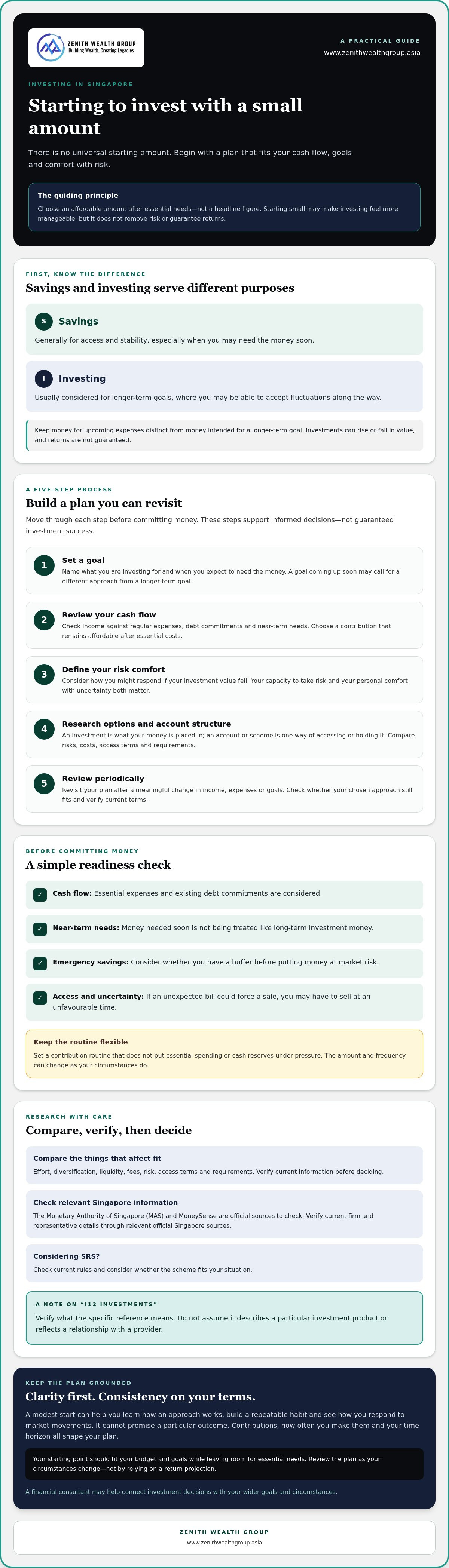
How to start investing with a small amount: five practical steps
A clear process can make a modest starting amount easier to manage. If you’re working out how to start investing with a small amount in Singapore, move through these five steps before committing money. They can help you make a considered choice, but they can’t guarantee investment success.
- 1. Set a goal. Name what you’re investing for and when you expect to need the money. A goal with a longer time horizon may call for a different approach from one that’s coming up soon.
- 2. Review your cash flow. Check income against regular expenses, debt commitments and near-term needs. Choose a contribution that remains affordable after essential costs. You don’t need to maintain a fixed schedule if your circumstances change.
- 3. Define your risk comfort. Consider how you might respond if your investment value fell. Your capacity to take risk and your personal comfort with uncertainty both matter. Be cautious about committing money you may need to access soon.
- 4. Research the options and account structure. An investment is what your money is placed in; an account or scheme is one way of accessing or holding it. Compare the risks, costs, access terms and requirements. Check current information with official Singapore sources such as the Monetary Authority of Singapore (MAS) and MoneySense. The MoneySense guide to investing is a useful place to review investing basics. If researching SRS, check current rules and consider whether the scheme fits your situation. For more background, see Mastering the SRS Account: A 2026 Strategic Guide to Tax Savings.
- 5. Review periodically. Revisit your plan after a meaningful change in income, expenses or goals, and check whether your chosen approach still fits. Verify current terms and relevant firm or representative details through official Singapore sources before making a decision.
Make the routine fit your life
Set a contribution routine you can maintain without putting essential spending or cash reserves under pressure. The amount and frequency can change as your circumstances do. A plan should be flexible enough to adjust, not a commitment that adds strain.
Set a goal, check your cash flow, define your risk, research carefully and review your plan. These steps support informed decisions, not guaranteed results. If you encounter the phrase “i12 investments,” verify what it refers to before relying on it. The information available here doesn’t confirm a specific product or relationship, so don’t assume either.
If you’d like to consider how investing fits with your wider financial picture, you can explore a conversation about your financial situation with a financial consultant.
How to compare investing approaches when your starting amount is limited
With a small starting amount, the details matter. Compare not just what an approach invests in, but also how much effort it requires, how your money is spread, how easily you can access it and what charges apply. The overview below is a starting point, not a product recommendation. Actual features depend on the investment and its terms.
Compare access, costs and diversification
| Approach | Effort | Diversification | Liquidity | Fees and risk |
|---|---|---|---|---|
| Choosing individual investments | More research and ongoing decisions | Depends on how many and which investments you hold | Depends on the investment and how it can be sold | Check transaction and other charges; value can fluctuate |
| Using a pooled investment | Research is needed before and during ownership | May spread money across multiple holdings; check what it contains | Depends on the investment’s terms and market | Check management and transaction costs; diversification doesn’t remove market risk |
| Using a managed portfolio | Less day-to-day decision-making, but you still need to understand and review it | Depends on the portfolio’s holdings and approach | Check withdrawal terms and how underlying investments are sold | Identify every applicable charge and understand the portfolio’s risks |
Diversification means spreading exposure across different investments rather than relying on a single holding. It can reduce the effect of a problem in one area, but it can’t prevent losses or protect against every market decline. For beginner-friendly background, consult MoneySense’s guide to investing in Singapore and verify current information with relevant official sources, including the Monetary Authority of Singapore (MAS).
List all charges you may pay, such as transaction, platform, management or other applicable fees. Check whether charges are fixed, percentage-based or subject to minimums, and consider how they affect small, recurring contributions. Minimum investment requirements and fees vary, so verify current details for any option rather than relying on old figures.
Choose risk that fits your goal and circumstances
Risk tolerance is how comfortable you feel with uncertainty; your capacity for risk is how much financial loss you could absorb without undermining essential needs or goals. They’re related, but they’re not the same. Before committing, check an investment’s purpose, risks, access terms and fees. Then consider whether its potential fluctuations and your time horizon fit your situation.
If you come across “i12 investments,” verify what the phrase refers to before treating it as an investment option or assuming a relationship with a provider. Compare the relevant features first, then decide whether an approach fits your goals and circumstances.
How to make a small-investing plan practical in Singapore
Turn your research into a short plan you can revisit. The aim isn’t to predict every market move. It’s to make decisions you understand, confirm the details that apply to you and avoid investing money you need for essentials.
- Set a goal: Write down what the money is for and when you expect to need it.
- Review cash flow: Check income, essential expenses, debt commitments and near-term needs.
- Research: Compare approaches and understand the investment’s purpose and risks.
- Verify terms: Check current fees, access conditions, eligibility and any relevant tax treatment.
- Start within your capacity: Choose a contribution that doesn’t compromise essential expenses or near-term needs.
- Review: Revisit your goal, assumptions and choices periodically, and after a meaningful change in your circumstances.
Which Singapore-specific details should you verify?
Check current Monetary Authority of Singapore (MAS) information where relevant to a financial firm, representative or service. Confirm details through official sources rather than relying only on promotional material or an old article. For CPF or the Supplementary Retirement Scheme (SRS), research eligibility, account terms and tax treatment rather than making assumptions. Rules can change, and whether a scheme suits you depends on your circumstances. Check current information with the relevant official sources, including CPF Board and IRAS. General information is not a personal tax conclusion.
If your financial affairs also involve Indonesia, Malaysia, the Philippines or Thailand, check the relevant official sources in those jurisdictions. Account access, tax treatment and investment rules may depend on where you live and hold assets, so don’t assume that Singapore information applies elsewhere.
If you come across “i12 investments,” verify what the phrase refers to before relying on it. The information available here doesn’t establish a specific product or relationship, so don’t assume either. For broader portfolio education, you can also look for the strategic investment management guide.
How can you keep the plan sustainable?
Choose a contribution routine that leaves room for essential spending and upcoming costs. Keep the goal, time horizon, assumptions, expected charges and reasons for your decisions in one place. Set a periodic review instead of reacting to every market movement. At review time, ask whether the goal, affordability and approach still fit.
If you’re considering how to start investing with a small amount in Singapore, this checklist gives you a practical way to turn research into a plan. Once you’ve worked through it, you may wish to discuss how investment decisions connect with cash flow and longer-term goals. Speak with a financial consultant about your plan.
When to speak with a financial consultant about investing
Some investing decisions are easier to assess with professional input, especially when several parts of your financial life overlap. You may be balancing debt repayments with long-term goals, supporting family members or unsure how much investment risk your finances can absorb. A financial consultant can help you review the trade-offs and consider how investing fits with your wider plans. That support can inform your decisions, but it can’t guarantee an investment outcome.
Zenith Wealth offers investment management and fee-based comprehensive financial planning. A discussion can help clarify what service is being considered, how it relates to your goals, what risks and costs may apply, and how the financial consultant is remunerated. Ask how recommendations are explained, including whether fees or commissions are involved and what they relate to.
What can a financial consultant help you review?
A conversation can connect your cash flow and commitments with your goals, time horizon and capacity to absorb potential losses. Consider asking how a proposed approach fits the purpose of your investment, what risks you should understand and how charges are described. You can also review Zenith Wealth's strategic investment management guide for broader portfolio education before a conversation. If you encounter “i12 investments,” verify what the phrase refers to before assuming it identifies an investment option or has a particular provider relationship.
What should you prepare before an introductory conversation?
You don’t need a perfect plan. Bring a short list of goals, approximate cash-flow details, existing commitments and questions you want answered. It may help to note when you expect to need the money and what changes in its value you could tolerate. Share only the information needed to discuss your situation, and ask for clarification whenever a term or cost isn’t clear.
A conversation is an opportunity to understand your options. You don’t have to decide to invest or purchase a financial product simply because you’ve asked for guidance. Take time to consider the information and check the details that matter to you.
If you’re considering how to start investing with a small amount in Singapore and would like to discuss how your goals and commitments fit together, you’re welcome to contact Zenith Wealth about your circumstances.
Build your investing plan one step at a time
You don’t need a large lump sum to begin planning. Start by choosing a goal, understanding your cash flow and selecting an approach that fits your time horizon and comfort with risk. Check fees, terms and access before committing, then review your plan as your circumstances change. Investments can fall in value, and returns aren’t guaranteed.
That’s the practical foundation for how to start investing with a small amount in Singapore: make informed choices, keep contributions within your capacity and focus on a process you can sustain. If you come across “i12 investments,” verify what the phrase refers to before treating it as a specific product or assuming a provider relationship.
Zenith Wealth Group is a Singapore-based financial advisory firm offering investment management and comprehensive financial planning. Its representatives operate under finexis advisory Pte Ltd. A financial consultant can help you consider how investing fits with your goals and wider financial picture. Ask about the costs, risks and nature of any remuneration before deciding what to do.
Frequently Asked Questions
Can I start investing in Singapore with a small amount?
Yes, you can begin with an amount that suits your circumstances, provided the investment option accepts it and you understand its risks and charges. Learning how to start investing with a small amount in Singapore means checking essential expenses, cash needs and goals, then comparing available approaches. Investment values can fall, and returns aren’t guaranteed. A small starting amount can support learning and consistency, but it doesn’t remove the possibility of loss.
How much money do I need to start investing in Singapore?
There isn’t one amount that applies to every investor or investment. Minimums and charges vary by option and account, so check the current terms before deciding. Look beyond the entry requirement: consider whether fees could take a meaningful share of a small or recurring contribution, and whether you can afford to leave the money invested. Choose a starting amount only after accounting for essential expenses, existing commitments and near-term needs.
Is investing a good idea if I have little money?
It may suit you if your essential expenses are covered, you’ve considered near-term cash needs and you understand that investments can lose value. If spare cash is tight or debt commitments are weighing on your budget, review your finances before taking market risk. A smaller contribution can help you develop an investing routine, but it won’t guarantee a particular outcome. Make sure the approach and time horizon fit your goal.
What is the first step before investing?
Start by reviewing your cash flow and naming the goal for the money. List essential expenses, debt commitments and costs you expect soon, then consider whether you have an emergency savings buffer. Next, decide when you may need the money and how much fluctuation you could tolerate. This groundwork can help you avoid investing funds you may need shortly and gives you a clearer basis for researching options.
Can I invest regularly with small contributions?
Yes, if the option you choose accepts the contribution size and frequency, and the routine remains affordable. Check minimums, applicable fees and any terms that could affect recurring contributions. You can adjust the amount or pause the routine if your income, expenses or goals change. Regular investing doesn’t guarantee returns or prevent losses, so review the plan periodically and don’t treat a contribution schedule as a promise of future performance.
Should I invest through SRS if I am starting with a small amount?
Not automatically. The Supplementary Retirement Scheme (SRS) has account rules and possible tax considerations that may affect whether it fits your circumstances. Before contributing or investing through it, check current eligibility, terms and tax treatment with official sources such as IRAS and the relevant SRS operator. Don’t assume that a potential tax benefit makes SRS suitable for every person, goal or contribution size. Consider your access needs and wider financial plan too.
How do I check whether a financial firm or representative is legitimate in Singapore?
Check the firm and representative using the Monetary Authority of Singapore’s official directories and confirm that the names and details match. Review the stated financial services and ask how recommendations, costs and any commissions are explained. Zenith Wealth Group is a Singapore-based financial advisory firm whose representatives operate under finexis advisory Pte Ltd; verify current details before engaging. If your circumstances also involve Indonesia, Malaysia, the Philippines or Thailand, check relevant official sources in those jurisdictions as well.
To discuss how investing could fit your goals and financial circumstances, contact Zenith Wealth Group about financial planning.


