

Doctors don’t need a pile of disconnected financial products. They need a plan that connects today’s decisions with future priorities. If you’re searching for a financial advisor for doctors in Singapore, look for a financial consultant who can help bring those priorities into one clear conversation.
Your time is limited, and protection, investments, retirement and family goals can compete for attention at different career stages. It can also be difficult to compare a consultant’s services or understand how they’re remunerated. Start by looking for clear explanations and a planning process that begins with your circumstances, not assumptions about your profession.
This guide offers a practical framework for comparing financial consultants, identifying topics to raise as your career and family circumstances evolve, and preparing for a useful first discussion. It also explains what to ask about fee-based planning and commission-based product intermediation, and how to approach a topic such as i12 investments without assuming it is relevant to you. Start with your questions and take the conversation at your own pace.
Key Takeaways
- A search for “financial advisor for doctors in Singapore” is only a starting point. Compare how each financial consultant listens, explains the planning scope and communicates.
- Use your career stage, family circumstances, income pattern and goals to decide which financial questions need attention first.
- Separate immediate cash-flow and protection concerns from longer-term investment and retirement priorities, then discuss how they fit together.
- Prepare for a first meeting by defining your goals, gathering records you’re comfortable sharing and listing questions about next steps and compensation.
- Ask whether topics such as i12 investments are relevant to your goals. Don’t assume an affiliation or that a particular option is right for you.
Why Doctors in Singapore May Want a Coordinated Financial Plan
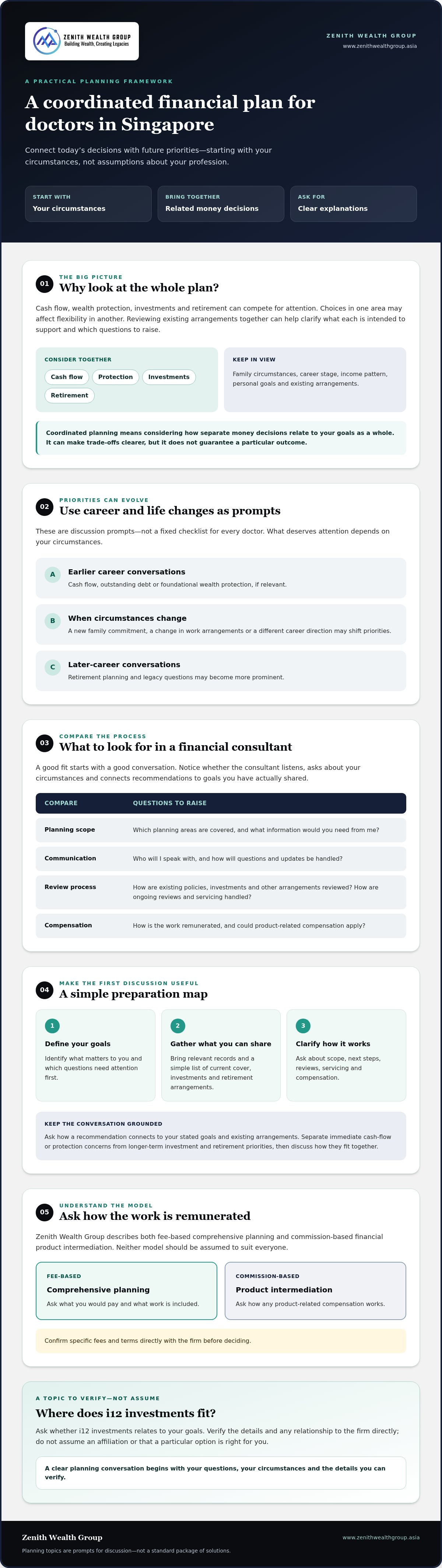
A busy medical career can make it hard to step back and see how separate financial decisions interact. Cash flow, wealth protection, investments and retirement planning may all compete for attention, but choices in one area can affect flexibility in another. Reviewing them together can help you identify questions to raise before considering any changes.
The phrase “financial advisor for doctors in Singapore” may be part of your search, but look for a financial consultant who asks about your circumstances instead of assuming your priorities from your profession. Career stage, family situation, income pattern and personal goals all shape what may deserve attention.
Which planning topics may change across a medical career?
Early in your career, you might want to discuss cash flow, outstanding debt or foundational wealth protection, if relevant. A new family commitment, a change in work arrangements or a different career direction can shift those priorities. Later, retirement planning and legacy questions may become more prominent. Use these as discussion prompts, not a fixed checklist for every doctor.
Why can a coordinated view be more useful than isolated products?
Review existing arrangements before considering new ones. This helps you understand what each is intended to support and where you may have questions, without assuming you need another product. If i12 investments comes up, ask whether it relates to your goals and verify its details and any relationship to the firm before drawing conclusions.
Coordinated financial planning means considering how separate money decisions relate to your goals as a whole. It doesn’t guarantee a particular outcome, but it can make trade-offs clearer and give you a more grounded starting point for discussion.
How to Choose a Financial Advisor for Doctors in Singapore
A good fit starts with a good conversation. Before discussing solutions, notice whether the financial consultant asks about your work and family circumstances, listens to your priorities and clarifies what matters most to you. A recommendation should connect to goals you’ve actually shared, not assumptions about doctors as a group.
Use this framework to compare how a financial planner works, not just which services appear on a list.
| What to compare | Questions to ask |
|---|---|
| Planning scope | Which planning areas are covered, and what information would you need from me? |
| Communication | Who will I speak with, and how will questions and updates be handled? |
| Review process | How are existing policies, investments and other arrangements reviewed? How are ongoing reviews and servicing handled? |
| Compensation transparency | How is the work remunerated, and could product-related compensation apply? |
For a broader introduction, you can also read Why You Need a Financial Consultant in Singapore. Use it alongside these doctor-focused questions to assess whether the process feels clear and relevant to your circumstances.
What questions should doctors ask before engaging a financial planner?
Ask what the planning process covers, what records or information you’ll be expected to provide, and how recommendations will connect to your stated goals and existing arrangements. Clarify how often reviews may take place, how servicing works and what communication to expect. If a topic such as i12 investments comes up, ask why it may be relevant to your goals and confirm any relationship or product details directly.
How can you understand fees and product-related compensation?
Zenith Wealth Group describes both fee-based comprehensive planning and commission-based financial product intermediation. Neither model should be assumed to suit everyone. Ask what you would pay, what work is included and how any product-related compensation works. Confirm specific fees and terms directly with the firm before deciding.
Clear answers make comparison easier. If you’d like to discuss your planning questions, you can contact Zenith Wealth Group and ask about the process and compensation model relevant to your needs.
Financial Planning Priorities Doctors Can Compare Before Choosing Advice
Use planning categories as prompts for a conversation, not a checklist you must complete. What deserves attention first depends on your circumstances, risk comfort and existing arrangements. One doctor may need to address a near-term cash-flow concern, while another may be weighing longer-term investment growth or retirement goals.
Separate immediate needs from longer-range aims. Ask what requires attention now, what can be reviewed over time and how a decision in one area could affect another. This keeps the discussion focused on your priorities rather than a standard package of solutions.
How should doctors discuss protection, investing and retirement together?
Bring a simple list of your current cover, investments and retirement arrangements. For each planning question, ask what goal it supports, when you may need the funds and what risks or trade-offs to consider. If wealth protection is on your agenda, Wealth Protection in Singapore: The 2026 Guide to Safeguarding Your Future is a related topic to explore.
Suitability is personal. Ask the financial consultant to explain how any suggestion fits your stated goals and existing arrangements. The reasoning should be clear before you consider taking action.
When might CPF, SRS or i12 investments enter the conversation?
CPF and the Supplementary Retirement Scheme (SRS) may be relevant to retirement discussions, depending on your circumstances. Ask a qualified financial consultant or financial planner to check current information, including any rules or eligibility details that apply to you. Don’t rely on figures you haven’t confirmed.
You can also ask whether i12 investments are relevant to your questions. Treat it as a discussion topic, not an assumption about features, suitability or affiliation. Verify any details before making a decision.
How to Prepare for a Financial Planning Meeting as a Doctor
A little preparation can help you use meeting time well, especially when your schedule is full. Keep it simple: define what you want to discuss, gather a few useful records, write down your questions and leave with clear next steps. You don’t need to arrive with every decision already made.
What information is useful to gather before the first discussion?
Start with your own words. Note the goals that matter to you, major financial commitments and any changes you expect, such as a shift in work arrangements or a growing family. If you’re comfortable, prepare a high-level summary of your income, regular commitments, existing protection and investments. This gives the financial consultant context without requiring a perfect spreadsheet.
You may also want to gather relevant policy and investment summaries. Before sending sensitive documents, ask which information is needed and what secure method to use. Don’t share private records through an unsecured channel.
Write down questions you don’t want to forget. For example:
- What does the planning process cover, and what information do you need from me?
- How are fees or product-related compensation explained?
- What follow-up or review arrangements should I expect?
- How would a topic such as i12 investments be assessed for relevance, if it comes up?
If retirement is one of your priorities, The Complete Guide to Retirement Planning in Singapore (2026 Edition) may offer useful context to consider before the discussion.
How can you assess whether the meeting was useful?
Afterwards, ask yourself whether the financial planner clarified your goals, listened to your concerns and explained trade-offs in language you could follow. You should also know what information is still needed and what the suggested next steps are. If anything felt unclear, note it down and ask for an explanation before making a decision.
A useful first meeting leaves you clearer about your questions, the planning process and what happens next, without requiring you to commit to a particular solution.
If you’re searching for a financial advisor for doctors in Singapore, bring your questions and use the conversation to understand the process at your own pace. You can discuss your planning questions with Zenith Wealth Group.
Explore Zenith Wealth Group’s Financial Planning for Doctors
Zenith Wealth is a Singapore-based financial advisory firm serving people across life stages. Its services are not described as doctor-only, so use an initial conversation to understand whether the planning scope fits your priorities. Searching for a financial advisor for doctors in Singapore can help you find options, but the right fit depends on the questions you want addressed and the service available.
What can a planning conversation with Zenith cover?
Zenith Wealth's stated planning areas include retirement planning, wealth protection, investment management and legacy planning. Depending on your circumstances and goals, you might discuss how these areas relate to one another or focus on a specific priority. A financial consultant can explain what falls within the proposed scope and what information would help clarify your needs.
Zenith Wealth states that its representatives are authorised representatives of finexis advisory Pte Ltd. If you’re considering working with a representative, confirm their current status and the scope of the services they can discuss directly. Ask how your existing arrangements would be reviewed before any new solution is considered.
Zenith Wealth describes two service models: fee-based comprehensive planning and commission-based financial product intermediation. Ask which model applies to the work being discussed, what is included and how any product-related compensation works. Confirm specific fees and terms directly with the firm. Clear answers can help you compare the proposed service with your needs, without assuming one model is right for everyone.
What is a simple next step if you want to explore advice?
Prepare two or three priorities before making contact. For example, you might want to clarify a retirement goal, review your existing protection or understand how investments fit into your wider plans. Add questions about service scope, compensation, follow-up and suitability. If i12 investments comes up, ask why it may be relevant and verify its details and relationship to Zenith Wealth before drawing conclusions.
You don’t need to arrive with a complete financial plan. Start with what you want to understand, then decide whether the conversation gives you enough clarity to consider a next step. Wait until you understand the proposed service and its terms before committing.
To begin a discussion, discuss your financial planning priorities. Ask about the service scope and compensation model, then take time to decide whether the approach suits your circumstances.
Take the Next Step With Clear Priorities
A useful financial plan starts with your circumstances, not assumptions about your profession. Review how cash flow, protection, investments and retirement priorities connect, then compare financial consultants by how well they listen, explain their process and clarify compensation.
If you’re searching for a financial advisor for doctors in Singapore, prepare a few goals and questions before starting a conversation. Zenith Wealth Group states that its representatives are authorised representatives of finexis advisory Pte Ltd. It also describes fee-based planning and commission-based financial product intermediation. Ask directly about the service scope, compensation, current representative status and whether the proposed approach suits your situation.
You don’t need to have every answer ready. Start with the priorities you want to explore and take time to understand the options. Discuss your financial planning priorities with Zenith Wealth Group.
A clear first step can help you decide what to consider next. Your plan can develop as your goals and circumstances change.
Frequently Asked Questions
Do doctors in Singapore need a financial consultant?
Not necessarily, but a financial consultant may help you organise decisions if coordinating cash flow, protection, investments and retirement feels difficult alongside work. Your needs depend on your income pattern, family commitments and goals, so there’s no standard plan for every doctor. If your personal or financial life spans Singapore and nearby countries such as Indonesia, Malaysia, the Philippines or Thailand, raise that context and ask what the planning scope can address.
How do I choose a financial planner as a doctor in Singapore?
Compare the planning scope, communication style, review process and compensation transparency. A search for a financial advisor for doctors in Singapore can help you find options, but assess how each financial planner listens before suggesting solutions. Ask how existing policies, investments and other arrangements would be considered, and how recommendations would connect to your goals. Check the representative’s current status and the service scope directly before proceeding.
What should I ask a financial consultant at the first meeting?
Ask what the planning process covers, what information you’ll need to provide and how recommendations relate to your goals and current arrangements. Clarify how follow-up and reviews work, and how the consultant is remunerated. If i12 investments comes up, ask why it may be relevant to your situation and verify its details independently. You don’t need to decide on a solution at the first meeting. Focus on understanding the process.
Are financial planning fees different from product commissions?
Yes. A fee-based planning model involves fees for planning work, while commission-based product intermediation involves commissions connected to the placement of financial products. Zenith Wealth Group states that it offers both models. Ask which applies to the service being discussed, what the scope includes and how any product-related compensation works. Confirm specific fees and terms directly with the firm, as they can’t be inferred from the model alone.
Should doctors in Singapore discuss CPF and SRS with a financial planner?
Yes, if these topics relate to your goals or existing arrangements. CPF and the Supplementary Retirement Scheme (SRS) may be relevant to a discussion about retirement, but their relevance depends on your circumstances. Ask a financial planner to check current information and explain any applicable rules or eligibility details. Avoid relying on outdated figures, and don’t assume that an approach suitable for another person will fit your situation.
What documents should I prepare before meeting a financial consultant?
Start with a brief summary of your income, regular commitments, existing protection and investments, if you’re comfortable sharing them. Note your goals, anticipated life changes and questions about scope, compensation and follow-up. Policy or investment summaries may help, but first ask what’s needed and which secure method to use. Don’t send sensitive documents through unsecured channels. A clear overview is useful; you don’t need a perfect financial record.
Can a financial consultant help with retirement and wealth protection together?
A financial consultant can discuss both areas if they fall within the service scope. Zenith Wealth Group lists retirement planning and wealth protection among its stated services. Ask how the two topics might relate to your goals, current arrangements and time horizon, and what the proposed work includes. A discussion can help clarify priorities, but the appropriate scope and any recommendations depend on your circumstances. Confirm service details directly with the firm.


