

What if your retirement "gold" loses its luster because of rising costs you didn't see coming? Many Singaporeans ask, how do you save for retirement when the daily cost of living feels like a moving target? It's a common worry; you want to ensure your lifestyle remains comfortable even as the statutory retirement age shifts to 64 this July. We know that the confusion between CPF LIFE and private options can make planning feel like a chore.
This guide changes that by offering a clear, actionable roadmap for 2026. You'll learn how to build a secure nest egg using the latest CPF updates, tax-efficient SRS strategies, and private vehicles like i12 investments. We've simplified the process so you can stop guessing and start growing your wealth with precision.
We'll break down the new salary ceilings and show you how a professional financial planner can help you secure your "retirement number." It’s time to move from uncertainty to a place of quiet confidence about your future.
Key Takeaways
- Shift your mindset from passive saving to a proactive 2026 strategy that accounts for rising inflation and shifting interest rates.
- Discover the exact steps for how do you save for retirement by balancing CPF LIFE, SRS tax relief, and private growth via i12 investments.
- Define your personal "retirement number" across three distinct lifestyle tiers tailored for the Singaporean professional.
- Build a rock-solid foundation with a cash flow audit and a six-month emergency fund before moving into aggressive investment phases.
- Understand how a financial planner adds value by navigating complex SRS withdrawal rules and optimizing your holistic wealth strategy.
Understanding the Retirement Landscape in 2026
Retirement isn't a destination you stumble upon. It's a structure you build with intent. In 2026, the central question isn't just "can I stop working?" but rather, how do you save for retirement in a way that outpaces the rising cost of living? With the statutory retirement age moving to 64 on July 1, 2026, the landscape is shifting beneath our feet. Relying on a passive habit of "saving what's left" no longer works in a high-inflation environment. You need a proactive strategy that treats wealth creation as a primary objective.
While state support provides a solid foundation, it often leaves a "lifestyle gap" for middle-to-high earners. A financial consultant can help you identify where your CPF payouts might fall short of your actual needs. By integrating sophisticated options like i12 investments into your portfolio, you move beyond basic survival toward true financial freedom. This professional guidance ensures your strategy remains flexible enough to handle fluctuating interest rates while staying focused on your long-term vision.
The Mindset Shift: From Saving to Investing
Traditional saving is often reactive. You pay your bills, spend on lifestyle, and tuck away the remainder. This approach fails most Singaporeans because the "remainder" is rarely enough to fight the eroding power of inflation. The real power lies in compounding. Starting your journey in your 20s versus your 40s isn't just a 20-year difference; it's often a million-dollar difference in the final nest egg. This proactive stance is essential for Understanding Retirement as a long-term financial project rather than a vague hope. Treat your retirement contribution as a non-negotiable monthly "bill" to yourself. Pay your future self before you pay for subscriptions or dining out. It's the only way to ensure your growth stays ahead of the curve.
Why 2026 is a Turning Point for Retirement
Current economic trends in Singapore and Southeast Asia have made 2026 a critical year for planning. The MAS exchange rate policy continues to influence our global purchasing power, which is vital if you plan to travel during your golden years. Additionally, the CPF monthly salary ceiling has reached S$8,000 as of January 1, 2026. While this increases your forced savings, it also means your take-home pay might feel tighter. You must balance these contributions with private vehicles to maintain your standard of living. When asking how do you save for retirement effectively, you must account for these macro shifts. You can find more details on calculating your specific needs in our guide on How Much Money to Retire in Singapore? (2026 Guide to Your Number). Understanding these numbers today prevents a shortfall tomorrow.
The Three Pillars of a Robust Singapore Retirement Plan
Building a secure future requires more than just a single savings account. In Singapore, a truly resilient strategy relies on three distinct pillars working together. Think of them as your safety net and your growth engine. When people ask how do you save for retirement effectively, they're often looking for a way to balance guaranteed income with market-driven growth. These pillars interact to provide stability through CPF, tax efficiency through SRS, and accelerated growth through i12 investments. By coordinating all three, you ensure that inflation doesn't erode your purchasing power over time.
Optimizing Your CPF Strategy
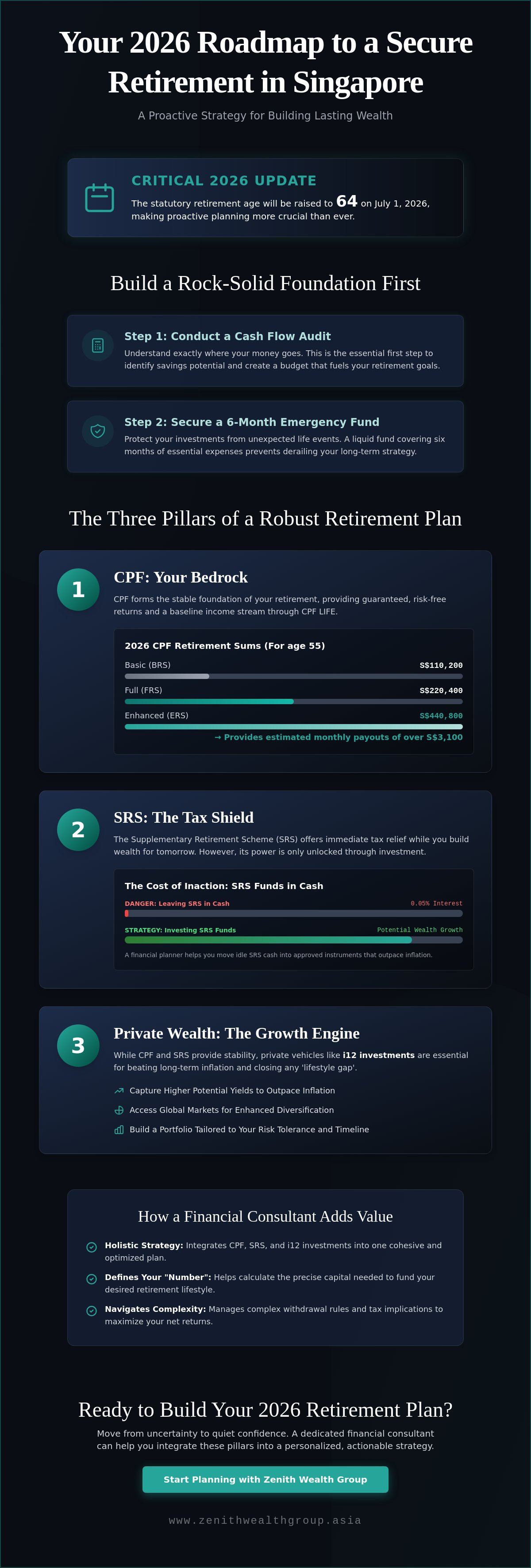
CPF is the bedrock of your plan. For those turning 55 in 2026, the Retirement Sums are set at S$110,200 for the Basic Retirement Sum (BRS), S$220,400 for the Full Retirement Sum (FRS), and S$440,800 for the Enhanced Retirement Sum (ERS). Reaching the ERS can provide estimated monthly payouts of over S$3,100, which offers a powerful baseline for your expenses. While voluntary top-ups to your Special Account (SA) earn a reliable 4% interest, these funds are less liquid once committed. You can dive deeper into these mechanics in The Complete Guide to Retirement Planning in Singapore.
SRS and Tax Efficiency
The Supplementary Retirement Scheme (SRS) is a dual-purpose tool. It offers immediate tax relief today while building wealth for tomorrow. However, many Singaporeans make the mistake of leaving their SRS funds in cash. At a mere 0.05% interest, your money loses value against inflation every day. A financial planner can help you move these funds into SRS-approved instruments. This ensures your tax savings turn into real wealth. Following a clear step-by-step retirement savings plan helps you avoid these common pitfalls and keeps your strategy on track.
Private Wealth Growth with i12 investments
CPF and SRS provide stability, but i12 investments act as your primary growth engine. This pillar is critical for beating long-term inflation by accessing global markets beyond Singapore's borders. Diversification is the goal here. By allocating a portion of your wealth to i12 investments, you capture higher yields from international equities and bonds. Your financial consultant will help you match this allocation to your specific timeline. This ensures you aren't taking unnecessary risks as you approach the 2026 statutory retirement age of 64. If you're ready to see how these pillars fit your life, you might want to speak with our team to start your personalized audit.
Calculating Your Target: Benchmarks and Lifestyle Tiers
Determining your final "number" starts with a vision, not just a spreadsheet. When you ask how do you save for retirement, you must first decide which version of the future you are funding. Most Singaporeans fall into one of three tiers. The Basic Tier focuses on HDB living and local hawker dining. The Moderate Tier moves into condo living with regular regional travel. Finally, the Luxury Tier encompasses landed property and a global lifestyle. Your target depends entirely on this choice.
The math behind these tiers usually involves the "Rule of 25" or the "4% Rule." The Rule of 25 suggests you need a portfolio equal to 25 times your annual expenses. Meanwhile, the 4% Rule is a benchmark for safe annual withdrawals. In our 2026 interest rate environment, these rules are starting points rather than absolute laws. The Retirement Gap is the specific difference between your projected CPF payouts and the actual monthly cost of your desired lifestyle.
Where Should You Be by Age 35, 45, and 55?
Benchmarks help you stay on track throughout your career. By age 35, aim to have one to two times your annual income in liquid assets. This is a critical window for saving for retirement because compounding has the most time to work. By age 45, you likely face the "sandwich generation" challenge. You are balancing your children's education funding with your own future needs. This is where a financial consultant can help you prioritize without sacrificing your growth.
When you hit 55, the focus shifts to the "final stretch." This is the time for the CPF Shielding debate and maximizing your Retirement Account. It is also a period where many professionals optimize their private holdings, such as i12 investments, to ensure their capital remains productive. A financial planner can review these benchmarks with you to ensure your trajectory remains realistic.
Accounting for Healthcare and Longevity
Longevity is a major factor in 2026. Roughly one in five Singaporeans aged 65 today will live past 90. This means your savings might need to last 30 years or more. Healthcare costs often become the largest expense in these later years. Schemes like CareShield Life provide a baseline, but private integrated shields are essential for comprehensive protection. You can learn more about securing these assets in our guide on Wealth Protection in Singapore: The 2026 Guide. Balancing healthcare readiness with your lifestyle goals is the only way to ensure you don't outlive your wealth.
Your Step-by-Step Retirement Savings Action Plan
Stop wondering and start doing. When you finally decide to take control, the process becomes much simpler. So, how do you save for retirement without feeling overwhelmed? It starts with a repeatable system that removes the guesswork from your monthly finances. This action plan is designed to move you from a state of uncertainty to a position of quiet confidence.
- Step 1: Conduct a full audit. Look at your current cash flow and CPF balances. With the 2026 CPF monthly salary ceiling now at S$8,000, you need to know exactly how much is going into your accounts versus what you need to contribute privately.
- Step 2: Build your foundation. Secure an emergency fund covering at least six months of expenses. This prevents you from liquidating your retirement assets during a market dip or personal emergency.
- Step 3: Automate your growth. Set up standing instructions for your SRS and private investment accounts. Consistency beats timing every single time.
- Step 4: Rebalance annually. Meet with your financial planner once a year. They will help you adjust your portfolio to stay aligned with your goals as regulations and market conditions change.
- Step 5: Define your legacy. Think about your legacy goals early. Planning for estate transfers now can optimize taxes and ensure your wealth protects the next generation.
Automating Your Wealth Building
The "Pay Yourself First" model is the most effective way to grow wealth. Instead of saving what is left over, treat your retirement contribution as your first and most important bill. You can use dollar-cost averaging (DCA) to move funds into i12 investments. This strategy helps mitigate market volatility by buying more when prices are low and less when they are high. To track your progress and see if you are on target for 2026, use our Retirement Planning Calculator. It provides a clear visual of your trajectory.
The Role of Insurance in Retirement
Saving is useless if a single health crisis can wipe out your nest egg. Think of insurance as the "floor" of your retirement plan. A critical illness can halt your ability to save and drain your existing funds. Evaluating term versus whole life insurance is a key part of this process. A financial consultant can help you determine which structure fits your budget while providing maximum wealth protection. Audit your policies every two years. This ensures you aren't paying for redundant coverage while keeping your protection levels current. If you haven't reviewed your plan lately, connect with our team to start your comprehensive audit today.
How a Financial Consultant Optimizes Your Path
Planning for the future is a dynamic process. It's not a one-time task you check off a list. As you look at how do you save for retirement in 2026, you'll find that the real value lies in professional optimization. A financial consultant looks at your entire life, not just a single product. Unlike bank-led models that often limit you to in-house options, holistic planning covers everything from tax efficiency to estate transfers. This ensures every dollar works toward your specific vision. When you ask how do you save for retirement effectively, the answer usually involves a partner who can see the big picture. They help you balance liquidity needs today with the growth required for tomorrow.
Regulations in Singapore are precise. Navigating SRS withdrawal rules or CPF top-up limits requires a steady hand. A financial planner ensures you don't trigger unnecessary taxes or penalties. They act as a guide through the complexities of the 2026 landscape. At Zenith Wealth, we believe personal connection is the foundation of good advice. We pair that human touch with institutional expertise to keep your strategy robust and responsive. Retirement planning is a journey. We're here to walk it with you through every market cycle and life stage.
Why DIY Retirement Planning Often Falls Short
DIY planning often hits a wall when emotions take over. Market dips in 2026 might tempt you to sell, but professional oversight keeps you grounded. Behavioral biases are the biggest threat to a long-term nest egg. A consultant ensures your i12 investments stay aligned with your changing risk profile as you age. They spot the blind spots you might miss. This includes specific tax incentives or CPF hacks, like the Matched MediSave Scheme, that can accelerate your growth. This proactive management is what separates a basic savings plan from a true wealth strategy. Without it, you might find yourself over-insured or under-invested.
Take the First Step with Zenith Wealth
Your journey toward a secure 2026 retirement starts with a single conversation. We invite you to a non-obligatory discovery session with our team. You won't find a high-pressure sales pitch here. Instead, you'll get a customized financial roadmap tailored to your lifestyle goals. We want to hear your story. We want to understand what a "good life" looks like for you. Our goal is to provide clarity so you can stop worrying about the "what ifs." Contact a Zenith Wealth financial consultant today to begin your 2026 plan. Let's build a future you can look forward to with confidence.
Take Command of Your 2026 Future
Securing your golden years is no longer a mystery. You now have the roadmap to balance CPF pillars with tax-efficient SRS strategies and the growth potential of i12 investments. By identifying your lifestyle tier and following a clear action plan, you've already moved ahead of the crowd. The question of how do you save for retirement is finally answered with a system that works for your specific life goals.
As authorized representatives of finexis advisory, our team at Zenith Wealth specializes in creating tailored roadmaps for Singaporean families and expats alike. We don't believe in one-size-fits-all solutions. Instead, we focus on human connection and professional integrity to ensure your wealth is protected for the long haul. It's time to turn these insights into a living strategy that grows alongside you.
Secure your future; book a consultation with a Zenith Wealth financial planner today to start your journey. Your future self will thank you for the clarity you find today. Let's start the conversation.
Frequently Asked Questions
How much should I save for retirement every month in Singapore?
Aim to save between 20% and 30% of your gross income as a reliable benchmark. With the CPF monthly salary ceiling rising to S$8,000 in 2026, your mandatory contributions are a great start, but they may not cover a luxury lifestyle. High earners often need to supplement these funds with private strategies to maintain their current standard of living. A financial consultant can help you calculate your specific "lifestyle gap" based on your desired retirement tier.
Is it better to top up my CPF or invest in SRS?
The choice depends on your tax bracket and your need for guaranteed returns versus growth. CPF Special Account top-ups offer a reliable 4% interest per annum, which is excellent for building a secure floor. SRS contributions provide immediate tax relief, making them ideal for those in higher tax brackets. However, you should invest your SRS funds in vehicles like i12 investments rather than leaving them in cash to avoid the low 0.05% interest rate.
Can I retire at 55 in Singapore with $1 million?
You can retire at 55 with S$1 million if you plan for a Basic lifestyle, but it carries risks for Moderate or Luxury goals. A S$1 million nest egg provides roughly S$40,000 a year at a 4% withdrawal rate. You must also account for the fact that CPF LIFE payouts typically don't begin until age 65. Since one in five Singaporeans aged 65 today will live past 90, your savings might need to last over 35 years.
What is the best investment for retirement in 2026?
The most effective strategy in 2026 is a diversified portfolio that balances state-backed security with market growth. There is no single "best" product, but many professionals use i12 investments to capture global market returns that stay ahead of inflation. Your mix should include a combination of CPF LIFE for stability, SRS for tax efficiency, and private investments for capital appreciation. A financial planner can tailor this mix to your specific risk tolerance.
How do i12 investments fit into a standard retirement plan?
They act as the primary growth engine for your portfolio, helping you beat long-term inflation. While CPF provides a solid foundation for basic needs, i12 investments allow you to access international markets for higher potential yields. This is crucial for bridging the gap between basic government payouts and a more comfortable lifestyle. They are managed as part of a holistic plan to ensure your total wealth remains balanced as you age.
What happens to my retirement savings if I leave Singapore as an expat?
You can generally withdraw your CPF and SRS balances, but you must follow specific regulatory steps. If you renounce your Permanent Residency or citizenship, you can apply to withdraw your CPF savings in full. For SRS, withdrawals made before the 2026 statutory retirement age of 64 incur a 5% penalty, and the full amount is subject to tax. Speak with a financial consultant to structure your departure in a way that minimizes these tax implications.
Should I pay off my mortgage before saving for retirement?
Prioritize high-interest debt first, but it's often better to save for retirement and pay your mortgage simultaneously. If your mortgage rate is lower than your expected returns from i12 investments, your money works harder in the market. However, entering retirement debt-free provides significant psychological peace of mind. A financial planner can run a comparative analysis to see which path optimizes your long-term net worth based on current 2026 interest rates.
How does inflation affect my retirement planning in 2026?
Inflation reduces your future purchasing power, which means you'll need a larger nest egg than generations before you. When you consider how do you save for retirement, you must account for the rising costs of healthcare and daily essentials. If inflation averages 3%, the cost of living doubles in about 24 years. This makes it vital to move beyond simple savings and use growth-oriented assets to ensure your funds last throughout a long retirement.


