

What if securing a world-class education at the Singapore American School didn't have to mean compromising your own financial freedom? Many expat families feel the pressure of rising tuition, especially with first-year Nursery costs now reaching SGD $55,640. It's natural to worry that these ultra-premium fees might derail your long-term retirement plans or leave you vulnerable to currency shifts.
We believe you shouldn't have to choose between your child's success and your own peace of mind. This guide reveals how to strategically fund an education at the Singapore American School while protecting your wealth. You'll discover how a financial planner can help you integrate tools like i12 investments into a multi-layered framework. We'll explore the true 2026 cost structure, effective tax strategies, and a clear roadmap to ensure your retirement stays on schedule.
Key Takeaways
- Break down the multi-tier fee structure to see how Nursery costs differ from High School requirements.
- Master the balancing act between singapore american school fees and your retirement planning objectives.
- Discover how tools like i12 investments and the SRS can work together to fund tuition and protect wealth.
- Learn why a customized strategy from a financial planner prevents common DIY funding mistakes.
- Secure a roadmap that prioritizes your child's education while keeping your estate and legacy planning on track.
Understanding the Commitment of a Singapore American School Education
Choosing a school is one of the most significant life-shaping decisions your family will make. The Singapore American School (SAS) stands as a premier, non-profit, independent co-educational day school. Located in the Woodlands area, it has long been considered the gold standard for American curriculum in Asia. For many expat and local families, it represents the pinnacle of international education on the island.
At the heart of the institution is the "Eagle Way" philosophy. This isn't just a catchy motto; it's a deep-seated commitment to a culture of care and excellence. Global families are drawn to this approach because it balances high-level academic expectations with a focus on character development. It creates an environment where students feel safe to take risks and grow into resilient global citizens.
However, entering SAS is a long-term financial relationship. If your child starts in the Early Learning Center, you're looking at a 12-to-15-year horizon of premium tuition and fees. This isn't a commitment to take lightly. With annual costs placed firmly in the ultra-premium band, success requires more than just a high monthly salary. It demands a structured, multi-year strategy to ensure the journey is sustainable from preschool through graduation.
The Long-Term Value Proposition of SAS
The value of an SAS education extends far beyond the classroom walls. The school maintains a strong correlation with admissions to Ivy League and other top-tier universities worldwide. This success is driven by a mix of rigorous Advanced Placement (AP) courses and personalized learning paths. Students also gain access to over 300 extracurricular activities and world-class facilities, from advanced robotics labs to professional-grade theaters. For parents, the school acts as a vital networking hub, offering deep connections within the professional expat community that often last a lifetime.
Why 2026 is a Pivotal Year for Enrollment Planning
As we approach the 2026-2027 academic cycle, the international school landscape in Singapore is evolving. Local inflationary pressures are impacting administrative costs and facility fees. Relying on outdated fee structures from 2024 or 2025 can lead to significant funding gaps. Early financial modeling is now essential to stay ahead of these shifts. A qualified financial planner can help you integrate specialized tools like i12 investments into your portfolio. This proactive approach ensures that your education funding keeps pace with rising costs while your other wealth goals remain secure. If you're ready to start building your roadmap, you can connect with us here to discuss your specific needs.
Calculating the Total Cost of Enrollment: Beyond the Tuition Fees
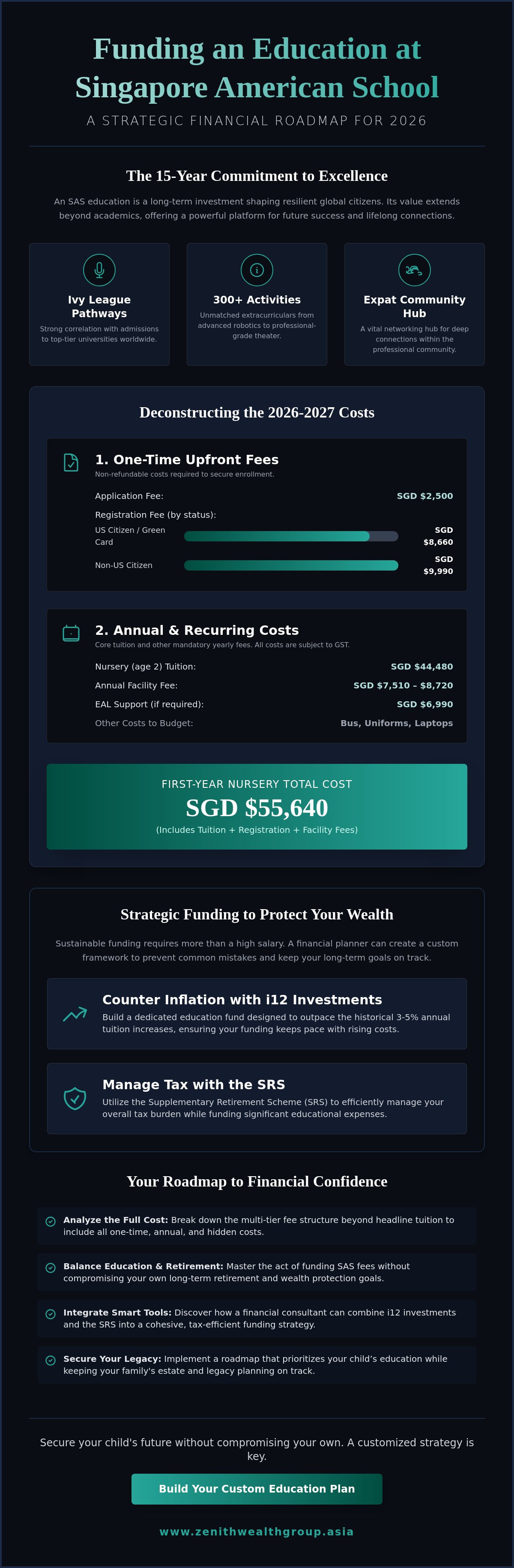
Most families look at the headline tuition figure and stop there. That's a mistake. For the 2026-2027 academic year, the singapore american school fee structure is a multi-tiered commitment. It begins before your child even sets foot in a classroom. You'll start with a non-refundable application fee of SGD $2,500. Once accepted, the one-time registration fee depends on your status. US passport or Green Card holders pay SGD $8,660, while non-US families pay SGD $9,990. These initial hurdles are just the entry point.
The annual tuition itself varies significantly by grade level. For a child entering Nursery at age two, the tuition is SGD $44,480. However, the first-year total often hits SGD $55,640 when you include the mandatory registration and facility fees. As students move from the Early Learning Center into High School, these numbers naturally climb. You must also account for the annual facility fee, which currently ranges between SGD $7,510 and SGD $8,720. This fee is included in your annual invoice and is vital for maintaining the school's world-class campus.
Hidden costs can quickly inflate a budget if you don't track them early. School bus transport, mandatory uniforms, and technology requirements like personal laptops for older students are standard expenses. If your child requires English as an Additional Language (EAL) support, expect an additional annual fee of SGD $6,990. Every one of these costs is subject to Singapore's Goods and Services Tax (GST), which adds a significant percentage to your total educational expenditure. Planning for these variables requires a clear strategy, perhaps by utilizing the Supplementary Retirement Scheme (SRS) to manage your overall tax burden while you fund these costs.
Annual Tuition vs. One-Time Capital Levies
Registration and facility fees are non-refundable. They function as capital levies that fund ongoing campus upgrades and sustainability initiatives. It's wise to budget for annual tuition increases. Historically, these have trended between 3% and 5% per year. When you compound that over a decade of schooling, the final figure is much higher than today's rates suggest. This is why many families use i12 investments to build a dedicated education fund that aims to outpace this specific inflation.
Incidental Expenses and Extracurricular Budgeting
Don't overlook the cost of the "Interim" program in High School. These global travel experiences are transformative but come with separate price tags. Competitive sports travel, specialized coaching, and private music lessons also add up. A financial consultant can help you audit these variables. They ensure your singapore american school journey doesn't compromise your wealth protection goals. If you're feeling overwhelmed by the math, we're ready to help you build a bespoke roadmap.
The Balancing Act: SAS Tuition vs. Retirement Planning
"Can I afford the singapore american school and still retire in Singapore?" This is the most common question we hear from expat families. It's a tough balancing act. When you spend over SGD $50,000 a year on tuition, you aren't just paying for school. You're also losing the potential growth that money could have earned in a retirement fund. Over a decade, that opportunity cost can run into the hundreds of thousands. Compounding works both ways, and every dollar spent today is a dollar that won't be growing for your future.
To understand the scale of this commitment, it's helpful to look at the Singapore Ministry of Education's 2024-2026 school fees. Even with recent increases for non-citizens, government-aided schools cost significantly less than private international options. Choosing SAS means you're prioritizing a specific "Educational ROI" for your child. This investment in their future is a cornerstone of many family legacy plans. However, it must be balanced with robust wealth protection to ensure your own financial security isn't the price of their education.
The Risk of Underfunding Your Future
High education costs often lead to "retirement drift." This is a quiet danger where your retirement date slowly moves further away because your savings can't keep up with your spending. Many families find themselves "cash-poor" despite high salaries because so much liquidity is tied up in termly fees. Maintaining an emergency fund is critical during these high-tuition years. You don't want to be forced to liquidate long-term assets during a market downturn just to pay for 10th grade. For a deeper look at protecting your golden years, see our guide on retirement planning in Singapore.
Using Cash Flow Management to Bridge the Gap
Optimizing your monthly take-home pay is the first step to staying on track. This might involve debt restructuring to lower interest payments or adjusting your tax strategy. A professional financial planner can run simulations to show how different funding levels impact your net worth over twenty years. They might suggest incorporating i12 investments to create a targeted growth vehicle for education while keeping your retirement assets separate. These simulations provide the clarity you need to move forward with confidence. You'll know exactly how much you can spend on SAS without sacrificing your own financial freedom. It's about making informed choices today to protect your lifestyle tomorrow.
Strategic Funding Options: From SRS to i12 Investments
Funding a singapore american school education requires more than a simple savings account. It demands a sophisticated approach that leverages local tax advantages and global market growth. While the tuition costs are high, the tools available in Singapore can help you manage the cash flow without draining your long-term wealth. The key is to move from passive saving to active, strategic investing.
Many families choose between endowment policies and direct investment portfolios. Endowments offer a structured, disciplined way to save, often with a guaranteed component. However, direct investment portfolios usually provide the flexibility and growth potential needed to outpace tuition inflation. To see how these different paths might look over a decade, you should use an investment calculator to project your potential growth. This helps you visualize the difference between a 2% return and a 6% return on your education fund.
Leveraging the SRS for Tax Efficiency
The Supplementary Retirement Scheme (SRS) is a powerful tool for any expat in Singapore. As of 2026, foreigners can contribute up to SGD $35,700 annually, while Singapore Citizens and PRs can contribute SGD $15,300. Every dollar you contribute reduces your taxable income, up to the SGD $80,000 personal income tax relief cap. It's a smart move. By lowering your tax bill, you effectively "find" extra capital that can be redirected toward school fees. For a deeper dive into these mechanics, read our guide on Mastering the SRS Account. Keep in mind that the statutory retirement age for penalty-free withdrawals rises to 64 on July 1, 2026, making long-term planning even more critical.
I12 Investments: A Framework for Education Growth
Traditional portfolios sometimes lack the specific focus needed for education funding. This is where i12 investments come in. These rule-based investment solutions provide a structured framework for mid-to-long-term goals. They allow for portfolio diversification that can hedge against the rising costs of a singapore american school education. By setting up automated contribution plans, you ensure your education fund grows steadily without requiring daily management. It's about being proactive. If you want to see how these strategies fit your specific family goals, speak with a financial planner today to build your custom roadmap.
How a Financial Planner Secures Your Child’s Academic Future
DIY financial planning often hits a wall when faced with the ultra-premium costs of the singapore american school. It's simple enough to track a monthly bill. It's much harder to project how that bill impacts your net worth over fifteen years. A financial planner brings the specialized tools needed to run these complex simulations. We look far beyond the next semester. We integrate your child's academic future with your legacy and estate planning goals. This ensures a world-class education doesn't come at the expense of your family's long-term security.
Zenith Wealth operates as your Modern Professional Guide. We value personal connection over cold, institutional processes. Our team acts as a proactive partner. We grow alongside your family as your needs evolve. Regular reviews are essential because tuition fees at SAS have a history of rising. Your investment strategy must keep pace. We ensure your roadmap remains relevant; we adjust for inflation and shifting family priorities so you never feel adrift.
The Zenith Approach to Education Funding
Our process is built on four clear pillars. First is Discovery. We learn about your values and your child's specific timeline. Second is Analysis. This is where we evaluate targeted vehicles like i12 investments to see how they fit your risk profile. Third is Implementation. We set the strategy in motion with precision. Finally, we provide ongoing Servicing. We also prioritize wealth protection as a core component. This ensures school fees are covered even if the unforeseen happens. Transparency is our foundation. You'll always have a clear, action-oriented view of your progress.
Start Your 2026 Planning Today
The 2026-2027 admissions cycle for the singapore american school will be here sooner than you think. Don't wait until the application deadline to look at the math. Starting the conversation now gives you a significant advantage. You can build a robust funding buffer before that first invoice arrives. We invite prospective parents to a non-obligatory consultation. It's a chance to see how a bespoke strategy can offer you true peace of mind. Contact a Zenith financial planner today to begin your journey.
Take Command of Your Family's Financial Legacy
Securing a spot at the singapore american school is a proud milestone for any family. It's a commitment to excellence and global opportunity. However, long-term success depends on a strategy that looks beyond the next tuition bill. You've seen how to map out total costs, leverage the SRS for tax efficiency, and use i12 investments to outpace inflation. These steps ensure your child's education doesn't compromise your own retirement freedom.
As authorized representatives of finexis advisory Pte Ltd, we provide specialized expertise in SRS optimization and holistic legacy planning. We focus on the unique needs of high-net-worth expat families. We don't just manage assets. We build roadmaps that protect your wealth across generations. Our team is ready to help you navigate these complex variables with quiet confidence and clarity.
Your future shouldn't be left to chance. Book a consultation with a Zenith financial planner to secure your child’s education. Let's start a conversation today to ensure your family's financial health remains as bright as your child's academic prospects.
Frequently Asked Questions
How much is the tuition at Singapore American School for the 2026 academic year?
Tuition fees for the 2026-2027 academic year range from SGD $46,530 to $61,690 depending on the grade level. For a child entering Nursery at age two, the annual tuition is SGD $44,480. However, first-year families should budget for a total of SGD $55,640 to include one-time registration fees and the annual facility fee. These costs place the school in the ultra-premium price band in Singapore.
Does Singapore American School offer any financial aid or scholarships?
Singapore American School is a non-profit institution and does not typically offer merit-based scholarships. They do maintain a restricted financial aid program designed to support currently enrolled families who face unexpected financial hardship. It's important to check the school's official admissions portal for specific eligibility criteria and application deadlines for the 2026 cycle before you begin the enrollment process.
Can I use my CPF to pay for Singapore American School tuition?
No, you cannot use CPF savings to pay for international school fees. The CPF Education Loan Scheme is only available for approved courses at local universities and polytechnics. Expats and locals alike must use private cash flow, employer education allowances, or dedicated investment portfolios to fund their children's education at the singapore american school. This makes early cash flow planning essential.
What are the most tax-efficient ways for expats to save for SAS fees?
The Supplementary Retirement Scheme (SRS) remains the most effective tax-saving tool for expats. As of 2026, foreigners can contribute up to SGD $35,700 each year to reduce their taxable income. While these funds are meant for retirement, the tax savings you generate can be redirected to cover school fees. Using this alongside a robust investment strategy helps maximize your total family wealth while paying for premium schooling.
How does SAS tuition compare to other international schools like UWCSEA or Tanglin Trust?
SAS sits at the top of the ultra-premium tier with an average annual cost of SGD $57,500. While schools like UWCSEA and Tanglin Trust also have high fees, SAS often has a more complex one-time fee structure, including registration fees that vary by nationality. For example, non-US passport holders pay a higher one-time registration fee of SGD $9,990 compared to the SGD $8,660 paid by US citizens.
What happens to my education fund if we leave Singapore unexpectedly?
The portability of your funds depends on how you've invested them. A bespoke investment portfolio or an i12 investments framework is typically very portable and can be managed from anywhere in the world. However, some local insurance-based endowment plans might have high surrender penalties or tax implications if you close them early. A financial planner can help you choose a structure that remains flexible for a global expat lifestyle.
Is it better to use an endowment plan or an investment portfolio for SAS fees?
Investment portfolios generally offer higher growth potential and the flexibility needed to keep up with rising tuition inflation. Endowment plans offer a disciplined savings structure but often come with lower returns and less liquidity. Many families now prefer rule-based solutions like i12 investments because they provide a clear framework for growth while allowing you to access capital when those large semester invoices arrive.
Should I consult a financial planner before applying to SAS?
Yes, consulting a financial planner is a smart move to ensure your child's education doesn't derail your retirement. A professional can run simulations to show how these fees impact your long-term wealth and wealth protection goals. They'll help you build a roadmap that balances these high costs with tax-efficient strategies. It's about finding peace of mind before you make a twenty-year financial commitment to the singapore american school.


