

Did you know that with inflation hitting 3.08% in May 2026, every idle Rupiah in your bank account is effectively losing value as we speak? It's a heavy realization. Most investors in Jakarta and beyond feel the constant pressure of IDR volatility and the uncertainty of which sectors are truly defensive. Building a recession-proof investment portfolio Indonesia isn't just a luxury anymore; it's a necessity for anyone serious about wealth protection. You deserve to know that your hard-earned capital is working as hard as you do.
We're here to help you transform that economic anxiety into a proactive strategy. You'll learn exactly how to safeguard your wealth using the same professional frameworks and diversification tactics used by a seasoned financial planner. This guide introduces the i12 investments approach to balance local stability with global opportunities. We'll walk through a clear roadmap for rebalancing your assets and identifying which Indonesian sectors hold their value best. By the end, you'll have the knowledge to secure your retirement and legacy plans with total confidence.
Key Takeaways
- Identify the specific 2026 triggers, from global trade shifts to local inflation, that could threaten your current asset allocation.
- Master the core pillars of building a recession-proof investment portfolio Indonesia by diversifying your reach beyond the local Jakarta market.
- Discover how the i12 investments framework helps you filter for high-quality assets designed to withstand significant market volatility.
- Learn the practical rebalancing steps needed to reduce debt exposure and protect your capital during economic downturns.
- Find out how a professional financial consultant can help you navigate cross-border regulations to secure your long-term legacy planning.
Understanding the 2026 Economic Climate in Indonesia
In a mature market, a recession is strictly defined as two consecutive quarters of negative GDP growth. For an emerging powerhouse like Indonesia, the definition feels different. Even when GDP stays positive, a "growth recession" can occur. This happens when the economy expands too slowly to create enough jobs or when inflation outpaces wage growth. Real resilience is about protecting your purchasing power when the local landscape shifts. Building a recession-proof investment portfolio Indonesia requires looking beyond simple growth numbers to find true stability.
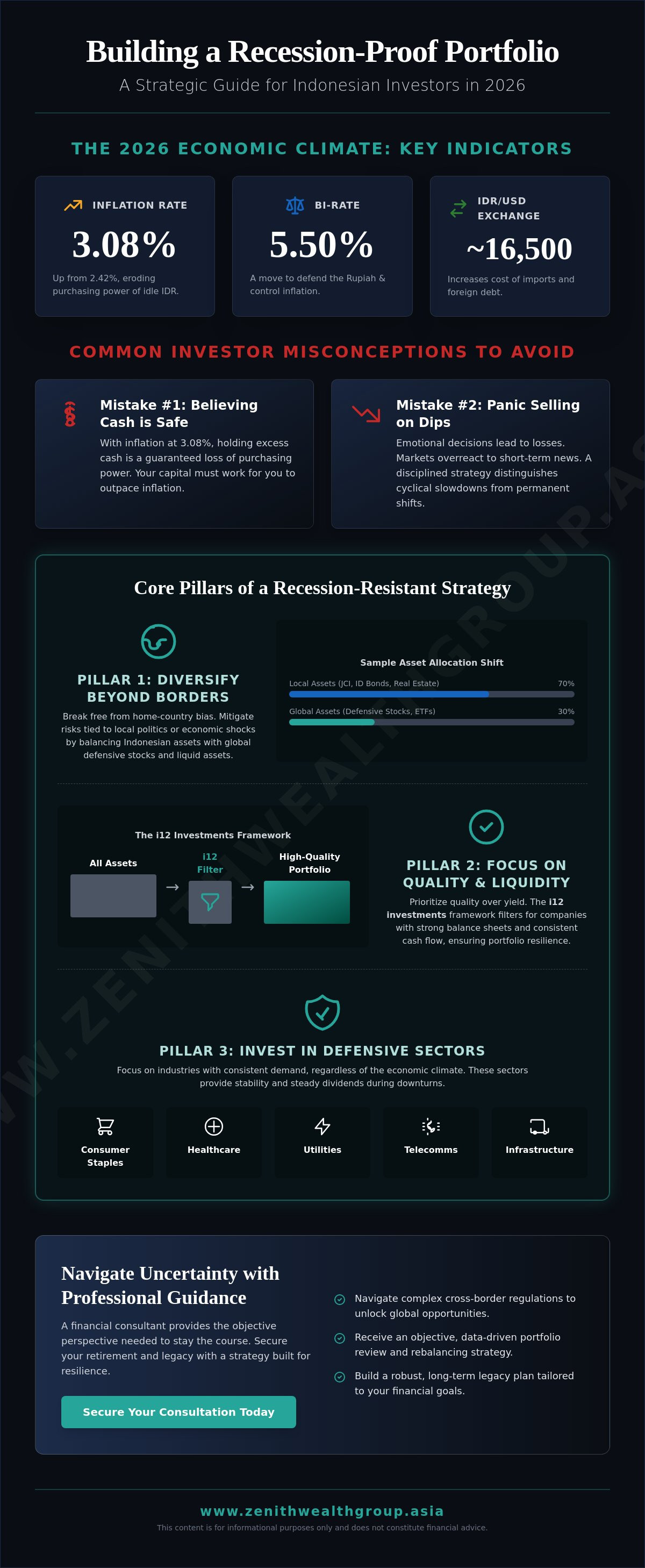
The triggers for 2026 are already visible. We're seeing a complex mix of global trade shifts and local price pressures. As of May 2026, Indonesia's annual inflation rate climbed to 3.08%. While this is within a manageable range, the upward trend from 2.42% in April signals a need for caution. Global energy costs and supply chain adjustments continue to test our domestic markets. A truly "recession-proof" strategy isn't about eliminating risk entirely. It's about managed resilience. You want a portfolio that can take a punch and keep moving forward.
Currency volatility is the most immediate hurdle for many. With the Rupiah projected to hover around IDR 16,500 per USD, the cost of imported goods and foreign debt rises. This volatility can erode your local investment returns quickly if you aren't prepared. This is where professional frameworks like i12 investments become essential. They provide a structured way to balance local assets with global hedges, ensuring your wealth isn't tied solely to the fate of a single currency.
Key Indicators for Indonesian Investors
Watch Bank Indonesia closely. The recent BI-Rate hike to 5.50% in June 2026 shows a clear move to defend the Rupiah and control inflation. These rate decisions directly impact bond yields and borrowing costs for local companies. You should also study Indonesia's Economic Landscape to understand how global commodity prices, like coal and palm oil, correlate with the Jakarta Composite Index. Domestic consumption remains our biggest buffer. When global trade slows, the spending habits of 280 million people keep the local engine running.
Common Misconceptions About Market Downturns
Many investors think cash is the ultimate safe haven. It's a dangerous trap. With inflation at 3.08%, holding too much cash means you're losing money every day. Another mistake is panic selling during a regional correction. Markets often overreact to short-term news. You need to distinguish between a cyclical slowdown, which is a natural part of the business cycle, and a structural shift that changes the economy permanently. A financial consultant can help you spot these differences. They provide the objective perspective needed to stay the course when others are rushing for the exit. Don't let temporary noise derail your long-term legacy.
Core Pillars of a Recession-Resistant Strategy
Relying solely on the Jakarta Composite Index (JCI) is a common mistake for local investors. While the JCI offers exposure to Indonesia's growth, it's often heavily weighted toward commodities and traditional banking. This concentration can be a liability during a downturn. Success in building a recession-proof investment portfolio Indonesia starts with breaking free from home-country bias. You need a mix of high-yield Indonesian bonds, currently buoyed by the 5.50% BI-Rate, paired with global defensive stocks that offer a safety net when local markets fluctuate.
Quality must always come before yield in 2026. Speculative stocks or unrated corporate bonds might look tempting, but they're often the first to crumble under pressure. Focus on investment-grade assets. The i12 investments framework is particularly useful here. It helps filter for companies with strong balance sheets and consistent cash flows. Liquidity is your other secret weapon. You must ensure you have access to funds without being forced to sell assets at a loss when the market dips. It's about having the right cash at the right time.
Diversification Beyond Borders
Spreading your capital across different geographies is vital. It mitigates risks tied to local political shifts or specific economic shocks in Southeast Asia. Balancing your Indonesian real estate with global liquid assets ensures you aren't "house poor" during a crisis. Understanding the core principles of diversification allows you to build a truly global shield for your wealth. A financial consultant can help you identify these non-correlated assets to keep your portfolio steady. We invite you to start a conversation about your global reach today.
Focusing on Defensive Sectors
Some industries simply don't stop. Consumer staples, healthcare, and utilities remain resilient because people still need food, medicine, and electricity, regardless of the economy. In Indonesia, the telecommunications and infrastructure sectors also show remarkable stability. These stocks provide the steady dividends needed to weather any storm. If you're feeling uncertain about your current sector weightings, it might be time to consult with a financial planner for a professional review of your strategy. Let's make sure your plan is ready for whatever 2026 brings.
The Role of i12 Investments in Portfolio Resilience
Investing isn't just about picking winners. It's about surviving the losers. When markets turn volatile, most investors let emotion drive their decisions. They buy at the peak and sell in a panic. The i12 investments framework changes that. It's a structured, rule-based approach to wealth management that takes the guesswork out of the equation. By using data-driven signals, it helps you maintain a steady hand while building a recession-proof investment portfolio Indonesia. It's about discipline, not just luck.
This systematic framework filters for high-quality, low-volatility global assets. It looks for companies that aren't just growing, but are built to last. Integrating i12 investments with your local wealth protection goals creates a powerful dual-track strategy. You get the stability of Indonesian defensive sectors and the resilience of global leaders. This balance is critical for protecting your capital against regional shocks. It ensures your long-term plans stay on track, regardless of short-term market noise.
Strategic Asset Selection via i12
The i12 methodology focuses on global leaders that maintain earnings even during economic contractions. These aren't speculative plays. They're established entities with "moats" around their businesses. One of the biggest advantages for Indonesian residents is how the framework handles currency. In a world where the Rupiah is projected at IDR 16,500 per USD, currency hedging is vital. You can apply this methodology to your broader strategic investment management to ensure your purchasing power remains intact across borders. It's a proactive way to manage global exposure.
Risk Mitigation Through Frameworks
Data doesn't have feelings. That's why it's so effective. A data-driven framework allows you to adjust your exposure before a recession fully manifests. It uses leading indicators to signal when to move toward defensive positions. This is why "stress testing" your portfolio against various 2026 scenarios is so important. Even though the World Bank's economic outlook for Indonesia suggests the economy remains resilient, downside risks always exist. Building a recession-proof investment portfolio Indonesia requires a plan for those risks. A financial planner is essential for executing this framework correctly. They help you stay aligned with the rules of the system, ensuring you don't make costly emotional mistakes when the headlines get loud.
Practical Steps to Rebalance Your Portfolio
A static strategy is a vulnerable strategy. As economic conditions shift, your asset mix often drifts away from your original goals. Building a recession-proof investment portfolio Indonesia requires a disciplined rebalancing process. You need to look at your holdings through the lens of the 2026 economic climate. This means conducting a fresh risk profile assessment. What worked in a low-interest-rate environment won't necessarily protect you today. It's time to be honest about where your capital is tied up.
Start by identifying over-leveraged positions. With the Bank Indonesia BI-Rate now at 5.50%, the cost of debt has climbed significantly. High leverage can turn a minor market dip into a major capital loss. Reducing this exposure is a priority. Once you've cleared the clutter, implement Dollar-Cost Averaging (DCA). This method allows you to capitalise on lower entry points during market volatility without the stress of timing the bottom. It's a key part of the i12 investments philosophy of systematic, unemotional growth.
Finally, don't overlook your safety net. Review and update your wealth protection measures to ensure they align with current inflationary pressures. Protecting what you've already built is just as important as finding new opportunities. It's about maintaining your standard of living regardless of market cycles.
Step 1: The Health Check
Evaluate your current debt-to-equity ratio. Rising interest rates mean that servicing loans takes a bigger bite out of your returns. You also need a robust emergency fund. Aim for at least 6 to 12 months of Indonesian living expenses held in accessible accounts. An ideal recession-ready liquidity ratio for 2026 involves maintaining at least 15% of your total portfolio in highly liquid, cash-equivalent assets to ensure immediate accessibility. This buffer keeps you from being a forced seller when prices are low.
Step 2: Tactical Rebalancing
Look for overvalued growth stocks that have had their run. It's often wise to rotate these gains into defensive value positions that offer better stability. Gold and alternative assets also play a vital role in 2026. They serve as a necessary hedge against IDR devaluation, especially with the Rupiah projected at IDR 16,500 per USD. Use an investment calculator to project how these shifts impact your long-term growth despite short-term dips. If you're ready to fine-tune your strategy, reach out to a financial planner for a personalized portfolio review. We're here to help you navigate these adjustments with confidence.
Securing Your Legacy: Why Professional Guidance Matters
Recession-proofing isn't just about surviving the next few quarters. It's about ensuring your vision for the future remains intact. Many investors feel a quiet anxiety when headlines turn sour. They worry that a market dip might erase years of hard work. Building a recession-proof investment portfolio Indonesia is the first step toward a much larger goal. It's about moving from a state of worry to a state of clear, decisive action. You deserve the peace of mind that comes from a professional financial roadmap.
Navigating the financial ties between Indonesia and Singapore requires specific expertise. Cross-border regulations are constantly evolving. A financial consultant provides the clarity needed to manage assets across these jurisdictions without falling into tax or compliance traps. They help you look past the immediate noise of the 2026 economy to focus on legacy planning. This long-term perspective ensures that your wealth serves your family for decades, not just until the next market cycle ends.
Investment as a Tool for Generational Wealth
A recession shouldn't be allowed to derail your children’s future. Proper asset structuring ensures that your i12 investments strategy supports long-term goals like education funding. In Indonesia, this means choosing assets that can withstand local economic shifts while providing consistent growth. We look at how to shield your heirs from the impact of IDR volatility. A comprehensive legacy plan also incorporates insurance and wealth protection. These tools act as a final safety net. They ensure your capital transfers smoothly to the next generation, regardless of the global climate.
The Zenith Wealth Approach
We believe in human interaction over institutional coldness. Our team provides tailored solutions for pre-retirees and business owners who need more than just generic advice. We're committed to professional integrity and modern standards. Building a recession-proof investment portfolio Indonesia is a collaborative process. We work alongside you to understand your specific fears and aspirations. The path to financial resilience starts with a single conversation. We invite you to reach out for a personalised portfolio review today. Let’s look at your current holdings and build a strategy that stands the test of time. Zenith Wealth is here to ensure your door to a secure future stays open.
Take Control of Your Financial Resilience Today
The economic landscape of 2026 presents unique challenges, but it also offers clear opportunities for those prepared to act. By embracing the data-driven i12 investments methodology, you can bridge the gap between local Indonesian stability and global growth. Success in building a recession-proof investment portfolio Indonesia isn't a one-time event. It's a continuous process of rebalancing and refining your strategy to protect your purchasing power against currency volatility and inflation. Your wealth deserves a strategy that's as dynamic as the market itself.
You don't have to navigate these complexities alone. As authorized representatives of finexis advisory Pte Ltd, we specialize in regional wealth management across Indonesia and Singapore. Our team is ready to help you move from economic anxiety to a proactive, professional roadmap. Secure your financial future; contact a Zenith Wealth financial consultant today. We look forward to starting this conversation and growing alongside you. Your legacy is worth protecting. Let's make sure it's ready for whatever comes next.
Frequently Asked Questions
Is gold a good investment for a recession in Indonesia in 2026?
Gold acts as a reliable hedge against currency devaluation and global market volatility. With the Rupiah projected to hover around IDR 16,500 per USD, holding gold helps preserve your domestic purchasing power. It doesn't offer high growth, but it serves as a stable anchor for your capital when other assets face pressure. You should consider it a defensive component of your broader wealth protection strategy.
How much cash should I hold during an economic downturn?
You should maintain an emergency fund that covers at least 6 to 12 months of your Indonesian living expenses. For your investment strategy, a liquidity ratio of 15% in cash-equivalent assets is ideal for 2026. This buffer ensures you aren't forced to sell long-term investments at a loss to cover immediate needs. It also gives you the flexibility to capitalize on new opportunities when prices drop.
What are the safest sectors to invest in within the Indonesian market?
Consumer staples, healthcare, and utilities are historically the most resilient sectors due to steady domestic demand. These industries provide essential services that people continue to use regardless of the economic climate. Telecommunications also remains a strong defensive play in the region. Focusing on these areas is a fundamental step in building a recession-proof investment portfolio Indonesia for long-term stability.
Can a financial consultant help me rebalance my portfolio for a recession?
A financial consultant provides the objective, data-driven analysis needed to identify over-leveraged positions in your portfolio. They help you adjust your strategy as the BI-Rate sits at 5.50%, ensuring your debt levels remain manageable. They're also essential for navigating the complex cross-border regulations between Indonesia and Singapore. Their guidance helps you transition from emotional reacting to proactive, professional management.
How does the i12 investments framework protect my capital?
The i12 investments framework uses a systematic, rule-based approach to filter for high-quality global assets with low volatility. It removes the emotional bias that often leads to panic selling during a regional market correction. This methodology is a core component of building a recession-proof investment portfolio Indonesia. It ensures your capital is allocated to companies with the balance sheet strength to withstand economic contractions.
Should I stop investing in my retirement plan during a recession?
Stopping your contributions is usually a mistake because it prevents you from using Dollar-Cost Averaging to buy assets at lower prices. Continuing to invest during a downturn allows you to lower your average cost and potentially accelerate your recovery when the market rebounds. Your retirement plan is a long-term commitment. Consistency is often the most effective tool for reaching your eventual financial goals.
What happens if the IDR weakens significantly against the USD?
A weakening Rupiah reduces your international purchasing power and increases the cost of imported goods and services. You can mitigate this risk by diversifying into USD-denominated global assets as part of your i12 investments strategy. This creates a natural currency hedge for your wealth. It ensures that your long-term plans remain viable even if the local currency faces significant downward pressure.
How do I protect my children’s education fund from market volatility?
Protecting an education fund requires shifting toward lower-risk, diversified assets as your child approaches university age. You should balance local Indonesian holdings with global defensive stocks to prevent a single regional downturn from erasing your progress. Regular reviews with a financial planner can help you adjust your risk exposure over time. It's about ensuring the capital is there exactly when it's needed.


