
The dream of retiring in Thailand is real. The lifestyle, the culture, the cost of living relative to Western countries — it genuinely delivers. But here's what most expats discover too late: getting the visa is the easy part. The harder work is building the financial architecture that actually keeps you there, comfortably and securely, for decades to come. Retirement planning for expats in Thailand isn't just about hitting a bank balance threshold; it's about constructing a multi-jurisdictional strategy that protects your wealth no matter what the Thai baht does next month or next year.
You already know this is more complex than retiring at home. Currency swings can quietly erode your monthly income, private hospital costs climb faster than most people budget for, and the visa financial requirements demand a structure that's both compliant and flexible. Those concerns are valid, and they deserve a serious answer.
This guide cuts through the complexity. Drawing on the cross-border wealth management expertise of Zenith Wealth Group and the portfolio discipline of i12 investments, you'll walk away with a clear, practical roadmap covering income stability, visa-compliant financial structures, and legacy protection across borders. Let's build your plan properly.
Key Takeaways
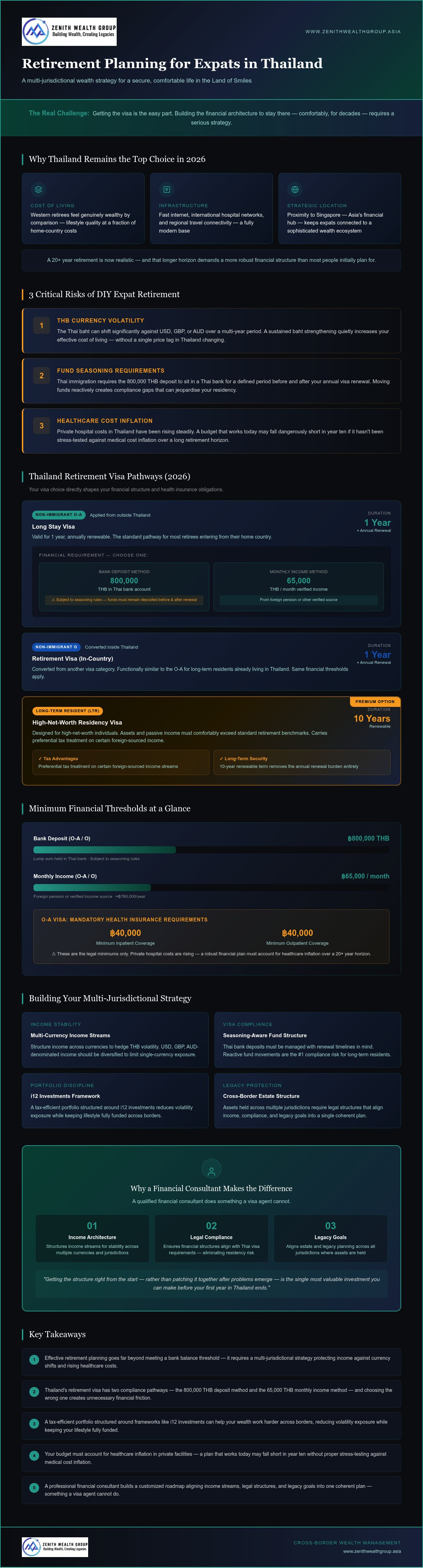
- Effective retirement planning for expats in Thailand goes far beyond meeting a bank balance threshold — it requires a multi-jurisdictional financial strategy that protects your income against currency shifts and rising healthcare costs.
- Thailand's retirement visa has two compliance pathways — the 800,000 THB deposit method and the 65,000 THB monthly income method — and choosing the wrong one for your situation can create unnecessary financial friction.
- Your cost of living varies dramatically depending on whether you settle in Bangkok, Chiang Mai, or Phuket, and your budget must account for both essential expenses and the healthcare inflation that catches most expats off guard.
- A tax-efficient portfolio structured around frameworks like i12 investments can help your wealth work harder across borders, reducing exposure to volatility while keeping your lifestyle fully funded.
- A professional financial consultant does something a visa agent cannot — they build a customized roadmap that aligns your income streams, legal structures, and legacy goals into one coherent plan.
Retirement Planning for Expats in Thailand in 2026
Thailand hasn't lost its appeal. If anything, the country has sharpened its edge as a retirement destination in 2026, offering a combination of modern infrastructure, world-class private healthcare, and a cost of living that still makes Western retirees feel genuinely wealthy by comparison. But the expats arriving today are different from those who came a decade ago, and the financial landscape they're stepping into demands a sharper strategy.
The 2026 Expat Profile: Why Thailand Remains Top Choice
The modern expat isn't just someone chasing cheap beach living. They're a global citizen with multi-currency income streams, cross-border assets, and financial obligations that span two or more countries simultaneously. Thailand earns its top-tier status not just through lifestyle, but through geography. Its proximity to Singapore, one of Asia's most significant financial and regulatory hubs, makes it uniquely practical for expats who need to keep one foot in a sophisticated financial ecosystem while living affordably in the region.
The infrastructure gap that once made expat life complicated has largely closed. Fast internet, international hospital networks, and seamless regional travel have made Thailand a genuinely liveable base for a 20-plus year retirement. That's the good news. The challenge is that a longer, more comfortable retirement costs more than most people initially plan for.
Common Pitfalls in DIY Expat Retirement
The "lifestyle-first" approach is the most common trap. Expats fall in love with the idea of Thailand, run rough numbers, and then build a financial plan backwards from a monthly budget. That approach tends to ignore three critical risks:
- THB currency volatility: The Thai baht can shift meaningfully against major currencies over a multi-year period. If your income arrives in USD, GBP, or AUD, a sustained baht strengthening quietly increases your effective cost of living without changing a single price tag in Thailand.
- Fund seasoning requirements: Thai immigration requires that the 800,000 THB deposit sit in a Thai bank account for a defined period before and after your annual visa renewal. Failing to understand this seasoning rule, or moving funds in and out reactively, creates compliance gaps that can jeopardize your residency.
- Healthcare inflation in private facilities: Private hospital costs in Thailand have been rising steadily. A budget that works today may fall short in year ten if it hasn't been stress-tested against medical cost inflation over a long retirement horizon.
This is precisely where retirement planning for expats in Thailand stops being a spreadsheet exercise and becomes a professional discipline. A qualified financial consultant bridges the gap between the assets you've built at home and the life you're building here, structuring income, compliance, and protection into a single coherent plan rather than a collection of improvised decisions.
Getting that structure right from the start, rather than patching it together after problems emerge, is the single most valuable investment you can make before your first year in Thailand ends.
Understanding Financial and Visa Requirements for 2026
Getting your visa right isn't a formality. It's the legal foundation your entire retirement rests on. And in 2026, the requirements are more structured than ever, which means the margin for error has narrowed considerably. Understanding exactly what Thai immigration expects, and planning your finances around those expectations well in advance, is where solid retirement planning for expats in Thailand actually begins.
Choosing the Right Visa Pathway
Three visa options sit on the table for most retirees, and each carries different financial implications.
- Non-Immigrant O-A (Long Stay): Applied for from outside Thailand, typically at a Thai consulate in your home country. Valid for one year with annual renewals. Requires either the 800,000 THB bank deposit or proof of a monthly income of 65,000 THB from a foreign pension or other verified source.
- Non-Immigrant O (Retirement): Converted inside Thailand from another visa category. Functionally similar to the O-A for long-term residents, but the application pathway differs. Many expats already living in Thailand use this route.
- Long-Term Resident (LTR) Visa: Introduced to attract high-net-worth individuals, the LTR offers a ten-year renewable visa with a significantly different financial threshold. It's worth a serious look if your assets and passive income comfortably exceed standard retirement visa benchmarks, as it also carries preferential tax treatment on certain foreign-sourced income.
Your visa choice directly shapes your mandatory health insurance obligations. The O-A visa requires inpatient coverage of at least 40,000 THB and outpatient coverage of at least 40,000 THB per year from a Thai-approved insurer. The LTR has its own health coverage requirements. Choosing the wrong pathway without accounting for these insurance costs can quietly inflate your annual overhead.
Financial Proof: Beyond the Bank Balance
The 800,000 THB deposit method is straightforward in concept but genuinely tricky in execution. Thai immigration requires those funds to be held in a Thai bank account, seasoned for a defined period before your renewal date, and maintained at that level for a period after renewal as well. This isn't a one-time transfer. It's an ongoing cash management discipline.
The income method, 65,000 THB per month from a verifiable foreign source, suits retirees with reliable pension income. But documenting that income for Thai immigration authorities requires more than a bank statement. Consular income letters, official pension documentation, and in some cases notarised translations are all part of the process.
This is where a financial consultant adds real, practical value. Structuring your cash flow so the seasoning requirement is always met, without locking up capital that should be working in a portfolio like i12 investments, requires forward planning across a six-to-twelve month window. It's not complicated once you have a system, but building that system correctly from the start saves considerable stress at renewal time.
If you'd like to map out a compliant, efficient structure before your next visa cycle, speak with the team at Zenith Wealth Group to get the conversation started.
Calculating Your Retirement Budget: Cost of Living and Healthcare
Numbers on a spreadsheet feel reassuring. The problem is that most expat retirement budgets are built around today's prices, today's exchange rate, and today's health. A plan that doesn't account for how those three variables shift over a 20-year retirement isn't really a plan. It's a starting point with an expiry date.
The first discipline of serious retirement planning for expats in Thailand is building a budget that grows with you, not one that flatlines at your current lifestyle cost.
Essential vs. Discretionary Spending: Know the Difference
Separating your non-negotiable costs from your lifestyle costs gives you real financial clarity. Essential monthly expenses typically include rent or housing costs, utilities, groceries, local transport, health insurance premiums, and visa-related fees. Discretionary spending covers dining out, travel, leisure activities, and home-country visits.
The split matters because these two categories respond differently to economic pressure. If the baht strengthens or your portfolio has a difficult quarter, discretionary spending can flex. Essential costs cannot.
Regional Price Differences in 2026
Where you live in Thailand shapes your budget more than almost any other single decision. The differences are meaningful, not marginal.
- Bangkok: The highest cost of the three major expat hubs. Mid-range condo rentals in central districts are running between 25,000 and 50,000 THB per month in 2026, reflecting both post-pandemic demand and sustained infrastructure investment in the city. Transport, dining, and entertainment costs are proportionally higher, though so is access to the widest range of international hospitals and specialists.
- Chiang Mai: Historically the budget-friendly favourite, and still meaningfully cheaper than Bangkok. Comfortable condo rentals typically sit in the 12,000 to 22,000 THB range, though quality properties in popular expat areas have seen price pressure in recent years. The slower pace and cooler climate make it a strong choice for retirees prioritising lifestyle over connectivity.
- Phuket: The premium island option. Rental costs rival Bangkok in desirable coastal areas, and imported goods, dining, and services carry a tourism premium. Retirees choosing Phuket tend to have higher discretionary budgets and accept the trade-off consciously.
Whichever city you choose, build in an annual cost increase of 3 to 5 percent across your essential spending. That's your inflation buffer, and it's not optional. A budget that works at 60 needs a structural mechanism to still work at 75.
Healthcare Planning: The Most Critical Variable
This is where most expat retirement budgets quietly break down. Private hospital costs in Thailand have been rising at a rate that consistently outpaces general consumer price inflation. A procedure or specialist consultation that cost a certain amount five years ago is measurably more expensive today, and that trajectory shows no sign of reversing.
The shift from international health insurance to Thai-compliant policies adds another layer of complexity. The O-A visa mandates coverage from a Thai-approved insurer, which means many expats are moving away from the global policies they held during their working years. Thai-compliant policies can offer excellent coverage, but the premium trajectory changes significantly with age.
Modelling your healthcare costs honestly means thinking in three phases:
- Age 60 to 70: Relatively predictable costs. Annual premiums are manageable, and most usage is routine. This is the window to lock in coverage at the most favourable rates.
- Age 70 to 80: Premiums accelerate. Chronic condition management, more frequent specialist visits, and a higher likelihood of hospitalisation all increase costs. A budget that hasn't grown alongside this reality will start to strain.
- Age 80 and beyond: This is the phase most people refuse to model. Long-term care, mobility support, and complex treatment costs can dwarf anything in the earlier phases. Building a dedicated healthcare reserve into your broader wealth structure isn't pessimistic; it's the most practical thing you can do.
Housing and Lifestyle Choices
Thai property law restricts foreign freehold ownership of land, which changes the rent vs. buy calculation considerably. Renting offers flexibility, no capital tied up in an illiquid asset, and the freedom to relocate as your needs change. Long-term leasehold arrangements exist, but they require careful legal structuring and carry their own risks that a visa agent won't flag for you.
For retirees who maintain strong ties to their home country or travel frequently, the "home-away-from-home" lifestyle is a real and recurring cost. Annual flights, accommodation during extended home visits, and maintaining financial connections across two countries all add up. Budget for this honestly rather than treating it as an occasional exception.
Keeping your lifestyle funded across borders over decades isn't just a budgeting question. It's a wealth protection question. Structuring your assets to withstand currency shifts, healthcare inflation, and unexpected life events is exactly what a robust wealth protection strategy is designed to deliver, and it's the foundation that keeps your retirement lifestyle intact when circumstances change.
The hidden costs of expat life, including annual visa fees, health insurance renewals, home-country tax obligations, and the occasional legal or financial advisory fee, rarely appear in first-draft retirement budgets. They should. A realistic total cost of living figure is always higher than the lifestyle number alone. Build from there, and your plan will hold.
Strategic Wealth Management and Tax Efficiency for Expats
Building a comfortable life in Thailand is one thing. Making sure your wealth actually supports that life, efficiently and legally, across two or more jurisdictions simultaneously, is an entirely different discipline. This is where retirement planning for expats in Thailand moves from lifestyle planning into genuine financial architecture.
The gap most expats fall into isn't ignorance. It's fragmentation. They have assets in Singapore, income arriving in USD, a Thai bank account for visa compliance, and no coherent structure connecting any of it. Each piece works in isolation. Together, they leak value through currency conversion costs, missed tax efficiencies, and idle capital that should be growing.
Optimizing Global Assets for Local Income
If you've spent working years in Singapore, your Supplementary Retirement Scheme account is one of the most tax-efficient tools available to you. SRS contributions reduce your assessable income while the funds remain invested, and withdrawals are taxed at a discounted rate. Used strategically, the SRS can serve as a structured drawdown vehicle during your Thailand retirement, releasing income in a tax-conscious sequence rather than in reactive lump sums. The full mechanics of maximising this are covered in depth in our guide to Mastering the SRS Account, which is worth reading alongside this section.
Beyond the SRS, the i12 investments framework offers a structured approach to portfolio resilience across asset classes. Rather than concentrating exposure in a single market or currency, i12 investments helps balance growth-oriented holdings against more stable, income-generating positions. For a retiree drawing down over 20-plus years, that balance matters enormously. A portfolio that grows in good years but doesn't collapse in difficult ones is what keeps your lifestyle funded without forcing you to liquidate assets at the wrong moment.
Currency management deserves its own discipline. Holding SGD or USD in your portfolio while converting to THB only when needed gives you the flexibility to time conversions around exchange rate movements rather than being forced into unfavourable rates by a fixed monthly transfer schedule. Your financial consultant can help you establish a conversion rhythm that protects purchasing power without overcomplicating your cash flow.
Legacy and Estate Planning Across Borders
A home-country Will does not automatically govern assets held in Thailand. Thai law applies to assets on Thai soil, which means a separate Thai Will isn't optional; it's essential. Without one, the distribution of your Thai-held assets could be subject to a lengthy legal process that your beneficiaries are entirely unprepared for.
Cross-border estate complexity compounds quickly when beneficiaries are spread across different countries. Trusts, beneficiary designations, and jurisdiction-specific legal structures all need to work in concert. Our guide to Legacy Planning in Singapore addresses the cross-border protection layer in detail, and it pairs directly with what you're building here.
Getting this right isn't a one-time task. As your asset base shifts, your Thai residency matures, and your family circumstances evolve, your legacy structure needs to evolve with it. That's an ongoing conversation, not a document you file away and forget.
If you're ready to bring your global assets, income streams, and legacy goals into a single coherent plan, connect with the Zenith Wealth Group team to start building the structure your retirement deserves.
How a Financial Consultant Secures Your Thai Retirement
There's a distinction that matters enormously and gets overlooked constantly. A visa agent helps you file paperwork. A financial consultant builds the structure that keeps your entire retirement intact. These are not the same service, and conflating them is one of the most expensive mistakes expats make when planning a move to Thailand.
Visa compliance is a legal checkbox. Retirement planning for expats in Thailand is an ongoing financial discipline. One gets you through immigration. The other keeps your income flowing, your portfolio growing, and your legacy protected across decades and borders.
The difference becomes painfully clear when something shifts. Exchange rates move. Healthcare costs climb. A family circumstance changes. A visa agent has no answer for any of that. A financial consultant does, because they've already stress-tested your plan against exactly those scenarios.
The Zenith Wealth Group Advantage
Zenith Wealth Group operates as an authorised representative of finexis advisory Pte Ltd, bringing a structured, regulated framework to a market that's full of informal and fragmented advice. That matters. It means the guidance you receive isn't based on a single product or a commission incentive. It's built around your situation.
The team specialises specifically in cross-border wealth management for expats across Southeast Asia. That's not a general financial planning service with Thailand added as an afterthought. It's focused expertise in the exact challenges you're facing: multi-currency income, visa-compliant cash structures, portfolio resilience across jurisdictions, and the kind of healthcare cost modelling that most generalist planners simply don't build into their frameworks.
The i12 investments approach sits at the core of Zenith's portfolio work. Rather than reactive, market-chasing strategies, i12 investments delivers a disciplined balance between growth and stability, designed for retirees drawing down over long time horizons. That balance is what keeps your lifestyle funded in difficult market years without forcing premature asset liquidation.
What you won't get is a cold, institutional experience. The firm's ethos is genuinely human-centric. Approachable, direct, and focused on making complex financial architecture feel manageable rather than overwhelming.
Your Next Steps to Paradise
Starting is simpler than most people expect. The process begins with a discovery conversation: aligning your vision of life in Thailand with the financial reality of sustaining it for 20-plus years. From there, a portfolio audit identifies whether your current asset structure is genuinely 2026-ready, or whether it's carrying hidden risks that haven't surfaced yet.
That audit often reveals gaps that are straightforward to fix once they're visible. Idle capital that should be working. Currency exposure that hasn't been managed. A legacy structure that doesn't account for Thai-held assets. Each of those is solvable with the right guidance in place early.
Your retirement in Thailand deserves more than a visa stamp and a rough monthly budget. It deserves a plan built to last. Book a consultation with a Zenith financial consultant today and start building the structure your retirement actually needs.
Your Thai Retirement Starts With the Right Plan
Thailand genuinely delivers on its promise. But a comfortable, lasting retirement there doesn't happen by accident. It's built deliberately, through the right visa structure, a budget that accounts for healthcare inflation over decades, and a portfolio designed to fund your lifestyle without eroding your wealth along the way.
The core lesson from this guide is simple: retirement planning for expats in Thailand is a long game. The decisions you make in year one shape what's possible in year fifteen. Getting those foundations right, from income structure to legacy protection, is where the real work happens.
Zenith Wealth Group brings exactly the expertise this requires. As authorised representatives of finexis advisory Pte Ltd and specialists in cross-border wealth management, the team builds customised strategies around your situation, including tailored i12 investments approaches that keep your portfolio resilient across market cycles.
Your retirement in Thailand is worth building properly. Connect with Zenith Wealth Group today and get a financial roadmap built for the long term.
Frequently Asked Questions
How much money do I need to retire in Thailand in 2026?
There's no single answer, because your required amount depends heavily on your chosen city, lifestyle, and healthcare needs. A comfortable but modest retirement in Chiang Mai might be sustained on 50,000 to 70,000 THB per month, while Bangkok or Phuket can push that figure considerably higher. Beyond monthly living costs, you'll need either 800,000 THB held in a Thai bank account or verified foreign income of 65,000 THB per month to satisfy visa requirements.
The figure most people underestimate is the long-term total. A 20-plus year retirement with healthcare cost inflation built in requires a meaningfully larger capital base than a simple monthly budget calculation suggests. A financial consultant can model the full horizon rather than just your year-one expenses.
Can I use my Singapore CPF or SRS to fund my retirement in Thailand?
Your SRS account can be a genuinely useful drawdown vehicle during retirement planning for expats in Thailand, releasing funds in a tax-efficient sequence while the balance remains invested. CPF is more restricted; it can't be freely transferred abroad, though you can withdraw your CPF savings upon reaching the eligible age if you've renounced Singapore PR or citizenship. The rules governing both accounts are specific and worth reviewing carefully before you build your income strategy around them.
The key is sequencing your drawdowns intelligently across both accounts rather than accessing funds reactively. Getting that sequence wrong can trigger unnecessary tax exposure or leave capital sitting idle. A financial planner familiar with cross-border structures can map the optimal withdrawal order for your specific situation.
Is it better to keep my investments in Singapore or move them to Thailand?
For most expats, keeping the bulk of your investment portfolio in Singapore makes strong practical sense. Singapore offers a stable regulatory environment, a wide range of investment vehicles, and no capital gains tax, which makes it an efficient base for long-term wealth management. Moving significant assets into Thailand introduces currency concentration risk and a more limited investment landscape without a proportional benefit.
The practical approach is to maintain your growth portfolio in Singapore, use a Thai bank account only for visa compliance and day-to-day living expenses, and convert currency strategically rather than through fixed monthly transfers. That structure keeps your capital working efficiently while satisfying Thai immigration requirements.
What are the health insurance requirements for a Thai retirement visa in 2026?
The Non-Immigrant O-A visa requires health insurance from a Thai-approved insurer with minimum inpatient coverage of 40,000 THB and outpatient coverage of 40,000 THB per year. This requirement applies at the point of application and at each annual renewal. Policies that don't meet these specific thresholds or aren't issued by an approved Thai insurer won't satisfy immigration requirements, regardless of how comprehensive they appear on paper.
It's important to note that these minimums are floors, not recommendations. Given the trajectory of private hospital costs in Thailand, a policy built around the bare minimum may leave you significantly underinsured within a few years. Review your coverage level alongside your premium budget, not just the compliance checkbox.
Do I have to pay tax in Thailand on my foreign investment income?
Thailand's tax rules for foreign-sourced income have evolved, and the current framework is one that expats need to understand clearly. Thailand taxes income that is remitted into Thailand in the same tax year it is earned. Income earned in a prior year and remitted later has historically been treated differently, though this is an area where professional tax advice is essential given that rules can shift and individual circumstances vary.
The Long-Term Resident visa carries preferential tax treatment on certain categories of foreign income, which makes it worth evaluating if your asset base qualifies. Don't rely on informal expat forum advice on this topic; the consequences of getting it wrong compound over years. Speak with a financial consultant who works specifically with cross-border expat structures.
What happens to my retirement visa if the 800,000 THB deposit falls below the limit?
Falling below the 800,000 THB threshold, even temporarily, creates a compliance problem that can affect your visa renewal. Thai immigration applies seasoning rules that require funds to be present in your account for a defined period before and after your renewal date. A balance dip during that window isn't simply corrected by topping up immediately; the seasoning clock may need to restart.
The practical safeguard is treating the 800,000 THB as a hard floor, not a target balance. Keep a buffer above it and build your monthly living expenses from a separate account funded by your income stream. That separation prevents accidental compliance breaches caused by routine spending.
Is it better to rent or buy property when retiring in Thailand?
For most foreign retirees, renting is the more practical and financially flexible choice. Thai law restricts foreign freehold ownership of land, which means buying typically involves leasehold arrangements or condominium units where foreigners can hold freehold title. Condominiums are a legitimate option, but they tie up capital in an illiquid asset and introduce property market risk in a country where your residency isn't permanent by default.
Renting preserves capital that can remain invested and growing, gives you the freedom to relocate as your needs change, and avoids the legal complexity of cross-border property ownership. If you're drawn to buying, get proper legal advice on the structure before committing, not after.
How does the i12 investments approach benefit an expat in Thailand?
Retirement planning for expats in Thailand requires a portfolio that can sustain regular income withdrawals over a long time horizon without being derailed by market volatility. The i12 investments framework addresses this by balancing growth-oriented holdings against more stable, income-generating positions, so your lifestyle stays funded even in difficult market years without forcing you to liquidate assets at the wrong moment.
For an expat drawing down across 20-plus years while managing currency exposure and rising healthcare costs, that kind of structural discipline matters far more than chasing short-term returns. It's the difference between a portfolio that grows in good years and one that actually holds up when conditions get harder. Zenith Wealth Group builds this approach into the retirement strategies they develop for expats across Southeast Asia.


