

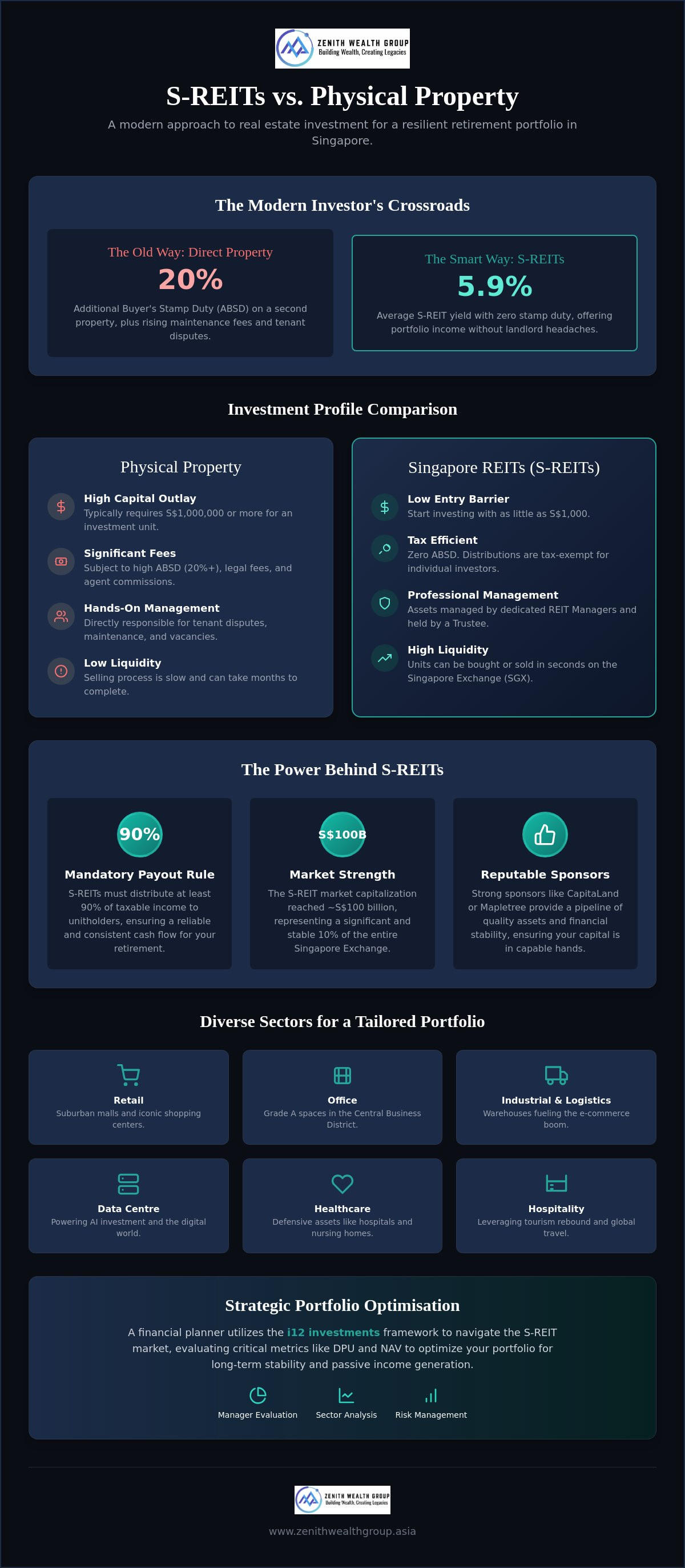
Why would you pay a 20% ABSD on a second property when the average S-REIT yield is 5.9% with zero stamp duty? For many, the dream of being a landlord is turning into a logistical nightmare of tenant disputes and rising maintenance fees. Understanding REITs in the Singapore market is no longer just for institutional players; it's the modern way to build a resilient retirement portfolio. It allows you to collect monthly income without the burdens of direct ownership.
We know you're looking for a way to secure your future without the heavy lifting of physical real estate. You want consistent payouts that outpace the 2.13% yield on 10-year government bonds without the stress of managing brick-and-mortar assets. This guide promises to simplify S-REITs and show you how they fit into a professional wealth strategy that prioritizes your peace of mind.
You'll discover how our i12 investments approach utilizes commercial and industrial sectors to generate passive income. We'll also explain how a financial consultant can help you navigate MAS gearing limits and interest coverage ratios to protect your capital. It's time to stop managing properties and start owning your time.
Key Takeaways
- Master the basics of understanding REITs in the Singapore market to bypass high ABSD and time-consuming property management.
- Learn why the mandatory 90% income distribution rule creates a reliable, tax-exempt cash flow for your retirement.
- Discover how to align S-REIT dividends with your legacy goals, from supplementing CPF LIFE to funding future education costs.
- Identify resilient assets by evaluating critical metrics like Distribution Per Unit (DPU) and Net Asset Value (NAV).
- See how the i12 investments framework allows a financial planner to optimize your portfolio for long-term stability.
What are S-REITs and Why Do They Dominate the Singapore Market?
At its core, Real Estate Investment Trusts (REITs) act as a collective investment scheme. They pool capital from thousands of investors to purchase and manage high-value properties like Ion Orchard or Mapletree Business City. For those focused on understanding REITs in the Singapore market, the primary appeal lies in the "90% Rule." To enjoy tax transparency, S-REITs must distribute at least 90% of their taxable income back to unitholders. This legal requirement effectively turns you into a co-owner of prime real estate with a consistent share of the rent.
Singapore has solidified its position as Asia's premier hub for these vehicles. By March 2026, the S-REIT market capitalization reached approximately S$100 billion, representing about 10% of the entire Singapore Exchange. A financial consultant often views these as "liquid real estate." Unlike a physical condo that takes months to sell, you can trade REIT units in seconds. This flexibility is vital for a Customized Financial Roadmap that needs to adapt to life's changes. It's about having the stability of property with the agility of a stock.
The Structure of an S-REIT
Every S-REIT operates through a professional ecosystem. The REIT Manager handles the strategic direction and acquisitions, while a Trustee holds the assets on your behalf. We look for strong Sponsors like CapitaLand or Mapletree. A reputable sponsor provides a pipeline of quality assets and financial stability. This structure removes the "landlord headache" entirely. You don't deal with leaking pipes. You don't chase rent. At Zenith, we use our i12 investments framework to evaluate these managers, ensuring your capital is in capable hands.
S-REITs vs. Physical Property in 2026
The barriers to physical property ownership have never been higher. With Additional Buyer’s Stamp Duty (ABSD) remains a significant hurdle for second properties in 2026, the initial cost is staggering. You might need S$1,000,000 or more for a decent investment unit. In contrast, you can start with as little as S$1,000 in an S-REIT. Beyond the capital, consider the liquidity. Selling a physical property involves agents, viewings, and legal fees. S-REITs offer immediate entry and exit on the SGX. This makes them a superior tool for Investment Management and retirement planning. If you're ready to explore these options, connect with our team to see how they fit your goals.
The 9 Types of REITs Available to Singaporean Investors
A common mistake when understanding REITs in the Singapore market is viewing them as a monolithic asset class. In reality, the S-REIT universe is incredibly diverse. It allows you to tailor your portfolio to specific economic trends. Whether you want the stability of a neighborhood mall or the high-growth potential of a global data hub, there's a sector for you. This variety is a key reason why the Singapore REIT Market Overview remains so compelling for local investors in 2026.
Retail REITs are perhaps the most visible. They own the suburban malls where you buy groceries and the iconic Orchard Road shopping centers. While e-commerce has changed shopping habits, well-located suburban malls remain resilient community hubs. Office REITs, on the other hand, let you capitalize on Singapore's status as a global business capital. These trusts own Grade A office spaces in the CBD, benefiting from high-quality corporate tenants and stable long-term leases.
The industrial and logistics segment has become the backbone of our digital economy. Driven by localized logistics and e-commerce growth, these properties are in high demand. Similarly, Data Centre REITs are riding the massive wave of AI investment. These specialized facilities house the servers that power our modern world. If you prefer a defensive stance, Healthcare REITs provide a buffer. They own hospitals and nursing homes, sectors that remain essential regardless of economic cycles and aging population trends.
Defensive vs. Growth REIT Sectors
Balancing yield and stability requires a strategic eye. Healthcare and suburban retail are generally considered defensive because people need medicine and groceries even during downturns. Hospitality REITs offer a different profile. They leverage the 2026 tourism rebound and are more sensitive to economic shifts. We often suggest a diversified approach. Mixing sectors ensures that a slump in one area, like office space, doesn't cripple your total income stream.
Specialised REITs and ETFs
For those seeking instant diversification, REIT ETFs are an excellent tool. They provide exposure to a basket of trusts in a single trade. While residential REITs remain a niche segment in Singapore, they offer unique exposure to the rental market. At Zenith, our financial planner team uses the i12 investments framework to select specific sectors that align with your risk profile. We don't just look at yields; we look at the underlying property quality. If you're unsure which sector fits your retirement plan, reach out for a chat to see how we can help.
Integrating REITs into Your Retirement and Legacy Plan
Many investors view property as a one-off purchase. However, understanding REITs in the Singapore market involves shifting your perspective toward long-term cash flow. S-REITs shouldn't just be an "extra" in your portfolio. They can serve as a central pillar for your Retirement Planning and Legacy Planning. One of the most significant advantages is tax efficiency. Distributions from S-REITs to individual investors in Singapore are tax-exempt. This means every dollar paid out goes straight into your pocket, unlike the taxable rental income from a physical condo.
Think about your future expenses. Maybe you're looking at Education Funding for your children or grandchildren. The dividends from a well-managed REIT portfolio can help cover high costs like SAS tuition without depleting your principal capital. When it comes to Estate planning, REIT units are much simpler to distribute among heirs than a single physical property. You can't easily split a house, but you can certainly divide units in a trust. This ensures your family continues to receive a steady income stream long after you're gone.
REITs in the Retirement Income Ladder
CPF LIFE provides a solid foundation, but it might not cover the lifestyle you want in 2026. This is where REITs bridge the gap. By calculating the required yield to meet your retirement estimates, you can build a "ladder" of income. With the average S-REIT yield at 5.9% as of late May 2026, the math often works in your favor. You can choose to reinvest dividends during your working years to benefit from compounding. Once you retire, simply switch to drawing down that cash flow. For a deeper look at this strategy, see The Complete Guide to Retirement Planning in Singapore (2026 Edition).
Protecting Wealth Through Diversification
While S-REITs are sensitive to interest rates, they also act as a powerful hedge against local inflation. As rents rise across Singapore, so do the distributions from the trusts. The MAS Regulatory Framework for REITs ensures that these vehicles operate with high transparency and strict gearing limits. Currently, the aggregate leverage is capped at 50% of total assets, providing a safety net for investors. At Zenith, we use our i12 investments methodology to ensure your portfolio isn't over-exposed to any single sector. If you want to see how this fits your specific needs, contact a financial consultant for a full portfolio review. We'll help you balance growth with Wealth Protection.
Evaluation Checklist: How to Pick Quality S-REITs
Picking the right trust requires more than just looking at the highest dividend. True mastery in understanding REITs in the Singapore market means looking under the hood at the financial engine. You want an asset that doesn't just pay out today but grows its distributions over time. Start your evaluation with the Distribution Per Unit (DPU). A rising DPU suggests the manager is successfully raising rents or acquiring better properties. If the DPU is shrinking, it's a red flag that the underlying business might be struggling.
Next, check the Net Asset Value (NAV). This tells you the value of the properties minus the trust's debt. If you're buying a REIT at a price below its NAV, you're essentially getting the real estate at a discount. However, a high premium might be justified if the management team has a stellar track record. You must also monitor the Gearing Ratio. Under the current MAS framework, S-REITs have an aggregate leverage limit of 50%. We also look for a minimum Interest Coverage Ratio (ICR) of 1.5 times. These regulations provide a safety net, ensuring the trust isn't over-leveraged in a fluctuating interest rate environment.
Qualitative Factors: The "Sponsor" Effect
The strength of the Sponsor often determines a REIT's long-term success. Giants like CapitaLand or Mapletree provide more than just a name. They offer a pipeline of high-quality properties and better access to cheap financing. A strong sponsor makes rights issues more palatable and acquisitions more seamless. Don't forget to check occupancy rates. A prime office building in the CBD is only valuable if it's full. High occupancy, combined with a long Weighted Average Lease Expiry (WALE), provides the income stability needed for a reliable retirement stream.
Common Pitfalls to Avoid
Beware the "Yield Trap." A REIT offering a 10% yield might look attractive, but if that yield is fueled by one-time gains or unsustainable debt, it won't last. You should also account for Capital Expenditure (Capex). Buildings age and need upgrades to stay competitive. If a manager ignores Capex to keep dividends high, the asset's value will eventually drop. Finally, avoid over-concentration. Even the best sector can face headwinds. Our i12 investments framework emphasizes a balanced mix to protect your wealth.
Selecting the right mix of assets is a full-time job. If you want a professional eye to audit your current holdings, connect with a financial consultant today for a tailored analysis. We'll help you build a portfolio that stands the test of time.
The Zenith Approach: Navigating REITs with i12 investments
Mastery of the S-REIT market isn't just about picking a popular name. It's about how those selections fit into a much larger Investment Management strategy. While understanding REITs in the Singapore market is a great start, the real challenge lies in the ongoing management. A professional financial planner helps you shift from reactive, DIY investing to a proactive, goal-based approach. We filter out the market noise so you can focus on the income that matters for your future. Success in 2026 requires more than just buying units; it requires a disciplined framework for asset selection.
At Zenith, we utilize the i12 investments framework to guide our strategic asset allocation. This isn't a "set and forget" model. It's a dynamic system that evaluates REIT managers, property valuations, and macroeconomic shifts in real-time. We look beyond the surface level to find managers who can sustain DPUs even during periods of volatility. By applying this structured approach, we ensure your portfolio remains resilient even when market conditions change. It's about building a foundation that supports your life goals without requiring you to watch the ticker every day.
Why Professional Advice Matters
Corporate actions like rights issues and private placements can be a significant headache for individual investors. You have to decide quickly whether to commit more capital or face dilution of your holdings. A financial consultant monitors these developments for you, providing the clarity needed to make informed choices. We also ensure your portfolio stays aligned with your Legacy Planning goals, ensuring wealth is transferred efficiently to the next generation. The i12 investments methodology provides the structured rigor needed to identify high-quality assets in a complex interest-rate environment.
Start Your Journey Today
Building a consistent income stream shouldn't feel like a second job. We invite you to start your journey with a professional review of your current holdings. This is particularly vital for pre-retirees who need to lock in their income floor. We'll help you:
- Identify "yield leaks" where high fees or poor asset quality are draining your returns.
- Align your REIT distributions with specific goals like Education Funding or retirement payouts.
- Develop a customized financial roadmap tailored to the 2026 market landscape.
We're ready to help you turn your investment goals into a reality through a human-centric approach. Speak with a Zenith financial consultant today to secure your retirement future and start a conversation about your legacy.
Your Path to Stress-Free Property Income
Success depends on a disciplined strategy rather than market timing. We utilize the i12 investments framework to ensure your portfolio remains robust against interest rate shifts. As authorized representatives of finexis advisory Pte Ltd, we are experts in Singapore retirement planning. We help you move past the guesswork of DIY investing toward a professional, customized financial roadmap that prioritizes your peace of mind.
It's time to let your capital work as hard as you do. We're ready to help you build a legacy that lasts. Secure your retirement income with a professional financial planner today. We look forward to starting this conversation with you.
Frequently Asked Questions
Are S-REIT dividends taxable for Singapore residents in 2026?
Dividends from S-REITs are generally tax-exempt for individual investors in Singapore. This makes them a highly efficient tool for retirement planning compared to physical property rental income, which is taxable. This tax-free status applies to both local and overseas properties held within the trust. It's one of the most compelling reasons for understanding REITs in the Singapore market when building long-term wealth.
What happens to my REITs if interest rates rise?
Rising interest rates usually increase borrowing costs for REITs, which can reduce the amount of income available for distribution. While higher rates might cause short-term price volatility, high-quality REITs often have hedged debt to mitigate these impacts. A financial planner can help you select trusts with strong balance sheets that can withstand these fluctuations while maintaining consistent payouts for your portfolio.
Can I use my CPF or SRS funds to invest in REITs?
You can use your CPF Ordinary Account or Supplementary Retirement Scheme (SRS) funds to invest in S-REITs. This allows you to put idle cash to work in search of yields higher than the 2.5% CPF OA floor. By incorporating REITs into your SRS strategy, you can build a tax-deferred income stream. We often include this as part of our i12 investments framework for holistic wealth management.
How much money do I need to start investing in Singapore REITs?
You can start investing in S-REITs with as little as S$1,000. Since the minimum board lot size on the SGX is 100 units, many trusts are accessible even for those just starting their journey. This low entry barrier is a major advantage over physical real estate, which requires substantial down payments and stamp duties. It makes building a diversified property portfolio achievable for most Singaporeans.
Is it better to buy individual REITs or a REIT ETF?
Individual REITs allow for targeted exposure to specific sectors like data centers, while REIT ETFs offer instant diversification across dozens of trusts. If you have high conviction in a specific manager, buying individual units might offer higher potential returns. However, an ETF reduces the risk of one trust underperforming. A financial consultant can evaluate which path best suits your risk profile and income needs.
What is the difference between an S-REIT and a business trust?
S-REITs are required by MAS to distribute at least 90% of their taxable income to enjoy tax transparency, whereas business trusts have no such legal mandate. REITs also face a strict 50% gearing limit to protect investors. Business trusts operate under different regulations and can retain more cash for operations. Understanding REITs in the Singapore market means recognizing these regulatory safeguards that prioritize your dividend consistency.
How often do S-REITs pay out dividends?
Most S-REITs pay out dividends on a quarterly or semi-annual basis. This regular frequency provides a steady cash flow that is ideal for supplementing your monthly expenses or reinvesting for growth. You can check the specific trust’s investor relations page for their exact distribution calendar. This predictable schedule helps our clients plan their retirement spending with much greater confidence and clarity.
What is the maximum gearing ratio allowed for S-REITs by MAS?
The Monetary Authority of Singapore (MAS) caps the aggregate leverage limit for S-REITs at 50% of total assets. This regulation ensures that trusts don't take on excessive debt that could jeopardize their stability. Additionally, REITs must maintain a minimum Interest Coverage Ratio (ICR) of 1.5 times. These safety boundaries are central to how we assess the quality of assets within the i12 investments framework.


