

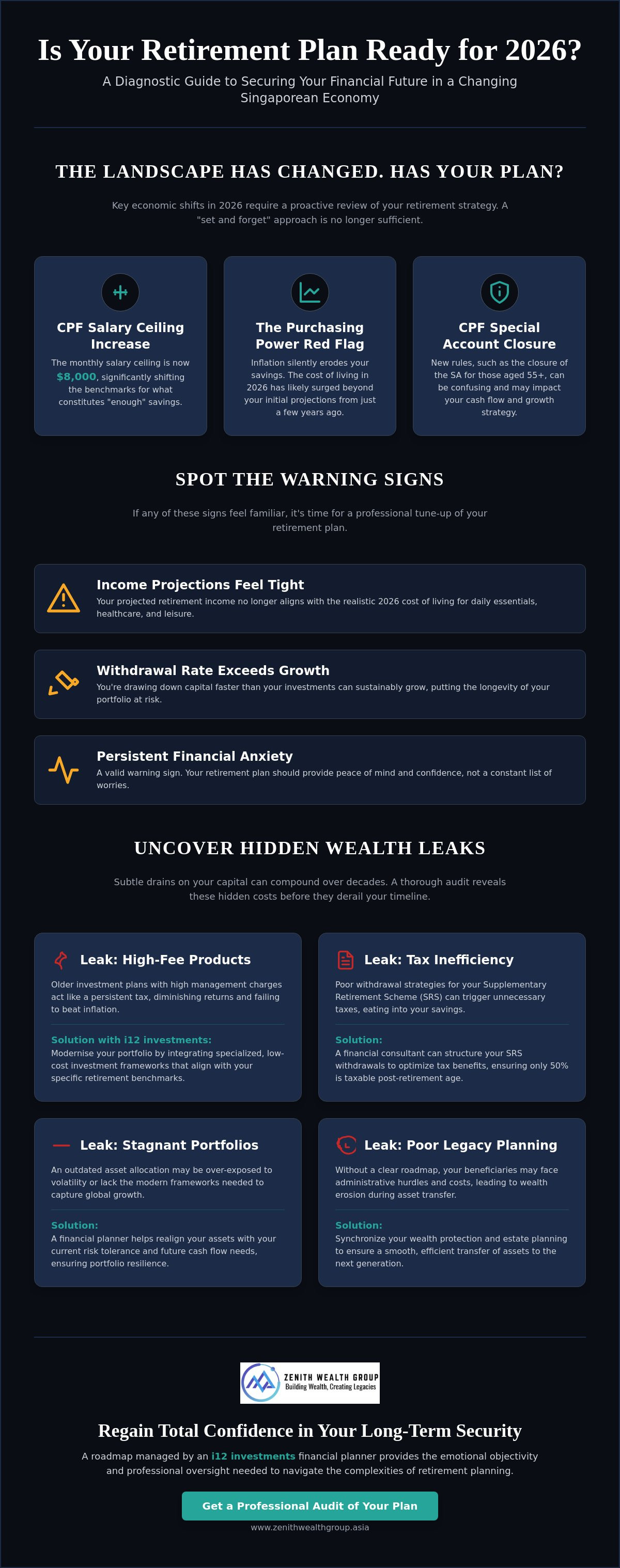
What if the retirement strategy you built just a few years ago is quietly losing its edge? If you find yourself thinking about troubleshooting my retirement plan, you've likely noticed that the 2026 economic climate feels different. With the CPF monthly salary ceiling now at $8,000 and inflation impacting your purchasing power, a "set and forget" approach might leave you vulnerable. It's a common fear to wonder if your savings will truly last your entire lifetime.
We agree that the complexity of new rules, such as the closure of the Special Account for those aged 55 and above, can be confusing. At i12 investments, our financial planners believe that a proactive audit is the best way to secure your future. This guide provides a clear diagnostic of your current strategy. You'll learn how to identify hidden gaps, apply professional fixes to improve cash flow, and regain total confidence in your long-term security.
Key Takeaways
- Spot the warning signs that your current income projections no longer align with the 2026 cost of living in Singapore.
- Uncover hidden wealth leaks by troubleshooting my retirement plan for tax inefficiencies and high-fee products that diminish returns.
- Audit your guaranteed income sources, including CPF LIFE and private annuities, to ensure your essential floor expenses are fully covered.
- Master a 5-step diagnostic to stress-test your portfolio against market volatility and recalculate your lifestyle costs for the years ahead.
- Learn why a roadmap managed by an i12 investments financial planner provides the emotional objectivity and professional oversight needed for long-term security.
Is Your Retirement Plan Still on Track? Signs It Needs Troubleshooting
Retirement planning isn't a one-time event. It's a living strategy. Many Singaporeans find themselves troubleshooting my retirement plan because the assumptions they made five years ago no longer hold water in 2026. If your projected income feels tight against the current cost of living, you aren't alone. It's a clear signal that your roadmap needs a professional tune-up. The world has changed. With the CPF monthly salary ceiling now at $8,000, the benchmarks for "enough" have shifted significantly.
A major warning sign is a withdrawal rate that outpaces your portfolio’s sustainable yield. If you're drawing down capital faster than your investments grow, your wealth won't last a lifetime. Life also happens. Unexpected health shifts or new family responsibilities can suddenly change your cash flow needs. Even if the numbers look okay on paper, a persistent sense of anxiety is a valid reason to audit your strategy. Your plan should provide peace of mind, not a list of worries.
The "Purchasing Power" Red Flag
Inflation is the silent thief of retirement security. It erodes your "safe" withdrawal amount every year. Think back to your 2020 projections. The pricing for daily essentials, healthcare, and leisure in 2026 has likely surged beyond those early estimates. A static plan is a dangerous plan. It fails to account for the dynamic nature of a modern economy. Without adjusting for the current purchasing power of the Singapore dollar, you might find your lifestyle significantly restricted in the years ahead. It's time to stop guessing and start measuring.
Diagnostic Questions for Your Portfolio
Take a moment to look at your current holdings. Are your assets too liquid, or perhaps too locked away for your current stage of life? Your risk tolerance often shifts as you age, yet many portfolios remain stuck in the past. At i12 investments, we suggest asking yourself: Does my asset allocation reflect my actual risk tolerance today?
- Are you over-exposed to market volatility as you approach your retirement date?
- Do your current investments provide the cash flow you need for 2026 expenses?
- When was the last time a financial consultant reviewed your legacy goals?
The Central Provident Fund (CPF) serves as a robust foundation for most locals, but it shouldn't be the only tool in your kit. Ensuring your wealth protection and estate planning are synchronized is essential for long-term security. If you feel your current strategy is falling behind, reaching out to a financial planner can help you realign your assets with your future needs.
Identifying Common Leaks in Your Wealth Strategy
Identifying where your money is disappearing is the first step in troubleshooting my retirement plan. Many Singaporeans suffer from "wealth leaks." These are subtle drains on your capital that compound over decades. High-fee products are a primary culprit. If you're holding older investment plans with high management charges, you might be seeing diminishing returns that fail to beat current inflation rates. These costs act like a persistent tax on your growth. Stagnant portfolios often lack the modern frameworks needed to capture global growth, leaving you with a plan that looks good on paper but fails in reality. You can't fix what you haven't diagnosed. A thorough audit reveals these hidden costs before they derail your timeline.
Optimising with i12 Investments
Modernising a portfolio requires a structured approach to growth. This is where i12 investments can make a significant difference. By integrating specialized investment groups into your broader wealth management strategy, you gain access to diversified frameworks that go beyond basic retail options. It's about evaluating performance against your specific retirement benchmarks. A financial planner can help you determine if your current asset mix is actually working or if it's just coasting. This proactive shift ensures your portfolio remains resilient against market shifts and remains aligned with your long-term wealth protection goals.
The Tax Leak: SRS and Legacy Planning
Tax inefficiency is another common trap. The Supplementary Retirement Scheme (SRS) is a powerful tool for reducing your immediate tax bill. However, many leave money on the table through poor withdrawal strategies. Withdrawing too much at once or at the wrong age can trigger unnecessary taxes, eating into your hard-earned savings. Remember that only 50% of your SRS withdrawals are taxable after the statutory retirement age. If you don't time this correctly, you're essentially giving back the tax benefits you worked so hard to gain.
Poor legacy planning also leads to wealth erosion during the transfer of assets. Without a clear roadmap, your beneficiaries may face administrative hurdles and costs that could have been avoided. This is a critical part of wealth protection. You can learn about Legacy Planning in Singapore to understand how to protect your generational wealth. If these leaks sound familiar, it's worth having a financial consultant review your current setup to ensure every dollar is working toward your goal.
Balancing Guaranteed Income: Audit Your CPF LIFE and Private Annuities
Your retirement "floor" represents the guaranteed income that covers your basic survival needs, regardless of market conditions. When troubleshooting my retirement plan, this floor is the first thing you should inspect. In Singapore, this foundation is primarily built on CPF LIFE. However, a plan that relies solely on one source can be fragile. You need to know if your guaranteed payouts actually match your 2026 "essential" expenses. If there is a gap, your strategy needs an immediate fix. Balancing these guaranteed streams with growth-oriented assets from i12 investments ensures you don't just survive, but thrive.
CPF LIFE: Is it Enough for 2026?
For those turning 55 in 2026, the Retirement Sums have shifted. The Full Retirement Sum (FRS) is now $220,400, while the Enhanced Retirement Sum (ERS) has reached $440,800. If you've hit the ERS, your estimated monthly payouts on the Standard Plan will range between $3,180 and $3,410. While this sounds substantial, you must analyze how these tiers track against 2026 inflation. Relying solely on government schemes might leave you vulnerable if your lifestyle costs exceed these tiers. You can explore The Complete Guide to Retirement Planning in Singapore to see how these numbers fit into a broader wealth protection strategy.
Private Annuities vs. CPF LIFE
Private annuities play a critical role in bridging the income gap. While CPF LIFE provides a reliable lifelong payout, it lacks the flexibility some retirees desire. Private plans often offer different liquidity options, allowing for partial withdrawals or varied death benefits that CPF LIFE does not prioritize. Adding a private annuity to your wealth strategy can provide a secondary layer of guaranteed income. This is particularly useful if you want to retire before age 65, the standard CPF LIFE payout age.
A financial planner can help you compare these payout structures. They will look at how your private annuity complements your CPF holdings. It's about finding the right balance. You want enough guaranteed income to sleep soundly, but enough investment growth to keep up with the rising cost of living. Troubleshooting my retirement plan involves stress-testing these income streams against potential healthcare hikes and long-term care needs. If your current "floor" looks a bit thin, a financial consultant can help you identify the right tools to reinforce it. This ensures that your wealth lasts as long as you do.
The 2026 Retirement Audit: 5 Steps to Fix Your Plan
Fixing a plan is often more effective than starting a new one. If you've identified gaps in your previous sections, it's time for a structured protocol. Effective troubleshooting my retirement plan requires a systematic approach to ensure no stone is left unturned. Follow these five steps to realign your strategy with the 2026 economic reality.
- Step 1: Recalculate your expenses. Separate "Essential" costs like healthcare and housing from "Lifestyle" costs like travel. Use 2026 pricing as your baseline, not outdated 2020 figures.
- Step 2: Stress-test your portfolio. Simulate a 20% market correction. If such a drop forces you to sell assets at a loss to fund your life, your sequence-of-returns risk is too high.
- Step 3: Rebalance your allocation. Align your assets with your current timeline. Use i12 investments to access structured frameworks that can capture growth while managing downside volatility.
- Step 4: Maximize tax reliefs. Use voluntary CPF contributions and SRS top-ups to lower your taxable income. Every dollar saved in tax is a dollar that remains in your retirement nest egg.
- Step 5: Consult a financial planner. A professional validation ensures your adjustments are mathematically sound and emotionally sustainable.
Stress-Testing Your Assumptions
Longevity is a significant factor in 2026. Singaporeans now have one of the highest life expectancies in the world. Many experts suggest planning to age 100 to avoid outliving your capital. What happens if you live longer than expected? You must simulate a prolonged high-inflation environment on your cash flow. If your plan breaks under these conditions, you need to adjust your withdrawal rates dynamically. Instead of a fixed percentage, consider a "guardrails" approach where you spend less during market downturns to protect your principal.
Tax and Efficiency Check
Efficiency is the secret to a lasting portfolio. Using the SRS account effectively can move you into a lower tax bracket, saving you thousands over a decade. You can master the SRS account for tax savings by understanding the specific withdrawal rules that apply in 2026.
Identify "dead" capital in your audit. This is money sitting in low-interest savings accounts that isn't working for your retirement. While liquidity is important, excess cash loses value every day due to inflation. Reallocating this capital into wealth protection or investment management tools can provide the boost your plan needs. If you're unsure where to start your audit, reach out to a financial consultant to begin a professional diagnostic of your current strategy.
Partnering with a Financial Consultant to Secure Your Future
The transition from a diagnostic audit to real-world execution is where most people face their biggest hurdles. While the five steps outlined previously provide a solid framework, the gap between a DIY plan and a professionally managed roadmap is often significant. When you're troubleshooting my retirement plan alone, it's easy to miss the subtle "wealth leaks" or tax inefficiencies that a trained eye spots immediately. A professional roadmap isn't just about numbers; it's about having a resilient strategy that survives the unexpected shifts of the 2026 economy.
One of the most valuable roles a financial consultant plays is providing emotional objectivity. Market stress can lead to impulsive decisions, especially when your life savings are on the line. Having a partner who remains focused on your long-term security helps you stay the course during volatile periods. Zenith Wealth Group’s approach is centered on human interaction and strategic clarity. We believe that your retirement plan should be as unique as your life story, blending wealth protection with a clear path for growth.
Why a Professional Audit Matters
Professional oversight helps you avoid the common cognitive biases that often lead to poor financial timing or asset misallocation. We all have blind spots. A financial planner uses data-driven insights to ensure your assumptions about inflation and longevity are realistic. This partnership also opens doors to institutional-grade insights and i12 investments opportunities that aren't always accessible to the general public. Beyond growth, we ensure your entire strategy meets current MAS regulatory standards, giving you the peace of mind that your legacy is secure and compliant.
Your Invitation to Connect
Zenith Wealth Group offers a welcoming, jargon-free environment where your questions are the priority. We don't believe in institutional coldness. Instead, we offer an open-door policy that encourages immediate connection and honest conversation. If you're ready to move from simply identifying gaps to executing a professional fix, we are here to help. Our team is eager to start a conversation and grow alongside you. You don't have to navigate these complex 2026 rules on your own. Take the first step toward a more secure future and book a consultation with a Zenith financial planner today to troubleshoot your retirement gaps.
Secure Your Future with a Proactive Audit
Your retirement isn't a static destination; it's a journey that requires constant navigation. The 2026 economic landscape has shifted the goalposts for many Singaporeans. By identifying wealth leaks and stress-testing your assumptions against current inflation, you take active control of your wealth protection. Recalculating your essential expenses and auditing your CPF LIFE "floor" are the first steps toward a resilient strategy. Troubleshooting my retirement plan doesn't have to be a solo effort that leaves you feeling overwhelmed.
At Zenith Wealth Group, we act as your modern professional guides. As authorized representatives of finexis advisory Pte Ltd, our team offers a specialized focus on i12 investments and holistic wealth management. We prioritize personal connection over corporate distance, ensuring your roadmap is both mathematically sound and human-centric. Don't wait for market volatility to dictate your lifestyle. You deserve a plan that evolves as fast as the world around you. Troubleshoot your plan with a Zenith financial consultant today and start your journey toward long-term certainty with confidence.
Frequently Asked Questions
How often should I troubleshoot my retirement plan?
You should conduct a thorough audit of your strategy at least once a year. It's also vital to review your roadmap after major life events or significant policy shifts, such as the 2026 increase in the CPF monthly salary ceiling to $8,000. Frequent check-ins allow you to catch wealth leaks early and ensure your asset allocation still matches your current risk tolerance. Consistent troubleshooting my retirement plan keeps your strategy aligned with the evolving economic environment in Singapore.
What is the "Safe Withdrawal Rate" for Singaporeans in 2026?
A safe withdrawal rate typically ranges between 3% and 4% of your total portfolio, though this requires careful adjustment for 2026 inflation. Relying on a static percentage can be risky if healthcare costs or daily expenses surge unexpectedly. A financial planner can help you simulate different market conditions to find a rate that preserves your principal. This ensures your capital lasts through a retirement that could span thirty years or more.
Can I change my CPF LIFE plan after payouts have started?
No, you cannot change your CPF LIFE plan once your monthly payouts have commenced. You have until one month before your payouts start to choose between the Standard, Escalating, or Basic plans. Because this decision is permanent, troubleshooting my retirement plan before you reach age 65 is essential. A financial consultant can help you model which payout structure best fits your long-term cash flow needs and legacy goals.
How do i12 investments fit into a conservative retirement portfolio?
i12 investments provide a structured framework for growth that complements the guaranteed "floor" of your CPF savings. These specialized investment groups focus on capturing market upside while managing downside volatility through professional oversight. For a conservative retiree, this adds a layer of diversification that helps your wealth keep pace with inflation. It's about balancing safety with the growth necessary to maintain your purchasing power over several decades.
What should I do if my retirement savings are falling short?
You can boost your future income by deferring your CPF LIFE payouts up to age 70, which increases your monthly amount by about 6% to 7% for each year of deferral. Another option is making cash top-ups to your Retirement Account to reach the Enhanced Retirement Sum of $440,800 for 2026. If you're still concerned, a financial planner can help you identify lifestyle adjustments or reallocate "dead" capital into more productive assets.
Is it too late to fix my retirement plan if I am already 60?
It is never too late to optimize your strategy and improve your financial security. At 60, you can still make strategic decisions regarding your SRS withdrawal timeline or rebalance your private investment portfolio to reduce risk. Small adjustments to your tax efficiency or wealth protection can have a cumulative impact on your capital longevity. A financial consultant can provide a quick diagnostic to identify the most effective fixes for your current stage of life.
How does inflation specifically affect Singaporean retirees?
Inflation erodes the real value of fixed income streams, making essential items like healthcare and food more expensive over time. While CPF LIFE provides a foundation, the Basic and Full Retirement Sums are designed to meet basic needs, not necessarily a luxury lifestyle. Without growth-oriented assets to act as a buffer, your standard of living may decline as you age. Ensuring your portfolio includes investments that outpace inflation is a key part of wealth management.
Should I prioritize paying off my mortgage or saving for retirement?
The decision depends on the interest rate of your loan versus the potential returns on your savings. With HDB concessionary loan rates at 2.6% and CPF Special Account floor rates at 4% until the end of 2026, keeping your cash in CPF might be more mathematically efficient. However, the peace of mind that comes with a debt-free home is also a significant factor. A financial planner can help you weigh these numbers against your personal goals to find the right balance.


