

Singapore's low-tax reputation is a double-edged sword that often leads expats to overlook thousands in potential savings. It's easy to feel confident about a 24% top marginal rate, but without a proactive strategy, your global wealth can still suffer from "silent" leaks. We know the anxiety of managing home-country tax rules while trying to decipher local schemes. You shouldn't have to choose between simplicity and growth. This guide delivers a definitive strategy for tax-efficient investing for expats in Singapore, helping you secure your financial future for 2026 and beyond.
We'll show you exactly how to utilize i12 investments and the S$35,700 SRS contribution limit for foreigners to lower your chargeable income. You'll also learn how to navigate the S$80,000 personal relief cap and the 60% tax rebate with the help of a dedicated financial planner. By the end of this article, you'll have the confidence to submit your 2026 tax filing knowing every dollar is working its hardest for you. Let's turn Singapore's territorial tax system into your greatest financial advantage.
Key Takeaways
- Leverage Singapore’s territorial tax system and the 183-day residency rule to protect your global wealth from local tax liabilities.
- Optimize your tax-efficient investing for expats in Singapore by maximizing the S$35,700 SRS limit alongside strategic i12 investments.
- Capitalize on the absence of capital gains tax to accelerate your wealth growth through smarter asset allocation.
- Secure your cross-border interests by understanding how Double Taxation Agreements and specific reporting requirements like FATCA impact your portfolio.
- Partner with a financial planner to eliminate expensive "tax leakage" and create a clear roadmap for your 2026 tax filing.
Understanding Singapores Territorial Tax System for Expats
Singapore stands out as a global financial hub primarily because of its straightforward approach to taxation. Unlike many Western nations that tax global income, the Lion City operates on a territorial basis. This means you are generally only taxed on income earned within Singapore's borders. For many, Singapore's territorial tax system is the cornerstone of their wealth-building strategy. It allows you to bring foreign-sourced investment returns or rental income into the country without triggering a local tax bill. This creates a unique environment for tax-efficient investing for expats in Singapore, as it leaves more capital available for strategic vehicles like i12 investments.
The system is designed to reward those who make Singapore their primary base. Foreign-sourced income, such as dividends from a UK portfolio or interest from a US savings account, remains exempt from Singapore tax when received here. However, your ability to fully capitalize on these benefits depends heavily on your residency status. Determining whether you are a resident or non-resident is the first task for any serious financial planner when structuring your 2026 roadmap.
The 2026 Tax Residency Criteria
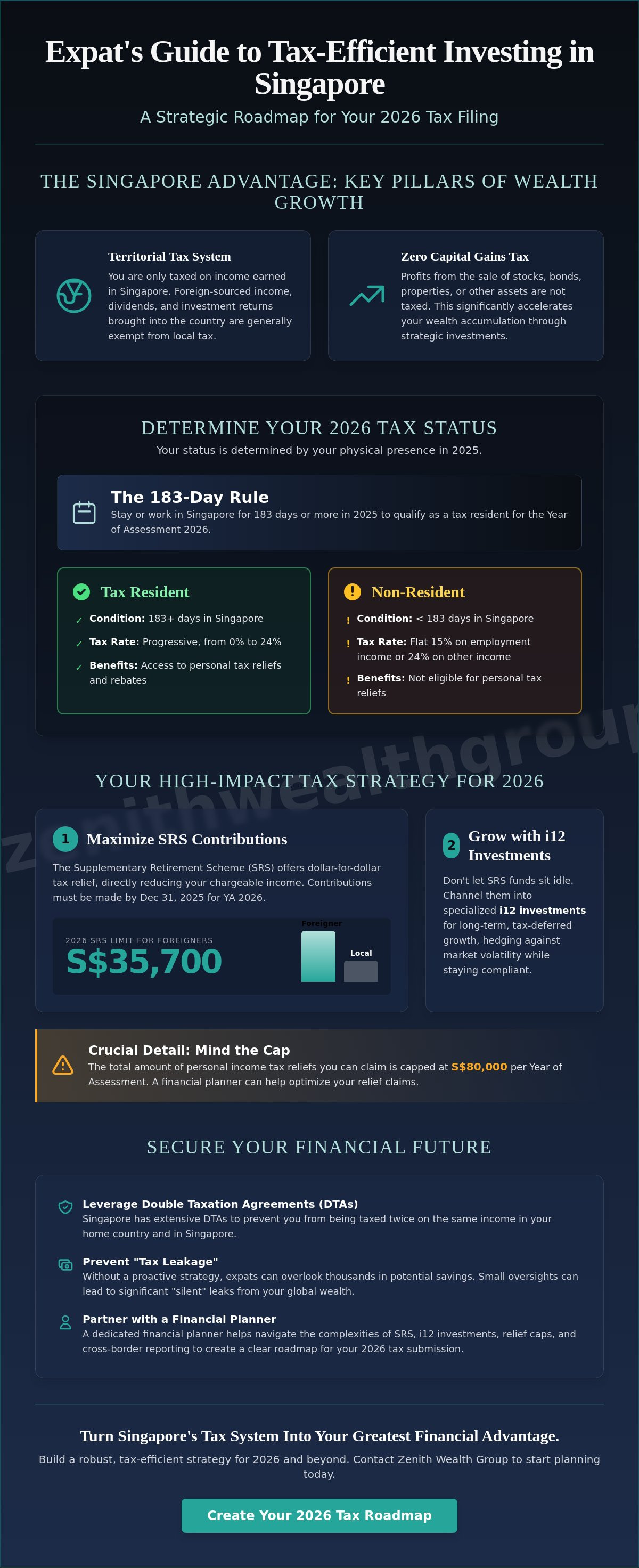
Your tax status for the Year of Assessment 2026 is determined by your physical presence in 2025. The Inland Revenue Authority of Singapore (IRAS) uses a clear 183-day rule. If you stay or work in Singapore for 183 days or more, you qualify as a tax resident. This count includes weekends and public holidays. It also includes short absences for business trips or vacations. If you frequently travel to neighboring countries like Thailand or Malaysia for work, keep a strict log of your dates. Falling just one day short of the 183-day threshold can significantly increase your tax liability on employment income.
Resident vs. Non-Resident Tax Rates
The distinction between resident and non-resident status is vital for your investment capital. Tax residents benefit from progressive rates ranging from 0% to 24% for income above S$1,000,000. Residents also enjoy personal tax reliefs and a 60% tax rebate capped at S$200 for 2026. Conversely, non-residents face a flat 15% tax on employment income or the resident rate, whichever is higher. Other income, such as director's fees, is taxed at a flat 24%. Working with a financial planner ensures you don't accidentally trigger these higher flat rates through poor timing of contract start dates. In 2026, you are considered a tax resident if you are physically present or working in Singapore for at least 183 days within a calendar year.
Maximising Tax Relief through SRS and i12 Investments
Lowering your tax bill isn't just about knowing the rules; it's about actively using the tools the Singapore government provides. For expats, the Supplementary Retirement Scheme (SRS) is arguably the most powerful lever available. It's a voluntary scheme that offers immediate, dollar-for-dollar tax relief on your contributions. When you combine this with the specialized structure of i12 investments, you move beyond simple compliance into high-performance wealth management. This dual approach is central to tax-efficient investing for expats in Singapore, ensuring you aren't just saving for the future, but growing your capital in a protected environment.
The goal is to move from a passive "tax-payer" mindset to an active "wealth-builder" strategy. By shifting a portion of your income into the SRS, you effectively defer taxes until a later date when your income might be lower. This strategy works best when you have a clear roadmap for how those funds are deployed. A professional financial planner can help you align these contributions with your broader portfolio to ensure every dollar is optimized for the 2026 Year of Assessment.
The Expat Guide to SRS Contributions
The 2026 contribution limit for foreigners stands at S$35,700. This is significantly higher than the S$15,300 limit for Singapore Citizens and Permanent Residents, reflecting the government's desire to attract global talent. To qualify for relief in the Year of Assessment 2026, you must complete your contributions by December 31, 2025. Every dollar you put in reduces your chargeable income, which can pull you into a lower tax bracket entirely. It's vital to keep the S$80,000 total relief cap in mind, as exceeding this limit provides no additional tax benefit. You can find a deeper dive into these mechanics in our article on Mastering the SRS Account.
Strategic Growth with i12 Investments
While the tax relief is immediate, the real magic happens through strategic asset selection. i12 investments are a cornerstone of the Zenith Wealth efficiency strategy because they focus on long-term, tax-deferred growth. Instead of letting your SRS funds sit in a low-interest cash account, we integrate i12 investments to help hedge against regional market volatility. This ensures your portfolio remains resilient while staying compliant with the official tax obligations for non-residents. Balancing your need for liquidity with these long-term vehicles requires precision. If you want to refine your tax-efficient investing for expats in Singapore, you should reach out to a financial planner at Zenith Wealth to calculate the exact contribution amount that maximizes your savings without over-committing your liquid cash.
Strategic Asset Allocation: Capital Gains vs. Dividend Income
Singapore's tax code offers a distinct advantage that most Western jurisdictions simply can't match: the total absence of capital gains tax. While you might be used to losing 20% or even 45% of your investment profits in the UK, US, or Australia, Singapore lets you keep every dollar of your growth. This lack of capital gains tax is the single most effective wealth builder for those focused on tax-efficient investing for expats in Singapore. It shifts the focus from merely "saving" to aggressively growing your capital through strategic asset location.
However, focusing only on growth can lead to missed opportunities or hidden costs. Dividends from Singapore-resident companies are tax-free under the one-tier corporate tax system, but foreign-sourced dividends often trigger withholding taxes. A financial planner can help you balance these two streams. By integrating i12 investments into your portfolio, you can capture global market appreciation while minimizing the impact of the 2026 MAS exchange rate fluctuations on your real returns.
The Zero Capital Gains Advantage
Expats often arrive with legacy portfolios from high-tax home countries. Transitioning these assets to a Singapore-based structure allows you to "reset" your tax base. This means any future appreciation occurs in a tax-neutral environment. It’s a vital step for long-term wealth protection. You can explore how this fits into a broader portfolio in our guide on Strategic Investment Management in 2026. We use i12 investments to ensure your capital appreciation isn't just theoretical, but strategically aligned with your residency status.
Dividend Withholding Taxes for Expats
Tax leakage is the silent killer of investment returns. If you hold US-listed ETFs on the NYSE, you’re likely losing 30% of your dividends to US withholding tax. Switching to Ireland-domiciled UCITS ETFs on the London Stock Exchange can often halve this leakage to 15%. Understanding these nuances is what separates a DIY investor from a professionally managed portfolio. Below is a quick comparison of how different asset classes are treated for Singapore tax residents in 2026:
| Asset Class | Singapore Tax Treatment | Primary Benefit |
|---|---|---|
| Local Stocks | 0% Tax on Dividends & Gains | Pure Tax Efficiency |
| Singapore REITs | 0% Tax for Individuals | High Yield, No Leakage |
| Foreign Stocks | 0% SG Tax; Subject to Foreign Withholding | Global Diversification |
| Bonds/Fixed Income | Generally Tax-Exempt for Residents | Capital Preservation |
Structuring your portfolio to prioritize tax-free capital appreciation while managing dividend leakage requires precision. Much like how professionals in technical fields check out Zenith Sales & Calibrations Pty Ltd for high-accuracy instrumentation, a financial planner can help you decide which assets belong in your SRS account and which should be held through i12 investments to ensure your 2026 tax filing remains as lean as possible.
Cross-Border Compliance: Navigating Global Tax Liabilities
Living in Singapore doesn't mean you've escaped your home country's tax office. For many, cross-border compliance is the most complex part of tax-efficient investing for expats in Singapore. You need to ensure that local gains don't become global liabilities. While the territorial system protects you here, your home jurisdiction might have a different view of your wealth. This is especially true for those with portfolios spread across multiple continents.
US citizens face unique challenges. It's vital to remember there's no comprehensive income tax treaty between the United States and Singapore. This makes FATCA and FBAR reporting non-negotiable; ignoring these can lead to severe financial penalties. UK expats must also be vigilant. The Statutory Residence Test determines your UK tax status based on the number of days spent in the country and your "ties" to the UK. Reporting your Singaporean assets correctly to your home tax office is a critical step in maintaining your financial reputation.
Double Taxation Agreements (DTA) Explained
DTAs are designed to prevent you from paying tax twice on the same income. Singapore has an extensive network of these treaties, especially across Southeast Asia. If you have investment interests, business income, or rental properties in Thailand or Indonesia, these agreements provide a clear framework for which country has the primary taxing right. We often integrate i12 investments to help clients structure their holdings within these treaty guidelines. This ensures that your regional growth isn't eroded by redundant tax claims. It's always best to consult a financial consultant to verify your specific treaty benefits before moving large sums of capital across borders.
Legacy and Estate Tax Considerations
One of the greatest gifts Singapore offers expat families is the absence of inheritance tax. This makes the city-state an ideal hub for wealth protection and generational transfer. However, the location of your assets and the residency of your heirs can change the math. If your beneficiaries live in high-tax countries like the UK or Japan, they might still face estate taxes on the assets they receive from you. Strategic planning ensures your hard-earned wealth actually reaches your loved ones without being decimated by foreign probate rules. You can learn more about these structures in our guide on Legacy Planning in Singapore. We focus on creating a multi-jurisdictional roadmap that respects both local exemptions and foreign requirements.
Managing these moving parts alone is a recipe for stress and expensive mistakes. If you're concerned about how your global assets interact with your 2026 tax filing, speak with a financial planner today to review your cross-border strategy and ensure your legacy remains protected.
Building Your Tax-Efficient Roadmap with a Financial Planner
Tax-efficient investing for expats in Singapore requires more than just a spreadsheet and a basic understanding of the SRS. While the rules seem straightforward, the execution often determines whether you actually save money or simply defer a headache. A DIY approach frequently leads to expensive "tax leakage." This happens when returns are lost to avoidable withholding taxes, inefficient asset holding structures, or missed relief opportunities that a specialist would have caught instantly. Success in 2026 depends on how well your local strategy talks to your global obligations.
The Zenith Wealth approach moves beyond chasing the highest investment returns. We focus on holistic planning. This means we look at how your i12 investments interact with your education funding goals for your children and your long-term retirement planning. We don't view tax as an isolated line item. Instead, it's a variable we manage to ensure more of your wealth stays in your pocket. By aligning your portfolio with Singapore’s unique territorial system, we create a path that supports your lifestyle today while protecting your legacy for tomorrow.
Personalised Wealth Analysis
Your journey begins with a deep dive into your current global holdings. A financial planner audits your existing assets to identify immediate "quick wins" in your 2026 tax structure. We look for assets that are better suited for the tax-deferred environment of the SRS or those that should be restructured through i12 investments to reset your tax base. This analysis ensures you aren't over-complicating your filing or leaving money on the table. If you're looking to secure your future, you can explore our Complete Guide to Retirement Planning for more strategic insights.
The Zenith Wealth Partnership
We believe in quiet confidence and personal connection. As authorised representatives of finexis advisory Pte Ltd, our team acts as your modern professional guide in a complex financial landscape. We don't just provide data; we provide the strategic insights needed to empower your financial future. We’re ready to start a conversation about your wealth protection and investment management needs whenever you are. The 2026 tax deadlines are closer than they appear. Take the first step toward a more efficient portfolio and book your consultation with our team today. Let’s build a roadmap that actually works for you.
Finalise Your 2026 Wealth Strategy Today
The window to optimize your 2026 tax filing is closing faster than most expats realize. Throughout this guide, we've explored how tax-efficient investing for expats in Singapore relies on the precise calibration of SRS contributions and strategic asset location. By moving beyond simple savings and embracing sophisticated vehicles like i12 investments, you ensure that your global portfolio remains both compliant and high-performing. Whether you are navigating US-Singapore reporting gaps or planning a multi-jurisdictional legacy, the key is proactive, holistic management.
Zenith Wealth acts as your modern professional guide, bridging the gap between local opportunities and international obligations. As authorised representatives of finexis advisory Pte Ltd, we specialize in cross-border wealth management and seamless i12 investments integration. Don't leave your financial future to chance or allow silent tax leakage to slow your progress. Secure your 2026 tax-efficient investment strategy with a Zenith Wealth financial consultant. Your path to optimized wealth starts with a single conversation. We look forward to helping you grow.
Frequently Asked Questions
Is Singapore a tax haven for expatriates?
Singapore is a low-tax jurisdiction rather than a tax haven. It uses a transparent, progressive tax system where residents pay between 0% and 24% on their income. The primary draw for expats is the territorial tax basis. This ensures you aren't taxed on income earned outside of Singapore, providing a stable environment for wealth protection and growth.
Can foreigners open an SRS account to save on taxes?
Yes, foreigners are encouraged to open a Supplementary Retirement Scheme (SRS) account. For the 2026 Year of Assessment, the contribution limit for expats is S$35,700. This offers a dollar-for-dollar reduction in your taxable income. It's a vital tool for tax-efficient investing for expats in Singapore, especially when you invest those funds into i12 investments for long-term growth.
Do I have to pay tax in Singapore on investments held in my home country?
Generally, you won't pay Singapore tax on your foreign holdings. Singapore’s territorial system usually exempts foreign-sourced income received by individuals. This includes dividends, interest, or rental income from assets held back home. You should still verify your home country's specific reporting rules, such as the UK’s statutory residence test or US FATCA requirements, to avoid global compliance issues.
How does the 2026 tax filing process differ for EP holders?
The filing process for Employment Pass (EP) holders hinges on the 183-day residency rule. For 2026, the e-filing deadline is April 18. If you've been in the country for at least 183 days, you'll be taxed at resident rates and receive a 60% tax rebate capped at S$200. The process is handled digitally through the IRAS MyTax Portal for maximum efficiency.
What is the maximum tax relief an expat can claim in Singapore?
The total personal income tax relief cap is S$80,000 per Year of Assessment. This cap includes all your deductions, such as SRS contributions and any qualifying personal reliefs. It's easy to hit this limit if you're a high earner. A financial planner can help you audit your current reliefs to ensure you aren't wasting contributions that provide no additional tax benefit.
Are capital gains from crypto or property taxed in Singapore?
Singapore does not impose a capital gains tax on crypto or property. This makes the city-state an exceptional hub for building wealth through capital appreciation. However, if the Inland Revenue Authority decides you're "trading" with high frequency rather than "investing" for the long term, they may classify those gains as taxable income. Keeping clear records is essential.
Should I work with a financial consultant or a tax accountant?
You'll often find the most value by using both professionals for different roles. A tax accountant ensures your past filings are accurate and compliant. A financial consultant focuses on your future. They help you implement strategies like tax-efficient investing for expats in Singapore by integrating i12 investments and optimizing your SRS contributions. This proactive planning is what actually lowers your future tax bills.


