

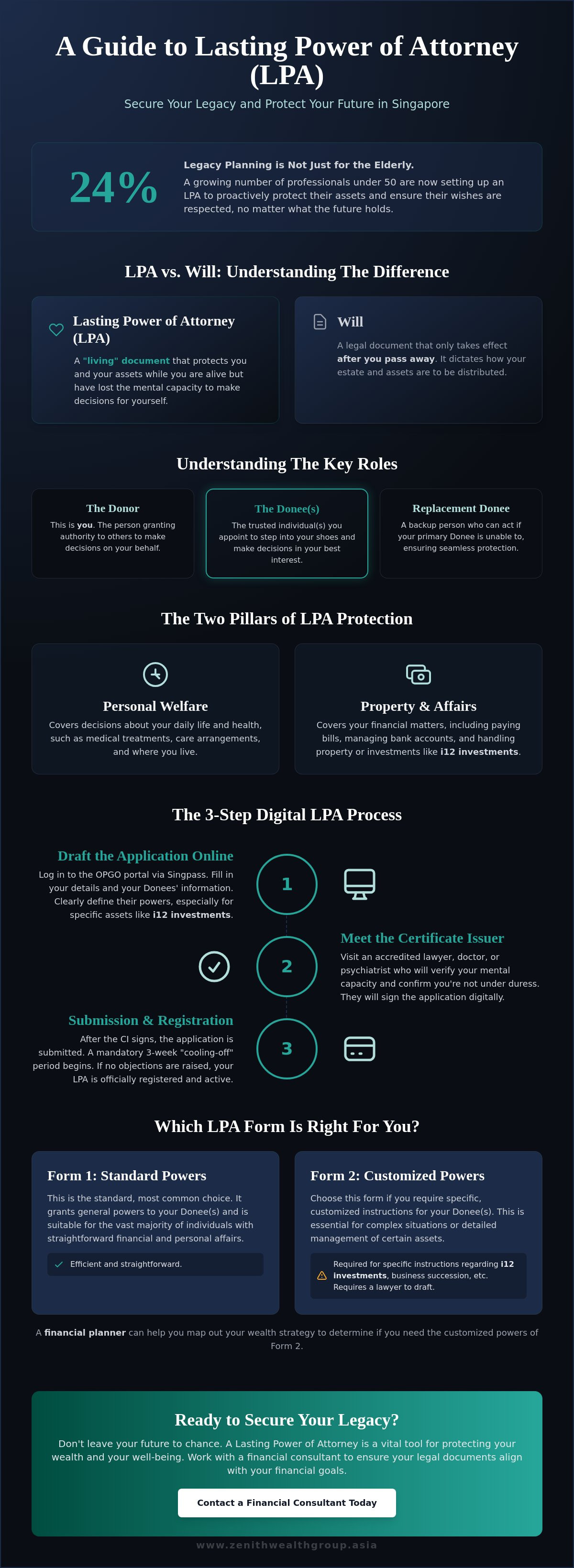
Did you know that 24% of people setting up a Lasting Power of Attorney (LPA) in Singapore are now under the age of 50? It's a common mistake to think that legacy planning is only for the elderly. In reality, protecting your future starts the moment you begin building your wealth. We're seeing more young professionals take this proactive step to ensure their hard work is never left to chance.
You might feel a bit overwhelmed by the OPG Online portal or anxious about choosing the right person to manage your i12 investments. That's completely natural. We understand that these decisions feel heavy, but they don't have to be complicated. You deserve the peace of mind that comes with knowing your voice will be heard, even if you can't speak for yourself. This guide shows you how to protect your assets and your well-being with a simple, step-by-step approach.
We'll walk through the registration process, explain the 2026 fee updates, and clarify why an LPA is just as vital as your Will. You'll learn exactly how to work with your financial planner to secure your legacy today.
Key Takeaways
- Understand the two critical pillars of an LPA—Personal Welfare and Property & Affairs—to ensure comprehensive protection for your future.
- Discover the streamlined 3-step process for setting up a Lasting Power of Attorney (LPA) in Singapore using the digital OPGO portal.
- Learn why selecting a donee requires more than just trust, especially when managing specific assets like i12 investments.
- See how an LPA serves as a vital foundation for legacy planning by preventing legal gridlock and protecting your generational wealth.
- Explore how a financial planner coordinates with legal and medical professionals to turn your estate strategy into a holistic roadmap.
What is a Lasting Power of Attorney (LPA) in Singapore?
A Lasting Power of Attorney (LPA) is a vital legal instrument. It protects you if you ever lose the mental capacity to make your own decisions. While some think it's a document only for seniors, the reality is that anyone can face an unexpected health crisis. By setting up a Lasting Power of Attorney (LPA) in Singapore, you're essentially creating a safety net for your future self. It ensures that your life remains in the hands of people you trust rather than being dictated by the court.
Many people confuse an LPA with a Will, but they serve very different purposes. A Will only takes effect after you pass away to manage your estate. In contrast, an LPA is a "living" document. It functions while you're still alive but unable to speak for yourself. Under the Mental Capacity Act, the LPA covers two main pillars: your personal welfare and your property and affairs. Without this document, your family might face a long, expensive, and stressful court process just to pay your monthly bills or decide on your medical treatments.
Donor vs. Donee: Understanding the Key Roles
When you begin setting up a Lasting Power of Attorney (LPA) in Singapore, you'll encounter two primary roles. You are the Donor. You're the person who is granting the authority. The people you choose to look after your interests are called Donees. They don't just follow a set of rules; they step into your shoes to make decisions that align with your best interests.
It's also proactive to appoint Replacement Donees. Life is unpredictable. If your primary donee is unable to act due to their own health or personal circumstances, your backup ensures there's no gap in your protection. This keeps your financial and personal affairs moving forward without a hitch.
Form 1 vs. Form 2: Which One Do You Need?
There are two types of forms available in Singapore. Form 1 is the standard version. It's designed for most individuals and grants general powers to your donees. It's efficient, straightforward, and covers the essential needs for personal and financial management. This is the choice for the vast majority of applicants who want a reliable, standard plan.
Form 2 is for those with more complex requirements. You'll need this if you want to include specific, customized instructions for your assets. For example, if you have detailed preferences regarding the management of your i12 investments or specific business succession needs, Form 2 allows for that level of detail. Since Form 2 requires a lawyer to draft the specific clauses, it's a good idea to consult a financial planner first. They can help you map out your wealth strategy so your legal documents match your financial goals. If you're ready to start this process, feel free to reach out to us for a conversation.
3 Steps for Setting Up Your LPA in 2026
The digital landscape has transformed how we handle legal documents. Setting up a Lasting Power of Attorney (LPA) in Singapore is now a streamlined, paperless experience centered on the Office of the Public Guardian Online (OPGO) portal. By 2026, the system relies almost exclusively on Singpass to verify identities and prevent unauthorized changes. This shift makes the process faster and keeps your records accessible whenever they're needed. It's a modern approach to a critical piece of legacy planning.
Step 1: Drafting the Application Online
The journey begins at the OPGO portal. You'll log in using your Singpass and fill in the digital application. You'll need the full names and NRIC numbers of your chosen donees. Be precise when defining the scope of their powers. A frequent error is failing to specify how complex assets should be handled. For instance, if your portfolio includes i12 investments, your instructions should clearly empower your donee to manage these specific holdings. Review every entry carefully. Errors at this stage can lead to unnecessary delays or rejection.
Step 2: Meeting the Certificate Issuer
Once your draft is ready, you must meet an accredited Certificate Issuer (CI). You can choose a lawyer, a psychiatrist, or a specially accredited GP. Their role is to ensure you have the mental capacity to make the LPA. They also verify that you're making the decision voluntarily. This session is a critical protection against duress or fraud. The CI will sign the application digitally through the portal. If you're unsure which CI fits your needs, a financial planner can often provide recommendations based on your overall estate strategy. You might find it helpful to speak with a consultant about coordinating these professional requirements.
Step 3: Submission and Registration
After the CI signs off, the application is officially submitted for registration. The OPG then initiates a mandatory 3-week "cooling-off" period. This is a legal requirement. It allows you or your family to raise objections if there are concerns about the appointment. If the period passes without issue, your LPA is officially registered. You can view your status and the digital certificate on the OPGO registry at any time. For a deeper look at why these safeguards exist, the official guide to Lasting Power of Attorney offers excellent context on the legislative framework that protects your interests.
Strategic Donee Selection: Protecting Your i12 Investments
Choosing a donee is the most critical decision you'll face when setting up a Lasting Power of Attorney (LPA) in Singapore. Many people instinctively choose their spouse or eldest child based on trust alone. While trust is the baseline, it's not the only requirement. You need to consider the practical competency of your chosen representative. If your portfolio includes i12 investments, your donee must have the financial literacy to manage those assets effectively. Without the right skills, even a well-meaning loved one might struggle to maintain your wealth growth strategy during a crisis.
You also need to decide how your donees will work together. In the Office of the Public Guardian (OPG) application, you can specify if they should act "Jointly" or "Jointly and Severally." If they act jointly, every single decision requires unanimous agreement. This offers a system of checks and balances but can lead to gridlock. "Jointly and Severally" allows donees to make decisions independently. This is often more efficient for daily tasks, such as paying bills or managing investment accounts. Think carefully about the dynamics between your chosen individuals before finalizing your application.
Managing Property and Financial Affairs
Your donee for property and affairs holds significant power. They will handle your banking, CPF matters, and i12 investments. It's a heavy responsibility that can be emotionally draining. To ensure continuity, your financial planner can play a vital role. They can work alongside your donee to explain your existing wealth roadmap. This collaboration ensures that your investment management continues without interruption. It's about making sure the person stepping into your shoes has the professional support they need to succeed.
Personal Welfare Decisions
Personal welfare is about your daily life. Your donee will decide where you live, what you eat, and what medical treatments you receive. This role is deeply personal and requires a clear understanding of your values. While setting up a Lasting Power of Attorney (LPA) in Singapore, it's wise to also complete an Advance Care Plan (ACP). An ACP provides a detailed guide on your healthcare preferences. By communicating these wishes today, you remove the guesswork for your donees later. It gives them the confidence to make hard choices, knowing they're following your exact wishes. If you're ready to align your legal and financial plans, let's have a conversation about your legacy strategy.
LPA as a Pillar of Legacy Planning in Singapore
Think of your legacy plan as a house. Your Will is the roof, but setting up a Lasting Power of Attorney (LPA) in Singapore is the foundation. Without it, the entire structure is at risk of collapsing during your lifetime. If you lose mental capacity without an LPA, your bank accounts, property, and investment portfolios are effectively frozen. Your family won't have the legal right to access your funds to pay for your medical bills or daily needs. This creates a legal gridlock that can last for months, leaving your loved ones in a difficult position.
The alternative to an LPA is applying for a court-appointed deputyship. This is a far more expensive and invasive process. It requires your family to hire a lawyer and seek permission from the court for every major financial decision. It's a heavy burden that most families aren't prepared for. By acting now, you ensure that your wealth remains accessible to those who need it most. Integrating your LPA with your Will and CPF nominations creates a seamless transition of authority and assets, regardless of what the future holds.
Wealth Protection and Mental Capacity
Wealth protection isn't just about market volatility. It's about ensuring your assets continue to serve you when you can't manage them yourself. When you link your LPA to a broader legacy planning strategy, you're building a complete defense system. For many of our clients, their i12 investments are a primary source of funding for long-term care. If these assets are locked away in a frozen account, your standard of care could suffer. An LPA ensures your donee can work with your financial planner to keep your wealth growing and liquid.
LPA vs. Advance Medical Directive (AMD)
It's easy to get confused by the various legal documents available. While an LPA covers your personal welfare and property, an Advance Medical Directive (AMD) is specifically about end-of-life care. An AMD tells doctors you don't want extraordinary life-sustaining treatment if you're terminally ill and unconscious. You likely need both to achieve full wealth protection and personal peace of mind. Streamlining these documents with a professional guide prevents gaps in your strategy. If you're ready to secure your future, reach out to our team to start your comprehensive legacy roadmap today.
How a Financial Planner Simplifies Your Estate Strategy
A clinic or law firm provides the certification, but they rarely look at your entire financial ecosystem. This is where a financial planner becomes a critical partner. Setting up a Lasting Power of Attorney (LPA) in Singapore is a legal necessity, but it shouldn't be a standalone task. Your financial consultant coordinates with medical and legal Certificate Issuers to ensure your legal authority matches your financial reality. This ensures that if the time ever comes, your donee isn't just holding a piece of paper; they're holding a strategy.
We align your LPA with your broader retirement planning goals. This ensures your i12 investments and other retirement assets remain under professional management even if you can't oversee them yourself. Without this coordination, there's a risk that your donee might make decisions that conflict with your long-term vision. We bridge that gap. We make sure your wealth continues to grow and support your standard of living exactly as you intended.
Personalized Legacy Reviews
Life isn't static. Your legal documents shouldn't be either. We recommend reviewing your LPA every 3 to 5 years. Family dynamics change. New assets are acquired. You might decide to restructure your i12 investments or change who you want as a replacement donee. These regular check-ins ensure your plan remains robust. It's about proactive maintenance rather than reactive crisis management. We help you update your strategy to reflect your current life stage and priorities.
Take the Next Step with Zenith Wealth
At Zenith Wealth, we believe in a human-centric approach. We don't just see numbers; we see families and legacies. Our team is here to help you manage the complexities of Singapore estate law with quiet confidence. We simplify the technical jargon and focus on what matters most: your peace of mind. We take the stress out of setting up a Lasting Power of Attorney (LPA) in Singapore by guiding you through every digital and strategic step. Are you ready to secure your future? Contact a Zenith Wealth financial planner today to start building your comprehensive legacy roadmap. We're ready to start the conversation whenever you are.
Protect Your Legacy with Confidence
Setting up a Lasting Power of Attorney (LPA) in Singapore is one of the most significant gifts you can give to your future self and your family. Throughout this guide, we've explored how the 2026 digital shift makes registration accessible, why financial literacy is crucial for your donees, and how this document acts as the foundation of your estate strategy. By acting while you have mental capacity, you prevent the freezing of your i12 investments and ensure your welfare remains a priority without court intervention.
As authorized representatives of finexis advisory Pte Ltd, Zenith Wealth specializes in blending legal preparedness with holistic wealth strategy. Our financial planners use a Singpass-integrated advisory process to help you navigate these choices with ease and clarity. We're here to ensure your legacy planning is comprehensive, covering everything from daily care to complex investment management.
Ready to take control? Secure your legacy—book a consultation with a Zenith Wealth financial planner today. We look forward to helping you build a future that is safe, certain, and uniquely yours.
Frequently Asked Questions
What is the cost of setting up an LPA in Singapore in 2026?
As of May 1, 2026, Singapore Citizens pay no application fee for LPA Form 1. Permanent Residents pay S$30, and foreigners pay S$160. If you require a customized Form 2, the fee is S$30 for citizens and PRs, or S$160 for foreigners. You'll also need to pay a Certificate Issuer fee directly to your chosen professional. These fees typically range from S$24 to S$600 depending on the complexity.
Can I change or revoke my LPA after it has been registered?
You can revoke your LPA at any time as long as you still have the mental capacity to do so. You must submit a specific revocation form to the Office of the Public Guardian and inform your donees. If you want to change your donees, you'll need to revoke the old document and start the process of setting up a Lasting Power of Attorney (LPA) in Singapore again to ensure your new instructions are legally binding.
What happens if I lose mental capacity without an LPA in place?
If you lose mental capacity without an LPA, your assets, including your i12 investments, will be frozen. Your family cannot automatically manage your affairs. They would have to apply to the court to become a "deputy," which is a costly and lengthy process. An LPA avoids this legal gridlock by allowing your handpicked representatives to act immediately on your behalf and maintain your standard of care and financial stability.
Can a foreigner or Permanent Resident (PR) set up an LPA in Singapore?
Yes, both Permanent Residents and foreigners can set up an LPA in Singapore. As of May 2026, the application fee for PRs is S$30, while foreigners pay S$160 for both Form 1 and Form 2. The process follows the same digital path through the OPGO portal using Singpass. It's a proactive way for expatriates to ensure their local assets are managed according to their wishes without unnecessary legal delays.
Does my donee need to be present when I sign the LPA with a Certificate Issuer?
Your donees do not need to be present when you meet with the Certificate Issuer. In the digital system, donees receive a notification via Singpass to accept their appointment first. Once they have accepted, you visit the CI alone or with a witness if required. This ensures that you are making the decision independently and without any pressure from the people you are appointing to manage your personal affairs.
What is the difference between an LPA and a Will?
An LPA protects you while you are alive, whereas a Will manages your estate after you pass away. The LPA only activates if you lose mental capacity. It allows your donees to handle daily tasks like paying bills or managing medical care. A financial planner can help you coordinate both documents to ensure your wealth protection strategy covers every stage of your life and secures your legacy for the next generation.
How long does the LPA registration process take?
The entire process generally takes about four to six weeks. This includes the time needed to draft your application, meet with a Certificate Issuer, and the mandatory three-week "cooling-off" period required by the OPG. Because the system is now fully digital through the OPGO portal, you can track your status in real-time. Starting early ensures your protection is in place before any unexpected health issues or crises arise.
Can I appoint more than one donee, and how do they make decisions?
You can appoint more than one donee and decide how they should make decisions. You can choose for them to act "jointly," meaning they must agree on everything, or "jointly and severally," allowing them to act independently. This is a critical choice when setting up a Lasting Power of Attorney (LPA) in Singapore. Many choose the latter for flexibility in managing financial accounts or i12 investments during a crisis.


