

A Sun Life survey in March 2026 found that 72% of Filipino respondents anticipate working beyond the age of 65. It's a sobering thought for anyone currently working abroad, especially when you feel the constant weight of family remittances and the sting of inflation on your peso savings. You want to come home for good, but you need to know your bank account is ready for it. Effective retirement planning for OFWs in the Philippines is the only way to shift from being a "remittance machine" to a confident asset owner who finally controls their own time.
You can achieve a comfortable, self-sustaining retirement with the right strategy. This guide offers an expert 5-step roadmap to help you build a stable monthly income back home. We'll show you how to maximize the latest 7.12% Pag-IBIG MP2 dividend rates and integrate private wealth strategies with a financial planner at i12 investments. By the end of this article, you'll have a clear timeline to return to the Philippines with the financial security your family deserves and the peace of mind you've earned.
Key Takeaways
- Identify the hidden "remittance trap" and why simple savings accounts often fail to keep pace with Philippine inflation.
- Master the three pillars of retirement planning for OFWs in the Philippines by combining government programs with strategic private investments.
- Evaluate different investment vehicles based on their liquidity to ensure you have accessible funds the moment you decide to repatriate.
- Follow our 5-step roadmap to audit your current financial leakages and establish a concrete timeline for your permanent return.
- Discover how a financial planner at i12 investments provides the objective guidance needed to protect your wealth from external family pressures.
The Reality of Retirement Planning for OFWs in the Philippines in 2026
For many, being an Overseas Filipino Worker (OFW) feels like running a race with no finish line. You send money home, pay for tuition, and cover medical bills, yet your own future remains a question mark. Retirement planning for OFWs in the Philippines isn't just about putting money aside; it's about building a multi-layered income engine that works while you sleep. In 2026, the old model of "saving for a rainy day" is no longer enough. You need a strategy that transforms you from a remittance provider into a wealth builder.
The "remittance trap" is a common hurdle. It happens when your entire salary is consumed by family demands, leaving nothing for your eventual return. If you only save in a traditional bank account, you're actually losing money. Inflation in the Philippines continues to erode the purchasing power of the peso. To break this cycle, you must start your planning while you're still physically working abroad. The goal is to build a Philippine-based lifestyle funded by global assets, ensuring that your transition home is a choice, not a financial necessity.
Working with a financial planner at i12 investments can help you bridge the gap between your current foreign earnings and your future local expenses. This isn't about complex jargon. It's about clear, action-oriented steps to protect your hard-earned money. You've spent years working away from your loved ones. You deserve a retirement that offers both comfort and dignity.
Why 2026 is a Turning Point for OFW Wealth
Global economic shifts have changed the rules. With the cost of consumer goods in the Philippines rising, your savings must work harder. Digitalization has finally made it easier for OFWs to manage investments from afar. You can now access high-performing government programs and private funds through mobile platforms. Relying on a basic savings account in 2026 is a losing strategy; you need diversified assets to stay ahead of rising costs.
The Emotional Transition: From Breadwinner to Retiree
Managing family expectations is often the hardest part of retirement planning for OFWs in the Philippines. You must set firm financial boundaries now. It's okay to say "no" to non-essential requests to ensure your retirement fund stays intact. Successful repatriation requires a psychological shift. You're moving from being the family's primary source of cash to being a self-sufficient retiree. Protecting your wealth is the best way to ensure you never become a financial burden to your children in the future.
The Three Pillars of a Secure Philippine Retirement Fund
A successful return to the Philippines relies on more than just a single savings account. You need a diversified structure that balances safety with aggressive growth. Think of your retirement fund as a tripod. If one leg is weak, the entire structure topples. Effective retirement planning for OFWs in the Philippines in 2026 utilizes three distinct pillars:
- Pillar 1: Government Mandates. These provide a guaranteed baseline through SSS and Pag-IBIG.
- Pillar 2: Personal Investments. This involves tangible assets like local real estate and Philippine equities.
- Pillar 3: Private Wealth Portfolios. This includes professional management through i12 investments to capture global market gains.
These pillars interact to protect you from different risks. While government funds offer stability, personal investments like real estate provide tangible value and potential rental income. Private portfolios then provide the growth necessary to beat inflation. When combined, they create a comprehensive safety net that allows you to stop working abroad without sacrificing your lifestyle.
Maximizing SSS and Pag-IBIG Benefits
Your government contributions are the foundation of your plan. For 2026, the SSS contribution rate for OFWs is set at 15% of the monthly salary credit. If you want a higher pension, you should aim for the maximum monthly salary credit of ₱35,000. Don't overlook the Pag-IBIG MP2 program either. With a 2025 dividend rate of 7.12% announced in early 2026, it remains one of the most reliable tax-free vehicles for your money. Remember that these funds are your "floor." They provide for the basics, but they won't fund a premium retirement on their own.
The Role of Private Wealth Management
To truly thrive, you need assets that outperform the local cost of living. This is where private wealth management and i12 investments become essential. A financial planner can help you move beyond mandatory savings into diversified portfolios that target higher returns. This third pillar bridges the gap between a modest government pension and the actual cost of a comfortable life in the Philippines. It ensures your wealth is protected from currency fluctuations and local market dips. If you're ready to start building your customized portfolio, consider speaking with a financial planner to explore your options.
Comparing Investment Vehicles: Government vs. Private Solutions
Choosing where to put your money is the most critical decision in retirement planning for OFWs in the Philippines. You don't want all your eggs in one basket. Government programs like the SSS provide a safety net, but they rarely offer the growth needed for a truly comfortable lifestyle. Private wealth strategies offer higher upside but require a more disciplined approach. Finding the right balance between these "buckets" is essential for long-term security.
Liquidity is a factor many OFWs overlook. You might have millions in property, but if you can't sell it when you need medical care or daily cash, that wealth is trapped. Strategic allocation usually involves putting 30% into safe government mandates, 40% into growth-oriented private portfolios, and 30% into tangible assets like real estate. This mix ensures you have both a guaranteed floor and the potential to build a significant legacy. It gives you the freedom to access cash when you finally repatriate.
Taxes also play a role in your final take-home wealth. Programs like the Personal Equity and Retirement Account (PERA) offer specific benefits for OFWs, including an annual contribution limit of ₱200,000 and a 5% tax credit. When you combine these with the tax-free dividends of Pag-IBIG MP2, your net gains increase significantly. A financial planner can help you navigate these rules to keep more of what you earn. They ensure your retirement planning for OFWs in the Philippines is as tax-efficient as possible.
Why i12 investments Offers a Modern Edge
Managed portfolios through i12 investments provide a level of sophistication that basic bank deposits can't match. While a standard savings account might offer negligible interest, a professionally managed fund targets benchmarks that actually beat inflation. This reduces the "overseas anxiety" many feel when trying to DIY their investments from thousands of miles away. You get the benefit of expert oversight without having to monitor the markets yourself every day. It's a proactive way to grow wealth while you focus on your career abroad.
Real Estate: Is it Still the Best OFW Investment?
Many OFWs still view property as the ultimate goal. However, the 2026 Philippine market has seen a saturation of condo units, making flipping much harder than it was five years ago. Maintenance costs, property taxes, and the struggle to find reliable tenants can quickly turn an asset into a liability. Diversifying into more liquid investments alongside your property ensures you aren't "house poor" when you move back. Balance your portfolio so your wealth is easy to manage and even easier to spend during retirement.
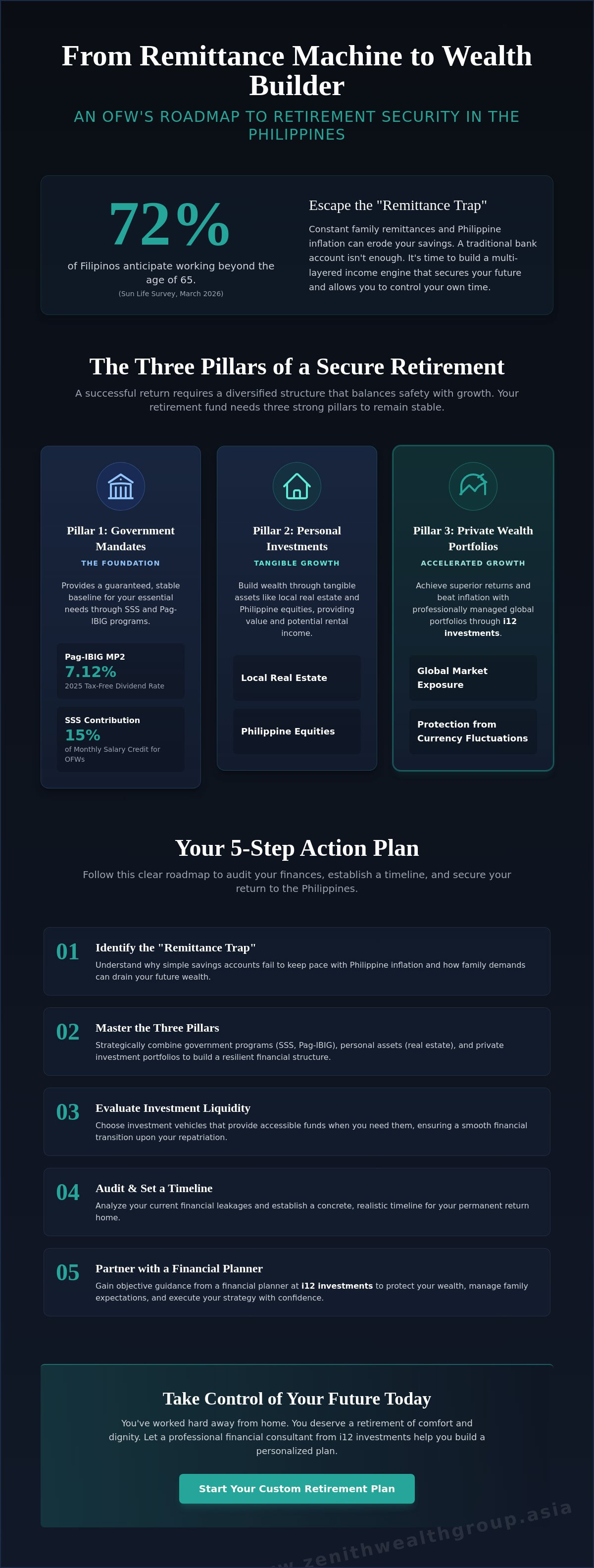
How to Build Your Retirement Roadmap: A 5-Step Guide
Creating a roadmap turns a vague dream into a concrete deadline. Retirement planning for OFWs in the Philippines requires a structured approach to ensure you don't run out of funds after your final flight home. Follow these five steps to secure your future.
- Step 1: Audit your current remittances and "leakage". Look for hidden costs in your monthly transfers. Identify non-essential family expenses or forgotten subscriptions that could be redirected toward your wealth.
- Step 2: Define your "Home for Good" target date and monthly budget. Pick a specific year for your return. Estimate how much you'll need each month to maintain your desired lifestyle once the foreign salary stops.
- Step 3: Establish an Emergency Fund in both your host country and the Philippines. Keep liquid cash in your current location for immediate needs and a separate fund in pesos to handle sudden family or property issues back home.
- Step 4: Automate contributions to i12 investments and government pillars. Treat your retirement fund like a mandatory bill. Set up automatic transfers so your wealth grows before you have the chance to spend it.
- Step 5: Review your plan annually with a financial consultant. Life changes, and so do market conditions. A yearly check-up ensures your strategy stays aligned with your goals and the 2026 economic reality.
If you're ready to move from guessing to knowing, speak with a financial planner today to start your personalized roadmap.
Calculating Your Retirement Number
Your Retirement Number is the total capital needed to generate your desired monthly income. When calculating this, you must factor in the rising cost of living in major hubs like Manila or Cebu. Prices in 2026 have shifted, and healthcare costs will naturally increase as you age. Don't just plan for today's expenses; plan for the inflation you'll face ten or twenty years from now. This ensures your fund remains self-sustaining for the rest of your life.
Automating Your Future
Willpower is a limited resource. Setting up direct transfers to your investment accounts removes the temptation to overspend on remittances or luxury items. Use modern digital tools to track your progress toward repatriation in real-time. It's also vital to have a conversation with your family. Ensure they understand that this automation isn't about being stingy; it's about securing a future where you can be physically present with them without financial stress.
The Essential Role of a Financial Consultant in Your Journey
DIY planning often fails for OFWs because distance makes it difficult to maintain objectivity. You're balancing a high-pressure job abroad with the emotional weight of family expectations at home. It's easy to let your retirement fund slip when immediate needs arise. A financial consultant provides the professional distance needed to keep your goals on track. They act as a neutral advocate for your future self. This ensures your retirement planning for OFWs in the Philippines isn't derailed by short-term pressures or family requests. You need a partner who prioritizes your long-term security above all else.
Don't mistake a collection of insurance policies or bank accounts for a retirement strategy. Buying a product is easy, but building a roadmap is where the real work happens. You need a plan that accounts for currency fluctuations, tax implications, and your specific timeline for repatriation. A financial planner helps you see the big picture. They ensure every investment, from your SSS contributions to your private portfolios, works in harmony. It's time to stop guessing and start executing a professional vision for your return. Moving from intention to action is the only way to guarantee your seat at the table back home.
Customising Your Strategy with Zenith Wealth
We understand the unique challenges of working across borders. Our team helps you navigate complex global markets while focusing on your eventual Philippine return. We integrate i12 investments into a holistic wealth protection strategy to safeguard what you've built. We also help you secure your legacy planning before you finish your overseas contract. This ensures your wealth is protected for the next generation while providing for your own comfort. We bridge the gap between your current foreign earnings and your future local lifestyle.
Next Steps: Your Consultation
Your first meeting is about clarity. Bring your current remittance records and a clear idea of the lifestyle you want to lead back home. We'll help you align your retirement planning with both your personal goals and your family's needs. This is the moment where your "Home for Good" dream becomes a reality. Reach out and take control of your timeline. Contact a Zenith Wealth financial consultant today to start your roadmap.
Your Roadmap to a Permanent Homecoming
You now have the framework to move from being a global provider to a local asset owner. Success comes from balancing government mandates with private growth and automating your savings before family pressures intervene. This proactive approach is the core of effective retirement planning for OFWs in the Philippines. It's about ensuring your return is a celebration, not a financial struggle.
At Zenith Wealth, we provide specialized expertise in cross-border wealth management. Our team serves as authorized representatives of finexis advisory Pte Ltd. We're ready to help you design personalized strategies, including i12 investments, that align with your 2026 goals. Don't leave your repatriation to chance. Secure your 'Home for Good' future—book a consultation with our financial consultants today. You've worked hard for your family. Now, it's time to work for your future. We're here to start that conversation whenever you're ready.
Frequently Asked Questions
When is the best time for an OFW to start retirement planning?
The best time to start is today, regardless of your age or how long you've been working abroad. Starting early gives your money more time to benefit from compounding growth. This is especially true while you have the advantage of earning in a stronger foreign currency. Don't wait until you're about to fly home to think about your future income; start building your base now.
Can I still contribute to SSS and Pag-IBIG even if I am working abroad?
You can absolutely contribute as a voluntary member through digital platforms. In 2026, the SSS contribution rate for OFWs is 15% of the monthly salary credit. Staying active in these programs is vital for your baseline security. It also allows you to take advantage of high-performing voluntary savings like the Pag-IBIG MP2 program. These government pillars provide a stable floor for your overall financial plan.
How much money do I need to retire comfortably in the Philippines in 2026?
There's no single number, but your goal should be to cover your monthly expenses through passive income. You need to factor in the 2026 cost of living and potential healthcare needs as you age. A financial planner can help you determine the specific capital required to ensure you don't outlive your savings after you repatriate. They'll help you adjust for inflation so your lifestyle remains comfortable.
What are the risks of relying solely on real estate for retirement?
Relying only on property makes you "asset rich but cash poor" because real estate isn't liquid. You can't easily convert a house into cash for an emergency. You also have to deal with property taxes, repairs, and the risk of vacant units. Balancing property with liquid options like i12 investments ensures you have money available whenever you need it. This diversification is essential for a stress-free retirement.
How does i12 investments differ from a regular savings account?
i12 investments is designed for growth, whereas a savings account is only for short-term safety. Regular bank accounts often provide interest rates that fall below the rate of inflation. These managed portfolios are a more proactive tool for retirement planning for OFWs in the Philippines. They help you build a fund that actually increases in value over time. It's a sophisticated way to manage your wealth while working overseas.
What happens to my investments if I decide to stay abroad longer than planned?
Your portfolio remains active and continues to earn returns regardless of where you live. If you extend your stay abroad, you can use the extra time to increase your contributions. It's a great opportunity to work with a financial consultant to refine your goals. They'll help you maximize this extra earning period for an even more comfortable return. Your plan is flexible enough to grow alongside your changing career timeline.
Do I need a financial consultant if I only have a small amount to save?
Professional advice is valuable at any stage of your journey, even if you're starting small. A financial consultant helps you choose the right "buckets" for your money so every peso counts. They provide the discipline and strategy needed to turn small monthly savings into a significant retirement fund. It's about building the right habits today for a better life tomorrow. You don't need a fortune to start; you just need a plan.
How can I protect my retirement fund from being used by my relatives?
Automation is your best defense against family requests for financial assistance. By setting up direct transfers to i12 investments, the money is committed before it's even seen in your bank account. This helps you stay disciplined with your retirement planning for OFWs in the Philippines. It also gives you a clear reason to tell relatives that your funds are already allocated for your long-term security. Protecting your future is not being selfish.


