

Choosing the right visa is no longer the hardest part of moving to Bangkok or Chiang Mai. Many expats assume that once the visa is stamped, the financial heavy lifting is over. You've likely spent hours comparing the O-A versus the LTR options, worrying about the 800,000 THB deposit or the $80,000 USD income floor. It's a common starting point, but effective retirement planning for expats in Thailand now requires looking far beyond the immigration desk.
Since the 2024 tax shifts became fully realized in 2026, your global income structure is just as vital as your residency status. This guide will help you master the financial, visa, and tax complexities of retiring in the Land of Smiles with a strategic plan built for Southeast Asian expats. You'll gain a clear roadmap for navigating the 35% top tax bracket, managing currency risk between SGD and THB, and ensuring long term visa compliance. We'll also preview how a dedicated financial planner uses the i12 investments framework to keep your portfolio steady against market volatility. It's time to replace uncertainty with a professional strategy that secures your peace of mind and your future.
Key Takeaways
- Master the evolving 2026 landscape of retirement planning for expats in Thailand to protect your lifestyle against inflation and shifting global rates.
- Compare the 10-year LTR visa against standard long-stay options to find the gold standard for high-net-worth residency.
- Navigate the post-2024 tax remittance rules to understand how to structure offshore assets without triggering local liabilities.
- Discover how the i12 investments framework provides a rule-based approach to growth, removing emotional bias from your portfolio management.
- Learn how a dedicated financial planner bridges the gap between Singapore and Thailand with a customized multi-jurisdictional roadmap.
The Expats Reality: Why Retirement Planning for Thailand is Different in 2026
The landscape has changed. Retiring in Thailand used to be the "budget" choice for many. By 2026, the focus has shifted toward wealth preservation for high-net-worth individuals. You aren't just looking for a cheaper lifestyle. You want to maintain your standard of living while navigating a world of shifting interest rates and complex tax laws. Proactive retirement planning for expats in Thailand is no longer optional; it's the foundation of a secure future.
Effective planning in this cross-border context means more than just saving money. It involves structuring your wealth to withstand currency fluctuations and regulatory changes. While the statutory Retirement age varies across the globe, the Thai visa system opens doors at age 50. However, the financial architecture must be built years before you pack your bags. Waiting until you arrive to manage your SGD or USD assets against your THB liabilities is a recipe for stress.
The 2026 Expat Profile in Thailand
Many of our clients are transitioning from corporate life in Singapore or Malaysia. You likely hold assets in multiple currencies and need a strategy that bridges these two worlds. A professional financial consultant acts as your guide during this transition. They help you align your global portfolio with your local needs. By utilizing frameworks like i12 investments, you can manage market volatility without the emotional stress of manual trading. This rule-based approach is essential for those moving from a high-pressure career to a structured, passive income stream.
Common Misconceptions About Retiring in Thailand
Don't fall into the "low cost of living" trap. While street food is affordable, luxury expat life in 2026 comes with its own price tag. Consider these factors:
- Inflation planning: Daily costs in Thailand are rising. If you don't account for this in your long-term roadmap, your purchasing power will erode.
- Private healthcare: Medical care for retirees over 60 is world-class but expensive. Premium coverage is a necessity to protect your capital from sudden health shocks.
- Legacy planning: Managing an estate across two jurisdictions requires specific legal and financial structures. Without a clear plan, your heirs could face significant hurdles.
Success requires a professional touch. A dedicated financial planner can help you structure your assets for maximum tax efficiency and visa compliance. If you're ready to build a resilient future, connect with our team to start your retirement planning for expats in Thailand today.
Choosing Your Path: 2026 Thailand Retirement Visa Comparison
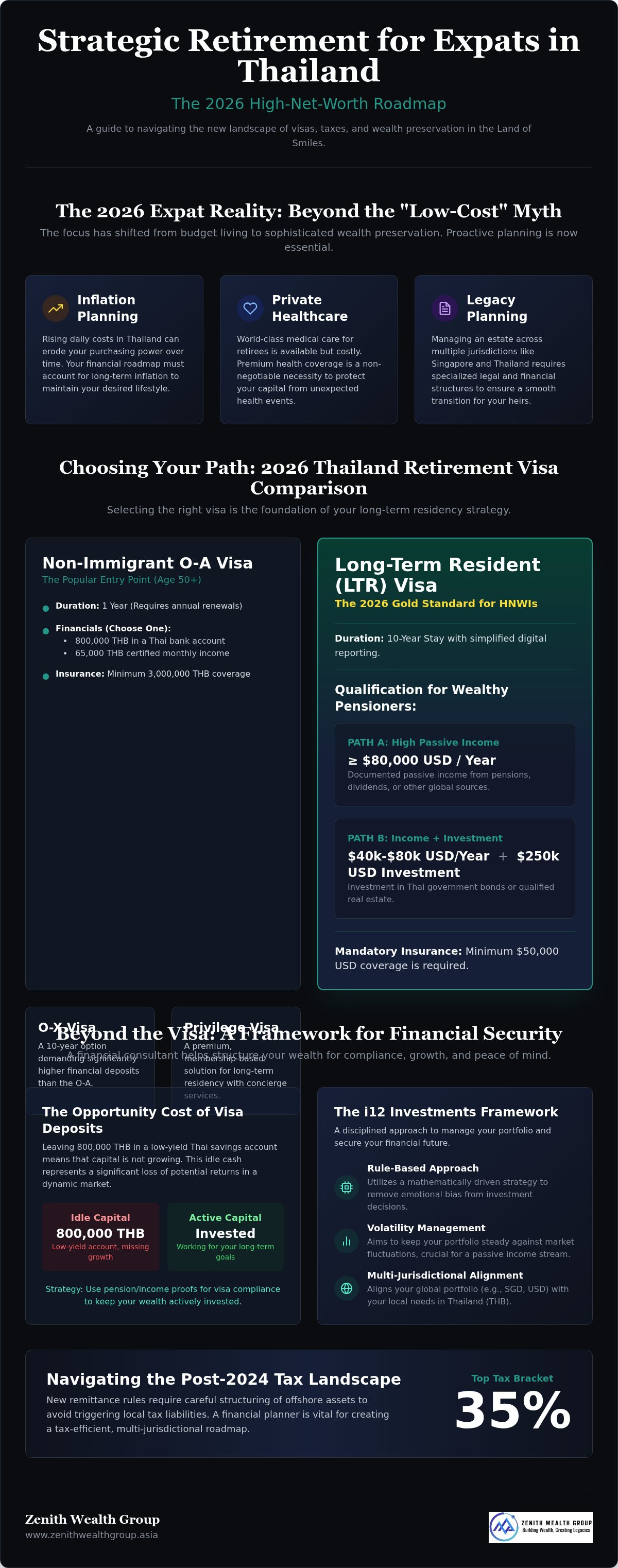
Selecting the right visa is the first concrete step in retirement planning for expats in Thailand. By 2026, the options have diversified to cater to different wealth profiles. The Non-Immigrant O-A visa remains a popular entry point for those 50 and older. It requires either 800,000 THB in a Thai bank account or a certified monthly income of 65,000 THB. While accessible, it demands annual renewals and mandatory health insurance with 3,000,000 THB in coverage. For those seeking a decade of stability, the O-X visa extends the stay to 10 years but requires significantly higher deposits.
If you prefer to bypass the annual financial reporting burden, the Thailand Privilege Visa offers a membership-based solution. It's a premium choice that exchanges a high upfront fee for long-term residency and concierge services. For many high-net-worth retirees, the cost is a fair trade for the time saved on immigration paperwork.
The LTR Visa for Wealthy Pensioners
The Long-Term Resident (LTR) visa is the 2026 gold standard. It offers a 10-year stay and digital reporting perks that O-A holders don't receive. To qualify as a wealthy pensioner, you need a passive income of at least $80,000 USD per year. If your income falls between $40,000 and $80,000, you must invest at least $250,000 USD in Thai government bonds or real estate. A financial planner is essential here to help you document global income streams and ensure your health insurance meets the $50,000 USD minimum requirement.
Opportunity Cost of Visa Deposits
Many retirees overlook the hidden cost of the 800,000 THB deposit. Leaving this capital in a low-yield Thai savings account for months means missing out on market growth. In a 2026 environment of shifting interest rates, that idle cash represents a significant opportunity cost. Instead of locking away liquid capital, some expats opt to meet requirements through pension income proofs. This strategy keeps more of your wealth active in rule-based frameworks like i12 investments. By using a disciplined, mathematically driven strategy, your capital can work toward your long-term goals while you maintain your residency status.
Navigating these choices requires a clear understanding of your total financial picture. If you're unsure which path fits your 2026 goals, speak with a financial consultant to review your options.
Navigating the New Tax Landscape: Remittance and Global Income
The rules for bringing money into Thailand have shifted. Starting on January 1, 2024, the Thai Revenue Department began taxing foreign-sourced income remitted into the country by tax residents. If you spend 180 days or more in Thailand during a calendar year, you're considered a tax resident. By 2026, these regulations are strictly enforced. Understanding the distinction between remitting income and simply holding assets offshore is now the most critical part of retirement planning for expats in Thailand.
If your wealth stays in a Singaporean brokerage or a bank account outside of Thailand, it's generally not subject to Thai personal income tax. The tax trigger is the act of "remitting" or bringing those funds into a Thai bank account to pay for your lifestyle. Fortunately, the Singapore-Thailand Double Taxation Agreement (DTA) provides a shield. It ensures you aren't taxed twice on the same dollar of income. Managing these boundaries requires a clear strategy before you make your first transfer.
The Remittance Rule Explained
The timing of your money transfers matters more than ever. Income earned before January 1, 2024, remains exempt from Thai tax even if you remit it today. However, you must maintain impeccable records to distinguish this "old wealth" from new earnings. A financial planner can help you design a transfer schedule that prioritizes these tax-exempt funds. This proactive approach prevents you from accidentally triggering a tax bill that can reach up to 35% for income exceeding 5,000,000 THB. Clear documentation of your cost basis and capital gains is your best defense against over-taxation.
Tax Savings Through Strategic Planning
Before you move, consider how you manage your Singapore-based assets. Maximizing your SRS account allows for tax-deferred growth while you're still working. Once you retire to Thailand, you can withdraw these funds strategically to minimize your global tax footprint. Combining this with legacy planning ensures your Thai-based assets don't create a legal nightmare for your heirs across two different jurisdictions.
Effective wealth management also requires a disciplined investment strategy. Using rule-based frameworks like i12 investments allows you to grow your offshore capital without the need for constant manual oversight. This ensures your retirement fund stays resilient regardless of local Thai tax shifts. If you need a customized roadmap for your cross-border transition, reach out to a financial consultant to discuss your specific situation.
Building a Resilient Portfolio with i12 Investments
Traditional "buy and hold" strategies often struggle in the high-inflation, volatile market of 2026. For those focused on retirement planning for expats in Thailand, a more disciplined approach is required. You need a portfolio that doesn't just grow but also protects your purchasing power. This is where investment management becomes a lifelong necessity rather than a one-time setup. Relying on outdated models can leave you vulnerable to sudden market shifts that erode your capital just when you need it most.
We utilize i12 investments to remove emotional bias from your financial decisions. It's a rule-based framework that uses mathematically driven trigger points to buy and sell assets. This system is particularly effective for managing the currency risk inherent in a Thai retirement. Since you're likely spending in THB while holding assets in SGD or USD, you need a strategy that can adapt to shifting trade balances and Fed rates without panic. By following a structured methodology, you can maintain your lifestyle regardless of how the exchange rate fluctuates.
Income Generation Strategies in Thailand
Balancing dividend-yielding assets with capital preservation is a delicate act. In 2026, global markets are sensitive to US trade balances and shifting interest rates across Asia. i12 investments help stabilize your cash flow by providing clear exit and entry signals based on data, not headlines. This ensures you have the liquid THB needed for daily expenses without eroding your core capital during market dips. It's about creating a sustainable stream that supports your 30-year retirement horizon while staying agile enough to capture growth.
Risk Mitigation for Expats
Geographic diversification is your safety net. We often recommend keeping a significant financial footprint in Singapore while enjoying life in Thailand. This dual-market approach protects you against localized economic shifts. For the risk-averse investor, this structure provides a sense of security that a single-country portfolio cannot match. It allows you to benefit from Singapore’s robust financial infrastructure while living in the Land of Smiles.
Rebalancing a cross-border portfolio is complex and requires constant attention. A professional financial consultant ensures your asset allocation remains aligned with your long-term goals as market conditions change. They act as the steady hand, ensuring your retirement planning for expats in Thailand stays on track through every economic cycle. If you're ready to build a portfolio that stands the test of time, contact a financial planner to explore how i12 investments can secure your Thai retirement.
The Roadmap: How a Financial Consultant Secures Your Future
A successful move isn't just about packing boxes. It's about building a bridge between your current corporate life and your future in the Land of Smiles. Retirement planning for expats in Thailand works best when it's treated as a multi-stage strategy. You need a clear path that accounts for both Singapore’s financial systems and Thailand’s regulatory environment. This isn't a DIY project; it's a high-stakes transition that requires professional precision.
Your journey follows a structured four-step process:
- Step 1: Comprehensive wealth analysis. We define your goals and map out your existing global assets against your projected Thai lifestyle costs.
- Step 2: Strategic structuring. We align your portfolio for tax efficiency under the 2026 remittance rules and ensure you meet specific visa financial thresholds.
- Step 3: Implementing i12 investments. We transition your capital into a rule-based framework designed to provide steady income while managing market volatility.
- Step 4: Ongoing monitoring. We adjust your cross-border plan as regulations shift, ensuring your strategy remains resilient for decades.
Why a Financial Planner in Singapore is Your Best Asset
Coordinating between your CPF or SRS accounts and Thai immigration requirements is complex. A financial planner based in Singapore understands the nuances of both jurisdictions. They ensure your wealth protection strategy remains robust as you cross borders. This isn't just about moving money; it's about safeguarding your legacy. You need a modern professional guide who prioritizes human connection alongside technical expertise.
Taking the First Step Toward Thailand
Don't wait until your final year of work to start this process. The most successful transitions begin 2-3 years before the actual move. This lead time allows you to season funds for visa applications and optimize your tax position before you become a Thai tax resident. It's about being proactive rather than reactive. Retirement planning for expats in Thailand is a marathon, not a sprint. We help you manage the timing so you don't face unnecessary hurdles at the finish line.
We’re ready to start the conversation whenever you are. Our team focuses on the unique needs of regional expats, providing the clarity you need for a confident move. Ready to plan your move? Speak with a financial consultant today to secure your future.
Your 2026 Thai Retirement Starts Today
Transitioning from a career in Singapore to a lifestyle in Thailand requires more than just a visa. You need a strategy that balances the 2024 tax shifts, currency risks, and long-term portfolio resilience. By now, you've seen how the LTR visa can simplify your residency and how rule-based i12 investments can protect your capital from market volatility. Effective retirement planning for expats in Thailand is about making your wealth work for you across two different jurisdictions.
As authorized representatives of finexis advisory, we bring specialized expertise in Singapore-Thailand cross-border wealth. We don't just manage money; we build the roadmap that lets you retire with true peace of mind. Our team is ready to help you navigate the complexities of 2026 with quiet confidence and clear, actionable advice. Start your transition with a partner who understands the regional landscape.
Secure your Thai retirement roadmap with a Zenith financial consultant. Your future in the Land of Smiles is within reach. Let's make it a reality together.
Frequently Asked Questions
Can I retire in Thailand if I'm under 50 years old?
You can retire in Thailand before age 50 by using the Thailand Privilege Visa or specific categories of the Long-Term Resident (LTR) visa. While the standard O-A retirement visa requires you to be at least 50, these alternatives cater to younger high-net-worth individuals or professionals. A financial planner can help you evaluate the membership costs of the Privilege program against your long-term wealth protection goals and residency needs.
How much money do I actually need to retire in Thailand in 2026?
Visa minimums require either a 800,000 THB deposit or a 65,000 THB monthly income, but a comfortable lifestyle often requires more. Effective retirement planning for expats in Thailand accounts for 2026 inflation rates and rising private healthcare premiums. We recommend a comprehensive wealth analysis to ensure your portfolio sustains your specific standard of living in cities like Bangkok or Phuket for a 30-year horizon without eroding your core capital.
Will my Singapore CPF or SRS income be taxed in Thailand?
Your CPF or SRS withdrawals may be subject to Thai personal income tax if you are a tax resident and remit those funds into Thailand. Under the rules enforced through 2026, foreign-sourced income brought into the country is taxable for residents staying 180 days or more. Fortunately, the Singapore-Thailand Double Taxation Agreement (DTA) often provides relief. A financial consultant can help you structure a remittance schedule to minimize your local tax liabilities.
Do I need a financial consultant to apply for a Thai retirement visa?
You don't legally need a professional for the visa application itself, but a financial planner is essential for the underlying strategy. Securing the visa is a logistics task; ensuring your wealth survives the move is a strategic one. We focus on structuring your global assets to meet THB requirements without triggering unnecessary tax events. This ensures your retirement planning for expats in Thailand is built on a foundation of long-term compliance and growth.
What is the best way to manage currency exchange from SGD to THB?
Managing the exchange between SGD and THB requires a disciplined approach to avoid the traps of market timing. Many retirees use multi-currency accounts to hold funds and transfer only what they need for monthly expenses. Utilizing a rule-based framework like i12 investments helps you manage this volatility by removing emotional decisions from the process. This strategy ensures you have sufficient local currency while keeping your primary wealth in stable, global assets.
Is private health insurance mandatory for all Thai retirement visas?
Private health insurance is mandatory for the O-A visa, requiring 3,000,000 THB in coverage, and the LTR visa, which requires $50,000 USD. Beyond visa compliance, comprehensive insurance is a cornerstone of wealth protection for retirees. It prevents a single medical emergency from depleting your retirement savings. It's vital to select a policy that provides global coverage and meets the specific 2026 regulatory standards for your chosen visa category.
How does legacy planning work if I have assets in both Singapore and Thailand?
Legacy planning for cross-border families involves coordinating wills and trusts across both jurisdictions to avoid probate delays. Assets held in Singapore follow Singaporean law, while Thai property must comply with local regulations. We work as authorized representatives of finexis advisory to help you structure an estate plan that protects your heirs. This ensures a smooth transfer of generational wealth and prevents your assets from being locked in complex legal battles across borders.
What are the benefits of the i12 investments approach for retirees?
The i12 investments approach provides a mathematically driven framework that removes emotional bias from your financial decisions. For retirees, this means having clear trigger points for buying and selling assets, which helps stabilize cash flow for daily expenses. It's particularly useful for managing the irregular income needs of a long retirement. By following this structured methodology, you can capture market growth while maintaining a defensive posture against global economic volatility.


