

What if the thousands of dollars you've remitted home over the years haven't actually bought you a ticket to stop working? It's a sobering thought for many Filipinos living in the Lion City. Most of us work tirelessly to provide for our families, yet we often find ourselves caught in the remittance trap. We send so much back home that our own personal savings are neglected, leaving us worried about how we'll survive once our work permits expire. It's natural to feel concerned that inflation in the Philippines, which hit 6.2% in July 2026, will erode your hard earned peso savings before you even get to enjoy them.
We understand these challenges. Effective retirement planning for Filipino OFWs in Singapore is about more than just saving; it's about building a strategic, cross-border roadmap that protects your family while growing your wealth. This guide will show you how to leverage Singapore’s stable financial environment to fund your Philippine lifestyle. We'll explain how to manage your CPF and SRS assets, the importance of working with a professional financial planner, and how a diversified portfolio featuring i12 investments can create reliable passive income. You'll gain a clear timeline for when you can finally head home for good, confident that your future is secure.
Key Takeaways
- Master the fundamentals of retirement planning for Filipino OFWs in Singapore by bridging your SGD earnings with a sustainable Philippine lifestyle roadmap.
- Discover how to optimize Singapore-specific tools like the Supplementary Retirement Scheme (SRS) and i12 investments to build a tax-efficient, cross-border portfolio.
- Gain a practical framework to balance family remittances with personal savings, ensuring you protect your future while supporting your loved ones.
- Follow a clear 5-step roadmap to audit your current assets and accurately project your retirement costs in 2026 prices.
- Understand the value of partnering with a professional financial consultant to navigate complex cross-border regulations and wealth protection strategies.
What is Strategic Retirement Planning for OFWs in Singapore?
For an Overseas Filipino Worker (OFW), 2026 is a critical year to reassess your wealth. Retirement planning for Filipino OFWs in Singapore isn't just about putting money aside. It's the active process of converting your current SGD earnings into long term PHP or USD lifestyle security. The global economy is changing. You need a plan that accounts for these shifts rather than just hoping for the best.
A professional financial planner helps you build what we call the SG-PH Financial Bridge. This concept focuses on using Singapore’s renowned financial stability to fund your specific Philippine goals. Navigating cross-border regulations is complex. A financial consultant ensures you're compliant in Singapore while maximizing the value of every dollar you intend to bring home. This strategic approach transforms your overseas stint into a permanent foundation for your future.
The Unique Financial Reality of the Singapore-based OFW
Singapore offers incredible salaries, but it also demands a high cost of living. Many Filipinos struggle with the temptation of high remittances, often prioritizing family needs over their own future. This creates the Retirement Gap. It's the painful difference between the lifestyle you want back home and the actual capital you've accumulated. The Expat Wealth Paradox describes a situation where a high monthly salary fails to translate into a high net worth because of poor asset allocation.
Why Traditional Saving Isn't Enough in 2026
Relying on a basic bank account is no longer a viable strategy. In July 2026, Philippine inflation hit 6.2%, meaning your money buys less today than it did last year. Keeping your hard earned cash in a standard savings account is a stealth tax on your future. It simply can't keep up with rising prices. You're effectively losing wealth even while you think you're saving.
You need a portfolio designed for strategic growth. Modern tools, including i12 investments, provide the diversification necessary to combat inflation and build a lasting legacy. A financial consultant can help you integrate these options into a cohesive plan. If you want to stop the erosion of your savings, reach out to us today to start building your roadmap.
Leveraging Singapore's Financial Ecosystem for Philippine Goals
Singapore's financial system offers tools that most overseas workers overlook. If you're serious about retirement planning for Filipino OFWs in Singapore, you can't rely solely on remittances. You need to use the local ecosystem to your advantage. This means looking beyond basic savings and exploring the Supplementary Retirement Scheme (SRS) and Central Provident Fund (CPF) options.
The SRS is a powerful tool for foreigners. It allows you to reduce your taxable income while building a nest egg. For high-earning professionals, this is a game changer. You can find deeper insights on tax strategies in our guide on Mastering the SRS Account. Research into financial education for Filipino domestic workers and professionals shows that understanding these local mechanisms significantly improves long term outcomes. It gives you the confidence to manage your SGD earnings with a purpose beyond the monthly remittance.
Don't forget your CPF contributions if you've held Permanent Residency status. As a non-citizen, you can withdraw your CPF funds in full when you leave Singapore permanently. This lump sum provides a massive boost to your Philippine retirement fund. A financial planner can help you time this withdrawal to minimize currency risk and ensure the capital is reinvested immediately into growth assets. They'll also help you navigate the 2026 CPF Full Retirement Sum (FRS) of S$213,000 if you plan to stay in Singapore longer before heading home.
The SRS Account: A Tax Shield for High-Earning OFWs
Every dollar you contribute to your SRS account reduces your taxable income in Singapore. For those in higher tax brackets, the immediate savings are substantial. Once the funds are in the account, you can invest them in various instruments designed for long term stability. The 10 year withdrawal window for foreigners is particularly helpful. It aligns perfectly with a 'Home for Good' timeline, allowing you to stagger your income and stay within lower tax brackets even after you've stopped working. This ensures your hard earned money goes further when you finally move back to the Philippines.
I12 Investments: A Pillar for Generational Wealth
Strategic growth requires more than just tax savings. Incorporating i12 investments into your portfolio provides the diversification needed to protect your wealth against market volatility. These assets are built for legacy. They ensure that the wealth you build in Singapore doesn't just fund your retirement but also provides for the next generation. This focus on long term growth is what separates a simple savings plan from true wealth management. You can learn more about this in our article on Legacy Planning in Singapore.
Building a cross-border portfolio requires precision. If you're ready to see how these tools fit your specific situation, speak with a financial consultant to get started.
Overcoming the 'Remittance Trap': A Framework for Balance
Saying "no" to a family member is one of the hardest things an OFW has to do. We're raised to be providers, and the cultural pressure to send every spare cent home is immense. However, this often leads to a cycle of perpetual work where you become an exhaustible resource. Strategic retirement planning for Filipino OFWs in Singapore means breaking this cycle. It's about finding a balance that honors your family commitments while securing your own future.
Many Filipinos rely on a "Real Estate Only" strategy. They buy a house or a condo in Manila and assume their retirement is sorted. This is a risky gamble. Real estate is illiquid. It doesn't provide the monthly cash flow needed for daily expenses unless it's managed perfectly as a rental. A financial planner helps you diversify your assets. They ensure you aren't over-concentrated in one asset class that might be difficult to sell when you need the cash most. Setting these boundaries protects both you and the people you love.
The 50/30/20 Rule for OFWs
We recommend adapting a classic budgeting framework to fit the OFW lifestyle. Aim to allocate 50% of your income to your needs in Singapore, 30% to remittances and personal wants, and 20% strictly for your personal retirement. Your own financial independence is the most sustainable gift you can ever give your family. It ensures you'll never be a financial burden to them in your later years.
This requires a psychological shift from being a "Provider" to becoming a "Wealth Builder." Instead of just sending money away, you're growing it. Allocating a portion of your 20% savings into growth-focused vehicles like i12 investments ensures your capital works as hard as you do. This disciplined approach builds a foundation that lasts long after your final Singapore paycheck.
Wealth Protection: Safeguarding Your Ability to Earn
Your greatest asset is your ability to work. A single medical emergency can derail years of saving if you aren't prepared. Critical illness and life insurance in Singapore are often more robust and cost-effective than options back home. By securing coverage here, you ensure that a health crisis doesn't wipe out your "Home for Good" fund. You can explore these strategies further in our guide on Wealth Protection in Singapore. Protecting your downside is just as vital as growing your upside. It gives you the confidence to keep building toward your 2026 goals without fear of the unexpected.
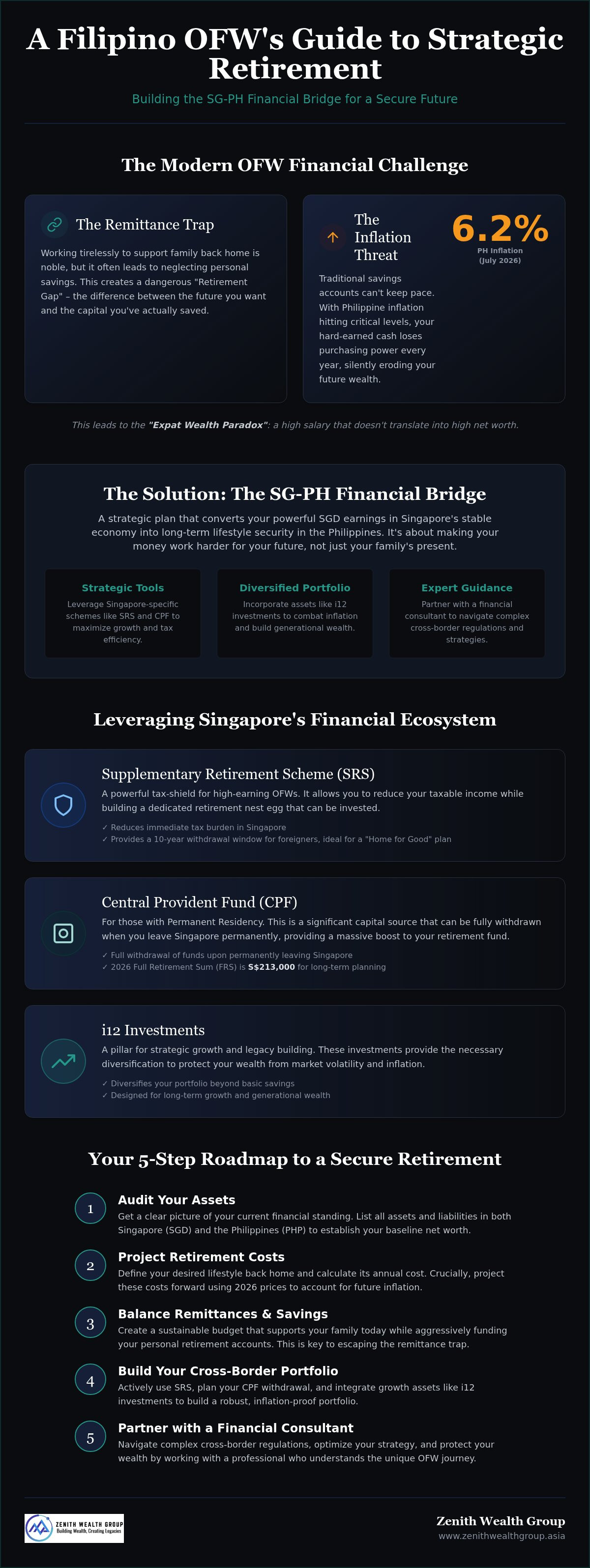
Your 5-Step Roadmap to Retiring 'Home for Good'
Retiring "Home for Good" is an emotional goal, but it requires technical execution. You need a transition plan that moves your wealth from the high growth environment of Singapore to the lifestyle focused reality of the Philippines. Effective retirement planning for Filipino OFWs in Singapore involves these five essential steps:
- Step 1: Define your 2026 Philippine Lifestyle Cost. Don't guess. Calculate what your ideal life costs today and adjust for the 6.2% inflation seen in the Philippines this year.
- Step 2: Audit your Singapore assets. Review your CPF balances, SRS contributions, and private savings. Know exactly what can be liquidated and when.
- Step 3: Diversify through i12 investments. Protect your savings from currency volatility. Keeping all your wealth in one currency or one market is risky.
- Step 4: Establish a Legacy Plan. Ensure your wealth can move across borders smoothly to support your family without legal hurdles.
- Step 5: Consult a financial consultant. Get a professional to stress test your assumptions before you book your one way flight.
Calculating the Real Cost of Retirement in the Philippines
Many OFWs underestimate how much they'll need. Healthcare costs in the Philippines often rise faster than general inflation. While Singapore has excellent public options, you'll likely rely on private care back home. We recommend planning for 120% of your current expected expenses. This 20% buffer accounts for SGD-PHP exchange rate fluctuations over a 20 year horizon. It ensures your lifestyle remains stable even if the peso weakens or local prices spike unexpectedly. It's about being prepared for the long term, not just the first few years.
Stress-Testing Your Portfolio Against Global Trends
Global markets are volatile. A roadmap that works in a boom might fail during a downturn. This is where i12 investments play a vital role. They provide a strategic buffer, helping your portfolio absorb market shocks while maintaining growth. You can learn more about these strategies in our guide on Strategic Investment Management in 2026. Regular reviews with a financial planner are non-negotiable. They help you adjust your roadmap as regulations change or your family goals evolve. If you're ready to stress test your own plan, book a strategy session with our team today.
Why Partner with a Financial Consultant at Zenith Wealth?
Zenith Wealth isn't a distant corporate entity. We act as your Modern Professional Guide. We know that retirement planning for Filipino OFWs in Singapore is deeply personal. It's about more than just numbers on a screen. It's about the security of your family and your eventual plane ticket home. We combine technical expertise with a welcoming, open-door policy. This ensures you feel supported throughout your financial journey. We avoid the heavy, jargon-filled atmosphere of traditional firms. Instead, we offer a friendly partnership that encourages immediate connection. Your future is waiting.
As authorized representatives of finexis advisory Pte Ltd, we bring institutional knowledge to every conversation. This partnership, backed by a firm founded in 2005, allows us to offer specialized solutions for cross-border needs. We specifically focus on i12 investments to help you achieve growth and wealth protection. This focus is a major differentiator for our OFW clients. It provides a modern alternative to traditional saving methods that often fall short. Our goal is to make complex Singaporean regulations work for your Filipino dreams. We invite you to a non-obligatory discovery call to discuss your 'Home for Good' goals. Let's start a conversation.
The finexis Advisory Advantage
Being part of the finexis family means we aren't tied to a single brand's products. We provide access to a wide range of independent solutions. This flexibility ensures your financial roadmap is truly personalized to your life. We prioritize professional integrity in every recommendation. Our financial planners bridge the gap between Singapore's strict financial landscape and the reality of life in the Philippines. We help you navigate the transition with quiet confidence. You get the benefit of a boutique, localized firm combined with the technical expertise of a major advisory network. It's the best of both worlds for a proactive retiree. We're here to help.
Take the First Step Toward Your Future Today
Waiting to plan is expensive. Even a one year delay can significantly impact the final value of a 20 year retirement fund. Time is your most valuable asset while earning in Singapore. Move from professional anticipation to concrete action. The roadmap we've discussed throughout this guide is only effective if you start. Don't let confusion over CPF or SRS assets hold you back. Our financial consultants are ready to simplify the process for you. We value straightforward communication and transparency above all else. Visit the Zenith Wealth contact page to begin. Your 'Home for Good' journey starts with a single, proactive step.
Your Path Back Home Starts Today
You've spent years building a life in Singapore. Now, it's time to ensure that those efforts translate into a secure future back in the Philippines. Successful retirement planning for Filipino OFWs in Singapore requires a strategic bridge between two economies. By optimizing tools like your SRS account and integrating i12 investments, you turn your SGD earnings into a lasting legacy. You don't have to choose between supporting your family today and protecting your own tomorrow.
At Zenith Wealth, we help you navigate this transition with quiet confidence. As authorized representatives of finexis advisory Pte Ltd, we specialize in creating tailored roadmaps for the Filipino community. We focus on practical execution and wealth protection so you can retire with peace of mind. Don't let another year of growth pass you by. Take the first step toward your "Home for Good" goal today. Your future is waiting.
Book a Discovery Call with a Financial Consultant to start your roadmap. We're excited to help you build the future you deserve.
Frequently Asked Questions
Can Filipino OFWs withdraw their CPF when they retire to the Philippines?
Yes, if you're a non-citizen and decide to leave Singapore permanently, you can withdraw your CPF contributions in a lump sum. This includes your Ordinary, Special, and Medisave accounts. It's a significant part of retirement planning for Filipino OFWs in Singapore as it provides immediate capital for your transition home. A financial planner can help you manage the timing and currency conversion to ensure you maximize these funds for your Philippine retirement.
Is the SRS account better than Pag-IBIG MP2 for Filipinos in Singapore?
Both have distinct benefits. The SRS account offers immediate tax relief on your Singapore income, which is a major advantage for high earners. Pag-IBIG MP2 is a voluntary savings program in the Philippines known for its tax-free dividends. Often, the best strategy involves using both. You can use SRS to lower your SG tax bill and invest in i12 investments, while maintaining MP2 for its local Philippine stability and competitive returns.
How much money do I need to retire comfortably in the Philippines in 2026?
The amount varies based on your lifestyle, but you should factor in the 6.2% inflation rate recorded in the Philippines in July 2026. We recommend planning for at least 120% of your current estimated expenses to buffer against rising healthcare costs and currency fluctuations. A financial consultant can help you calculate a personalized target by auditing your current Singapore assets and projecting your future needs in 2026 prices to ensure you don't outlive your savings.
What are i12 investments and how do they help with retirement?
i12 investments are a specific focus within our wealth management strategy at Zenith Wealth. They are designed to provide strategic growth and wealth protection for clients looking for a modern alternative to traditional saving. These investments help diversify your portfolio, reducing reliance on a single market or currency. By incorporating them into your roadmap, you can build a more resilient retirement fund that targets long term security and generational wealth for your family.
Should I buy life insurance in Singapore or the Philippines?
Life insurance in Singapore is often more robust and cost-effective than similar plans in the Philippines. Policies here are denominated in SGD, providing a hedge against the peso's volatility. However, you should also maintain basic coverage in the Philippines for local convenience. A financial planner can help you audit your current coverage to ensure that a medical emergency doesn't wipe out your "Home for Good" fund, regardless of where you are when you need it.
How do I manage the tax implications of bringing my Singapore savings back to the PH?
Income earned abroad by Filipino OFWs is generally exempt from Philippine income tax. However, bringing large sums home requires careful management of bank regulations and potential transfer fees. In Singapore, withdrawing from your SRS account before the statutory retirement age may incur a 5% penalty and taxes on the full amount. A financial consultant can guide you on the most tax-efficient way to stagger these withdrawals and transfers over a 10 year window.
Can a financial consultant help me even if I only have a small monthly savings amount?
Yes, absolutely. We believe that everyone deserves a clear roadmap, regardless of their starting point. Effective retirement planning for Filipino OFWs in Singapore is more about consistency and strategy than having a massive initial sum. Small, regular contributions into growth-focused vehicles like i12 investments can compound significantly over time. Our team acts as your modern professional guide, helping you optimize your cash flow so you can start building wealth even with modest monthly savings.
What happens to my Singapore investments if I move to another country before retiring?
Your Singapore investments, including SRS and private portfolios, are generally portable. If you move to another country, you can often maintain these accounts, though tax treaties may change. As authorized representatives of finexis advisory Pte Ltd, we specialize in cross-border wealth management. We can help you restructure your plan to ensure your assets continue to grow and remain accessible, no matter where your career takes you before you finally head back to the Philippines.


