

Imagine one of you wants to chase high-growth opportunities, while the other feels a cold sweat just looking at a market dip. This "investor versus saver" tension is the most common hurdle in retirement planning for couples with different risk appetites Singapore. It’s a delicate balance. One partner fears losing what you’ve built. The other fears the silent erosion of inflation, which sits at 1.8% as of mid-2026.
We understand that this stalemate often leads to analysis paralysis. It's frustrating to see your CPF and SRS accounts sit underutilized because you can't find a middle ground. You want a secure future without the constant worry of potential losses or missed gains. You shouldn't have to settle for a compromise that leaves both of you feeling uneasy about your financial security.
In this article, we’ll show you how a financial consultant helps you harmonize these conflicting styles into a single, high-growth retirement portfolio. You’ll learn how to leverage the 4% SMRA floor alongside growth engines like i12 investments. We will map out a strategy that maximizes your 2026 SRS tax relief while building a roadmap that satisfies both the cautious saver and the bold investor.
Key Takeaways
- Identify the "Retirement Risk Zone" and learn to build a portfolio that provides a secure income floor for the cautious partner.
- Discover how to navigate retirement planning for couples with different risk appetites Singapore by harmonizing individual CPF and SRS accounts.
- Explore the Core-Satellite framework to include growth engines like i12 investments without triggering resentment or anxiety.
- Follow a five-step audit to align your private assets and define a "Survival Number" that both partners can agree on.
- Understand the value of a financial planner as a neutral guide to prevent decision-making stalemates and ensure tax efficiency.
The Psychology of Risk: Why Singaporean Couples Clash Over Retirement
Money is rarely just about math. It's about safety, legacy, and the fear of the unknown. Effective retirement planning for couples with different risk appetites Singapore requires understanding how each partner perceives a market dip. One partner might see a 10% drop as a clearance sale, while the other sees it as a threat to their future home. This difference in "risk appetite" is emotional, but your "risk capacity" is the objective ability to lose money without losing your lifestyle.
Many couples enter the "Retirement Risk Zone" without a unified plan. This critical window spans five to ten years before and after your retirement date. During this phase, a major market downturn can be devastating because you don't have the time to wait for a recovery. This sensitivity often causes one partner to pull back toward "safe" assets, while the other pushes for growth to outpace the 1.8% inflation rate recorded in mid-2026. Without a professional Zenith Wealth financial consultant to mediate, this gap can lead to a complete stalemate.
Identifying Your Financial Personality Type
Most couples are a mix of two distinct profiles. The Guardian prioritizes capital preservation. They find comfort in the 4% floor of the CPF Special Account and want to ensure the base is locked away in low-volatility instruments. They aren't being difficult; they're protecting the nest egg.
The Adventurer seeks market-beating returns. They understand that while CPF is a great foundation, it may not fund the lifestyle they envision. They advocate for growth engines like i12 investments and global equities. To align these types, conduct a "no-judgement" risk assessment as part of your retirement planning for couples with different risk appetites Singapore. Instead of arguing about specific stocks, focus on how much of a temporary loss the household can actually sustain before it impacts your daily life.
The Cost of Inaction in 2026
Defaulting to cash is a common trap for couples who can't agree. In a high-cost environment like Singapore, sitting on the sidelines is its own kind of risk. With the MAS forecasting core inflation to stay between 1.5% and 2.5% for the year, "safe" assets that yield less than 2% effectively lose value every day.
Principles from Modern Portfolio Theory help bridge this gap by diversifying across uncorrelated assets. It isn't about choosing one partner's style over the other. It's about building a portfolio where different assets play different roles. This approach ensures you aren't just saving for a rainy day, but investing for a sunny retirement that accounts for both currency fluctuations and rising healthcare costs.
The Core-Satellite Framework: Blending Two Styles into One Portfolio
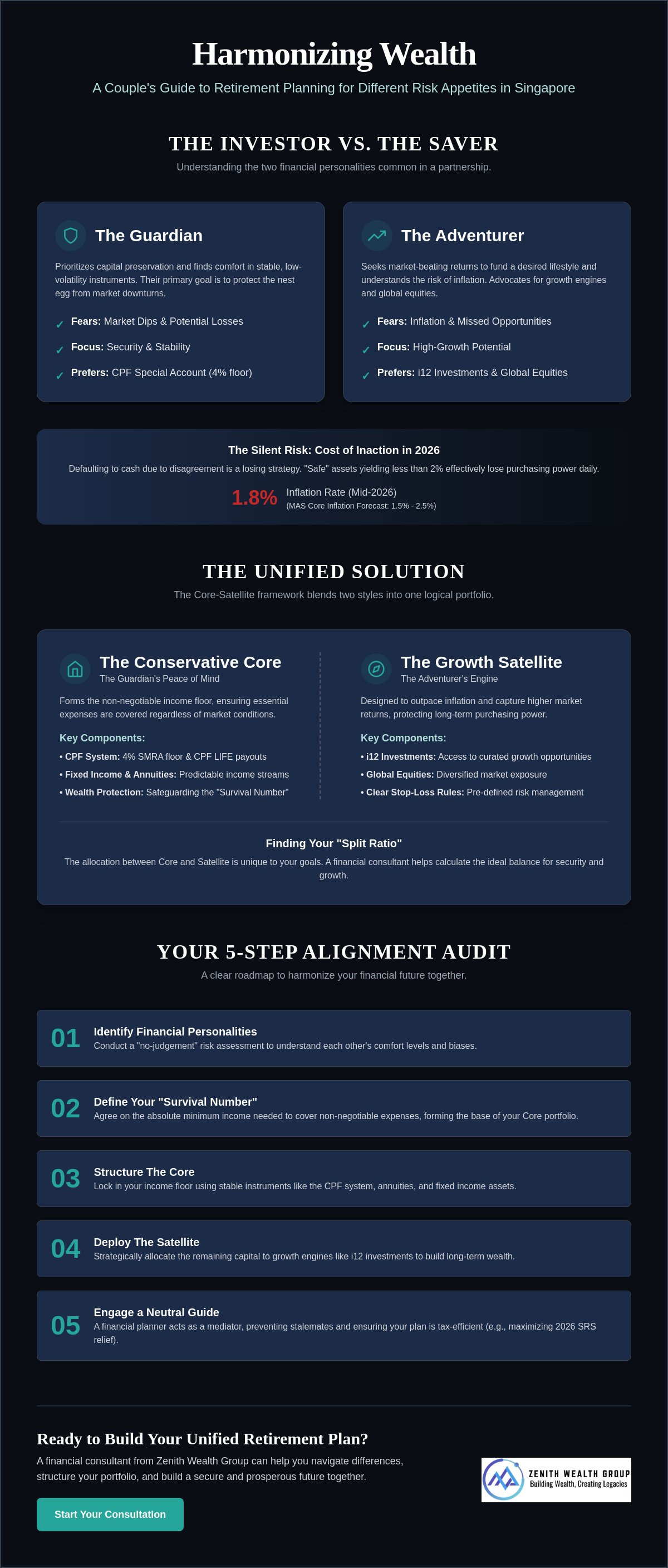
Retirement planning for couples with different risk appetites Singapore often feels like a tug-of-war. One partner wants to protect the nest egg at all costs, while the other wants to maximize every dollar. The solution isn't to meet in the middle and create a mediocre plan. Instead, we use a "Core-Satellite" framework. This strategy assigns specific roles to your money so both the saver and the investor feel heard. It moves the conversation from emotional compromise to structural logic.
The "Split Ratio" between your core and satellite depends on your combined FIRE (Financial Independence, Retire Early) goals. If your basic expenses are high, your core must be larger. If you have a significant surplus, your satellite can expand. A financial consultant can help you run the numbers to find the exact percentage that secures your floor without capping your ceiling.
Building the Conservative Core
The core is the non-negotiable income floor. Its job is to provide peace of mind for the conservative partner. We lean heavily on Singapore's CPF system as the bedrock of this section. With the 4% SMRA interest floor extended through December 31, 2026, CPF is an exceptionally stable engine for capital preservation. At age 65, CPF LIFE takes over, acting as a hedge against longevity risk by providing monthly payouts for life.
To further strengthen this floor, we integrate fixed income and annuities. This ensures that even in a market crash, your mortgage and groceries are covered. This is also the stage where we implement Wealth Protection strategies. By locking in these guarantees, the conservative partner can relax, knowing the "survival number" is safe from market volatility.
Deploying the Growth Satellite
Once the core is secure, we look at the satellite. This portion is designed to satisfy the growth-oriented partner and protect against long-term purchasing power erosion. We often utilize i12 investments here to capture higher market returns. This isn't blind gambling. It’s a calculated move to ensure your portfolio outpaces inflation, which sat at 1.8% in mid-2026.
To keep the cautious partner comfortable, we set clear "Stop-Loss" boundaries. We also diversify across global markets to mitigate risks specific to the Singaporean economy. Rebalancing is key here. We shift profits from the satellite back into the core periodically. This locks in gains and prevents "buyer’s remorse" during periods of market turbulence. It ensures the growth partner gets their excitement while the saver sees the safety net growing larger every year.
Optimising CPF and SRS: The Singaporean Couple’s Advantage
While emotional differences in risk appetite can cause friction, Singapore’s financial ecosystem provides structural tools to bridge the gap. Retirement planning for couples with different risk appetites Singapore is actually easier when you view CPF and SRS as flexible buckets rather than rigid accounts. By strategically allocating these funds, you can give the conservative partner the safety they crave while allowing the growth-oriented partner the room to seek higher returns.
One powerful tactic for the conservative partner is the transfer of CPF Ordinary Account (OA) funds to the Special Account (SA). In 2026, with the SA interest rate floor maintained at 4% through the end of the year, this move provides a significant boost over the 2.5% OA rate without any market risk. For couples approaching age 55, "CPF Shielding" becomes a vital conversation. This involves temporarily investing SA funds so that the Retirement Account is formed primarily from OA funds. This keeps more of your savings in the high-interest SA environment, satisfying the "Guardian" profile’s need for guaranteed, low-risk growth.
Joint legacy planning is the final piece of this puzzle. It’s common for the risk-averse partner to worry about being left unprotected if the investor partner passes away first. We help couples structure their nominations and insurance to ensure the survivor's "survival number" is fully funded. This security often makes the conservative spouse more comfortable with the other partner managing a more aggressive growth portfolio elsewhere.
SRS Strategies for Two
The Supplementary Retirement Scheme (SRS) is a gift for tax efficiency. For Singapore Citizens and PRs in 2026, the annual contribution cap remains at $15,300. We recommend that couples maximize this limit to reduce their immediate tax burden. Rather than letting SRS funds sit in low-interest bank accounts, you can invest them into i12 investments. This allows for tax-deferred growth, which is a perfect middle ground for mixed-risk couples. You can find more specific tactics in our SRS Account Guide.
CPF LIFE: The Great Equaliser
Choosing a CPF LIFE plan is a major decision point. The Standard Plan offers stable payouts, while the Escalating Plan provides payouts that increase by 2% annually to combat inflation. For a mixed-risk couple, the Escalating Plan often provides the peace of mind the conservative partner needs. When the "basics" are covered by a lifelong, government-backed stream of income, the "Adventurer" partner feels more freedom to take calculated risks with private investments. Use our Retirement Planning Guide to calculate your projected payout gaps and see which plan fits your combined vision.
5 Steps to Aligning Your Retirement Portfolios Without Conflict
Moving from disagreement to a unified strategy requires a structured process. Retirement planning for couples with different risk appetites Singapore doesn't have to be a battle of wills. It’s about building a system where both partners feel secure and empowered. By following a clear, data-driven path, you can remove the emotion from the equation and focus on shared results. Follow these five steps to create a roadmap that works for your household.
- Step 1: Define the "Survival Number". This is the non-negotiable floor that covers all your basic needs. It must be 100% safe and backed by guaranteed income.
- Step 2: Audit all individual assets. Document your CPF balances, SRS accounts, and private i12 investments. Total transparency is the first step toward alignment.
- Step 3: Create a "Play Money" bucket. Allocate a specific portion for higher-risk ventures. This allows the aggressive partner to explore opportunities without risking the family’s core stability.
- Step 4: Establish a formal review schedule. Meet with a neutral financial planner regularly. They act as a mediator to keep the plan on track and prevent one partner from dominating the strategy.
- Step 5: Document your "Legacy Intent". Ensure that your estate plan protects the more conservative partner if the investor passes away first. This provides the emotional safety net needed for the couple to take growth risks elsewhere.
The "Survival Number" Exercise
Start by calculating your essential monthly expenses for your future retired self. In 2026, you must account for the rising costs of healthcare and daily living in Singapore. Match these essential costs against guaranteed income streams like CPF LIFE and fixed annuities. The "Survival Number" is the foundation of marital financial peace because it removes the fear of insolvency from the equation. Once this number is met, the "investor" partner can seek higher returns without causing the "saver" partner undue stress.
Maintaining Individual Autonomy
You don't have to merge every single cent to have a successful retirement. In fact, keeping separate "satellite" accounts often improves relationship harmony. It gives the "Adventurer" partner room to breathe and make independent choices. We suggest setting clear thresholds, such as a dollar amount, for when a joint discussion is required for new investments. Using i12 investments provides a transparent and trackable growth vehicle that both can monitor. This clarity prevents the "saver" from feeling left in the dark and the "investor" from feeling micro-managed.
Ready to bridge the gap between your investment styles and secure your future? Speak with a financial consultant today to build your custom retirement roadmap together.
Why a Financial Consultant is the Essential Neutral Party
When two people view money through different lenses, even the best financial tools can't fix a lack of alignment. Retirement planning for couples with different risk appetites Singapore often hits a wall because of the emotional weight behind the decisions. This is where a financial planner becomes indispensable. We don't just look at the spreadsheets. We act as a professional mediator to ensure that both partners feel their concerns are respected and their goals are reachable.
Professional advice prevents the "bullying" dynamic that often occurs in DIY planning. Sometimes, the more financially vocal partner can inadvertently push the other into a risk profile that keeps them awake at night. A financial consultant ensures the portfolio reflects the household's collective risk capacity, not just the loudest opinion. We provide a safe space to discuss fears of loss and aspirations for growth, turning a potential source of conflict into a collaborative project.
Regular "stress tests" are a core part of this professional oversight. We run scenarios to see how your combined portfolio, including i12 investments and CPF balances, would hold up against market volatility or a sudden change in inflation. This data-driven approach gives the conservative partner the proof of security they need, while showing the growth-oriented partner the potential path to their desired lifestyle. It’s about moving from "I think we’re safe" to "I know we’re prepared."
Moving from Conflict to Collaboration
DIY plans often have blind spots, especially regarding the 2026 tax landscape and evolving CPF regulations. A financial consultant identifies these gaps before they become expensive mistakes. During periods of market turbulence, having a third-party perspective prevents impulsive decisions that could derail your long-term security. We help you stay disciplined and focused on the roadmap we’ve built together. Ready to start? Connect with a Zenith Wealth financial consultant today.
The Zenith Wealth Approach to Mixed-Risk Planning
Our methodology focuses on the seamless integration of i12 investments into traditional Singaporean portfolios. We look beyond just the retirement date, prioritizing Legacy Planning to ensure your wealth serves your family for generations. This holistic view provides the ultimate peace of mind for both the saver and the investor. We invite you to a personalized couple’s wealth discovery session. Let’s sit down, look at your numbers, and find the perfect balance for your future together.
Start Your Unified Retirement Journey Today
The friction between a cautious "Guardian" and an ambitious "Adventurer" doesn't have to stall your future. The key lies in a structural approach. Treat your finances as a unified engine with specialized parts. By implementing a Core-Satellite framework and maximizing your 2026 CPF and SRS benefits, you move past analysis paralysis. This is the heart of retirement planning for couples with different risk appetites Singapore. Create a portfolio where the floor is guaranteed and the ceiling is actively managed for growth.
You have the five-step roadmap. Audit your assets. Define your survival number. With growth engines like i12 investments and professional mediation, retirement becomes a period of abundance. No more compromise. We help you navigate these complexities with clarity and quiet confidence. Your shared legacy starts with a single, aligned step.
Book a Couple’s Wealth Discovery Session with a Zenith Wealth Financial Consultant. Turn your conflicting styles into a powerful, shared future.
Frequently Asked Questions
How do we handle it if one spouse wants to invest in i12 investments and the other wants to keep everything in CPF?
You handle this by adopting a Core-Satellite framework. The conservative partner's preference for CPF forms the "Core" of your plan, utilizing the 4% SMRA interest floor extended through 2026. The growth-oriented partner uses a "Satellite" portion for i12 investments. This structure ensures the saver feels secure with a guaranteed base while the investor pursues higher returns to combat the current 1.8% inflation rate.
Is it better for couples with different risk appetites to keep their finances separate in Singapore?
A hybrid approach is often more effective than strictly separate or fully merged finances. Keeping individual satellite accounts for SRS or private investments allows for personal autonomy and reduces friction. However, you should align on a joint survival number and legacy plan. This balance is a key part of retirement planning for couples with different risk appetites Singapore because it protects individual comfort zones while securing shared goals.
What is the "Survival Number" and how do we calculate it for our Singapore retirement?
The Survival Number is the minimum monthly income needed for your essential living costs like housing, healthcare, and groceries. To calculate it, audit your current spending and adjust for 2026 inflation forecasts of 1.5% to 2.5%. Once you have this figure, match it against guaranteed income streams like CPF LIFE. A financial consultant can help you run these projections to ensure your baseline is 100% safe before you take market risks.
Can a financial consultant help us if we are already in the "Retirement Risk Zone"?
Yes, a financial planner provides critical mediation and technical expertise for those in the Retirement Risk Zone. This period is highly sensitive to market volatility and sequence of returns risk. We help you bucket your assets to ensure you don't have to sell growth investments like i12 investments during a downturn. Professional guidance at this stage prevents emotional decision-making and helps you lock in gains to fund your immediate retirement years.
How does SRS tax relief work differently for a high-earning investor spouse vs. a conservative saver spouse?
SRS tax relief provides a dollar-for-dollar reduction in taxable income, benefiting the higher-earning spouse most significantly. The investor spouse can reduce their taxable income by contributing up to $15,300 in 2026 and use those funds for i12 investments to maximize tax-deferred growth. While the conservative spouse also gains tax relief, they might prioritize lower-risk SRS-approved products. This creates a powerful wealth engine for the household while respecting both risk profiles.
What happens to our i12 investments if one partner passes away unexpectedly?
Your assets are distributed based on your specific estate nominations and joint ownership structures. It is vital to have a clear legacy plan that includes updated nominations and a will. We ensure the surviving partner has immediate access to liquidity and that the transition of assets is seamless. This protection is especially important for the risk-averse partner. It guarantees their survival number remains funded regardless of market conditions at that time.
How often should a mixed-risk couple review their retirement plan with a financial planner?
We recommend a formal review at least once every twelve months. Regular reviews allow you to rebalance your portfolio and move profits from high-growth satellites into your secure core. This cadence keeps both partners informed and prevents resentment from building up. It also ensures your strategy remains aligned with 2026 regulatory changes, such as the increased CPF contribution rates for workers aged 55 to 65. Stay proactive together.
Does CPF LIFE provide enough security for a risk-averse partner in 2026?
CPF LIFE serves as an excellent safety net, but it is rarely a complete solution for all retirement goals. It is designed to cover basic needs for life, which offers great security for a risk-averse partner. However, with the Basic Healthcare Sum rising to $79,000 for those turning 65 in 2026, you may need additional layers. A financial planner helps you identify payout gaps and supplement CPF LIFE with other secure income streams.


