

In the quiet days following a funeral, you might find yourself sitting at a kitchen table staring at a stack of documents that feel like a foreign language. It's a heavy burden to carry when your heart is still processing a profound loss. You are likely worried about making a mistake that could impact your HDB ownership or your retirement. Navigating financial decisions after losing a spouse in Singapore is an overwhelming task, but you don't have to do it alone.
We understand that you need space to breathe and time to heal. This guide offers a structured roadmap to manage your CPF, property, and long-term wealth with quiet confidence. You'll learn how to distinguish between immediate legal requirements and tasks that can wait. We also explore how the i12 investments framework helps maintain your lifestyle on a single income. By working with a dedicated financial planner, you can secure your future while honoring your past. Here is your clear path toward financial independence.
Key Takeaways
- Establish a "Decision-Free Zone" during the first 30 days to avoid making irreversible financial choices while you focus on healing.
- Understand how HDB ownership and CPF distributions change based on joint tenancy rules and existing nominations to secure your home.
- Learn the essential differences between a Grant of Probate and Letters of Administration to manage Singapore-based assets efficiently.
- Simplify navigating financial decisions after losing a spouse in Singapore by using the i12 investments framework to build a resilient single-income plan.
- Discover how a financial consultant acts as your administrative buffer, handling complex paperwork so you can prioritize your emotional well-being.
Immediate Steps: The First 30 Days in Singapore
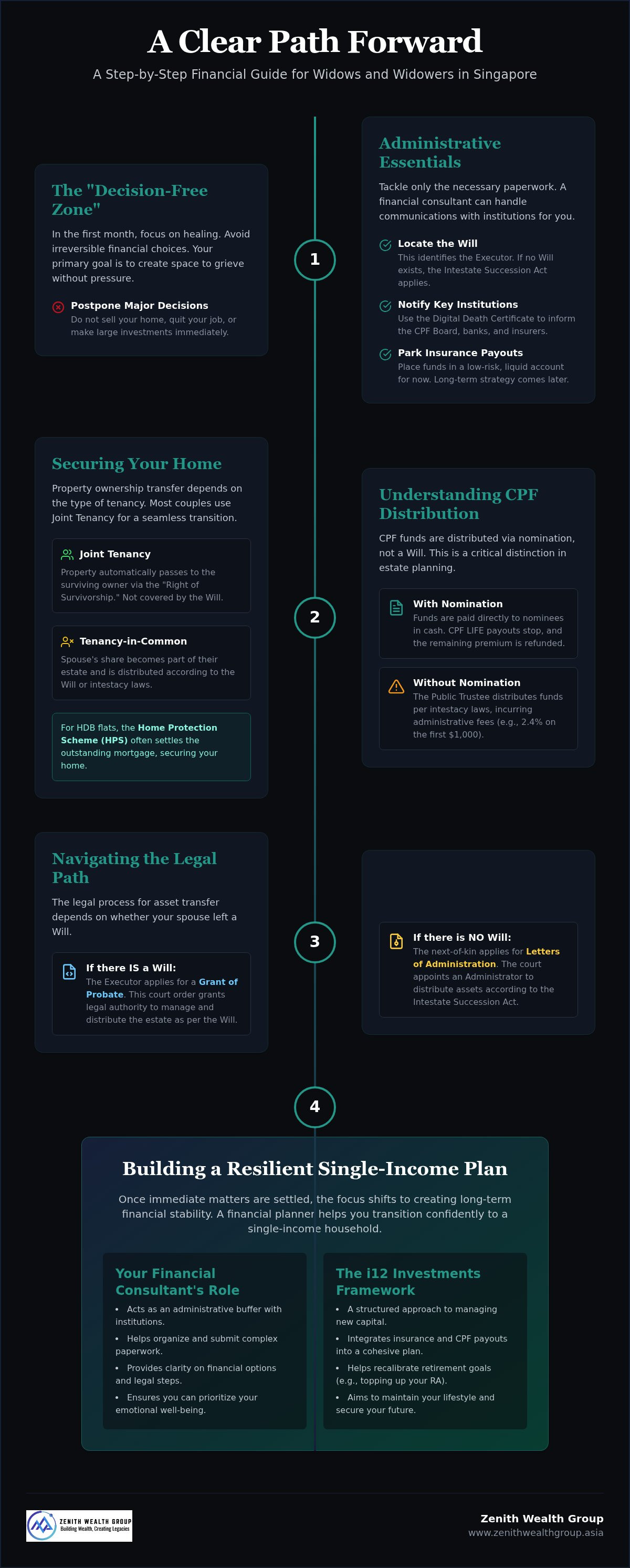
The first month after a loss is often a blur of emotion and logistics. Your main priority should be understanding the grieving process and giving yourself permission to pause. We call this the "Decision-Free Zone." It's a period where you commit to making no major, irreversible life changes. Don't sell your home. Don't quit your job. Don't give away large sums of money. Navigating financial decisions after losing a spouse in Singapore requires a clear head, which takes time to find. Focus only on the essentials and let the rest wait.
During these early weeks, you'll also need to locate your spouse's Will. This document identifies the appointed Executor who will manage the estate. If there's no Will, the Intestate Succession Act will govern how assets are distributed. Knowing who is in charge of the legal process early on prevents confusion among family members. It also allows you to focus on your immediate well-being while the formal legal steps begin to move in the background.
Administrative Essentials in Singapore
The administrative load can feel heavy, but the My Legacy portal simplifies much of it. You can obtain the Digital Death Certificate there, which is the primary document needed for almost every financial institution. You must notify the CPF Board to trigger the nomination process. This is a critical step because CPF funds are distributed according to nominations rather than a Will. Banks generally freeze individual accounts once they are notified of a death. However, joint accounts typically remain accessible for your immediate living expenses and funeral costs. Check with your bank to confirm their specific policies on joint account operations during this transition.
Managing Insurance Claims Early
Gather all life and mortgage insurance policies as soon as possible. Your financial consultant can act as an administrative buffer here. They'll help streamline claim submissions and handle the back-and-forth with insurance providers so you don't have to. It's often helpful to have a professional eye on the paperwork to ensure nothing is missed. When you receive insurance payouts, resist the urge to spend or invest them immediately. Park these funds in a low-risk, liquid account for now. We eventually use the i12 investments framework to integrate these payouts into a resilient long-term plan, but for the first 30 days, your goal is simply to protect your cash flow. Navigating financial decisions after losing a spouse in Singapore is a marathon, not a sprint. Take the time to secure your immediate surroundings before looking at the horizon.
Understanding Singapore Property and CPF Transitions
Securing your home is often the biggest worry when navigating financial decisions after losing a spouse in Singapore. The transition of property ownership depends entirely on how the title was held. Most married couples in Singapore hold property under Joint Tenancy. This arrangement includes the "Right of Survivorship," meaning the property automatically passes to the surviving owner without needing a Will. If you own an HDB flat, the Home Protection Scheme (HPS) acts as a vital safety net. It's a mortgage reducing insurance that settles the outstanding loan with the HDB or bank, ensuring you remain in your home without the immediate weight of a mortgage.
Property Ownership: The Right of Survivorship
While Joint Tenancy is straightforward, Tenancy-in-Common is more complex. In this scenario, your spouse’s share does not automatically go to you. Instead, it becomes part of their estate. Distributing this share requires following the official probate process to determine the rightful heirs. You'll need to manage mortgage payments during this legal transition to avoid default. If you find the paperwork or legal distinctions confusing, a financial planner can help clarify your status and coordinate with legal professionals to ensure a smooth transfer.
CPF and Retirement Account Recalibration
Navigating financial decisions after losing a spouse in Singapore involves understanding that CPF savings don't form part of a person's estate and aren't covered by a Will. The CPF Nomination process is the primary tool for asset distribution outside of probate. If your spouse made a nomination, the CPF Board will contact the nominees directly. Without one, the Public Trustee’s Office distributes the funds according to intestacy laws, which involves administrative fees. For example, the Public Trustee charges 2.4% on the first $1,000 of un-nominated monies, with fees decreasing for higher amounts.
Your spouse’s Ordinary and Special Account balances will be distributed as cash to nominees. However, if they were receiving CPF LIFE payouts, those monthly payments stop upon their passing. Any remaining premium balance they paid into the scheme will be refunded to their nominees. This influx of capital often requires a new strategy. We use the i12 investments framework to help you decide whether to top up your own Retirement Account or invest the funds for long-term growth. This ensures your own retirement sum remains on track as you transition to a single-income household.
The Legal Process: Probate and Estate Administration
Once you move past the immediate 30-day window, the focus shifts toward the legal transfer of assets. If your spouse left a Will, the appointed Executor must apply for a Grant of Probate. This court order gives the Executor the legal power to manage and distribute the deceased's assets. If there's no Will, you'll likely need to apply for Letters of Administration instead. Both processes ensure that debts are paid and assets reach the right people. Navigating financial decisions after losing a spouse in Singapore often starts with this legal hurdle. It's a necessary step to unlock bank accounts, sell property, or transfer investments that weren't held jointly.
The Executor's role is administrative and significant. They must identify all assets, settle outstanding debts, and ensure final tax clearances with IRAS. While estate duty was abolished in Singapore for deaths occurring on or after February 15, 2008, final income tax for the year of death must still be settled. The Executor also manages the transition of specific holdings, such as i12 investments, ensuring these assets are correctly accounted for within the estate's total value.
Navigating the Singapore Court System
The Family Justice Courts handle these applications. For straightforward cases, the process generally takes between three to six months. If the estate is valued at $50,000 or less, you may be able to apply to the Public Trustee for assistance, which is often faster and less costly than a full court application. While you'll need a lawyer for the court filings, a financial planner plays a vital role in the background. They help you compile a comprehensive list of assets and liabilities, which simplifies the lawyer's job and reduces the risk of missing accounts during the filing process.
Protecting Portfolio Value During Probate
Market volatility doesn't pause while you wait for a Grant of Probate. Assets held in individual investment accounts can fluctuate significantly during the months it takes to get legal clearance. We work with you to monitor these holdings, including any i12 investments, to assess risk levels. The goal is to prevent a significant loss of value before the assets can be distributed. A financial consultant also ensures you have enough personal liquidity to cover your daily needs while the estate is being settled. Once the legal clearances are ready, we integrate the i12 investments into your new personal wealth plan. This proactive approach ensures a seamless transition from the estate back into a structured, growth-oriented strategy for your future.
Managing this process requires patience and precision. Navigating financial decisions after losing a spouse in Singapore is easier when you have a clear understanding of the timeline. By handling the administrative heavy lifting early, you protect the legacy your spouse built while securing your own financial stability.
Recalibrating Your Long-Term Wealth and Retirement
Moving from a joint financial life to an individual one is a profound mindset shift. For years, you likely planned for "us." Now, you must plan for "me." This transition is often the most difficult part of navigating financial decisions after losing a spouse in Singapore. It requires you to look beyond the immediate administrative tasks and redefine what a successful future looks like on your own terms. Your risk tolerance has likely changed. Without a second income to lean on, your portfolio needs to work harder while providing a stronger safety net.
Updating your own legacy plan is also vital during this stage. You've seen firsthand how important clear documentation is for the people left behind. Ensure your Will, CPF nominations, and Lasting Power of Attorney (LPA) reflect your new circumstances. Taking these steps now prevents future family disputes and ensures your wishes are carried out exactly as you intend. It's about taking control of the narrative for the next chapter of your life.
The i12 Investments Approach for Survivors
We use the i12 investments framework to help survivors build resilience. This disciplined approach focuses on structuring your assets for consistent income generation. In the 2026 economic landscape, inflation can quickly erode the purchasing power of a static payout. We balance growth with wealth protection to ensure your capital lasts as long as you do. For single-head households, this framework provides a clear set of rules that removes the emotional guesswork from investing. It allows you to maintain your current lifestyle while growing your wealth for the long term.
Updating Your Retirement Roadmap
Losing a spouse often means losing a significant portion of planned retirement income. You might be facing the loss of their CPF LIFE payouts or a private annuity. This necessitates a complete recalculation of your retirement age and lifestyle expectations. With the statutory retirement age set at 64 as of July 2026, you need to know if your current trajectory still aligns with your goals. Our The Complete Guide to Retirement Planning in Singapore offers deeper insights into these specific benchmarks.
A financial consultant can help you model different scenarios to find a path that feels secure. Whether it's adjusting your investment mix or finding new ways to protect your wealth, having a professional guide makes the process less daunting. If you're ready to start this recalibration, reach out to us for a personalized strategy session. We'll help you turn confusion into a clear, actionable plan for your independent future.
How a Financial Consultant Supports Your Journey
The weeks following a loss shouldn't be spent buried in administrative paperwork or wrestling with bank forms. A financial consultant acts as your administrative shield, taking the heavy lifting off your shoulders. We handle the complex coordination with insurance providers, the CPF Board, and various financial institutions. This allows you to focus on your family and your own healing process. Navigating financial decisions after losing a spouse in Singapore is an emotional journey, and having a professional guide ensures you don't miss critical deadlines while your mind is occupied elsewhere.
Emotions can often cloud judgment during major life transitions. We provide an objective perspective when you're faced with big choices, such as whether to sell a family home or how to allocate an insurance payout. Our role is to ensure your long-term interests are protected. We coordinate with your probate lawyer for estate matters and ensure final tax clearances with IRAS are handled correctly. By integrating your existing assets into the i12 investments framework, we create a seamless bridge from your past joint planning to your new independent future. We also ensure all your legacy planning documents are refreshed to protect your heirs.
The Zenith Wealth Difference
We believe in quiet confidence and personal connection. As authorized representatives of finexis advisory, Zenith Wealth combines the vast resources of a large firm with the attentive service of a boutique group. You aren't just another account number to us. We build relationships based on trust and proactive communication. Our goal is to grow alongside you, providing a steady hand as you move through life's most challenging chapters. We prioritize human interaction, ensuring you always have a direct line to someone who knows your story.
Taking the First Step When You're Ready
You don't need to have everything figured out before we talk. A complimentary consultation is simply an open-door invitation to start a conversation. When you're ready, bring along any existing insurance policies, your spouse’s Will, and recent bank statements. We'll help you organize these into a clear checklist of what needs to happen next. This is also the perfect time to review our guide on Legacy Planning in Singapore to understand how to protect your own future. If you're feeling overwhelmed, reach out to us today. We're here to help you move forward with clarity and peace of mind.
Securing Your Path Forward
The transition from joint planning to individual independence is a significant milestone. While the initial weeks were focused on immediate administrative hurdles, your focus now shifts toward long-term resilience. Navigating financial decisions after losing a spouse in Singapore is a marathon that requires a balance of emotional space and strategic action. By integrating the i12 investments framework into your new roadmap, you ensure that the legacy your spouse built continues to provide security for years to come.
Our team at Zenith Wealth, as authorized representatives of finexis advisory, understands the delicate nature of this period. We combine our expertise in Singapore estate and legacy laws with a commitment to personal, human-centered advisory. You've honored the past; now it's time to protect your future. Speak with a compassionate financial consultant at Zenith Wealth today to begin your personalized strategy session. We're here to help you move forward with quiet confidence and a clear vision for what lies ahead.
Common Questions About Estate Transitions
How long does it take to get the Grant of Probate in Singapore?
A straightforward Grant of Probate application in Singapore typically takes between three to six months. This timeline depends on how quickly you can compile the schedule of assets and the court's current caseload. Delays often occur if there are missing documents or complex overseas holdings. A financial planner can help speed up this process by organizing all your insurance and investment details before you engage a lawyer for the court filings.
Can I still withdraw money from our joint bank account if my spouse passes away?
Yes, in most cases you can still access joint accounts for immediate expenses. Singapore banks typically allow the surviving joint account holder to continue operating the account through the right of survivorship. However, you should notify the bank early to understand their specific terms. This liquidity is vital for covering funeral costs and daily bills while you are navigating financial decisions after losing a spouse in Singapore and waiting for other assets.
What happens to our HDB flat if it was under Joint Tenancy?
The flat automatically transfers to you under the Right of Survivorship. You don't need a Will or a Grant of Probate to take over ownership of the property. You must lodge a Notice of Death with the Singapore Land Authority to update the records. If you have an outstanding loan, the Home Protection Scheme might settle it. This ensures you remain in your home without the weight of an immediate mortgage.
Does the CPF Board automatically pay out the nomination to the beneficiaries?
Yes, the CPF Board initiates the payout once they receive the death notification. They will contact the nominees listed in their records directly. If no nomination exists, the funds go to the Public Trustee for distribution under intestacy laws, which involves administrative fees. It's a common area of confusion when navigating financial decisions after losing a spouse in Singapore, as CPF funds aren't covered by a standard Will.
Should I pay off the mortgage immediately with the life insurance payout?
Not necessarily. You should first assess your overall cash flow and current interest rates. Paying off a low-interest mortgage might not be as beneficial as investing the payout for long-term income. We often use the i12 investments framework to evaluate these choices. This disciplined approach helps you decide if your capital is better served providing a monthly income or clearing debt, depending on your new single-income household needs.
What is the difference between a financial consultant and a lawyer in this process?
A lawyer handles the legal filings for Probate or Letters of Administration in the Family Justice Courts. A financial consultant focuses on your long-term wealth and immediate cash flow. We act as your administrative buffer, coordinating claims and refreshing your legacy plan. While the lawyer settles the legal past, the financial planner helps you build the future. We ensure your i12 investments and insurance payouts are managed strategically to support your lifestyle.
How does 'i12 investments' help in managing an inheritance?
The i12 investments framework provides a structured way to manage a sudden influx of capital. Instead of making emotional decisions, you follow a disciplined strategy that balances growth with wealth protection. This is especially helpful for survivors who need to generate a reliable income from inherited assets. It ensures your portfolio remains resilient against inflation. This framework provides the financial independence you need as you transition to being a single head of household.
Do I need to pay inheritance tax in Singapore in 2026?
No, you don't need to pay inheritance tax. Singapore abolished estate duty for deaths occurring on or after February 15, 2008, and this remains the law in 2026. While you don't pay a specific tax on the inheritance itself, the Executor must ensure that the deceased's final income taxes are settled with IRAS. This tax-friendly environment allows you to focus entirely on recalibrating your wealth and securing your own retirement roadmap.


