

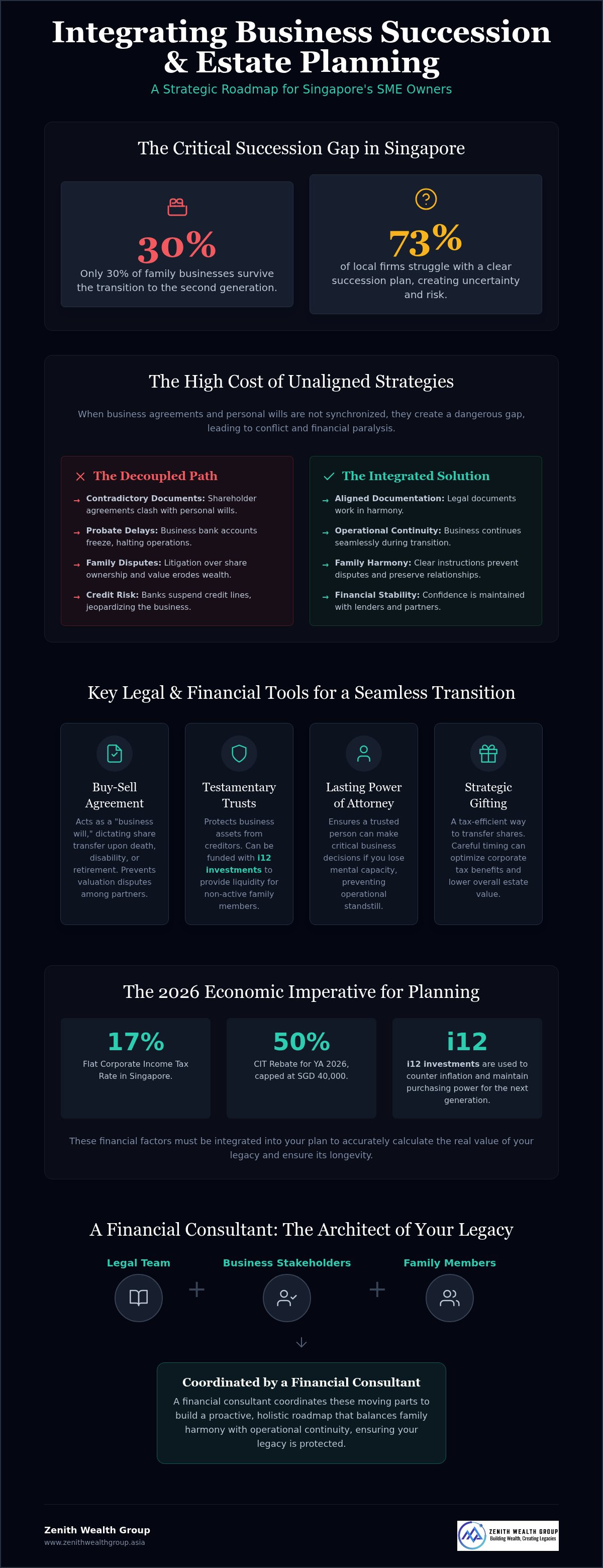
Did you know that only 30% of family businesses in Singapore survive the transition to the second generation? It's a sobering statistic, especially since a 2026 survey found that 73% of local firms struggle with succession planning. You've worked hard to build your company, and it's natural to worry about family disputes or high administration costs once you step away. You want a legacy that lasts, not a legal headache for your loved ones.
We agree that protecting your life's work requires more than just a standard will. By integrating business succession into estate plan Singapore strategies, you can harmonise your exit with your personal goals for total continuity. In this guide, you'll learn how to ensure a seamless leadership transition while maintaining tax efficiency. We'll also look at how a financial planner can use i12 investments to provide financial security for family members who aren't active in the business. It's about moving from uncertainty to a clear, proactive roadmap for the future.
Key Takeaways
- Understand why aligning leadership transitions with asset distribution is vital for Singapore SMEs to avoid costly probate delays.
- Discover how to use Buy-Sell Agreements and Testamentary Trusts to protect your business's future and your family's interests.
- Bridge the liquidity gap using strategic funding and i12 investments to ensure heirs receive their fair share without selling the company.
- Avoid the "Succession Trap" by integrating business succession into estate plan Singapore strategies that balance family harmony with operational continuity.
- Learn how a financial planner coordinates with your legal team to build a proactive 2026 roadmap for your legacy.
Why Business Succession and Estate Planning Must Co-Exist in Singapore
Integrated Succession is the synchronisation of corporate governance and personal legacy. It's about more than just picking a successor; it's about aligning the "who runs it" with the "who gets the value." For many business owners, these two paths are treated as separate silos. One is handled by a lawyer, the other by a financial planner. However, failing to bridge them creates a dangerous gap that can swallow years of hard work.
In the Singapore context, SMEs are particularly vulnerable to probate delays. If a business owner passes away without a clear, integrated strategy, the legal process of validating a will can take months. During this time, corporate bank accounts often freeze. This "cost of silence" can be fatal for a company that needs to pay suppliers, staff, and rent. Integrating business succession into estate plan Singapore frameworks ensures that the business remains a living, breathing entity even during a personal transition.
The Risk of Decoupled Planning
A common pitfall occurs when Shareholder Agreements and Wills contradict each other. Your corporate documents might dictate that surviving partners have the right to buy out your shares. Meanwhile, your Will might state that your spouse inherits those same shares. This mismatch leads to expensive litigation and family friction. Effective Succession planning requires these documents to speak the same language to avoid a legal stalemate.
Decoupled planning also puts your business credit lines at risk. Banks in Singapore often review or even suspend credit facilities when a key owner passes. Without a clear roadmap, minority shareholders may also feel vulnerable, leading to internal power struggles that devalue the company. A financial planner can help you navigate these complexities by ensuring your personal legacy doesn't compromise corporate stability.
The 2026 Economic Imperative
As we move through 2026, the economic landscape in Singapore demands more precision. With the corporate income tax rate at 17% and a CIT rebate of 50% capped at SGD 40,000 for the year, business valuations are shifting. It's essential to account for these figures when calculating the "real value" of your legacy. Inflation continues to impact cash reserves, making it vital to look at diversified options like i12 investments to maintain purchasing power for the next generation.
Protecting generational wealth in this environment requires a holistic view. You can explore more about these strategies in our guide on Legacy Planning in Singapore. By acting now, you ensure that your business remains an asset rather than a burden for your heirs. It's about creating a transition that's as efficient as the business you've built.
Key Legal and Financial Tools for Seamless Integration
Legal tools aren't just paperwork; they're your business's safety net. Integrating business succession into estate plan Singapore models requires a blend of corporate governance and personal wealth protection. A Lasting Power of Attorney (LPA) is a critical first step. It ensures that if you lose mental capacity, a trusted person can make business decisions. This prevents a total standstill that could devalue your company overnight.
The Power of the Buy-Sell Agreement
Think of the Buy-Sell Agreement as your "Business Will." It dictates exactly what happens to your shares when a trigger event occurs, such as death, disability, or retirement. Without a clear valuation formula, these transitions often dissolve into bitter disputes over share prices. A financial consultant plays a vital role here as a neutral mediator. They help partners agree on a fair price before emotions run high. This process is key to keeping succession planning simple and sustainable for everyone involved.
Using Trusts to Shield Business Interests
Testamentary trusts allow you to maintain control over business assets even after you're gone. In Singapore, you can choose between revocable and irrevocable trusts. Irrevocable trusts offer robust protection against creditors and potential divorce settlements. Within these structures, many owners utilise i12 investments to manage the underlying capital efficiently. This ensures that the trust remains liquid enough to support non-active family members while the business continues to grow. If you're unsure which structure fits your needs, it's a good idea to speak with a financial planner to map out your options.
Gifting shares is another tax-efficient strategy for the 2026 landscape. While Singapore doesn't have a gift tax, the timing of share transfers can impact corporate tax benefits. Since the corporate tax rate is a flat 17%, and many firms qualify for the 50% CIT rebate (capped at SGD 40,000 for YA 2026), structured gifting can lower the overall estate value without triggering massive liabilities. It's a proactive way to transition ownership while you're still able to mentor the next generation.
Strategic Funding: Ensuring Liquidity for Your Legacy
Imagine owning a business valued at $10 million but having no liquid cash to pay out heirs who aren't interested in the company. This is the "liquidity gap." It's a common hurdle when integrating business succession into estate plan Singapore strategies. Without a cash reserve, your family might be forced to sell the business quickly at a discount just to settle estate costs or inheritances. You've spent years building value; don't let a lack of liquidity tear it down.
Strategic funding solves this by creating a liquid bridge between your business assets and your personal legacy. While your company is the engine of your wealth, your estate plan needs the fuel of liquidity to function properly. Balancing your Supplementary Retirement Scheme (SRS) account with potential business exit proceeds is a core part of this harmony. It ensures you don't just leave behind a valuable company, but also the liquid means to manage the transition without selling off core assets.
Leveraging i12 Investments for Transition
Diversified portfolios are essential for maintaining business valuation stability during a leadership change. By using i12 investments, you can build a "sinking fund" dedicated to future share buybacks. This fund acts as a financial cushion. It allows the company to buy out a deceased partner's shares without straining operational cash flow or taking on high-interest debt. It's a proactive approach that aligns with the Strategic Investment Management pillar of a robust financial roadmap. These investments provide the long-term capital growth needed to fund a smooth transition years before it actually happens.
Insurance Solutions for Key Person Risk
What happens if a key leader is suddenly gone? Keyman insurance protects the company’s bottom line during such a crisis. The payout provides the necessary capital to fund the search for a professional CEO or to stabilise the business while a successor is trained. In Singapore, the tax treatment of insurance premiums can be advantageous for companies. Generally, premiums are deductible if the policy is a term policy intended to replace lost profits.
A financial consultant can help you structure these policies so they don't just cover risks but actively support your succession goals. It's about turning a potential disaster into a managed transition. By coordinating insurance with i12 investments, you create a dual-layered safety net. One layer provides immediate cash, while the other ensures long-term growth. This balance is what makes integrating business succession into estate plan Singapore strategies truly effective for the long haul.
Avoiding the "Succession Trap": Common Pitfalls for SG Business Owners
Building a successful company takes years of grit. Losing it to a poorly designed exit takes only a few months. Many owners fall into the "Succession Trap" because they focus solely on the legal transfer of shares while ignoring the human element. Integrating business succession into estate plan Singapore frameworks requires you to look beyond the balance sheet. You must address the emotional and practical realities of your family and your leadership team.
One common pitfall is assuming your children want to run the business. While you might see a legacy, they might see a burden. If they lack the passion or skill to lead, forcing them into a management role can destroy the company's value. Another often overlooked detail is the CPF nomination. Since CPF savings aren't covered by your Will, a mismatch between your nomination and your business plan can leave your estate short on cash. This lack of coordination can stall the entire transition.
The "Fair vs. Equal" Dilemma
The most dangerous trap is the "Fair vs. Equal" distribution dilemma. Many parents feel they must leave equal shares of the business to all children. However, a 50/50 split between a child working in the business and one who is not often leads to gridlock. The working child wants to reinvest profits, while the non-working child may want dividends. This tension can devalue the firm overnight.
Instead of equal shares, consider giving voting control to the active successor. You can then use personal assets like real estate or cash to balance the inheritance for other heirs. This is where i12 investments become invaluable. They provide a separate, growing pool of wealth to compensate non-active family members without diluting the business's management. It's a cleaner way to ensure everyone feels valued without compromising corporate efficiency.
The Importance of Regular Reviews
Your business is a living entity, and your plan should be too. Failing to update your strategy as the company grows is a recipe for disaster. In the high-interest environment of 2026, valuations and debt costs have shifted significantly since the pandemic era. An annual review with your financial planner ensures your plan reflects current market realities and your evolving personal goals.
This process should also align with your broader exit strategy. You can find more details on how this fits into your later years in our Retirement Planning in Singapore guide. Don't let an outdated document dictate your future. If you haven't looked at your strategy in over a year, it's time to book a review with a financial consultant to ensure your legacy remains on track.
Collaborating with a Financial Planner for Your 2026 Roadmap
Succession isn't a solo journey. It's a complex puzzle that requires multiple specialists to work in sync. This is where a financial planner becomes your "quarterback." They don't just look at numbers; they lead the coordination between your lawyers, accountants, and family members. By integrating business succession into estate plan Singapore strategies, they ensure that every legal document and financial vehicle works toward a single, unified goal. You've built a great company, and it deserves a professional hand to guide its transition.
Our discovery process at Zenith Wealth Group is designed to be human-centric. We start by listening to your vision for the company and your family's needs. We don't jump straight into spreadsheets. Instead, we help you navigate the "Fair vs. Equal" dilemma and key person risks with quiet confidence. This collaborative environment ensures that when we finally engage the lawyers and accountants, the strategy is already clear and agreed upon by the key stakeholders. It's about moving from "thinking" to "executing" with a clear roadmap in hand.
Why a Holistic Approach Wins
Looking at a Will in isolation is a mistake. A holistic approach considers your entire balance sheet, including corporate assets and personal wealth. As authorised representatives of finexis advisory, we bring an objective, independent-minded perspective to your planning. We focus on your personal values rather than just chasing tax codes. This means ensuring your legacy provides for your family while keeping the business competitive. We often incorporate i12 investments into these roadmaps to provide the stability and growth necessary for a multi-year transition. It's a modern way to manage wealth that prioritises human interaction alongside professional advisory services.
Your Next Strategic Move
In 2026, the pace of business in Singapore is faster than ever. Regulatory changes and shifting economic trends mean your roadmap needs to be agile. A financial consultant helps you review these plans annually, ensuring that tools like i12 investments are still performing as expected. This ongoing relationship is what distinguishes an attentive team from a distant corporate entity. We're here to grow alongside you, adjusting the sails as your business evolves.
The first step is simple: gather your current corporate documents, shareholder agreements, and your existing Will. Once you have these, you're ready for a legacy audit. This audit identifies the gaps we've discussed, such as liquidity shortages or conflicting clauses. It's about being proactive today to prevent a crisis tomorrow. We invite you to connect with the Zenith Wealth Group team to start this conversation. Let's build a roadmap that protects your business and honours your family legacy.
Securing Your Business Legacy for 2026 and Beyond
Your business is one of your greatest achievements. Protecting it requires a strategy that looks beyond the boardroom. Successfully integrating business succession into estate plan Singapore frameworks ensures that your hard work translates into a lasting family legacy. By aligning tools like Buy-Sell Agreements with your personal Will, you prevent the legal gridlock that often devalues SMEs. We've explored how i12 investments can bridge the liquidity gap, providing the necessary cash to compensate heirs without forcing a sale of the company.
As authorised representatives of finexis advisory, we bring specialized expertise in Singaporean legacy laws and the i12 investments framework. We're here to act as your Modern Professional Guide, helping you avoid common pitfalls like the "Fair vs. Equal" dilemma. It's time to move from uncertainty to a clear, actionable roadmap. Secure your business legacy; book a consultation with a Zenith Wealth Group financial consultant today. Your future self, and your family, will thank you for taking this proactive step.
Frequently Asked Questions
How do I start integrating business succession into my estate plan in Singapore?
Start by identifying your potential successor and obtaining a professional business valuation. Integrating business succession into estate plan Singapore strategies requires you to coordinate your corporate documents with your personal Will. You should meet with a financial planner to review your total balance sheet. This helps identify liquidity gaps where your estate might lack the cash to pay out non-active heirs or settle corporate debts during the transition.
Can I use my CPF savings to fund my business succession plan?
CPF savings cannot be used directly to purchase business shares or fund a Buy-Sell Agreement. However, CPF nominations are a vital part of your broader estate context. If your CPF funds aren't nominated correctly, your family might lack the immediate cash needed to manage the business during the probate process. A financial consultant can help you balance your CPF Life and SRS accounts alongside your corporate exit proceeds.
What is the difference between a Will and a Buy-Sell Agreement?
A Will dictates the distribution of your personal assets, while a Buy-Sell Agreement is a contract between business owners governing share transfers. A Will is often subject to probate delays, which can freeze corporate bank accounts for months. A Buy-Sell Agreement, often funded by insurance or i12 investments, provides a pre-agreed mechanism for surviving partners to buy out your interest, ensuring the business continues without legal gridlock.
Is a testamentary trust necessary for a small family business?
It's often necessary if you want to protect the business from creditors or ensure control stays with specific family members. A testamentary trust allows you to set conditions on how shares are managed after your passing. This is particularly useful for small businesses where you want to provide income for a spouse or non-active children without giving them voting rights that could disrupt the company's daily operations.
How does i12 investments fit into a legacy plan?
i12 investments act as a strategic funding vehicle for your legacy. They provide a diversified pool of capital that grows independently of your business's operational risks. You can use these funds to create a sinking fund for future share buybacks or to provide a fair inheritance for heirs who aren't involved in the company. This ensures your legacy remains liquid and robust even during a leadership transition.
What happens to my company shares if I die without a Will in Singapore?
Your shares will be distributed according to the Intestate Succession Act 1967, which may not align with your business goals. For example, your shares could be split between your spouse and children, giving non-active family members unintended voting power. This can lead to internal conflicts and stall decision-making. Having a formal plan for integrating business succession into estate plan Singapore structures prevents this legal uncertainty.
How often should a business owner review their estate plan?
You should review your plan at least once a year or whenever a major life event occurs. In the 2026 economic environment, shifting interest rates and business valuations can quickly make an old plan obsolete. A financial planner can help you conduct a legacy audit to ensure your i12 investments and insurance policies still provide enough liquidity to meet your current business valuation and your family's evolving financial needs.
Can a financial consultant help with the legal aspects of succession?
A financial consultant acts as the quarterback who coordinates with your legal team. While they don't draft legal documents, they ensure the financial funding is in place to make those documents effective. They work with lawyers and accountants to ensure your Buy-Sell Agreement and Will are synchronised. This holistic approach ensures your personal values and tax efficiency goals are reflected in every part of your transition roadmap.


