

What if the red numbers on your screen weren't a signal to panic, but a scheduled part of your long-term success? It's completely natural to feel a knot in your stomach when headlines report a 4.2% inflation rate or unexpected shifts in the federal funds rate. You've worked hard for your savings. The fear of losing that progress during a market dip is a heavy burden to carry. Many people feel helpless when the news turns sour, but managing market volatility in my investment portfolio doesn't have to be a guessing game.
At i12 investments, we believe that quiet confidence comes from a clear, actionable strategy. Our financial planners help you move past the noise of conflicting reports and focus on frameworks that prioritize wealth protection. In this 2026 guide, you'll discover how to stay on track for retirement despite economic shifts. We'll explore the latest updates on the INVEST Act, explain how the current 3.50% to 3.75% interest rate environment affects your holdings, and provide a straightforward plan for rebalancing your assets with total peace of mind.
Key Takeaways
- Redefine volatility as a natural market metric rather than a permanent loss to gain a clearer perspective on your long-term growth.
- Learn how i12 investments uses strategic frameworks for managing market volatility in my investment portfolio through true diversification across varied asset classes.
- Identify why the "sequence of returns" makes the five years before retirement the most critical window for protecting your wealth.
- Discover how to turn market swings into opportunities by implementing Dollar Cost Averaging and re-evaluating your actual risk tolerance.
- Understand the value of partnering with a financial consultant to maintain an objective plan that avoids emotional decision-making during economic shifts.
Understanding Market Volatility in the 2026 Economic Landscape
Volatility is often treated like a dirty word, but in the financial world, it's a neutral metric. Technically, it's the standard deviation of returns. This measures how much an asset’s price swings away from its average. It isn't just a downward slide; it includes the sudden upward jumps that build wealth over time. At i12 investments, we view these movements as data points rather than disasters. Understanding this distinction is the first step toward managing market volatility in my investment portfolio without losing sleep.
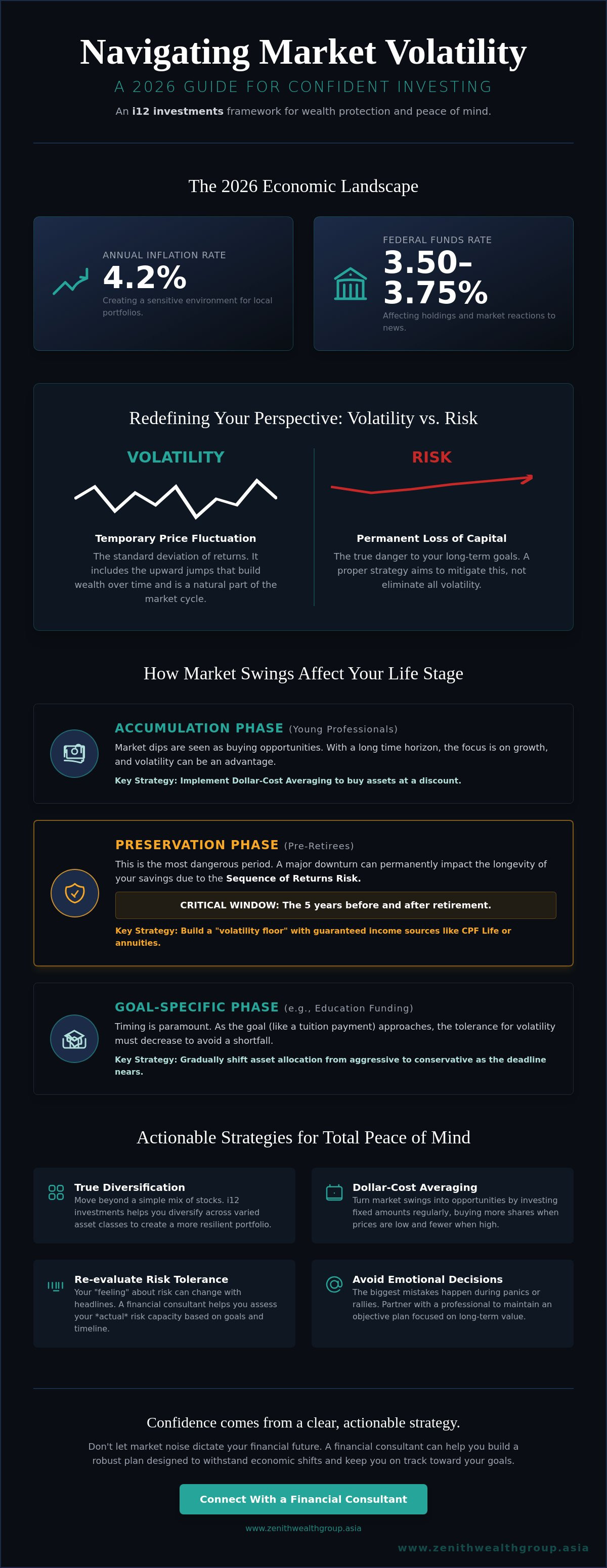
In mid-2026, the economic picture is particularly complex. The Federal Reserve has held the federal funds rate between 3.50% and 3.75%, while annual inflation remains at 4.2%. These figures, combined with shifting MAS exchange rate policies, create a sensitive environment for local portfolios. Markets today react instantly to every headline. This sensitivity creates a "rollercoaster" effect where prices move sharply based on short-term news rather than long-term value. Distinguishing between "good" volatility that drives growth and "bad" volatility that signals decay is essential for any serious investor.
The Difference Between Risk and Volatility
A volatile asset isn't always a risky one for your long-term goals. Risk is the permanent loss of capital; volatility is just the temporary fluctuation of price. When we apply the principles of Modern Portfolio Theory, we see that a certain level of movement is necessary to capture higher expected returns. A financial planner can help you determine if your portfolio is actually at risk or simply experiencing a bumpy ride. Remember that volatility is a temporary hurdle rather than a finish line.
Why 2026 Markets Are Moving Differently
Digital connectivity has shortened the modern "panic cycle." News travels faster, and retail investors often react to social media trends before traditional data is even released. In Southeast Asian markets, regional trade deficits and the evolving central bank policies in Singapore and the Philippines add layers of sensitivity to local equity markets. This environment makes managing market volatility in my investment portfolio a task that requires both patience and a structured framework. If you feel overwhelmed by these shifts, you can always connect with a financial consultant to review your current strategy and ensure it aligns with your retirement goals.
The Real Impact: How Market Swings Affect Your Life Stages
Market volatility isn't a one-size-fits-all experience. Its impact depends entirely on where you stand in your life journey. For a young professional, a market dip is often an opportunity to buy assets at a discount. However, for those nearing retirement, the same swing can feel like a direct threat to their future security. Managing market volatility in my investment portfolio requires a strategy that evolves as your goals get closer. It's about shifting from a focus on accumulation to a focus on preservation at just the right time.
One of the most overlooked dangers is the "Sequence of Returns" risk. This is the risk that the market performs poorly just as you begin to withdraw funds. If a major downturn occurs in the five years before or after you retire, it can significantly reduce the longevity of your savings. Unlike a 20-year-old who has decades to wait for a recovery, a pre-retiree doesn't have that luxury. This is where i12 investments provides a structured approach to ensure your sequence of returns doesn't derail your lifestyle. We look at the big picture to make sure your cash flow remains steady even when prices fluctuate.
Pre-Retirees and the Danger of the Big Drop
When you're in your 50s, a market crash requires a far more nuanced response than it did in your 20s. Managing market volatility in my investment portfolio becomes a defensive game as you approach your 60s. You need a "volatility floor" to protect your essential expenses. In Singapore, CPF Life and annuities play a vital role here by providing guaranteed monthly payouts regardless of market conditions. This allows your other investments to stay focused on growth without the pressure of immediate liquidation. For a deeper look at these mechanics, check out The Complete Guide to Retirement Planning in Singapore.
Parents and Education Savings Timelines
Managing college funds requires a similar focus on timing. If your child’s university tuition bill is only two years away, your tolerance for volatility should be minimal. Staying too aggressive can lead to a shortfall right when the bill arrives. Conversely, being too conservative too early means losing purchasing power to the 4.2% inflation rate we see in 2026. A financial planner can help you shift your asset allocation gradually to match your child's age. You can learn more about this in our guide on Education Funding for Singaporean Parents.
True wealth protection goes beyond just picking the right stocks. It involves legacy planning and insurance buffers that act as a secondary shield for your family. By integrating these elements into a cohesive plan, you ensure that even during a "2026 rollercoaster" market, your core objectives remain safe. If you're unsure how your current stage of life changes your risk profile, consider speaking with a financial consultant to refine your approach.
Strategic Frameworks for Stability: Diversification and i12 Investments
Diversification is often misunderstood as simply owning a lot of different things. In reality, true diversification means owning assets that don't move in the same direction at the same time. If your portfolio consists of ten different technology stocks, you aren't diversified; you're concentrated. A single regulatory shift or a spike in the core inflation rate, which sat at 2.9% in May 2026, could impact all ten holdings simultaneously. Managing market volatility in my investment portfolio requires a more sophisticated approach that looks across sectors, geographies, and asset classes.
This is where i12 investments makes a difference. It's a structured framework designed to smooth out the jagged edges of market movements. By incorporating diverse asset classes, we create a sturdier foundation for your wealth. These assets often have low correlation with traditional stocks. When equities dip, other components might hold their value or even grow. We focus on a blend of traditional and alternative options to ensure stability:
- Real Estate: Often provides steady rental yields and acts as an inflation hedge.
- Gold: Historically serves as a "safe haven" during times of high global uncertainty.
- Private Equity: Offers exposure to markets that aren't tied to the daily swings of public exchanges.
- Fixed Income: Provides a predictable cash flow, especially with the federal funds rate currently at 3.50% to 3.75%.
The i12 Investments Methodology
Our framework balances the need for growth with the necessity of wealth protection. We don't just chase the highest returns; we build for the worst days as much as the best. The logic behind our asset selection within i12 investments is rooted in historical performance and forward-looking economic data. Strategic asset allocation through i12 investments focuses on resilience, not just returns. This proactive stance ensures your portfolio is built to endure, not just react.
Asset Correlation: Your Shield Against Volatility
Understanding how different assets react to news is vital. When the Federal Reserve holds rates steady, bonds and equities react in distinct ways. Managing market volatility in my investment portfolio also involves using tax-efficient tools available in Singapore. The Supplementary Retirement Scheme (SRS) is a prime example. It doesn't just offer tax relief; it serves as a stabilizing component where you can hold a variety of instruments. For a deeper dive into this strategy, read our guide on Mastering the SRS Account.
A financial planner can help you map out these correlations. By ensuring your SRS contributions and private investments work together, you create a comprehensive shield. This balance allows you to stay invested through the "2026 rollercoaster" without the urge to exit at the wrong time. We invite you to look at your portfolio as a cohesive system rather than a collection of random tickers.
Practical Steps to Manage Portfolio Swings Without Panic
It's easy to feel confident when markets are rising. However, true risk tolerance is only revealed when prices drop. If you find yourself losing sleep over the current 4.2% inflation rate or the federal funds rate pause at 3.50% to 3.75%, your current allocation might be too aggressive. Managing market volatility in my investment portfolio starts with an honest assessment of your emotional limits. Once you align your portfolio with your actual temperament, you can move from a reactive state to a proactive one.
Dollar Cost Averaging (DCA) is your most powerful tool during a "2026 rollercoaster." By investing a fixed amount regularly, you naturally buy more shares when prices are low and fewer when they are high. This turns market dips into opportunities. Combined with tactical rebalancing, you ensure that your winners don't over-concentrate your risk. Managing market volatility in my investment portfolio requires more than just a "buy and hold" mindset; it requires a "buy and rebalance" discipline. If a high-performing sector now takes up too much of your pie, sell a portion. Use those gains to buy undervalued assets within the i12 investments framework.
Never underestimate the power of cash. A robust emergency fund prevents forced liquidation. If you have to sell during a downturn to pay bills, you turn a paper loss into a permanent one. Aim for six months of expenses. This is especially vital with the bank prime loan rate at 6.75% making debt more expensive today.
The Mechanics of Rebalancing
Rebalancing is the disciplined act of buying low and selling high. It sounds simple, but it’s emotionally difficult to sell what’s winning. You don't need to check your accounts every day. In fact, checking once a quarter is often more than enough. A financial planner acts as an objective partner here. They execute these trades based on data, not fear, ensuring your strategy stays on target. This removes the burden of timing the market from your shoulders.
Emotional Regulation and the "News Fast"
Distinguishing between market noise and fundamental shifts is crucial. Most headlines are designed to capture attention, not to inform your long-term strategy. History shows that the market's best days often follow its worst. Missing just a few of those recovery days can significantly impact your retirement savings. Having a written Investment Policy Statement (IPS) provides a roadmap to follow when emotions run high. It reminds you why you started and where you're going.
If you want to build a more resilient strategy, start a conversation with our team today. We're here to help you stay on track.
Partnering with a Financial Consultant for Long-Term Peace of Mind
When the market shifts, staying objective is your most significant challenge. Human biology is wired for survival, not the complexities of modern asset allocation. When you see your balance dip, your instinct is to protect what's left by exiting. This emotional response often leads to selling at the bottom and missing the recovery. A financial consultant provides the necessary distance to make logical decisions. They act as a steady hand, ensuring that fear doesn't dictate your financial future.
It's important to understand the difference between product selling and strategic financial planning. Product selling is a one-time transaction focused on a single tool. Strategic planning is an ongoing partnership that looks at your entire life. At Zenith Wealth, we utilize i12 investments to build bespoke portfolios tailored to your specific needs. We don't offer generic advice. Instead, we focus on a holistic approach that includes wealth protection and legacy planning. Managing market volatility in my investment portfolio becomes a streamlined process when you're working within a proven framework rather than guessing on your own.
What to Expect from a Zenith Financial Planner
Our process begins by aligning your portfolio with your specific life goals. We don't just look at returns; we look at your timeline for retirement or business succession planning. We take on the burden of monitoring global trends so you don't have to. Whether it's the 3.63% effective federal funds rate or shifts in regional trade deficits, we're watching the data. This proactive oversight allows us to adjust your strategy before a trend becomes a crisis. You can learn more about our approach in our guide to Strategic Investment Management in 2026.
Taking the First Step Toward a Stable Future
A proactive stance is always superior to a reactive one. While economic conditions present challenges, your long-term goals remain achievable with the right structure. Managing market volatility in my investment portfolio is about preparation, not panic. We invite you to a portfolio "stress test" conversation. We'll look at how your current holdings would handle a sudden downturn or a shift in core inflation. This isn't a high-pressure sales pitch; it's an open-door invitation to see how the i12 investments methodology can offer you more stability.
Your future is too important to leave to chance. Let's build a plan that gives you quiet confidence regardless of what the headlines say tomorrow. Contact our team today for a personalized wealth consultation and let's start a conversation about your path forward.
Secure Your Path to Retirement Confidence
The 2026 economic environment requires a shift from reactive fear to proactive strategy. You've seen how volatility is simply a tool for growth when viewed through the right framework. By focusing on true asset correlation and utilizing i12 investments, you can protect your wealth from the "sequence of returns" risk. Managing market volatility in my investment portfolio doesn't have to be a solo journey filled with uncertainty.
Our team brings localized expertise across Singapore and Southeast Asia to help you navigate these shifts. As authorized representatives of finexis advisory Pte Ltd, we specialize in the i12 investments framework to build portfolios that endure. Don't wait for the next market dip to check your strategy. We invite you to initiate a conversation that prioritizes your peace of mind and long-term goals. It's time to move forward with a plan built for resilience.
Book a Portfolio Review with a Zenith Financial Consultant today. Let's ensure your plan is ready for whatever comes next. Your future is bright with the right partner by your side.
Frequently Asked Questions
Is it better to move my portfolio to cash during high market volatility?
Moving to cash is usually a reactive move that locks in temporary losses. With the 2026 inflation rate at 4.2%, idle cash loses purchasing power quickly. Managing market volatility in my investment portfolio is about staying invested with a better structure rather than exiting entirely. Missing just a few of the market's best recovery days can significantly derail your retirement goals.
How does i12 investments help reduce the impact of a market crash?
The i12 investments framework uses a structured approach to include asset classes that don't move in sync with the stock market. By incorporating alternatives like gold or private equity, this methodology provides a cushion when traditional equities drop. It prioritizes resilience and wealth protection, helping to smooth out the jagged edges of sudden market shifts.
How often should a financial consultant rebalance my portfolio?
A financial consultant typically reviews and rebalances your portfolio quarterly or when asset weights drift significantly from your target. This disciplined schedule ensures you are naturally buying low and selling high. Frequent checking often leads to emotional stress, while quarterly adjustments maintain the right balance between growth and protection without unnecessary transaction costs.
Can I use my SRS account to hedge against market volatility?
Yes, your SRS account is a tax-efficient tool that can hold defensive assets to stabilize your overall wealth. Because it offers immediate tax relief, it provides a built-in "return" that offsets some of the downside in your other accounts. Using it to hold bonds or specialized funds within the i12 investments framework creates a sturdier foundation for your future.
What is the "Sequence of Returns" risk and why does it matter for retirement?
This risk involves the timing of market dips relative to when you start withdrawing your savings. If a crash occurs in the five years before or after you retire, it can drastically reduce the longevity of your portfolio. Managing market volatility in my investment portfolio is most critical during this window to ensure your lifestyle remains funded regardless of market timing.
How do I know if my risk tolerance is actually lower than I thought?
True risk tolerance is revealed when you feel a strong urge to sell during a market dip. Many people overestimate their bravery during bull markets but lose sleep when the 2026 rollercoaster begins. If short-term swings make you anxious or tempted to check your balance daily, your current allocation is likely too aggressive for your temperament.
Does diversification guarantee I won’t lose money in 2026?
No strategy can provide a absolute guarantee against losses in any given year. Diversification is a management tool designed to minimize the impact of any single asset failing, but it doesn't eliminate general market risk. It helps you stay the course by ensuring your entire future isn't tied to the performance of a single sector or geography.
What is the role of insurance in managing investment volatility?
Insurance acts as a vital secondary buffer that protects your portfolio from forced liquidation. If a medical emergency or life event happens during a market downturn, insurance payouts cover the costs so you don't have to sell investments at a loss. It provides a "volatility floor" that keeps your long-term investment strategy intact during personal or economic crises.


