

What if your most volatile income months became the foundation of your retirement? It's a common worry. Most freelancers in Thailand feel left behind without the safety net of an employer-sponsored provident fund. You deal with the "feast or famine" cycle while trying to decode complex tax rules. Mastering specific investment strategies for freelancers in Thailand can turn that unpredictability into a powerful wealth-building tool.
We're here to help you move from financial uncertainty to quiet confidence. This guide shows you how to transform irregular earnings into long-term wealth using tailored frameworks. We'll explore the 2026 tax landscape, covering the new Thailand Individual Savings Account (TISA) and updated Retirement Mutual Fund (RMF) limits. You'll also see how our i12 investments methodology builds a diversified global portfolio. A professional financial planner can help you ensure your Thai-sourced income works as hard as you do. Let's start building a roadmap that respects your independence while securing your future.
Key Takeaways
- Master the i12 investments framework to automate your wealth building without the stress of rigid monthly costs.
- Navigate the 2026 tax landscape by learning the best investment strategies for freelancers in Thailand, including the transition to the new TISA limits.
- Avoid the "home bias" trap by diversifying your assets globally to ensure your retirement isn't tied solely to the Thai Baht.
- Create a robust "Freelance Buffer" that allows you to invest confidently through both high and low income months.
- Understand how a professional financial planner helps you bridge the gap between irregular earnings and a predictable retirement plan.
The Freelance Financial Reality in Thailand's 2026 Economy
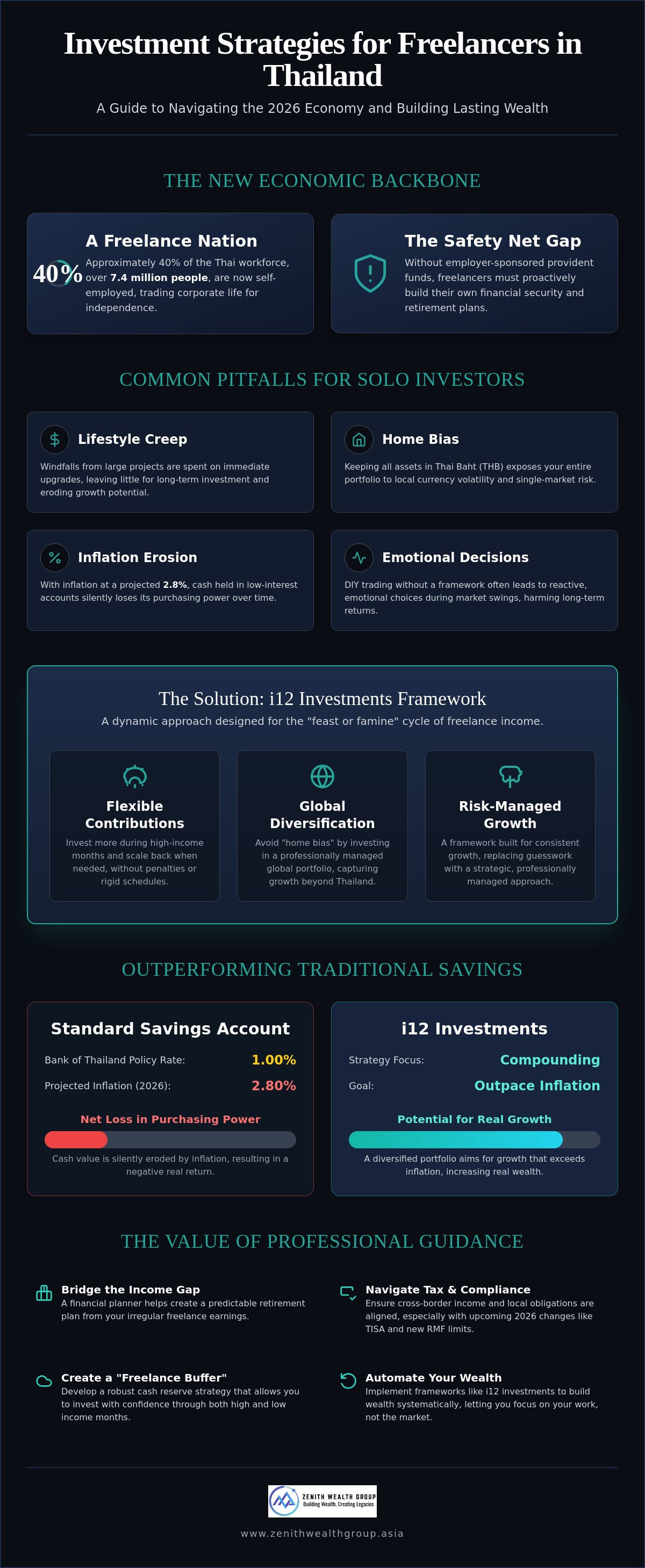
The "Slashie" generation isn't just a trend; it's the new backbone of the Thai economy. Recent data shows that approximately 40% of the Thai workforce now identifies as freelance or self-employed. This shift represents over 7.4 million people who've traded the corporate ladder for the freedom of independent work. While the autonomy is rewarding, it leaves a significant "Safety Net Gap." You no longer have an employer-sponsored provident fund or a HR department managing your tax deductions. In 2026, relying on a basic savings account isn't enough. The complexity of Thailand's economic landscape means you need a more sophisticated approach to stay ahead of inflation and currency shifts.
Effective investment strategies for freelancers in Thailand must bridge this gap. You're now the CEO of your own retirement. This is where the i12 investments methodology becomes essential. It provides a framework for growth that doesn't rely on the rigid monthly contributions typical of traditional corporate schemes. A professional financial planner can help you navigate these waters. They ensure your cross-border income and local tax obligations align with your long-term goals. Managing your own wealth requires proactive planning, especially as the digital economy continues to outpace traditional sectors. You need a partner who understands that your income might fluctuate but your long-term goals remain fixed.
Understanding the Thai Freelance Landscape
Thailand has evolved into a global center for high-value digital services. Hubs in Bangkok, Chiang Mai, and Phuket are no longer just for backpackers. They're populated by software developers, creative directors, and consultants. Moving from informal labor to these high-stakes roles requires legal clarity. Whether you're navigating the Long-Term Resident (LTR) visa requirements or managing local tax residency, staying compliant is the first step toward wealth. Understanding these regulations ensures you can focus on your craft without worrying about sudden regulatory hurdles.
Common Pitfalls of Solo Investors
Many freelancers fall into the "lifestyle creep" trap. When a big project pays out, it's tempting to upgrade your life immediately. Without a plan, those spikes in income vanish before they can be invested. Another risk is "home bias." Keeping all your assets in Thai Baht (THB) exposes you to local currency volatility. Inflation in 2026 is projected at 2.8%, which quietly erodes the value of your cash. Successful investment strategies for freelancers in Thailand require a balance between local tax efficiency and global asset exposure. Don't let your hard-earned income sit idle in a low-interest account. Diversification is your best defense against local market shifts.
The i12 Investments Framework for Variable Income
Freelancing means your income isn't a straight line. One month brings a windfall; the next might be quiet. Traditional investment models often fail because they demand rigid, fixed monthly contributions that don't account for this "feast or famine" cycle. You need a methodology that breathes with your cash flow. This is where i12 investments changes the game. It's a framework designed for consistent growth even when markets feel volatile. i12 investments is a strategic approach to risk-managed growth for SE Asian professionals. It allows you to scale your contributions based on your current earnings without the pressure of a corporate schedule.
Effective investment strategies for freelancers in Thailand must prioritize flexibility. With the Bank of Thailand's policy rate sitting at 1.00% as of mid-2026, keeping your surplus in a standard savings account is a missed opportunity. Stagnant cash simply can't outpace the projected 2.8% inflation rate. By using the i12 investments framework, you can automate wealth building while maintaining the liquidity you need for lean months. It mirrors global economic shifts, ensuring your portfolio captures growth in sectors like the emerging EV ecosystem and the digital economy.
Strategic Asset Allocation for Freelancers
Success requires a balance between high-growth equities and income-generating assets. You shouldn't have to choose between long-term wealth and short-term stability. Using i12 investments helps you diversify across different sectors and geographies, reducing your reliance on any single market. This structured approach provides a massive psychological benefit. When you have a clear financial planning for freelancers roadmap, you can stop reacting to every market dip. Instead, you stay focused on the bigger picture while your assets work in the background.
Why i12 Investments Outperform Simple Savings
Compounding growth is the freelancer's best friend. While bank interest rates remain low, a well-managed portfolio leverages the power of time and market momentum. Many solo investors struggle with "DIY" trading, often making emotional decisions during market swings. i12 investments replaces guesswork with professional management tailored to the SE Asian context. It addresses the specific needs of Thailand-based investors who want to reach global goals. If you're ready to move beyond basic savings, it might be time to chat with a financial planner about building a more resilient portfolio. This proactive shift ensures you aren't just surviving the freelance life, but actually building a legacy.
Thai Tax-Efficient Vehicles vs. Global Diversification
Effective investment strategies for freelancers in Thailand require a two-pronged approach. You need to maximize local tax benefits while ensuring your wealth isn't trapped within a single border. In 2026, the landscape has shifted. The Super Savings Fund (SSF) has largely made way for the Thailand Individual Savings Account (TISA). While these local vehicles offer immediate tax relief, relying solely on them creates a "home bias." This risk is real. Thailand's GDP growth is currently forecasted between 1.6% and 2.3%. Capturing higher growth elsewhere is vital for your long-term success.
Currency hedging is another critical piece of the puzzle. With headline inflation projected at 2.8% for 2026, keeping all your assets in Thai Baht (THB) can erode your global purchasing power. A balanced portfolio uses local tax-advantaged funds as a foundation but builds upward into international markets. This strategy protects you from local economic downturns while leveraging the tax efficiency of the Thai system. A skilled financial planner can help you strike this balance without overcomplicating your monthly workflow. You don't have to choose between saving on taxes and growing your wealth.
The Role of RMFs and TISA in Your Strategy
For freelancers reporting income in Thailand, Retirement Mutual Funds (RMF) remain a cornerstone. You can contribute up to 30% of your taxable income, capped at THB 500,000. The new TISA offers an even higher cumulative limit of up to THB 800,000. However, remember the rules. These are long-term commitments. RMFs require you to hold the investment until age 55. This makes liquidity planning essential. Don't lock away cash you might need for business expenses. Instead, treat these as the "locked" portion of your retirement plan while using i12 investments for more flexible growth.
Global Exposure: Beyond the Thai Border
Your investment management strategy must look toward US and EU markets to capture innovation that the local market might miss. Accessing global ETFs and institutional funds is now easier than ever for Thailand-based professionals. By integrating i12 investments, you can diversify across sectors like global tech and healthcare. This links your local Thai strategy to a broader SE Asian wealth plan. It ensures your portfolio isn't just tax-efficient; it's globally competitive. Working with a financial planner ensures these international moves remain compliant with Thailand's 2024 rules on foreign-sourced income. You get the growth you need without the tax surprises you don't.
Building a Volatility-Proof Portfolio: Actionable Steps
Managing money when your income swings wildly requires a system, not just willpower. You need a strategy that handles both dry spells and windfalls without breaking your momentum. Implementing specific investment strategies for freelancers in Thailand starts with stabilizing your foundation. This volatility-proof roadmap ensures you aren't just reacting to your bank balance but actively steering your future. By following a structured set of steps, you can turn variable income into a reliable engine for wealth.
- Step 1: Establishing the 'Freelance Buffer'. This is Emergency Fund 2.0. Aim for 6 to 12 months of living expenses. It acts as a shock absorber, allowing you to stay invested during market dips even if a major project is delayed.
- Step 2: Implementing Dollar Cost Averaging (DCA). Use the i12 investments framework to invest a set amount regularly. This removes the stress of trying to "time" the market and lowers your average cost per share over time.
- Step 3: Creating a 'Tiered Contribution' model. Set a "base" investment amount you commit to every month. In high-profit months, add a "bonus" tier. This ensures you never stop growing but capitalize on your biggest wins.
- Step 4: Annual rebalancing. Once a year, sit down with a financial planner to review your asset allocation. They'll help you sell high-performing assets and buy undervalued ones to keep your risk levels in check.
Managing Cash Flow for Investment
Automating Your Future
Decision fatigue is a real threat to your long-term wealth. If you have to manually transfer money every month, you'll eventually find an excuse to skip it. Set up automated transfers from your operational account to your investment accounts. This creates a friction-free path to growth that works while you sleep. It's also the perfect time to integrate wealth protection into your automated plan. Proper coverage ensures a health emergency won't force you to liquidate your portfolio at the wrong time. Ready to build your personalized roadmap? Connect with a financial planner today to start your journey toward financial independence.
Why Freelancers Need a Professional Financial Planner
Managing your own wealth is empowering, but it carries hidden risks. Many freelancers start with a DIY approach, using spreadsheets to track income and basic apps to buy stocks. This works for a while. However, as your income grows and your life becomes more international, the complexity multiplies. In 2026, staying ahead of tax changes and market shifts requires more than just a casual interest in finance. You're no longer just managing cash; you're building a multi-decade roadmap. A professional financial planner helps you bridge the gap between simply "earning" and true wealth building.
Compliance is a major hurdle for the modern freelancer. Thailand's tax laws for residents, specifically those staying 180 days or more, have become more stringent regarding foreign-sourced income. Navigating these cross-border issues alone is daunting. A financial planner ensures that your investment strategies for freelancers in Thailand remain compliant while maximizing growth. They provide the objective, fee-based advice necessary for long-term retirement planning. This professional oversight prevents emotional decision-making during market volatility, keeping your i12 investments portfolio on track for the long haul.
Tailored Solutions for the Multipreneur
Your life doesn't fit into a standard corporate box. You might have multiple income streams from different countries, or you might be planning a "mini-retirement" between major contracts. A cookie-cutter investment plan won't work. We specialize in customizing roadmaps for multipreneurs who value flexibility. This includes ensuring your local Thai assets, such as RMFs or TISA, align perfectly with your broader legacy planning goals. Whether you're staying in SE Asia for five years or fifty, your strategy should reflect your specific lifestyle and values.
Your Next Steps with Zenith Wealth
We're ready to help you take control of your financial future. It starts with a discovery session where we analyze your current freelance cash flow and identify untapped opportunities. We don't just give advice; we partner with you to implement the i12 investments methodology. This ensures your portfolio is diversified, tax-efficient, and resilient against local inflation. We invite you to start a conversation with us today. It's time to move beyond survival mode and start growing a legacy that lasts. Contact our financial planners today to secure your future in Thailand.
Secure Your Financial Independence Today
The freelance lifestyle offers unmatched freedom, but it shouldn't come at the cost of your future security. You've seen how balancing local tax vehicles like RMFs with global exposure creates a resilient portfolio. By moving away from stagnant savings and adopting the i12 investments methodology, you turn variable income into a predictable wealth engine. Mastering investment strategies for freelancers in Thailand is about more than just picking funds; it's about building a legacy that withstands market shifts and inflation.
As authorized representatives of finexis advisory, we bring specialized expertise in Thailand and SE Asia wealth management to your unique situation. We understand the "Slashie" generation because we're part of this regional growth. Don't let another year of irregular income pass without a structured plan. We're ready to start the conversation and help you transition from simple earning to sophisticated wealth building. Our team is here to guide you through every cross-border hurdle and tax nuance.
Book a consultation with a Zenith financial planner to build your custom freelance roadmap. Let's make 2026 the year your financial independence becomes permanent. We look forward to growing alongside you.
Frequently Asked Questions
Can foreigners invest in Thai RMF and TISA funds to save on taxes?
Yes, foreigners who are tax residents in Thailand can use Retirement Mutual Funds (RMF) and the Thailand Individual Savings Account (TISA) to reduce their tax bill. You qualify as a tax resident by staying in the country for 180 days or more in a calendar year. For 2026, the RMF limit is 30% of your taxable income up to THB 500,000, while TISA offers a cumulative limit of up to THB 800,000. These are essential tools for local tax efficiency.
How much of my freelance income should I invest every month?
Aim to invest at least 20% of your monthly profit, though the exact amount should scale with your current earnings. Consistency is more important than a high fixed dollar amount, especially when managing irregular cash flow. Use the tiered contribution model to ensure you still invest during leaner months after securing your 6 to 12-month emergency buffer. This disciplined approach is a cornerstone of successful investment strategies for freelancers in Thailand.
Is it better to invest in Thai Baht or US Dollars while living in Thailand?
A hybrid approach is best to protect your wealth from local currency fluctuations and inflation. While you need Thai Baht for local expenses and tax-advantaged funds, holding US Dollars or global assets provides a necessary hedge. With 2026 headline inflation projected at 2.8%, keeping all your assets in THB can erode your global purchasing power. Diversifying into international markets ensures your portfolio remains resilient against domestic economic shifts.
What happens to my Thai investments if I move to another country?
You can typically keep your Thai investments, but you'll lose the ability to claim new tax deductions once you're no longer a resident. RMFs and TISA have strict holding periods; for example, RMFs require you to hold the investment until age 55. Withdrawing early usually triggers tax penalties and the requirement to pay back previous tax savings. A financial planner can help you restructure your holdings to remain compliant and efficient during an international move.
Do I need a high income to start using i12 investments?
No, you don't need a massive starting balance to implement the i12 investments framework. This methodology is designed to be scalable, making it accessible for freelancers at the start of their journey as well as established professionals. The focus is on creating a structured, risk-managed path to growth that adapts to your specific cash flow. It's about the quality of the strategy and the consistency of your contributions rather than the initial amount.
How do I protect my freelance income against illness or disability in Thailand?
Secure comprehensive private health and disability insurance to replace the lack of employer-sponsored safety nets. If you're on an LTR visa, you're already required to maintain at least $50,000 in health insurance coverage. Beyond that, specialized wealth protection plans can provide a monthly income if you become unable to work. This prevents a medical emergency from forcing you to liquidate your i12 investments portfolio at an inopportune time.
What are the tax implications for freelancers investing in global markets from Thailand?
Foreign-sourced income is taxable if you're a Thai tax resident and bring those funds into the country. This regulation, which became effective in 2024, means that profits from global stocks or offshore funds remitted to Thailand must be reported as personal income. Understanding these rules is vital when building investment strategies for freelancers in Thailand. For those managing cross-border interests including Australian tax obligations, you can visit The Sphere Group to explore how professional business accountants handle such complexities. A financial planner can help you navigate these reporting requirements to ensure your global portfolio stays fully compliant with local laws.
Can a financial planner help me with both Thai and Singaporean assets?
Yes, a financial planner at Zenith Wealth can coordinate your strategy across multiple SE Asian jurisdictions. We specialize in cross-border wealth management, ensuring that assets held in Thailand and Singapore work together toward your long-term goals. This holistic view is crucial for preventing double taxation and ensuring your legacy planning is seamless. We help you manage your regional wealth as a single, unified portfolio rather than a collection of disconnected accounts.


