

What if your highest performing stocks are actually the biggest threat to your retirement? It's a common dilemma for local investors wondering how to rebalance my investment portfolio Malaysia while the Ringgit strengthens and market volatility lingers. You probably hate the idea of selling a winner. It's natural to feel overwhelmed by the math or worry that transaction costs will eat your profits. We know the 10% Capital Gains Tax on unlisted shares adds another layer of complexity to your decision making process.
At i12 investments, we believe rebalancing shouldn't be a source of stress. We understand that you want to protect your hard earned gains without making costly mistakes. This guide provides a clear path to align your assets with your long term vision. You'll discover a repeatable process to reduce risk and keep your strategy on track. We'll explore how a professional financial planner uses these steps to secure your retirement timeline. It's time to move from uncertainty to quiet confidence in your financial future. Let's start a conversation about your growth.
Key Takeaways
- Identify portfolio drift early to prevent accidental over-exposure in high-risk sectors. Learn why a hands-off approach fails in the 2026 Malaysian market.
- Master the math behind how to rebalance my investment portfolio Malaysia using threshold or calendar-based methods. Discover the hybrid strategy used by professional consultants.
- Integrate local assets like EPF i-Invest and unit trusts with your i12 investments holdings. This creates a unified view of your total equity allocation.
- Follow a repeatable five-step process to analyze your current asset values across all platforms. It's the most effective way to keep your risk levels in check.
- Recognize when your portfolio's complexity requires a professional touch. Learn how a financial planner provides the objective view needed for long-term success.
Understanding Portfolio Drift: Why Rebalancing is Essential in 2026
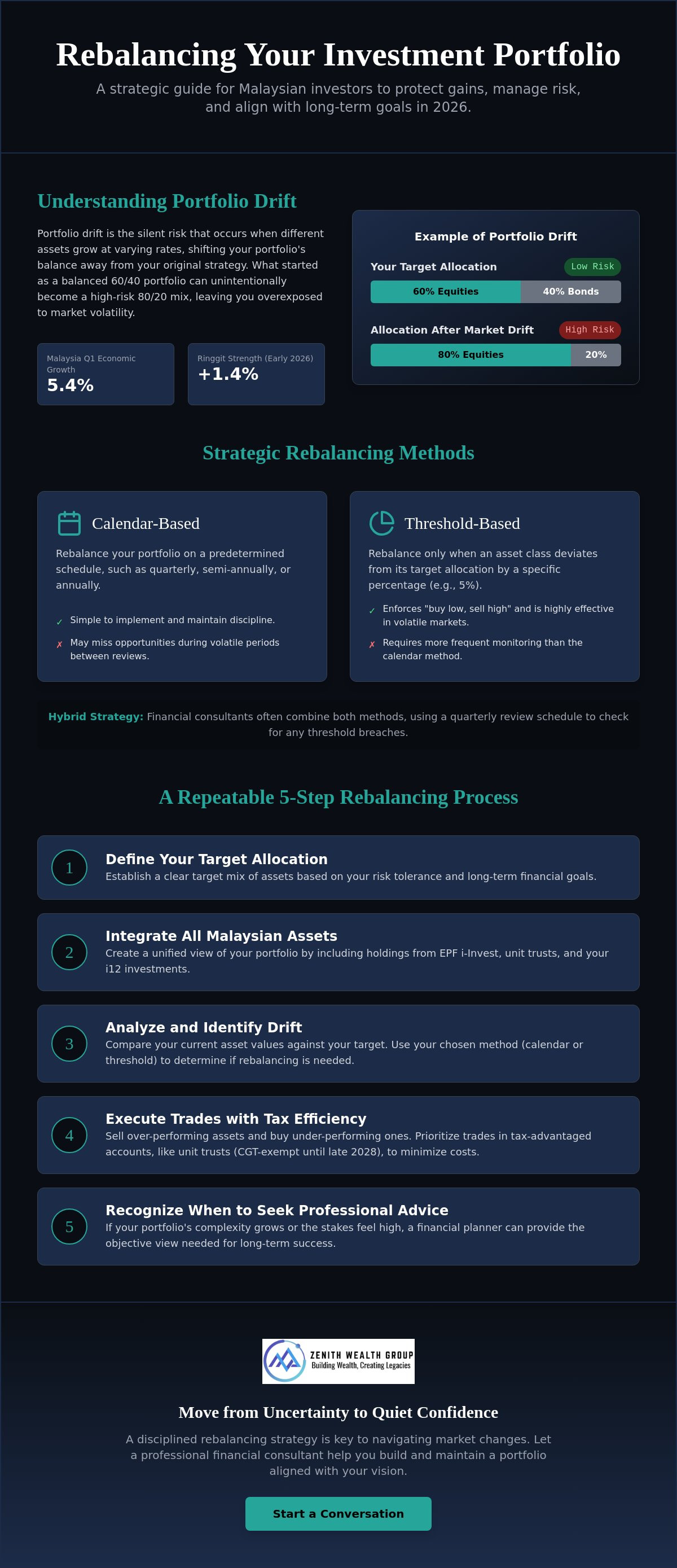
Portfolio drift is the silent thief of your investment strategy. It happens when different parts of your portfolio grow at different speeds. One year, your tech stocks soar. The next, your property trusts lag behind. Suddenly, the balanced mix you started with looks completely different. Your risk has changed, even if your goals haven't. Understanding what is portfolio rebalancing helps you regain control before the market shifts against you.
In the 2026 Malaysian market, a hands-off approach is dangerous. With the economy growing at 5.4% in the first quarter, certain sectors have moved significantly faster than others. If you don't act, you might find yourself accidentally over-exposed to high-risk areas. Rebalancing is your tool to enforce a "buy low, sell high" discipline. It removes the emotional bias that makes us want to hold onto winning stocks for too long. It's about math, not feelings. By selling a portion of your winners and buying more of your underperforming assets, you maintain the safety net you originally built.
The Risk of Doing Nothing
Doing nothing is a choice with real consequences. Consider a standard 60/40 portfolio. During a strong equity run, that split can drift to 80/20 without any new deposits. You're now far more vulnerable to market corrections than you intended to be. Currency shifts also play a massive role. The Ringgit strengthened by 1.4% in early 2026. This movement changes the actual value of your international holdings compared to your local ones. If you're asking how to rebalance my investment portfolio Malaysia, you must start by looking at these currency impacts on your global weightage. A failure to adjust means you're walking into the next market dip with a shield that's too small.
Rebalancing vs. Re-optimising
Don't confuse rebalancing with re-optimising. Rebalancing simply brings you back to your original target. Re-optimising means changing your target because your life goals shifted. Perhaps you're closer to retirement or need to fund a child's education. A financial planner can help you distinguish between these two needs. While i12 investments offers a structured foundation for growth, your overall strategy requires regular check-ups to stay effective. If the math feels complex or the stakes feel high, it's a good time to reach out for a professional perspective. Stick to your plan, but know when the plan itself needs an update.
Strategic Rebalancing Methods: Threshold vs. Calendar-Based
Choosing a method is the first step in learning how to rebalance my investment portfolio Malaysia effectively. You need a system that fits your schedule and your risk tolerance. Without a clear rule, most investors wait until a market crash to take action. By then, the damage is often done. We recommend two primary strategies to keep your i12 investments on track: the calendar method and the threshold method. Each has its own strengths, but the best approach often combines both into a hybrid system.
Transaction costs are a major factor in the Malaysian market. Between brokerage fees, stamp duties, and the 10% Capital Gains Tax on unlisted shares, trading too often can hurt your returns. A smart strategy focuses on tax efficiency. For instance, unit trusts remain exempt from Capital Gains Tax until late 2028. This makes them a flexible tool for rebalancing without immediate tax penalties. A professional financial planner can help you time these moves to minimize costs while maximizing your portfolio's health.
The Calendar Method (Periodic Review)
The calendar method is straightforward. You set a specific date, perhaps once every six months, to review your holdings. In 2026, with headline inflation at 1.6%, the economy feels stable but requires attention. We suggest frequent "look-ins" but fewer "trade-outs." You check the numbers quarterly to stay informed, but you only execute trades if the deviation is significant. This prevents over-trading while ensuring you never go a full year without assessing your progress toward retirement.
The Threshold Method (Tolerance Bands)
The threshold method ignores the date and focuses on the data. You set specific percentage limits, often called tolerance bands, for each asset class. If your target for Malaysian equities is 30% and it drifts to 35%, you trigger a rebalance. Tolerance bands act as the guardrails that prevent emotional trading. This method is highly effective during volatile periods because it forces you to sell when prices are high and buy when they're low. It's a disciplined way to manage how to rebalance my investment portfolio Malaysia without guessing the market's next move.
If you're unsure which method suits your current wealth level, it might be time to start a conversation with a professional. A financial planner can design a custom framework that accounts for your specific tax situation and long-term goals. This ensures your strategy is both repeatable and efficient.
Rebalancing the Malaysian Way: EPF, Unit Trusts, and i12 investments
Local investors often make the mistake of viewing their accounts in isolation. You might check your Bursa Malaysia stocks on one app and your unit trusts on another, while your EPF savings sit in the background. If you're serious about learning how to rebalance my investment portfolio Malaysia, you must view these pieces as a single "mega-portfolio." When one sector grows too large, it doesn't matter which account it's in. The risk to your total wealth remains the same. A unified view is the only way to ensure your asset allocation actually matches your goals.
The 2026 financial landscape offers unique advantages for those using local vehicles. For instance, unit trusts are currently exempt from Capital Gains Tax until December 31, 2028. This makes them a highly efficient tool for rebalancing. You can shift gains from an over-weighted equity fund into a bond fund without the 10% tax hit that now applies to unlisted shares. However, you must stay alert to exit loads and switching fees. These small costs can add up if you rebalance too frequently without a clear plan from your financial planner.
Integrating EPF i-Invest into Your Total Strategy
Your EPF Account 1 is a core pillar of your equity allocation. Members under age 55 can transfer up to 30% of savings that exceed their Basic Savings into approved funds via i-Invest. This platform allows you to rebalance your retirement holdings without withdrawing a single ringgit of cash. If the Malaysian stock market has a strong quarter, your i-Invest equity funds might suddenly represent too much of your total net worth. Shifting a portion of those funds back into lower-risk fixed income options within the platform keeps your retirement timeline secure. Managing wealth across borders requires a similar level of care. You might find our insights on Strategic Investment Management helpful if you hold assets in both the Malaysian and Singaporean markets.
The Role of i12 investments in Portfolio Stability
Within this broader strategy, i12 investments serves as a vital foundation for long term growth. These holdings are designed to provide a structured anchor for your wealth. Because they often encompass diverse asset groups, they naturally buffer your portfolio against the volatility of the local market. When Bursa Malaysia experiences swings, having a stable core reduces the pressure to make panic trades. A financial consultant can help you determine the right weight for these specialized holdings. They ensure your i12 investments work in harmony with your EPF and unit trust allocations to protect your legacy. This coordinated approach turns a collection of accounts into a powerful, resilient financial engine.
5 Steps to Rebalance Your Portfolio Manually
Rebalancing manually gives you total control over your assets. It's a hands-on way to understand your risk and see exactly where your money is working. If you're wondering how to rebalance my investment portfolio Malaysia without automated tools, these five steps provide the structure you need. It requires discipline and a bit of math, but the clarity you gain is worth the effort. You'll move from guessing to knowing exactly how your wealth is positioned for the future.
Step 1 & 2: The Audit and Analysis
Start by gathering your latest statements from various Malaysian financial institutions. You need a full view of your Bursa Malaysia holdings, unit trust portals like EPF i-Invest, and any international accounts. In 2026, the 5.4% GDP growth has likely pushed certain sectors, such as digital infrastructure, ahead of others. Record the current market value of every asset. Once you have the totals, calculate the percentage of each asset class relative to your whole portfolio. This drift analysis shows you where you've become over-exposed. Rebalancing is a re-alignment, not a re-guessing of the market. You aren't chasing the next big thing. You're simply returning to the safety of your original plan.
Step 3 & 4: Execution and Fee Management
Now, determine the exact ringgit amount needed to buy or sell to reach your target allocation. This is a crucial part of knowing how to rebalance my investment portfolio Malaysia effectively. You must account for Malaysian stamp duty and brokerage commissions. These costs can eat into your gains if you aren't careful. A more tax-efficient way to rebalance is through new contributions. Instead of selling your winners, use your monthly savings to buy the underperforming assets. This "cash inflow" method avoids triggering unnecessary transaction fees or the 10% Capital Gains Tax on unlisted shares. i12 investments can simplify this process by providing broad exposure that keeps your core allocation stable while you adjust smaller holdings.
Finally, execute your trades. Prioritize your tax-advantaged accounts first, such as unit trusts which remain exempt from certain taxes until late 2028. Once you've finished, document every change in a simple spreadsheet. This creates a paper trail for your future self and resets your "look-in" date for the next review. If the manual math feels daunting or your portfolio has grown too complex, a financial planner can help you streamline the process. They ensure your trades align with your broader retirement goals without incurring hidden costs. Don't let the technical details stop you from protecting your hard-earned wealth.
When to Engage a Financial Consultant
Managing a small portfolio is often a simple weekend task. You check your apps, do some basic math, and move on. But as your wealth grows, you'll reach a complexity threshold where spreadsheets simply can't capture the full picture. Knowing how to rebalance my investment portfolio Malaysia becomes much harder when you're balancing Bursa stocks, international holdings, and i12 investments across different tax environments. This is where a professional perspective changes everything. A financial consultant doesn't just do the math. They provide an objective, third party view that helps you stay rational when the market feels chaotic.
Professional consultants use institutional grade tools for drift analysis. These systems track volatility and correlation in real time, offering insights that a standard spreadsheet misses. At Zenith Wealth Group, we specialize in navigating these sophisticated rebalancing needs. We ensure your i12 investments are perfectly aligned with your risk tolerance and tax obligations. This level of precision is vital for protecting your hard earned gains in a turbulent global economy. We help you move beyond manual tracking and into a proactive, data driven strategy.
The Value of Professional Oversight
Professional oversight goes far beyond simple arithmetic. It addresses the bigger picture, including legacy planning and tax efficiency in the Malaysian context. A financial planner acts as a behavioral coach, preventing the "panic selling" that often happens during market dips. We help you understand that a temporary drop is often an opportunity to rebalance at a lower cost. For those with regional interests, understanding Legacy Planning is essential for long term wealth transfer. We ensure your current investment moves support the future you want to build for your family.
Taking the Next Step with Zenith Wealth Group
Every investor needs a personalized financial roadmap. At Zenith Wealth Group, our consultants integrate wealth protection with active investment management. We don't just look at how to rebalance my investment portfolio Malaysia; we look at how your entire wealth structure supports your life goals. We invite you to experience a more human side of financial advisory. Our team is ready to help you simplify the complex and secure your financial future. If you're ready to move from uncertainty to quiet confidence, book a consultation with us today. Let's start a conversation about your growth.
Securing Your Financial Legacy Through Disciplined Action
Rebalancing is more than a technical chore; it's a commitment to your future self. By addressing portfolio drift today, you prevent market volatility from dictating your retirement timeline. You've learned that a systematic approach, whether through threshold bands or scheduled reviews, takes the guesswork out of the process. Integrating local assets like EPF i-Invest with your broader i12 investments strategy ensures every ringgit works toward a single, unified goal. This discipline turns a collection of accounts into a resilient financial engine.
Mastering how to rebalance my investment portfolio Malaysia is a journey that evolves as your wealth grows. When complexity increases, having a trusted partner makes all the difference. Our team at Zenith Wealth Group consists of authorized representatives of finexis advisory Pte Ltd. We are specialists in retirement and legacy planning with deep expertise in global asset management. We invite you to speak with a Zenith Wealth Group financial consultant today to optimize your portfolio. Let's build a strategy that stays aligned with your vision. Your path to financial clarity starts with a single conversation.
Frequently Asked Questions
How often should I rebalance my investment portfolio in Malaysia?
Most investors find success by reviewing their portfolio every six months or whenever an asset class drifts by more than 5% from its target. In 2026, the Malaysian economy's 5.4% growth means certain sectors move faster than others. Regular health checks are essential, but you don't need to trade every time. Focus on frequent reviews and only execute trades when the deviation is significant enough to change your risk profile.
Will rebalancing my portfolio trigger capital gains tax in Malaysia?
It depends on the asset type. Rebalancing unlisted shares acquired on or after March 1, 2024, will trigger a 10% Capital Gains Tax on net gains. However, unit trusts remain exempt from this tax until December 31, 2028. This makes unit trusts an excellent tool for those learning how to rebalance my investment portfolio Malaysia without incurring immediate tax penalties on every move.
Is it better to rebalance by selling assets or by adding new capital?
Adding new capital is almost always the better choice. By using your monthly savings to buy underperforming assets, you avoid the brokerage fees and taxes associated with selling your winners. This "cash inflow" method is highly efficient and keeps your momentum strong. It's a simple way to stay on track while avoiding unnecessary costs in the local market.
Can I rebalance my EPF i-Invest account myself?
Yes, you can manage your EPF i-Invest holdings directly through the i-Akaun portal. Members under age 55 can shift their invested savings between different approved funds to maintain their desired equity levels. This allows you to stay disciplined with your retirement strategy without needing to withdraw cash or wait for annual dividends to see results.
What happens if I never rebalance my portfolio?
If you never rebalance, your portfolio will naturally drift toward higher risk. High performing stocks will eventually dominate your holdings, making you vulnerable to sudden market crashes. This accidental over-exposure can lead to losses that are much larger than you originally planned for. It puts your retirement timeline and your long term wealth protection at serious risk.
Do I need a financial consultant to help with rebalancing?
While DIY rebalancing is possible, a financial consultant is invaluable as your wealth grows. They provide the objective, third party view needed to make rational decisions during market swings. A professional financial planner also uses institutional tools to analyze drift and tax efficiency. They ensure your strategy remains aligned with complex goals like legacy planning and business succession.
How do i12 investments impact my rebalancing strategy?
i12 investments serve as a stable foundation for your total wealth. Because these holdings are designed with broad asset exposure, they often experience less drift than individual Malaysian stocks. Including them in your strategy reduces the need for frequent, small adjustments. This stability allows you to focus your rebalancing efforts on more volatile parts of your portfolio while your core remains secure.
Are there specific tools for Malaysian investors to track portfolio drift?
Many local unit trust platforms and digital wealth managers now offer basic tracking and alert features. However, a simple spreadsheet is often the most flexible tool for those wondering how to rebalance my investment portfolio Malaysia across multiple platforms. For the most precise data, a financial consultant can provide comprehensive reports that cover your Bursa stocks, international assets, and private holdings in one view.


