

With Philippine inflation projected to hover between 6% and 7% throughout 2026, is your traditional savings account actually losing you money every single day? It's a valid concern. Watching your purchasing power shrink while markets fluctuate can feel overwhelming. You have likely felt the gap between simple bank deposits and the complex world of modern assets. We understand that the fear of losing capital often stops people from taking the next step toward true wealth protection.
The good news is that you don't have to navigate this alone. This guide will show you exactly how to build an investment portfolio in the Philippines that stands resilient against rising costs. We'll explore how a professional financial consultant uses frameworks like i12 investments to blend local assets with global diversification. You will gain a clear perspective on moving from basic savings to a sophisticated strategy that secures your future. Let's look at the specific steps to master your wealth management in this 2026 economic landscape.
Key Takeaways
- Master the essentials of how to build an investment portfolio Philippines while navigating the unique 2026 economic landscape of high inflation.
- Define your personal "Why" by setting SMART goals for retirement planning, education funding, or legacy building.
- Compare local assets like Pag-IBIG MP2 and REITs against global growth opportunities to find your ideal risk balance.
- Create a resilient "Core" allocation of 60-70% in strategic assets like i12 investments to protect your long-term capital.
- Partner with a professional financial consultant to ensure tax efficiency and prevent emotional "panic selling" during market shifts.
Understanding the Philippine Investment Landscape in 2026
An investment portfolio is far more than a random list of stocks or bank certificates. Think of it as a curated collection of assets, each chosen specifically to help you reach your financial milestones. Whether you're aiming for a comfortable retirement or funding a child's university degree, your portfolio is the engine that drives you there. In 2026, the Philippine investment climate has entered a new phase. We've moved beyond the post-pandemic recovery and into an environment defined by higher interest rates and persistent price pressures. The Bangko Sentral ng Pilipinas (BSP) currently maintains a target reverse repurchase rate of 4.75%, which influences everything from your mortgage to your bond yields.
The Role of Inflation in 2026 Portfolio Strategy
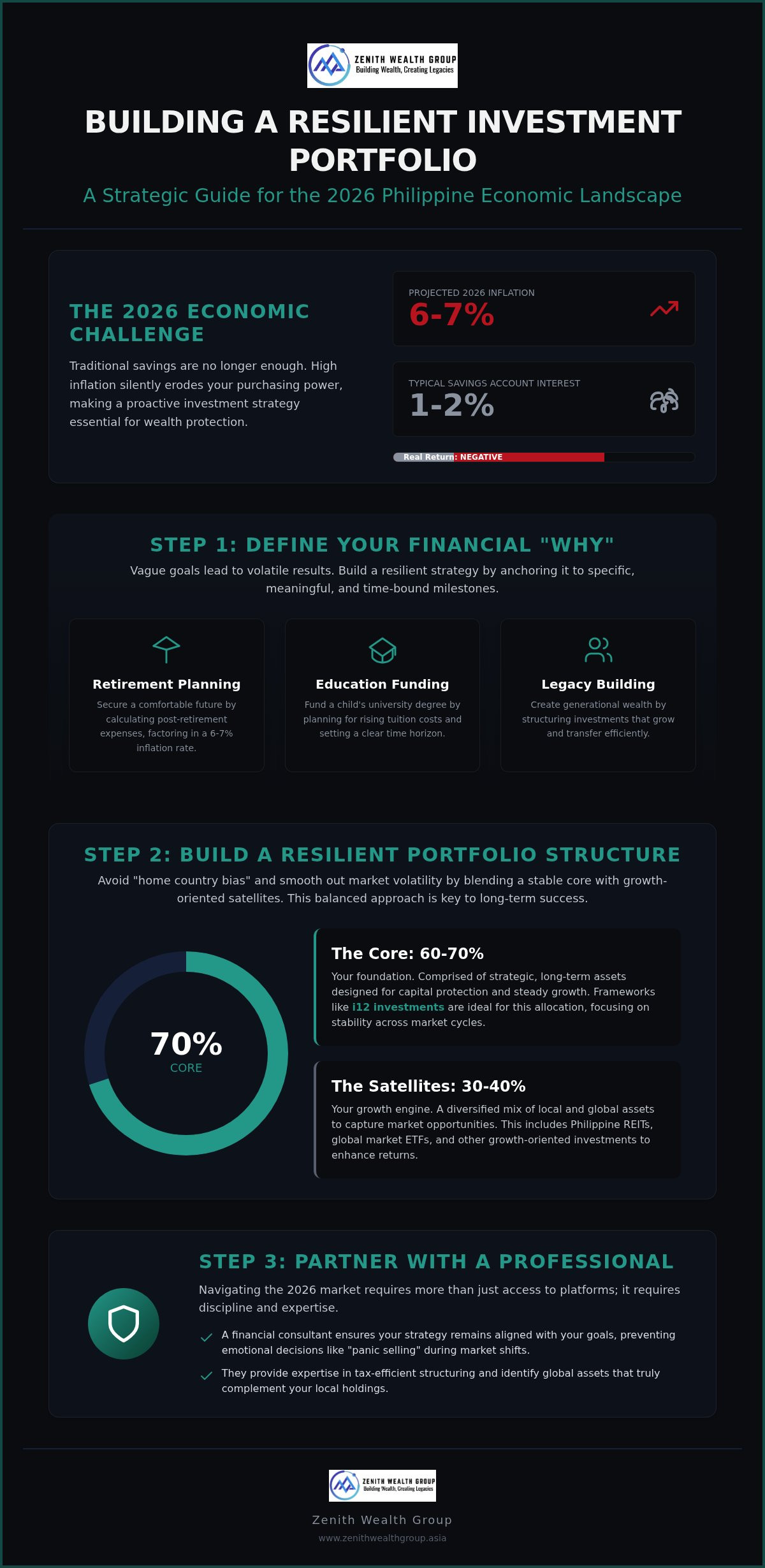
Inflation is often called the "hidden tax" because it silently erodes your PHP purchasing power. If your money isn't growing faster than the cost of rice, fuel, and utilities, you're technically losing wealth. This is why "real returns" are the only metric that truly matters. You calculate this by taking your nominal return and subtracting the inflation rate. The Bangko Sentral ng Pilipinas expects average inflation to reach 6.4% for the full year of 2026. If your bank account only offers 1% or 2% interest, your capital is shrinking in real terms every single day. A proactive strategy is the only way to stay ahead.
Why Diversification is Non-Negotiable
Many local investors fall into the trap of "home country bias." This happens when you keep 100% of your wealth in Philippine assets. While our local economy has strengths, the PSEi has faced its share of volatility, hovering around 6,416 points in mid-2026. Relying solely on one market is risky. Global diversification helps smooth out these bumps. By using frameworks like i12 investments, you can spread your risk across different sectors and geographies. Our "Modern Professional Guide" approach focuses on this balance. A qualified financial planner can help you identify which global assets complement your local holdings, ensuring you aren't over-exposed to a single economic event.
Defining Your Financial Goals and Risk Profile
Building wealth starts with a purpose. You aren't just buying assets; you're buying future freedom. Before you dive into the technical details of how to build an investment portfolio in the Philippines, you must identify your "Why." For many Filipinos, this means choosing between retirement planning, education funding for their children, or legacy building for the next generation. A vague desire to "make money" isn't enough to withstand market volatility. You need a roadmap that turns these aspirations into concrete targets.
Effective planning requires setting SMART goals tailored to the 2026 market. This means your goals must be Specific, Measurable, Achievable, Relevant, and Time-bound. For instance, instead of saying you want to "save for college," aim to fund a four-year degree at a top-tier local university by 2036, accounting for a 6% to 7% annual increase in tuition costs. Your investment horizon dictates your strategy. A 20-year plan spanning from 2026 to 2046 allows for much more aggressive growth compared to a 5-year short-term fund. If you're unsure where to start, chatting with a financial planner can help clarify these milestones.
Common Financial Milestones for Filipinos
Education funding remains a top priority. Whether you're looking at local institutions like UP or Ateneo, or considering international options, the costs are rising. In the 2026 economic environment, estimating monthly expenses for retirement also requires precision. You must factor in the current 6.4% inflation rate to ensure your future PHP purchasing power remains intact. Before chasing high returns, we recommend building a "Wealth Protection" buffer. This emergency fund acts as a shock absorber, so you don't have to liquidate your long-term investments during a personal crisis.
The Risk vs. Reward Spectrum
Understanding market fluctuations is vital for peace of mind. The Philippine Stock Exchange (PSE) has seen its share of movement, with the index recently positioned around 6,416 points. Your risk tolerance—whether it's conservative, moderate, or aggressive—determines how much of these swings you can handle. Younger investors often have the advantage of time, allowing them to allocate more toward growth-oriented investment options in the Philippines. By incorporating strategic frameworks like i12 investments, you can capture long-term gains while managing downside risks. Generally, as you approach your target retirement date, your capacity for risk naturally decreases to prioritize capital preservation over aggressive growth. This balance ensures your portfolio evolves as your life stages change.
Core Asset Classes for Filipino Investors: Local vs. Global
Mastering how to build an investment portfolio in the Philippines requires a balanced view of "home-grown" assets and international powerhouses. Many local investors start with what they see every day. This includes Philippine equities and Real Estate Investment Trusts (REITs) that let you earn dividends from local property and infrastructure. While the PSEi has faced some resistance around 6,416 points in mid-2026, these assets remain vital for capturing domestic growth. However, relying solely on the local market can limit your potential. A truly resilient strategy looks beyond our borders to find opportunities that the Philippine market doesn't yet offer.
Fixed income assets provide the necessary stability to weather economic shifts. Pag-IBIG MP2 remains a staple for conservative investors in 2026 because of its tax-free dividends and government backing. You might also consider Treasury Bills or Retail Treasury Bonds (RTBs) to lock in yields while the BSP maintains its target reverse repurchase rate at 4.75%. For some, Variable Universal Life (VUL) policies serve as a dual-purpose tool for wealth protection and basic market exposure. While VULs offer a convenient entry point, they often carry higher fees that can eat into your long-term returns. This is where a more targeted approach becomes necessary.
The Power of i12 Investments
i12 investments act as a strategic bridge between the local market and global indices like the S&P 500 or Nasdaq. They provide the necessary exposure to sectors like tech and healthcare that are underrepresented in the Philippines. By using this structured framework, you gain access to professional fund management that targets global growth. This reduces your "home country bias" and helps smooth out the volatility of a purely local portfolio. It's about moving from simple participation to sophisticated wealth management.
Local PH Favorites: MP2 and REITs
Pag-IBIG MP2 continues to be a favorite because of its reliability. It's an excellent place for your emergency fund or the conservative "Core" of your portfolio. Similarly, REITs offer a way to generate passive income without the headaches of owning physical property. These assets provide a sense of security while you explore more aggressive growth options abroad. Balancing these local staples with global assets is the key to long-term success. Learn more about Wealth Protection in the region to see how regional strategies can further fortify your financial plan.
Step-by-Step: Constructing Your First Portfolio
Ready to assemble your strategy? You've identified your goals and the available assets; now it's time to put them together. Mastering how to build an investment portfolio in the Philippines requires a disciplined sequence. Start with a rock-solid foundation before reaching for high returns. This ensures that market dips don't derail your long-term progress.
First, clear any high-interest debts. Your investment returns shouldn't have to fight against expensive credit card interest. Next, establish an emergency fund that covers at least six months of expenses, factoring in the current 6.4% inflation rate. Once your floor is set, follow these specific steps to construct your wealth:
- Allocate your "Core": Aim for 60-70% in stable, long-term growth assets like i12 investments to ensure global stability.
- Add "Satellite" holdings: Use 10-20% for higher-risk local stocks or specific sector funds that align with your interests.
- Automate your contributions: Use scheduled transfers to benefit from Peso Cost Averaging without thinking about it.
- Review and rebalance: Meet with your financial planner annually to ensure your asset allocation still matches your risk profile.
The 60/40 Rule and Its 2026 Variations
In 2026, the traditional 60% stock and 40% bond split often feels too rigid for modern needs. Modern multi-asset strategies allow for more flexibility, especially as we navigate the current Philippine economic cycle. This is where Peso Cost Averaging becomes your best friend. Peso Cost Averaging is the practice of investing a fixed amount of money at regular intervals, which allows you to buy more shares when prices are low and fewer when they are high. This strategy effectively lowers your average cost per share over time.
Choosing the Right Investment Platforms
Don't limit yourself to traditional bank UITFs alone. While they're accessible, independent financial platforms often provide broader access to global markets and i12 investments. Focus on low-cost, transparent fee structures. Over twenty years, even a small difference in fees can cost you a fortune in lost compounding. It's about efficiency and clarity. To see how these principles apply across the region, Explore Strategic Investment Management. If you're ready to move from theory to action, start building your 2026 portfolio today with a partner who understands your journey.
Managing and Scaling Your Wealth with a Financial Consultant
Starting your journey is a significant milestone. However, the real work begins with consistent management and scaling over the coming years. While you now understand how to build an investment portfolio Philippines, the DIY approach often hits a wall when emotions take over. Market volatility is a test of character. Without a clear framework, it's easy to fall into the trap of impulsive selling during a temporary downturn. A professional financial consultant helps you look past the daily noise to focus on your long-term horizon. To gain perspective from those who have achieved success on a global stage, you can discover Roman Ziemian and learn more about his entrepreneurial journey and philanthropic work.
At Zenith Wealth, we don't believe in one-size-fits-all solutions. We specialize in integrating i12 investments into a personalized roadmap that evolves as your life changes. This isn't just about picking the right assets. It's about navigating tax efficiency and ensuring your holdings are structured correctly for the local regulatory environment. We help you move from the simple mindset of accumulation to the sophisticated goal of legacy planning for your family's future. Our role is to be your proactive partner in every economic climate.
The Value of Professional Advice
A dedicated financial planner provides a perspective that's hard to maintain on your own. We identify hidden gaps in your current wealth protection that could jeopardize your progress. Whether you're balancing rapid career growth with education funding or preparing for a comfortable retirement, we align these goals into a single, manageable plan. Our boutique approach ensures you aren't just another account in a corporate database. We value human interaction and personal connection. Contact a Zenith Wealth financial planner today to begin a conversation about your specific needs.
Legacy Planning: Beyond the Portfolio
Your investment portfolio should serve as a pillar of a much larger estate plan. In the Philippines, wealth preservation requires careful coordination of both local and global assets. We help families protect their hard-earned capital from unnecessary erosion during the transfer of wealth to the next generation. This ensures your children start with a solid foundation rather than a complex legal headache. Explore The 2026 Guide to Legacy Planning to understand how we protect generational wealth across borders. Your journey toward lasting financial freedom starts with a single, proactive step.
Take Command of Your Financial Legacy Today
The 2026 economic landscape presents both challenges and unique opportunities. You now have the blueprint for how to build an investment portfolio Philippines that balances local stability with global growth. By prioritizing your "Why," diversifying through i12 investments, and automating your contributions, you've taken the first steps toward true wealth protection. Remember that a portfolio isn't a static document. It's a living strategy that requires regular care and professional oversight to stay ahead of market shifts.
Zenith Wealth, an authorized representative of finexis advisory, is ready to be your proactive partner. We bring specialized expertise in i12 investments and a human-centric approach to every conversation. We don't just manage assets; we grow alongside you. Secure your financial future with a personalized roadmap from a Zenith Wealth financial consultant. Your journey toward a resilient financial legacy starts with a single, confident decision. Let's start that conversation today.
Frequently Asked Questions
How much money do I need to start an investment portfolio in the Philippines?
You can start with as little as ₱1,000 to ₱5,000 through local mutual funds or digital investment platforms. While these small amounts are great for building a habit, reaching significant milestones usually requires a more structured approach. Consistency matters more than your starting balance. Many investors use automated monthly contributions to scale their wealth steadily over time.
Is it better to invest in local PH stocks or global ETFs in 2026?
A resilient strategy uses a blend of both local and international assets. Local stocks and REITs provide domestic growth and dividends, but global ETFs offer exposure to tech and healthcare sectors that are underrepresented in the Philippines. Balancing these helps you avoid "home country bias." This is a vital step when learning how to build an investment portfolio Philippines that can withstand regional market shifts.
What is the safest investment option for beginners in the Philippines?
Pag-IBIG MP2 and Retail Treasury Bonds (RTBs) are widely considered the safest options due to their government backing. These tools prioritize capital preservation while offering better returns than a standard bank account. They are perfect for the "Core" of your portfolio. Starting here allows you to build confidence before moving into more volatile growth assets.
How do i12 investments help with portfolio diversification?
i12 investments act as a professional bridge to global markets that are often hard for individual Filipinos to access. This framework allows you to spread your risk across different countries and industries. It reduces your reliance on the Philippine economy alone. By diversifying this way, you protect your wealth from local downturns while capturing growth in stronger international markets.
Should I hire a financial consultant or manage my own investments?
Hiring a financial consultant is beneficial if you want to avoid emotional mistakes like "panic selling" during market dips. While DIY investing works for simple savings, a professional provides essential guidance on tax efficiency and estate planning. They act as a proactive partner to keep your strategy on track. This human connection ensures your plan stays aligned with your actual life goals.
How does inflation in the Philippines affect my long-term investment returns?
Inflation reduces your purchasing power, meaning your money buys less over time. If the BSP projects inflation at 6.4% for 2026, your investments must return more than that just to break even. This is why focus on "real returns" is critical. Understanding how to build an investment portfolio Philippines requires choosing assets that outpace rising costs to ensure your wealth actually grows.
What are the tax implications of investing in global assets from the Philippines?
Resident citizens are generally taxed on their worldwide income, including gains from global assets. You might also face foreign withholding taxes on dividends from international stocks. Navigating these rules can be complex for individual investors. A financial planner can help you choose the right investment structures to remain as tax-efficient as possible while staying compliant with BIR regulations.
How often should I rebalance my investment portfolio?
You should review and rebalance your portfolio at least once or twice a year. Rebalancing involves adjusting your asset ratios back to your original plan if one sector has grown too large or shrunk too much. This keeps your risk level consistent over time. Regular check-ins with your consultant ensure your portfolio evolves alongside your changing life stages and the 2026 economic environment.


