

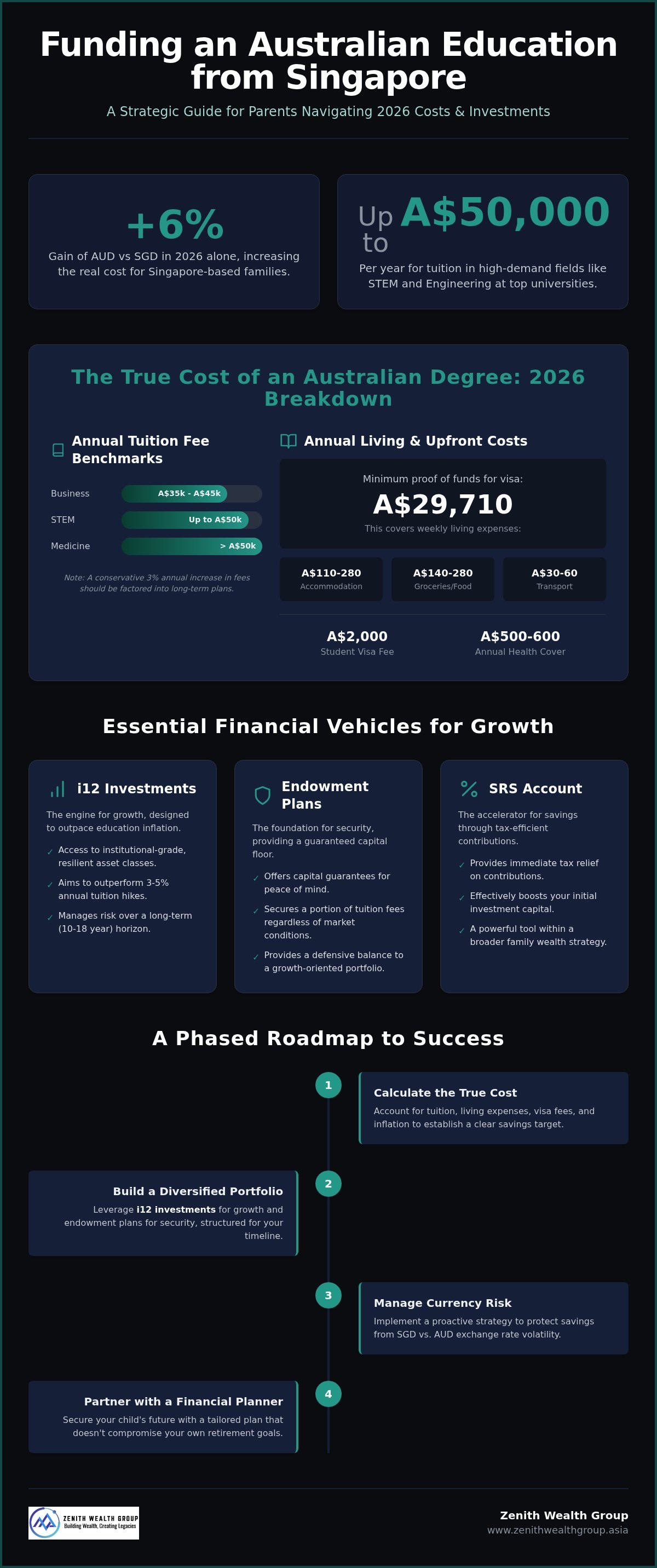
Did you know the Australian dollar gained over 6% against the Singapore dollar in 2026 alone? For many parents, the dream of a world-class degree comes with a side of sticker shock as tuition fees now reach up to AUD $50,000 per year. Effectively funding child's education in Australia from Singapore has become a complex wealth management challenge rather than a simple savings goal.
It's natural to feel concerned that these rising costs might force a choice between your child's degree and your own retirement security. We understand that you want a plan that protects your lifestyle while providing for theirs. You aren't just looking for a bank account; you're looking for a strategy that respects your hard work and your family's future.
This guide provides a strategic roadmap to master these financial hurdles with confidence. We'll show you how a financial planner can use i12 investments to build a tax-efficient portfolio tailored for your unique needs. You'll gain a clear savings target and the peace of mind that comes from a proactive approach to currency volatility and long-term growth.
Key Takeaways
- Calculate the true cost of an Australian degree in 2026, including tuition, living expenses, and the latest visa requirements.
- Explore how leveraging i12 investments helps your portfolio keep pace with education inflation through diversified global growth.
- Protect your savings from currency swings with a proactive strategy for managing the SGD vs. AUD exchange rate.
- Follow a phased roadmap for funding child's education in Australia from Singapore, ensuring you meet milestones from birth to enrollment.
- Partner with a financial planner to secure your child’s future without compromising your personal retirement goals.
The Reality of Australian Education Costs in 2026
Sending your child to a Group of Eight (Go8) university is a proud milestone. However, the financial landscape for international students has shifted significantly by 2026. Understanding the full scope of Australian tertiary education fees is the first step in effective planning. For parents in Singapore, this isn't just about tuition. It's about accounting for a stronger Australian dollar and rising local inflation. Effectively funding child's education in Australia from Singapore requires looking at the "Total Cost of Attendance," which combines tuition, mandatory health cover, visa fees, and daily living expenses into one comprehensive figure.
Tuition Fee Benchmarks for Popular Degrees
Tuition isn't uniform across disciplines. In 2026, a Bachelor of Business or Commerce at a top-tier institution typically ranges between AUD $35,000 and $45,000 per year. STEM and Engineering degrees often sit higher, reaching up to $50,000 annually due to specialized equipment and lab fees. Medicine and Veterinary Science remain the high-cost outliers. These programs frequently exceed the $50,000 mark. When you factor in the current 3.5% inflation rate, a 3% annual increase in fees is a conservative estimate for your long-term projections.
Living and Accommodation Costs in 2026
Where your child lives matters as much as where they study. Sydney remains the most expensive metro, followed closely by Melbourne. Perth offers a slightly lower cost of entry, but housing prices there are rising fast. Many students now opt for purpose-built student accommodation (PBSA). These facilities offer security and community but come with a premium price tag. To meet visa requirements, applicants must now show proof of a minimum of AUD $29,710 per year for living costs. You should budget for the following weekly expenses:
- Accommodation: AUD $110 to $280 per week.
- Groceries and Food: AUD $140 to $280 per week.
- Public Transport: AUD $30 to $60 per week.
Beyond daily needs, don't forget the "hidden" entry costs. The Australian student visa (Subclass 500) application fee has increased to AUD $2,000. Additionally, Overseas Student Health Cover (OSHC) costs approximately $500 to $600 per year. These upfront figures can catch families off guard if they haven't consulted a financial planner. By utilizing strategic tools like i12 investments, you can build a portfolio that aims to outpace these rising costs while keeping your retirement plans intact.
Essential Financial Vehicles for Singapore-Based Parents
Once you understand the rising costs of an Australian degree, the next step is choosing the right vehicles to grow your capital. Funding child's education in Australia from Singapore is a marathon, not a sprint. It requires a balanced mix of growth-oriented investments and defensive assets to ensure the money is there when the first tuition bill arrives. Relying solely on a standard savings account won't work in a high-inflation environment. Instead, a modern strategy focuses on institutional-grade tools and tax-efficient structures.
Integrating i12 investments into Your Strategy
Generic retail platforms often lack the depth needed for long-term education goals. This is where i12 investments make a difference. By providing exposure to resilient asset classes that aren't always available to the public, i12 investments help your portfolio withstand market volatility. When you have a 10-to-18-year horizon, your financial planner can help you balance risk and reward effectively. This institutional-grade fund management ensures your core capital isn't just sitting idle. It's working to outpace the 3% to 5% annual tuition hikes seen in major Australian cities.
For parents who prioritize safety, endowment plans remain a vital component of the education pot. These plans offer capital guarantees that provide a "floor" for your savings. While they may offer lower returns than equity-heavy portfolios, they ensure that a specific portion of the tuition fee is secured regardless of market conditions. A balanced approach often involves using i12 investments for growth and endowment plans for certainty.
Tax Efficiency and the SRS Account
Smart funding isn't just about what you earn; it's about what you keep. The Supplementary Retirement Scheme (SRS) is a powerful tool for Singapore-based parents. Contributions to your SRS account earn immediate tax reliefs, which effectively "boosts" your investment capital from day one. While SRS is designed for retirement, strategic withdrawal planning allows you to use these funds as part of your broader family wealth strategy. You can learn more about optimizing this tool in our guide to Mastering the SRS Account.
Every family has unique milestones and risk tolerances. A financial consultant can help you weave these different vehicles into a cohesive plan that protects your retirement while securing your child's degree. It's about creating a roadmap that feels manageable and clear. If you're ready to see how these tools fit your specific situation, feel free to start a conversation with our team. We're here to help you navigate these choices with confidence and clarity.
Navigating Exchange Rate Risks and AUD Volatility
Currency fluctuations can make or break your education fund. In 2026, the Australian dollar gained 6.1% against the Singapore dollar, significantly increasing the cost for families in Singapore. With the rate at approximately 0.9118 in August 2026, many parents are feeling the pinch. Effectively funding child's education in Australia from Singapore requires more than just a high-yield savings account in SGD. It demands a sophisticated approach to currency management. A "set and forget" strategy in Singapore dollars leaves you vulnerable to market swings that could erase years of disciplined saving.
To mitigate this risk, many parents now use multi-currency accounts to dollar-cost average (DCA) into Australian dollars. By converting smaller amounts regularly, you smooth out the exchange rate over several years. This prevents the need for a "panic conversion" when your child finally receives their university offer. Holding AUD-denominated assets through i12 investments can also act as a natural hedge. When your assets are held in the same currency as your future liabilities, you're better protected against a strengthening Australian dollar.
Hedging Against a Stronger Australian Dollar
The Monetary Authority of Singapore (MAS) manages the SGD against a trade-weighted basket of currencies. While this provides stability, the AUD is a commodity-linked currency that can move sharply based on global demand. A 10% currency swing on a four-year degree costing AUD $200,000 could result in an unplanned expense of nearly SGD $20,000. By working with a financial planner, you can identify the right time to shift your asset allocation. Utilizing i12 investments allows you to maintain growth while ensuring your purchasing power in Australia remains intact as your child approaches enrollment age.
Timing the Conversion: A Strategic Approach
Lump-sum transfers are often tempting when the rate looks "good," but they carry high timing risk. A more resilient strategy involves gradual conversion over the three to five years leading up to university entry. Your financial consultant can monitor global macro trends and the 2026 forecast range of 0.9099 to 0.9471 to help you make informed decisions. This proactive stance ensures you aren't at the mercy of short-term volatility. It transforms currency risk from a source of stress into a manageable part of your broader wealth protection strategy.
A Step-by-Step Education Funding Roadmap
Successfully funding child's education in Australia from Singapore requires a disciplined, multi-stage approach. It isn't just about saving a flat amount every month. Your strategy must evolve as your child grows. A plan that works for a toddler is often too aggressive for a teenager preparing for their first year at a Go8 university. By breaking the journey into distinct phases, you can manage risk while keeping your retirement goals on track.
Early Start: Maximizing Compounded Growth
The first 10 years of your child's life are your most powerful asset. This is the accumulation stage. During this window, time is on your side. Your financial planner will likely recommend a higher allocation to growth-oriented assets to outpace tuition inflation. It's the ideal time to leverage strategies found in our guide on Education Funding in 2026. By leaning into the growth potential of i12 investments early, you allow compounded returns to do the heavy lifting. Setting up automated contributions during this phase is vital. It removes emotional bias and ensures your education pot grows steadily through various market cycles.
As your child moves into the consolidation stage between ages 11 and 15, the focus shifts toward rebalancing. You've built the core of the fund; now you must protect it. Your financial consultant will help you gradually reduce exposure to high-volatility assets. This ensures that a sudden market dip won't erase years of gains just as university applications begin.
The Final Countdown: Shifting to Low-Volatility Assets
Between ages 16 and 18, you enter the preservation stage. This is all about liquidity. You need to ensure cash is ready for the first semester's tuition and the AUD $2,000 student visa fee. During these final years, your portfolio should transition toward lower-volatility instruments and cash equivalents. This shift prevents last-minute "panic selling" if the market becomes unstable.
This final phase also involves managing the trade-off between education and retirement. You shouldn't have to compromise your lifestyle to fund their degree. A well-structured roadmap ensures that both your retirement pot and the education fund remain healthy and distinct. Annual reviews are essential to adjust for currency swings and changing family milestones. If you want to build a personalized timeline that secures your child's future, reach out to a financial planner today. Let's make sure your roadmap is ready for 2026 and beyond.
How a Zenith Financial Planner Secures the Journey
Zenith Wealth Group isn't a distant corporate entity. We're an attentive team of professionals eager to start a conversation about your family's future. As an authorized representative of finexis advisory, we provide the quiet confidence you need to manage complex cross-border finances. We believe in human interaction over institutional coldness. Our role is to act as your modern professional guide, ensuring that funding child's education in Australia from Singapore feels like a manageable, shared journey rather than a source of stress.
We take a holistic approach to wealth management. This means we look beyond just the tuition bill. Your education goals shouldn't exist in a vacuum. We tailor every portfolio to align with your specific family milestones, whether that's a career change, a new home, or your long-term legacy. By focusing on reliability and proactivity, we position ourselves as partners who grow alongside you. It's about creating a strategy that respects your hard work while providing for your child's dreams.
Why a Financial Consultant is Essential for Overseas Planning
Cross-border financial regulations are constantly shifting. A financial consultant helps you stay ahead of these changes without the heavy jargon. One of the biggest risks parents face is the "education trap," where funding a degree accidentally compromises their future security. We ensure your education plan integrates seamlessly with your Retirement Planning. Additionally, our clients gain access to exclusive insights into i12 investments. These institutional-grade strategies provide the growth potential necessary to keep pace with Australian inflation while maintaining a focus on long-term wealth preservation.
Ready to Start the Conversation?
Our digital presence is just the beginning. We've built an open-door policy that encourages immediate connection. During your first discovery session, we won't overwhelm you with complex syntax or unnecessary fluff. We'll listen to your goals and assess your current progress. From there, we build a custom 2026 education roadmap that addresses currency risks, tax efficiency, and investment growth. It's a clear, action-oriented path designed to give you peace of mind. Contact Zenith Wealth Group today for a personalized consultation and let's start securing your child's future together.
Secure Their Future and Your Peace of Mind
Navigating the financial path to an Australian university doesn't have to be a solo effort. We've explored the rising 2026 costs and the vital role of active currency management. Effectively funding child's education in Australia from Singapore requires a blend of growth-oriented i12 investments and a disciplined, phased roadmap. This strategic approach ensures you meet every tuition milestone without ever sacrificing your own retirement security.
Zenith Wealth Group acts as your modern professional guide. As an authorized representative of finexis advisory Pte Ltd, we offer specialized expertise in building resilient portfolios that grow alongside your family. We invite you to step through our door and start a conversation today. Let's build a custom 2026 roadmap that turns your child's academic dreams into a clear financial reality. We're ready to help you navigate these complexities with quiet confidence and personal care.
Secure your child’s Australian education with a Zenith financial consultant
Frequently Asked Questions
Can I use my CPF Ordinary Account (OA) to fund my child’s education in Australia?
No, you cannot use your CPF Ordinary Account for overseas studies. The CPF Education Loan Scheme is strictly reserved for approved full-time courses at local institutions in Singapore. To bridge this gap, many parents look toward private investment portfolios. A financial consultant can help you structure a plan that utilizes your cash savings and other assets to meet the high costs of an international degree.
How much should I save monthly for an Australian university degree starting in 2026?
Your monthly target depends on your child's current age and your chosen university. With 2026 tuition fees reaching up to AUD $50,000 annually and living costs at AUD $29,710, the total requirement is significant. Effectively funding child's education in Australia from Singapore requires a precise calculation. A financial planner can help you determine the exact SGD amount needed to hit these milestones while accounting for projected inflation and currency shifts.
Is it better to take an education loan in Singapore or Australia?
It's generally better to secure an education loan in Singapore. Local banks offer competitive interest rates for students heading abroad, and the application process is more straightforward for residents. Australian loans for international students are rare and often come with much higher interest rates. You should compare the total cost of borrowing in SGD versus the potential currency risks involved with an AUD-denominated loan before making a final decision.
What happens to my education fund if my child decides not to go to Australia?
Your education fund remains flexible and accessible. If you've built your portfolio using i12 investments, your capital isn't tied to a specific country or institution. You can easily redirect these funds to a university in Singapore, the UK, or the USA. Alternatively, you can keep the assets invested as part of your broader wealth protection or legacy planning strategy. This flexibility ensures your hard-earned savings are never "wasted."
How does i12 investments differ from a standard savings account for education?
Standard savings accounts rarely keep pace with the 3.5% Australian inflation rate or the rising costs of tuition. In contrast, i12 investments provide exposure to institutional-grade fund management designed for long-term growth. While a bank account offers safety, it lacks the compounding power needed for a 10-year horizon. By choosing i12 investments, you're opting for a strategy that aims to preserve your purchasing power and grow your education pot more aggressively.
Are there any tax implications in Australia for funds sent from Singapore?
Singapore and Australia share a comprehensive Double Taxation Agreement (DTA) that protects your funds. Generally, the money you send from Singapore to pay for tuition and living expenses is not taxed as income in Australia. However, if your child earns interest in an Australian bank account, a withholding tax capped at 10% may apply. It's wise to have your financial planner review the latest 2026 regulations to ensure your transfers remain tax-efficient.
How often should I review my education funding plan with a financial planner?
You should review your plan at least once a year. Regular reviews are essential for funding child's education in Australia from Singapore because they allow you to adjust for currency volatility. For instance, the 6.1% AUD gain in 2026 might require a shift in your monthly contributions. Your financial consultant will help you rebalance your portfolio as your child gets closer to enrollment, ensuring you move from growth to capital preservation at the right time.
Can I fund the entire degree using only SRS withdrawals?
Funding a full degree solely through SRS is possible but often inefficient. While the Supplementary Retirement Scheme offers great tax reliefs, early withdrawals before the statutory retirement age incur a 5% penalty and are fully taxable. It's better to treat SRS as a supplementary tool rather than your primary funding source. A financial planner can show you how to blend SRS with i12 investments to maximize tax savings without triggering unnecessary penalties.


