

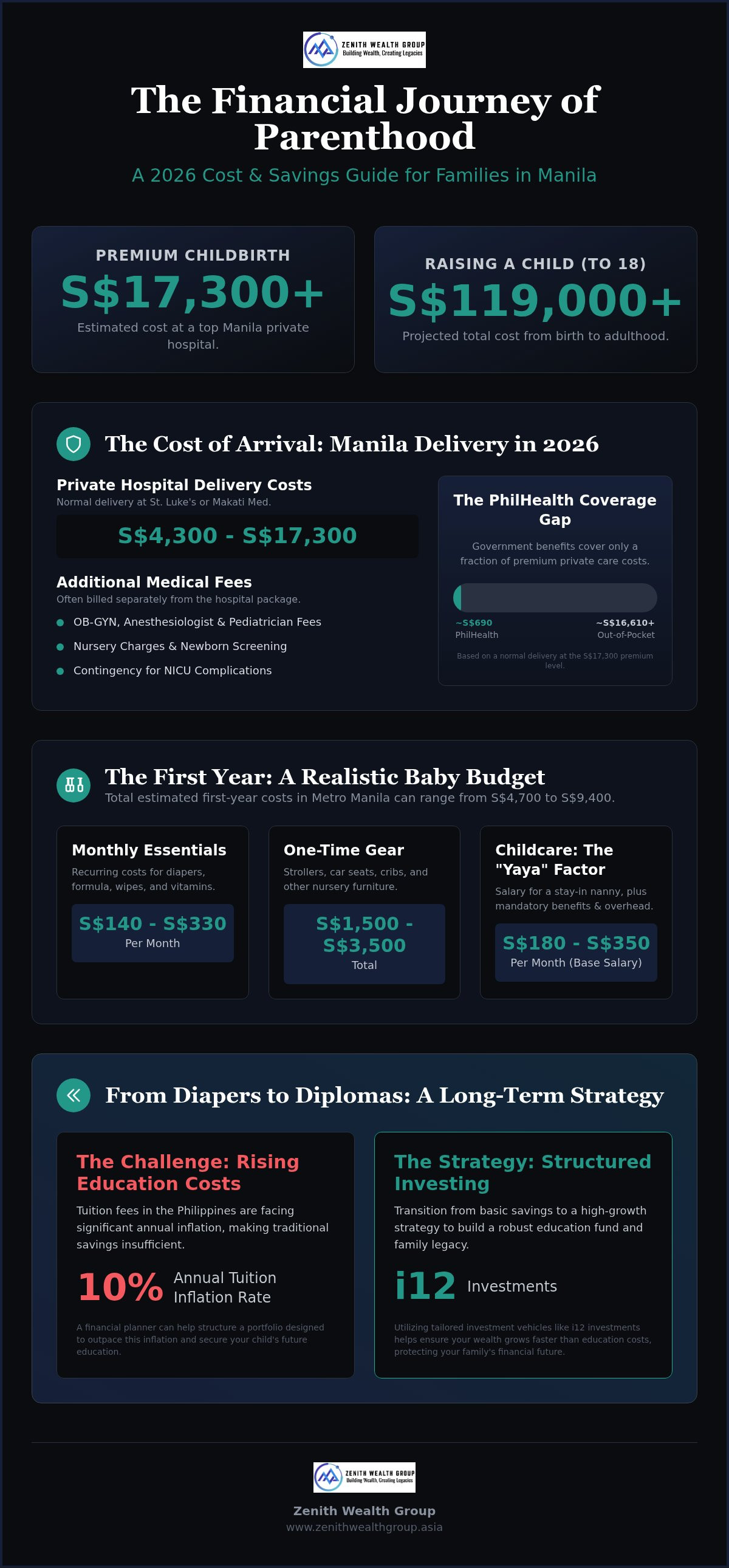
Did you know that a premium delivery at a Manila hospital like Makati Medical Center can now exceed S$17,300? For families planning from Singapore, this is just the first step in a journey where the total cost to raise a child can reach over S$119,000 by age 18. It's a staggering figure that makes learning how to save for child's education Philippines feel like a daunting task. Even with PhilHealth coverage increasing to roughly S$690 for normal deliveries, the out-of-pocket gap remains wide for those seeking private care.
As your financial planner, we understand that you want the best for your children without sacrificing your own financial security. Balancing rising tuition fees in Manila with your retirement needs requires more than just a standard savings account. This 2026 guide provides a strategic financial roadmap to help you master the costs of parenthood from day one. You'll find clear estimates for delivery and schooling, alongside a structured investment plan using i12 investments. We're here to help you build a family legacy that offers both excellence and peace of mind. Let's start planning for your child's future today.
Key Takeaways
- Get a clear breakdown of 2026 delivery costs at premium Manila hospitals and learn how to build an essential liquid reserve for your baby's first year.
- Discover exactly how to save for child's education Philippines by transitioning from basic savings to a structured, high-growth investment strategy.
- Learn how to maximize PhilHealth maternity benefits while identifying critical gaps in corporate HMO coverage that could impact your family's finances.
- Explore how i12 investments can help you stay ahead of 10% annual tuition inflation and secure top-tier schooling for the next two decades.
- Understand how to use education funding as a catalyst for holistic legacy planning that protects your family's wealth across generations.
Estimating the Cost of Welcoming a Baby in Manila (2026)
Manila's economic landscape is rapidly shifting. While government initiatives continue to address Poverty in the Philippines, the cost of premium private healthcare remains a significant hurdle for growing families. For 2026, the financial baseline for private maternity care is higher than ever. You need a clear strategy on how to save for child's education Philippines, and that journey starts before your baby even arrives. A financial planner helps you map out these initial "Day 0" milestones so they don't derail your long-term wealth protection goals.
Private Hospital Delivery Costs: St. Luke’s vs. Makati Med
Expect to pay between S$4,300 and S$17,300 for a normal delivery at premium institutions like St. Luke's Medical Center or Makati Medical Center. If a Cesarean section is required, these figures can climb significantly higher. Professional Fees (PF) for your OB-GYN, Anesthesiologist, and Pediatrician are often billed separately from the hospital’s room and board. These fees depend on your doctor's seniority and the complexity of the case. Always budget for:
- Private suite room rates and hospital service fees.
- Nursery charges and mandatory newborn screenings.
- A contingency reserve for the Neonatal Intensive Care Unit (NICU) in case of unexpected complications.
Pre-natal Care and Diagnostic Milestones
The financial journey starts long before delivery. Monthly check-ups in Manila now average between S$35 and S$120 per visit. A critical milestone is the Congenital Anomaly Scan (CAS) during the second trimester, which requires a dedicated budget. You must also account for the recurring costs of prenatal vitamins and diagnostic blood tests across all three trimesters. A Maternity Fund is a 9-month liquid cash target designed to cover all pregnancy and delivery costs without touching your long-term investments.
PhilHealth has expanded its 2026 coverage, offering approximately S$690 for normal deliveries and up to S$1,475 for complicated C-sections. For families choosing the private healthcare trajectory, these benefits cover only a small fraction of the total bill. This is where a financial planner becomes an essential partner. We help you prioritize these immediate liquid needs while ensuring you're also learning how to save for child's education Philippines through tailored investment roadmaps. Balancing today's delivery costs with tomorrow's tuition is the first step in securing your family legacy.
Creating a Realistic "Baby Budget" for the First Year
Transitioning from a dual-income-no-kids (DINK) lifestyle to parenthood is a significant financial shift. In Metro Manila, the first year alone can cost between S$4,700 and S$9,400. This doesn't just include big-ticket items. It covers the daily "Manila Premium" on imported essentials. Brands like Enfamil or premium diapers often cost more in the Philippines than their local counterparts. To manage this, you'll need to pivot from discretionary spending to a structured cash flow plan. Avoiding high-interest credit card debt during this first year is vital for your long-term wealth.
Inflation in 2026 continues to hover around 10 percent for education and related services. While you're focusing on immediate needs, remember that your current spending habits dictate your future capacity to invest. Learning how to save for child's education Philippines starts with mastering your monthly consumables. A financial planner can help you align these first-year costs with your broader Philippine education investments strategy to ensure your child's 2040 goals remain on track.
The Essentials: Diapers, Formula, and Gear
Monthly consumables for a baby in Manila typically range from S$140 to S$330. This depends heavily on whether you're breastfeeding or using imported formula. One-time purchases like strollers, car seats, and nursery furniture can easily add another S$1,500 to S$3,500 to your budget. To save without compromising quality, look for official flagship stores during "double-day" sales like 11.11 or 12.12. Buying in bulk during these windows can significantly reduce your per-unit cost for diapers and wipes.
Childcare in Manila: The Yaya Factor
Unlike many other regions, the "Yaya" or nanny culture is a central part of Manila's childcare landscape. For 2026, expect stay-in yaya salaries to range between S$180 and S$350 per month. This cost doesn't stop at the base salary. You're legally required to provide mandatory benefits, including SSS, PhilHealth, and Pag-IBIG contributions. You should also budget for increased household overhead, such as extra food and higher utility bills for water and electricity. These recurring costs can sneak up on you if they aren't explicitly tracked in your monthly roadmap.
Managing these moving parts can feel overwhelming. If you're ready to build a sustainable plan that balances today's diapers with tomorrow's degrees, we're here to help. You can reach out to our team to start crafting your family's financial roadmap today.
Navigating Healthcare and Insurance in the Philippines
Healthcare costs in Manila can quickly erode your family's liquidity if you aren't prepared. While you are learning how to save for child's education Philippines, it's vital to first secure your foundation with a robust healthcare strategy. Relying solely on private savings is a common mistake. Instead, you should maximize government benefits as your first line of defense. This proactive approach ensures that your education fund remains untouched by hospital bills. A financial planner can help you audit your current coverage to identify where your protection might fall short.
Maximizing PhilHealth and SSS Maternity Benefits
Effective April 2026, PhilHealth has significantly increased its maternity case rates. You can now claim approximately S$690 for normal deliveries and up to S$1,475 for complicated C-sections. To ensure a seamless reimbursement at private hospitals, keep your PhilHealth Member Data Record (MDR) updated. Simultaneously, the SSS maternity benefit provides 105 days of paid leave. To claim these credits in 2026, follow these steps:
- Notify your employer via the SSS portal as soon as you confirm your pregnancy.
- Ensure you have at least three monthly contributions within the 12 month period immediately preceding the semester of childbirth.
- Submit your maternity notification (MAT-1) and later, your reimbursement claim (MAT-2) with the required birth certificate or medical records.
Comprehensive Wealth Protection for Parents
Many parents assume their company HMO is sufficient. However, most corporate plans in the Philippines cap maternity benefits between S$700 and S$1,200. This is often inadequate for premium care at hospitals like St. Luke's. As a new parent, your focus must shift toward holistic wealth protection to safeguard the provider’s income. This involves upgrading your life and critical illness insurance to cover the "protection gap" that arises when you add a dependent to your household.
Evaluating maternity riders in the Philippine insurance market is another smart move. Some plans offer specific coverage for pregnancy complications or congenital conditions, which standard HMOs ignore. By integrating these tools, you create a safety net that protects your family legacy. If you're unsure how your current policies stack up against the rising costs of 2026, you can reach out to a financial planner for a personalized audit. Securing your health today is the best way to ensure you can continue learning how to save for child's education Philippines without financial stress.
Strategic Saving and Investing for Your Child’s Education
Traditional savings accounts are no longer enough to meet 2040 goals. If you're exploring how to save for child's education Philippines, you must look beyond basic bank deposits to outpace the 10 percent annual tuition inflation. Starting at birth gives you an 18 year runway, allowing compound interest to perform the heavy lifting. We often see parents struggle to balance these needs with their retirement planning. A financial planner ensures you don't have to sacrifice your future comfort to fund your child's degree.
The secret lies in moving from passive saving to active, disciplined growth. By the time today's newborns reach university, the cost of a four year degree could easily triple. Integrating i12 investments into your roadmap provides the structure needed to stay consistent through market cycles. It's about building a portfolio that grows alongside your child, ensuring the funds are ready exactly when those first tuition bills arrive.
Building the Family Safety Net
Before you commit to long-term market positions, you must secure your immediate surroundings. A 6-month reserve of your household expenses is now the minimum recommended baseline for Manila parents. This liquidity protects you from having to liquidate your education investments during an emergency. In the Philippines, you can park these funds in high-yield digital bank accounts or money market funds for easy access. The Family Safety Net is a non-negotiable first step that ensures your long-term investments remain untouched during personal or economic crises.
Education Funding and i12 Investments
Current 2026 estimates show private school tuition in Manila ranging from S$715 to S$3,570 per year. For premier international schools, these costs are significantly higher. To bridge this gap, i12 investments offer a structured growth path designed for long-term horizons. These vehicles allow you to leverage professional investment management to seek returns that outpace the rising costs of Manila's top universities. This disciplined approach removes the guesswork and emotion from your financial planning.
Securing a top-tier education requires more than just good intentions; it requires a calculated strategy. If you're ready to move beyond basic savings and start a high-growth roadmap, we're here to guide you. Contact us today to start your i12 investment plan and guarantee your child’s academic future.
Securing Your Family’s Legacy and Next Steps
The arrival of a child marks the transition from short-term financial management to long-term legacy building. It’s the moment when "future planning" stops being a theoretical concept and becomes an urgent priority. While you've already explored how to save for child's education Philippines, the final piece of the puzzle is ensuring those savings are protected by a formal legal and financial structure. A written roadmap doesn't just manage your money; it provides a sense of quiet confidence that your family is prepared for any eventuality. We maintain a friendly, open-door policy to help you navigate these big life changes without the stress of institutional coldness.
Estate Planning and Guardianship in Manila
A common oversight for new parents is delaying the creation of a will. In the Philippines, this document is essential for designating legal guardians who will care for your child and trustees who will manage their inherited assets. Whether you opt for a handwritten holographic will or a witnessed notarial will, the goal is to prevent legal ambiguity during a crisis. For families with regional ties, integrating your strategy with legacy planning standards provides an extra layer of cross-border protection. It’s about ensuring your child’s financial world remains stable even if you aren't there to guide it.
Partnering with a Financial Consultant
A financial planner acts as a steady partner during the complex transition into parenthood. We help you synthesize all the moving parts, from HMO coverage gaps to the specifics of how to save for child's education Philippines, into one cohesive family strategy. During your first session, we’ll audit your existing wealth protection tranches and identify opportunities for more efficient growth. It’s a collaborative process designed to remove the "protection gap" and replace it with a proactive plan. You don't have to navigate these decisions alone. Our team is eager to start a conversation and grow alongside your family.
You can Connect with a Zenith Wealth financial consultant today to start building your family’s unique roadmap. We're ready to help you turn your aspirations into a secure, documented reality.
Your Third Trimester Financial Checklist
- Review all insurance beneficiary designations to include your newborn.
- Finalize your guardianship choices and notify your chosen trustees.
- Confirm your Maternity Fund is fully liquid and accessible for hospital discharge.
- Establish your first education investment tranche to maximize time in the market.
- Schedule a final strategy session to sign off on your written roadmap.
Start Your Family’s 2026 Financial Journey Today
Mastering the costs of parenthood in Manila requires a shift from reactive spending to proactive wealth management. You now have the data to estimate delivery costs at premium hospitals and navigate the expanded 2026 PhilHealth benefits. Most importantly, you understand why learning how to save for child's education Philippines involves more than a basic bank account. It requires a structured growth strategy to outpace the 10 percent annual tuition hikes.
Our approachably professional financial consultants are ready to help you bridge the protection gap. We specialize in Education Funding strategies and i12 investments that protect your family's legacy while you focus on the joy of a new arrival. Planning for 2040 starts with the decisions you make today. It's about more than just numbers; it's about the peace of mind that comes from a clear, written roadmap.
Secure your family’s future with a personalized financial roadmap. We look forward to starting this conversation with you. Your child’s future is a journey we’re honored to join.
Frequently Asked Questions
How much should I save for a baby in Manila before the due date?
Aim for a liquid Maternity Fund of S$10,000 to S$20,000. This range covers premium delivery fees at top hospitals, prenatal diagnostics, and essential baby gear. Having this reserve prevents you from dipping into long-term investments. It also provides a vital buffer for neonatal emergencies or unexpected complications. Starting this fund early allows you to focus on the joy of arrival without immediate financial stress.
Is PhilHealth enough to cover a private hospital delivery in 2026?
PhilHealth is a supporting benefit rather than a total solution for private care. In 2026, case rates cover roughly S$690 for normal births and up to S$1,475 for complicated C-sections. Given that premium Manila hospital bills often exceed S$10,000, you'll face a significant out-of-pocket gap. We recommend using PhilHealth to reduce the bill while relying on your Maternity Fund to cover the substantial balance.
Should I prioritize my child’s education fund or my own retirement?
You should aim to fund both goals simultaneously through a balanced roadmap. While your child can take loans for school, nobody will lend you money for retirement. Learning how to save for child's education Philippines involves using high-growth vehicles that don't cannibalize your pension. A financial planner helps you allocate tranches so both goals remain on track. This ensures you don't become a financial burden to your child later.
What is the average cost of a yaya in Manila for 2026?
Budget between S$180 and S$350 per month for a base salary. This excludes mandatory SSS, PhilHealth, and Pag-IBIG contributions, which add roughly 10 percent to your monthly overhead. You must also account for increased household consumption in food and utilities. These labor costs are a unique factor in Philippine family budgeting. Factoring them in early prevents cash flow surprises during your baby's first year.
Can a financial planner help me if I have existing debts?
Debt management is a core part of building a family roadmap. We help you restructure high-interest liabilities to free up cash for education funding. Clearing expensive debt is often the first step in learning how to save for child's education Philippines effectively. By optimizing your cash flow, you can start investing sooner. This proactive approach turns debt stress into a disciplined path toward long-term wealth protection.
How does i12 investments fit into a college fund strategy?
They act as a structured growth engine designed to outpace tuition inflation. Traditional savings accounts often lose value against the 10 percent annual rise in school fees. i12 investments provide a disciplined framework for long-term compounding. They allow you to build a dedicated tranche that matures exactly when your child enters university. This ensures the funds are available without disrupting your other family legacy goals or retirement plans.
What insurance is most important for a first-time father in Manila?
Comprehensive life and critical illness coverage is your most vital tool. As the provider, your income is the family's biggest asset. You need a policy that replaces your earnings and covers the "protection gap" created by a new dependent. Standard company HMOs are rarely enough for long-term security. Upgrading your wealth protection ensures your child's education and your spouse's lifestyle remain secure regardless of life's uncertainties.
How do I start an estate plan for my newborn in the Philippines?
Begin by drafting a will to designate legal guardians and trustees. This is a critical step in legacy planning that many young parents overlook. You should also review your beneficiary designations on all existing insurance policies and investment accounts. Formalizing these choices ensures your assets are managed according to your wishes. It provides a clear path for your child’s financial future and offers you total peace of mind.


