

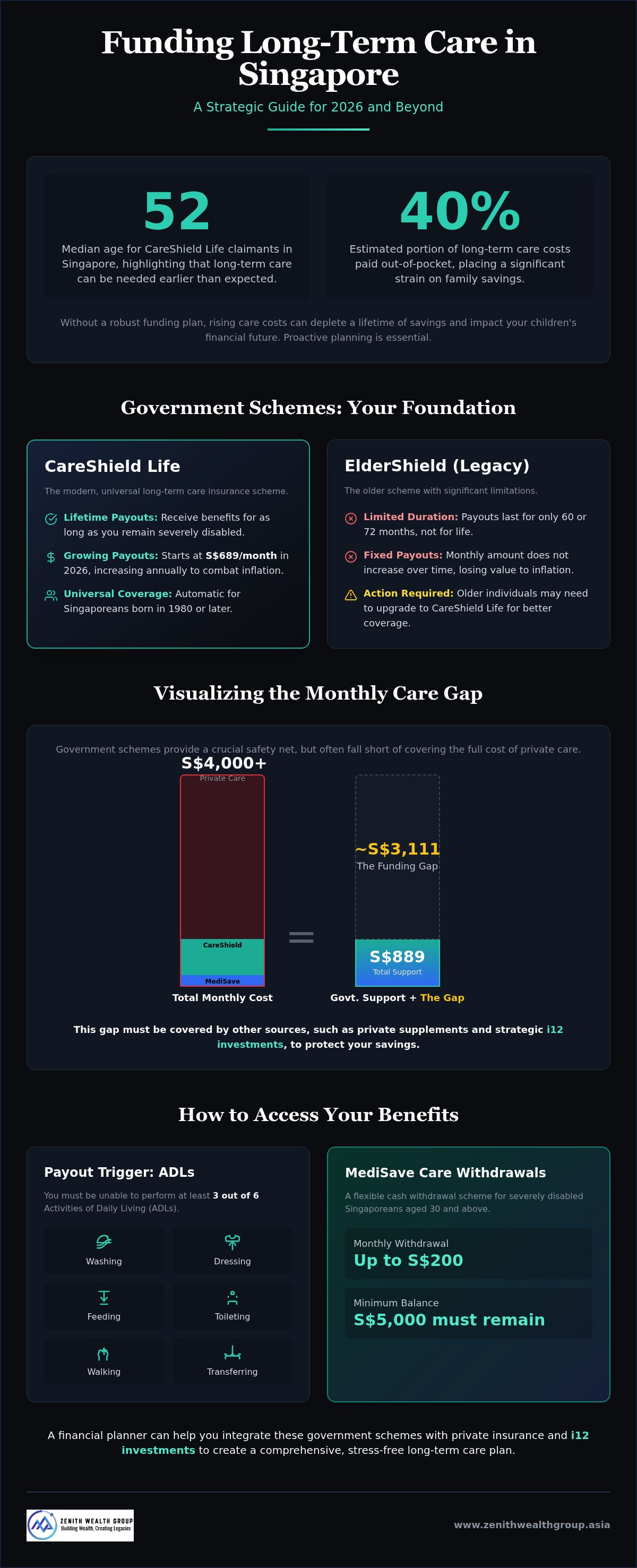
Did you know the median age for CareShield Life claimants in Singapore is just 52? It’s a sobering fact. Long-term care isn’t just a concern for the elderly. It can impact families during their prime years. You likely feel the pressure of rising nursing home costs. You might worry about becoming a financial burden to your children. Finding the right strategy for funding long term care Singapore is the first step toward peace of mind.
This guide shows you how to protect your legacy using government schemes and strategic wealth tools. Learn how to maximize CareShield Life payouts. Discover how i12 investments preserve your assets. Understand why an Advanced Medical Directive provides essential legal certainty. Partner with a financial planner to build a plan that keeps you in control. Your future deserves this level of clarity.
Key Takeaways
- Understand why traditional savings aren't enough for rising nursing home costs and how to build a robust strategy for funding long term care Singapore in 2026.
- Get clear on the latest CareShield Life payouts and MediSave withdrawal limits to ensure you're maximizing every government benefit available to you.
- Learn how an Advanced Medical Directive (AMD) acts as a vital safeguard for your estate, preventing extraordinary medical costs from draining your family's inheritance.
- Discover how to bridge the monthly care gap using a combination of private insurance supplements and the growth potential of i12 investments.
- See how a financial planner can help you align legal tools like the LPA and AMD with your wealth protection goals for total peace of mind.
The Reality of Long-Term Care Costs in Singapore (2026)
Long-term care isn't just about hospital stays or surgery. It involves the daily support needed when you can no longer perform basic tasks like bathing, dressing, or moving around. For many Singaporeans, this means nursing homes, day care centers, or hiring domestic help for home-based care. In 2026, the costs are rising significantly. While government subsidies help, out-of-pocket spending still accounts for roughly 40% of long-term care financing according to recent estimates. This puts immense pressure on the "Sandwich Generation." These are middle-aged adults supporting both aging parents and growing children simultaneously. Without a solid plan for funding long term care Singapore, your children's future savings could be at risk.
Integrating care costs into your retirement plan is now a necessity. It's no longer an optional add-on. If you don't account for these expenses, you're essentially leaving your legacy to chance. A single health crisis can deplete decades of hard-earned savings in a matter of months.
Understanding the Care Gap
Eligibility for most support schemes depends on your ability to perform Activities of Daily Living (ADLs). These include washing, dressing, feeding, toileting, walking, and transferring. If you can't perform at least three out of six, you typically qualify for full insurance payouts. Singapore's healthcare system relies on a shared responsibility model where the state, community, and individual all play a part. While public nursing homes are subsidized for those who qualify, private care costs can easily exceed S$4,000 per month in 2026. This creates a massive gap between what you receive from basic schemes and what you actually spend. Effective long-term care funding is a strategic mix of insurance and assets.
Why Self-Funding is Rarely Enough
Living longer is a blessing, but it brings longevity risk. This is the danger of outliving your money. Relying solely on your primary savings or CPF can be risky. Medical inflation often outpaces general inflation, meaning the S$100,000 you saved today won't buy the same level of care in fifteen years. If you require care for a decade or more, even a large nest egg can vanish. This is why we suggest using i12 investments to create a dedicated buffer. These investments help your wealth grow even while you're drawing down for care. It's about protecting your lifestyle and your family's inheritance. For a broader look at your financial future, see The Complete Guide to Retirement Planning in Singapore (2026 Edition). Talk to a financial planner to see how these pieces fit your specific needs.
Government Schemes: CareShield Life and MediSave
Singapore's approach to funding long term care Singapore starts with a strong government foundation. The primary pillar is CareShield Life. It's a universal, long-term care insurance scheme designed to provide lifetime cash payouts for those with severe disabilities. If you were born in 1980 or later, you're automatically enrolled. For those on the older ElderShield scheme, upgrading is a choice you should weigh carefully. ElderShield offers fixed payouts for only 60 or 72 months. CareShield Life provides payouts for as long as you remain disabled. In 2026, the monthly payout is S$689. This amount is set to grow at 4% annually until 2030 to help keep pace with inflation.
Beyond insurance, the government provides means-tested subsidies for nursing homes and home-care services. As of July 2026, the per capita household income ceiling for these subsidies is S$4,800. This increase means more families can access support. Depending on your income and residency status, you could receive subsidies covering up to 80% of your care costs. You can speak with a financial planner to see where your family falls on this scale.
CareShield Life Payouts and Limitations
To qualify for payouts, you must be unable to perform at least three of the six Activities of Daily Living (ADLs). While the S$689 monthly payout in 2026 is a helpful start, it's rarely enough on its own. Most private nursing home or intensive home-care setups cost significantly more. CareShield Life is a foundation. It isn't a complete solution for those seeking a higher standard of care or private room options. It's best used alongside other assets like i12 investments to ensure your lifestyle remains protected.
Maximizing MediSave for Care
The MediSave Care scheme allows severely disabled Singaporeans aged 30 and above to withdraw cash for their care needs. In 2026, you can withdraw up to S$200 per month, provided your MediSave balance stays above S$5,000. It's a flexible way to fund daily expenses, but you must balance this with your other medical needs. Using too much MediSave now could leave you short for future hospitalizations. Many families also use their MediSave to support aging parents. This is where strategic planning becomes vital. You need to protect your own future while caring for the previous generation. For more on this, read our guide on Wealth Protection in Singapore: The 2026 Guide to Safeguarding Your Future. A financial planner can help you map out these withdrawals without draining your primary healthcare reserves.
The Advanced Medical Directive (AMD) as a Wealth Protection Tool
An Advanced Medical Directive (AMD) is often viewed through a purely medical lens. In reality, it's a vital component of funding long term care Singapore. An AMD is a legal document that allows you to refuse extraordinary life-sustaining treatment if you're terminally ill and unconscious. Without this directive, medical providers are frequently legally required to continue interventions that may only prolong the dying process. These treatments in an intensive care setting can cost thousands of dollars every day. This creates a "financial drain" that can quickly deplete an estate you spent decades building. By making your wishes clear today, you protect both your medical autonomy and your family's future inheritance.
A financial planner views the AMD as a strategic stop-loss for your wealth. While insurance schemes like CareShield Life provide the necessary cash inflow for daily care, the AMD manages the potential outflow during terminal stages. This proactive step ensures that the assets you've grown through i12 investments remain intact for your beneficiaries. It's about ensuring your wealth serves your family rather than being consumed by futile medical debt.
AMD vs. LPA: Managing Your Health and Wealth
Understanding the difference between the AMD and the Lasting Power of Attorney (LPA) is essential for legacy security. The LPA allows you to appoint trusted individuals to manage your affairs, including your i12 investments, if you lose mental capacity. The AMD is more specific. It's a direct instruction to doctors regarding end-of-life care in the event of a terminal illness. Under the Singapore AMD Act, a terminal illness is defined as an incurable condition where death is imminent and life-sustaining treatment only postpones the end. Given that the cost of elderly care in Singapore continues to rise, having both documents ensures your financial roadmap stays on track regardless of your health status.
Preserving Your Generational Legacy
Clear documentation is the best way to reduce family conflict and legal costs. When your end-of-life wishes are legally recorded, your children don't have to make agonizing decisions during an emotional crisis. This clarity is a core pillar of funding long term care Singapore effectively. It isn't just about having the money; it's about controlling how that money is used. To see how these medical directives fit into a broader estate plan, read our guide on Legacy Planning in Singapore: The 2026 Guide to Protecting Generational Wealth. Taking these steps now provides the ultimate peace of mind for you and your loved ones.
Strategic Funding: Supplements and i12 Investments
CareShield Life is a vital safety net, but it's rarely a complete solution for funding long term care Singapore. In 2026, the gap between basic payouts and the cost of quality private care can easily exceed S$2,000 monthly. If you want a private nursing home or dedicated home nursing, you'll need a layered strategy. This involves private supplements and a robust investment portfolio. Early planning is your best defense against high premiums. Locking in a supplement plan while you're younger and healthier keeps your long-term costs manageable. It also ensures you don't face exclusions for pre-existing conditions later. Waiting until your 50s or 60s often results in significantly higher costs or even a denial of coverage.
Building a plan for your "Care Years" also requires a balance between growth and liquidity. You need assets that outpace medical inflation while remaining accessible when you need them. This prevents you from being forced to sell investments at a loss during a market downturn just to pay for care. By integrating insurance with wealth growth, you ensure your lifestyle remains protected.
While financial tools safeguard your assets, investing in your daily health can help delay the need for intensive care. To explore how tailored nutrition can support your long-term vitality, you can visit Zenutri Personalised Vitamins. Keeping your body resilient is just as important as keeping your portfolio robust.
Comparing Private CareShield Supplements
Private insurers like Singlife and Great Eastern offer supplements that increase your monthly benefit. These plans can raise your total payout to S$5,000 or more, providing a much more realistic budget for private care. When comparing options, look for features like lifetime payout durations and premium waivers that kick in as soon as you meet the claim criteria. You can use up to S$600 from your MediSave per year to pay for these supplement premiums. This reduces your out-of-pocket expenses while significantly boosting your coverage. A financial consultant can help you compare these providers to find the right fit for your budget. They'll ensure your insurance layers work together without overlapping unnecessarily.
The i12 Investment Advantage
When it comes to funding long term care Singapore, i12 investments offer a unique advantage. By structuring a portion of your wealth into these vehicles, you create a secondary passive income stream specifically for care costs. Linking your care strategy to your Supplementary Retirement Scheme (SRS) account is also a smart move for tax efficiency. It allows you to build a dedicated care fund while reducing your taxable income today. This dual benefit is a cornerstone of smart wealth protection. i12 investments provide the flexibility to adjust your funding as your medical needs or personal preferences change over time, which is something fixed insurance payouts cannot offer.
Ready to bridge the gap and secure your future? Contact our team for a strategic wealth analysis today.
Building Your Roadmap with a Financial Planner
Planning for funding long term care Singapore isn't a one-time task. It's a continuous process of alignment. Zenith Wealth helps you move from confusion to clarity by starting with a strategic wealth analysis. This identifies gaps between your projected expenses and current coverage. By 2026, with CareShield Life premiums and payouts rising annually, your previous calculations likely need an update. You need a roadmap that accounts for these shifts while protecting your lifestyle.
Follow these four steps to secure your legacy:
- Step 1: Conduct a strategic wealth analysis. Review your total assets against 2026 care cost projections. This includes checking your MediSave balances against the latest Basic Healthcare Sum.
- Step 2: Coordinate your legal tools. Ensure your AMD and LPA reflect your financial goals. Your medical directives should prevent the "inheritance drain" and provide clear instructions for your caregivers.
- Step 3: Optimize your i12 investments. These should balance your retirement lifestyle with potential care needs. These assets provide the liquidity that fixed insurance payouts often lack.
- Step 4: Schedule regular reviews. Adjust for inflation and policy changes every year. The 2026 landscape proves that government grants and subsidies are dynamic; your plan must be too.
The Role of Professional Advisory
Navigating the complexities of long-term care requires expert guidance. As authorized representatives of finexis advisory Pte Ltd, a financial planner at Zenith Wealth can help you access a wide range of solutions. They ensure your medical directives complement your CPF LIFE payouts. This holistic approach prevents your care plan from conflicting with your retirement income. You gain the peace of mind that comes from a unified legacy plan. It's about knowing every piece of your financial puzzle fits together perfectly.
Start the Conversation Today
Waiting until you're sick is the most expensive mistake you can make in Singapore. By then, your options are limited. High premiums or medical exclusions often become unavoidable. Discussing funding long term care Singapore with aging parents is also vital. It ensures their wishes are respected and their assets are protected. These conversations can be difficult, but they're necessary for family harmony. Don't leave your future to chance. Take the first step toward a secure roadmap now.
Secure your future; speak with a Zenith Wealth financial consultant today to begin your strategic wealth analysis.
Take Control of Your Care Journey Today
Securing your future in 2026 requires more than just basic savings. You've seen how CareShield Life acts as a foundation, but true peace of mind comes from a layered strategy. By coordinating medical directives with private supplements and i12 investments, you ensure that your care needs never compromise your family's inheritance. It's about maintaining autonomy while protecting the wealth you've worked so hard to build. Effective funding long term care Singapore isn't just about paying for nursing homes; it's about preserving your dignity and your legacy.
As authorized representatives of finexis advisory, Zenith Wealth specializes in legacy planning for Singaporean families. We maintain a strategic focus on i12 investments to help you navigate these complex decisions with quiet confidence. Don't wait for a crisis to define your roadmap. Start a conversation with us to see how your financial and medical tools can work together seamlessly. We're ready to help you build a future that's both secure and expectant.
Secure your legacy today; speak with a Zenith Wealth financial consultant
Frequently Asked Questions
Is CareShield Life enough to cover nursing home costs in Singapore?
No, CareShield Life provides a basic foundation rather than full coverage. With a 2026 payout of S$689 per month, it falls short of the S$4,000 or more typically required for private nursing home care. You'll need additional sources for funding long term care Singapore to avoid depleting your family's savings. Combining these payouts with private supplements and personal assets is the most reliable way to bridge this gap.
How does an Advanced Medical Directive (AMD) protect my inheritance?
An Advanced Medical Directive (AMD) protects your inheritance by preventing medical debt from extraordinary life-sustaining treatments. When you refuse these interventions in a terminal state, you stop the rapid drain on your estate. This ensures that the wealth you've built, including your i12 investments, passes to your beneficiaries rather than being consumed by intensive care costs. It's a critical tool for legacy preservation.
Can I use my MediSave to pay for my parents’ long-term care?
Yes, you can use your MediSave to support your parents' care through the MediSave Care scheme and premium payments. Severely disabled Singaporeans aged 30 and above can withdraw up to S$200 monthly for care needs. You can also use up to S$600 of your MediSave annually to pay for their private CareShield Life supplement premiums. This helps manage the family's overall costs while protecting your own cash flow.
What is the difference between CareShield Life and its private supplements?
Private supplements increase your monthly payouts and can provide easier claim criteria. While the basic scheme pays S$689 in 2026, supplements can boost this to S$5,000 or more. Some private plans also trigger payouts if you can't perform just two Activities of Daily Living (ADLs), whereas the government scheme requires three. This makes supplements a vital part of funding long term care Singapore for those seeking higher care standards.
Do I need a financial planner to set up an AMD or LPA?
While you don't legally require a financial planner to file these forms, their guidance is essential for strategic coordination. A financial planner ensures your Lasting Power of Attorney (LPA) empowers someone to manage your i12 investments effectively. They help align your legal directives with your wealth protection goals. This prevents a scenario where your medical wishes and financial assets are managed in isolation.
How do i12 investments fit into a long-term care funding plan?
i12 investments provide a flexible, growing buffer that supplements fixed insurance payouts. Unlike insurance, which pays a set amount based on disability, these investments can be adjusted based on your actual care needs and market conditions. They generate passive income that can cover the lifestyle gap in care, such as better equipment or private home nursing. For those choosing home care, this might include high-quality storage systems from Zessentials Holdings Pte. Ltd. to keep essential medical supplies organized. This creates a more resilient funding plan for your later years.
What happens to my CareShield Life payouts if I recover?
Your CareShield Life payouts will stop if your condition improves and you no longer meet the claim criteria. The scheme requires you to be unable to perform at least three Activities of Daily Living (ADLs) to receive funds. If a reassessment shows you have regained enough function to perform four or more ADLs, the monthly cash support ends. This highlights why having personal assets remains important for ongoing support.
Are long-term care insurance premiums tax-deductible in Singapore?
Long-term care insurance premiums are not directly tax-deductible for individuals in Singapore. However, using your MediSave to pay for CareShield Life and its supplements is a tax-efficient strategy. Since MediSave contributions themselves provide tax relief, using these funds for premiums helps you save on out-of-pocket costs. Speak with a financial consultant to see how to maximize these internal CPF balances for your care strategy.


