

Did you know that 67% of Americans are more worried about running out of money than they are about death? It's a heavy burden to carry, especially when you're staring at the ceiling at 3 a.m. wondering if your retirement savings will actually last. We understand that finance often feels like a maze of complex jargon and high-stakes risks. You want to protect your family and find mental clarity, but the fear of making a wrong move can feel paralyzing.
Effective financial planning to reduce anxiety is about more than just tracking 2026 tax brackets or IRA contribution limits. It's about building a system that works for you. This guide offers a clear, manageable roadmap to transform your money-related stress into long-term security. We'll explore how a professional financial planner uses tools like i12 investments to remove emotion from the investment process. You'll discover a straightforward path to protecting your legacy and finally achieving a sense of quiet confidence.
Key Takeaways
- Identify the gap between your current resources and future uncertainties to regain control over your financial narrative.
- Implement a proactive 5-step framework that prioritizes wealth protection and a thorough financial audit for immediate clarity.
- Learn how professional financial planning to reduce anxiety leverages i12 investments to automate growth and eliminate the stress of market timing.
- Understand why a financial consultant acts as a vital emotional circuit breaker, protecting your portfolio from panic-driven decisions.
- Transition from financial overwhelm to quiet confidence by establishing a structured roadmap designed for long-term family security.
The Psychology of Money: Why Financial Anxiety Persists in 2026
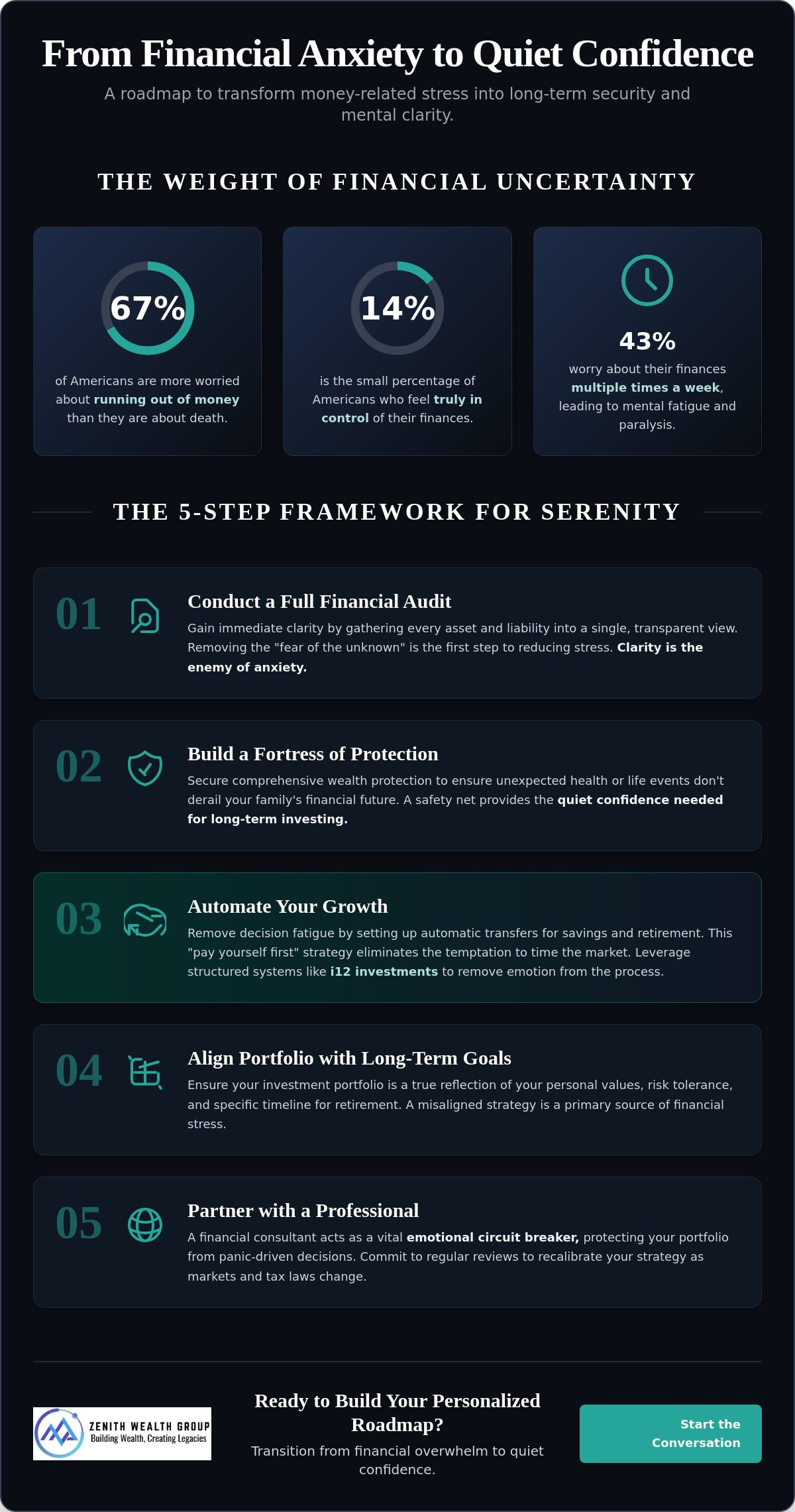
Financial anxiety isn't just a mood; it's the measurable gap between your current resources and future uncertainty. In 2026, with inflation impacting every household and market volatility remaining high, this gap feels wider than ever. Understanding The Psychology of Money helps us see that this stress is a rational response to an unmanaged financial environment. It's a heavy burden to carry, but you aren't alone in feeling it. Only 14% of Americans feel truly in control of their finances right now. That means the vast majority of people are operating in a state of high alert.
Current data shows that 43% of Americans worry about their finances multiple times a week. This constant worry creates a vicious cycle. Anxiety leads to mental fatigue, which causes poor decision-making or total paralysis. When you're overwhelmed, you're more likely to make impulsive choices or ignore long-term goals entirely. Breaking this cycle requires a shift in perspective. You need a structured roadmap that replaces guesswork with a clear plan. Validating your anxiety as a response to a lack of structure is the first step toward reclaiming your peace of mind.
While financial strategies provide a logical solution, many women find that the emotional toll of financial uncertainty requires a more personal approach. Engaging with a service like Female Focused Therapy can help you process the psychological roots of your anxiety, offering a gentle guide to starting your journey toward mental wellness alongside fiscal security.
The Cost of Inaction
Money worries don't stay in your bank account; they spill into your career productivity and your family life. When you're distracted by bills or retirement fears, you aren't fully present for the moments that matter most. Many people suffer from the "ostrich effect," where they avoid looking at bank statements because the reality feels too heavy to face. This reactive state only fuels more stress. Proactive financial planning to reduce anxiety moves you from a place of fear to a position of control. It's about facing the numbers so they stop haunting your sleep.
Identifying Your Primary Stressors
Not all financial burdens are equal. It's vital to differentiate between "good debt," like a manageable mortgage, and "anxiety-inducing debt" that carries high interest. With the median home price reaching $429,300 in May 2026, housing costs are a major trigger for many families. Another common fear is outliving your savings. In fact, 67% of Americans worry more about running out of money than they do about death. This is where a financial consultant provides immense value. By utilizing strategies like i12 investments, you can remove the guesswork from your growth strategy. Financial serenity is simply the absence of fiscal surprises. It's the confidence that comes from knowing exactly where you stand and where you're going next.
A 5-Step Financial Framework to Restore Serenity
Transitioning from a state of worry to one of action requires a structured approach. While many people focus solely on budgeting, a comprehensive 5-Step Financial Framework bridges the gap between your current stress and future stability. This process isn't about restriction; it's about empowerment. When you follow a professional roadmap, you're engaging in active financial planning to reduce anxiety by replacing chaos with order. It's time to stop reacting to every market dip and start building a foundation that lasts.
The Power of the Financial Audit
Start by gathering every asset and liability into a single, transparent view. Seeing your numbers clearly often reduces cortisol levels immediately because it removes the "fear of the unknown." Use modern tracking tools to see exactly where your cash flows without getting bogged down in unnecessary fluff. Once you see the full picture, you can stop guessing and start growing. Clarity is the enemy of anxiety. When you know exactly what you own and what you owe, the path forward becomes visible.
The second step is building a "Fortress of Protection." This involves securing comprehensive wealth protection to ensure that unexpected health or life events don't derail your family's progress. Without this safety net, even the best investment strategy remains vulnerable to external shocks. Protection provides the quiet confidence you need to invest for the long term without fear of a sudden setback.
Automating Your Way to Peace
Decision fatigue is a major source of financial stress. Set up "invisible" transfers for goals like education funding and retirement. This "paying yourself first" strategy removes the monthly debate about how much you can afford to save. It also curbs the urge to "market-time" because your contributions remain consistent and systematic. By automating these moves, you remove the emotional weight of execution. This is where systems like i12 investments shine, as they provide a structured focus that removes the anxiety of trying to "choose winners" in a volatile market.
Fourth, align your portfolio with long-term retirement planning that reflects your specific values and timeline. Finally, commit to a regular review with a professional partner. A dedicated financial consultant helps you recalibrate as tax laws and market conditions change. If you're ready to move from overwhelm to mental clarity, connect with us to start a conversation about your personalized roadmap today.
Systematising Growth: The Role of i12 investments
Growth should feel like a steady climb, not a rollercoaster. Many people feel overwhelmed by the sheer volume of choices in the market today. You might wonder if you're holding the right stocks or if you've missed the next big trend. This is where i12 investments becomes a vital part of your strategy. It's a core pillar designed to bring order to your portfolio. By using a rule-based approach, it removes the heavy lifting of "choosing winners" and replaces it with a disciplined methodology. This shift is essential for effective financial planning to reduce anxiety because it replaces guesswork with a proven system.
A structured investment focus does more than just grow wealth; it protects your mental energy. Instead of reacting to every headline, you rely on a framework that prioritizes long-term outcomes. This disciplined approach to investment management ensures your assets are working toward your goals without requiring your constant intervention. Diversification is built into the i12 investments framework, spreading risk across various sectors to buffer against regional market volatility. It's about building a portfolio that stands strong, regardless of short-term noise.
Why Structure Beats Speculation
Speculation is an anxiety engine. Chasing "hot" stocks often leads to buying high and selling low out of fear. In contrast, a managed strategy provides a sense of calm. You aren't gambling on a single outcome; you're participating in a broader growth story. i12 investments aligns perfectly with long-term wealth preservation. It keeps you focused on the horizon rather than the daily dips. Disciplined systems outperform emotional reactions every single time.
Risk Mitigation as a Wellness Strategy
Your "sleep-at-night" factor is a legitimate financial metric. If your portfolio keeps you awake, the risk is too high. A financial planner helps you adjust your risk tolerance to match your actual comfort level. i12 investments helps manage this by creating a buffer against sharp market moves. Knowing your downside is professionally managed provides immense peace of mind. It allows you to focus on your family and career while your wealth grows in the background. This proactive management is a cornerstone of a stress-reduced life.
By removing emotion from the equation, you gain more than just financial returns. You gain time. You gain clarity. Most importantly, you gain the confidence that your future is on a stable path. This isn't about complex syntax or unnecessary fluff; it's about a functional path to security. Let's start building that path together.
Why Every Plan Needs a Financial Consultant
When markets dip, your brain's fight-or-flight response often takes over. This biological reaction is why many investors sell at the bottom and buy at the peak. A financial consultant acts as your Modern Professional Guide and emotional circuit breaker. They provide a steady hand when headlines turn red. This professional oversight is a core component of financial planning to reduce anxiety. It ensures that your long-term goals aren't derailed by short-term fear or impulsive reactions.
Delegating the complex execution of your strategy allows you to reclaim your time. You have a career to build and a family to love. You shouldn't spend your weekends stressed over rebalancing spreadsheets or complex tax filings. A dedicated financial planner handles the technical details, ensuring your i12 investments strategy remains on track. They also provide an objective third party for sensitive topics like legacy planning. This objectivity prevents family tension and ensures your wishes are documented with precision.
Professional Titles Matter
The difference between a salesperson and a financial consultant is significant. A salesperson wants to close a deal; a financial planner wants to build a roadmap. You need someone who prioritizes your destination over a specific product. This relationship provides an essential accountability factor. It's much easier to stick to a plan when you have a partner checking in on your progress. They ensure you don't just start the journey, but actually arrive at your goal.
Simplifying the Complex
Financial jargon often fuels the very stress we're trying to avoid. Terms like CPF, SRS, and tax efficiency can feel like a foreign language. A consultant translates these into simple, actionable steps. For example, they can show you how to leverage SRS accounts for tax-induced calm. This professional intermediation removes the "paperwork anxiety" that stops many people from optimizing their wealth. It's about making the system work for you, rather than you working for the system.
If you're tired of second-guessing your every move, it's time to bring in a guide. We're ready to help you simplify your path and secure your peace of mind. Start a conversation with our team today to see how a professional partner can change your outlook.
The transition from constant worry to quiet confidence is a powerful shift. It changes how you show up at work and how you interact with your family. Throughout this guide, we've explored how a professional roadmap can replace the chaos of unmanaged finances. Effective financial planning to reduce anxiety is the bridge between your current resources and the peace of mind you deserve. By leveraging systems like i12 investments, we remove the emotional burden of decision-making. This allows you to focus on living your life while your wealth works in the background. You deserve a plan that feels like a partner, not a chore.
Your First Meeting: What to Expect
Our firm operates with a friendly, open-door policy. When you walk through our doors or join a digital call, your goals come first. We don't believe in the heavy, jargon-laden atmosphere of traditional professional services. Instead, we prioritize human interaction and immediate connection. This first meeting is about you. We'll discuss your aspirations, your fears, and your vision for the future. We don't just look at numbers on a screen; we look at the person behind them. It's a low-pressure environment where you can ask questions and get clear, direct answers. You don't need to be a finance expert to talk to us. We're here to be your Modern Professional Guide, not a distant corporate entity. We value straightforward communication because transparency is paramount in building trust.
Take the First Step Today
They say the best time to start was yesterday, but the second best time is right now. Every day you wait is another day spent carrying the weight of financial uncertainty. Small, proactive steps today lead to a massive reduction in anxiety tomorrow. By starting your journey now, you're choosing to protect your family and secure your legacy. Our team is ready to engage and grow alongside you. We combine professional integrity with a welcoming accessibility that makes the entire process feel manageable. We don't over-promise. We simply provide the clarity you need to move forward with confidence. Your personalized wealth roadmap is waiting to be built. Let's start that conversation today and turn your financial stress into a sense of quiet security.
Ready to find your financial serenity? Connect with a Zenith financial consultant today.
Secure Your Peace of Mind for 2026 and Beyond
You've seen how a structured approach can turn sleepless nights into a clear roadmap. By identifying your stressors and implementing a rule-based framework, you reclaim control over your future. This shift is the heart of effective financial planning to reduce anxiety. It's about moving away from market noise and toward a system that values your mental clarity as much as your portfolio growth. Stop reacting to headlines. Start trusting your strategy.
As authorised representatives of finexis advisory Pte Ltd, we pride ourselves on being a boutique, localized firm. We value personal connection over institutional distance. Our team specializes in i12 investments frameworks to ensure your growth is disciplined and emotion-free. You don't have to navigate the complexities of 2026 alone. We're ready to act as your professional guide, simplifying every step so you can focus on your family and career.
Start your journey to financial serenity; Contact our consultants today. Your future is waiting. We look forward to helping you build it with quiet confidence.
Frequently Asked Questions
Can financial planning really help with my anxiety?
Yes, a structured roadmap directly reduces stress by replacing the unknown with a clear plan. Financial planning to reduce anxiety works by identifying your current assets and mapping them to future goals. This process lowers cortisol levels as you move from a reactive state to a proactive one. When you have a professional system in place, you stop worrying about "what if" and start focusing on "what's next." It's about gaining control.
Is it too late to start financial planning if I'm already in my 40s?
It's never too late to begin, and your 40s are a critical time for wealth acceleration. At this stage, you likely have higher earning potential and a clearer picture of your retirement needs. Starting now allows you to optimize your SRS accounts and leverage frameworks like i12 investments to maximize your remaining time. Every proactive step you take today improves your financial security and mental clarity for the decades ahead. Don't look back; look forward.
What is the difference between a financial consultant and a financial planner?
Both titles refer to professionals who prioritize your long-term roadmap over individual product sales. A financial planner typically focuses on the comprehensive structure of your wealth, including retirement and estate planning. A financial consultant often guides you through the strategic execution and management of those plans. Both serve as your Modern Professional Guide. They ensure your strategy remains aligned with your personal values and family needs without the coldness of institutional firms.
How much does it cost to work with a financial consultant at Zenith?
Fees are based on the complexity of your needs and the specific services required to build your roadmap. We believe in transparency and will discuss all costs openly during our initial conversation. Whether you need comprehensive retirement planning or specific investment management, we ensure our value aligns with your goals. Our focus is on building a long-term partnership where your peace of mind is the primary return. We prioritize honest, straightforward communication about all professional fees.
Will financial planning require me to give up all my current lifestyle comforts?
Planning is about alignment, not deprivation. A good plan ensures your spending matches your values while still securing your future. We look for ways to optimize your current resources, such as improving tax efficiency or automating savings, so you can enjoy your life today—perhaps by treating your family to a curated stay through TOM BENZON. You don't have to choose between a morning coffee and a secure retirement. It's about creating a balance that feels sustainable. You gain serenity by knowing your lifestyle is protected.
How does i12 investments help reduce my investment risk?
i12 investments reduces risk by using a disciplined, rule-based approach that removes human emotion from the equation. This framework focuses on systematic growth rather than speculative stock picking. By diversifying across sectors and adhering to strict criteria, it buffers your portfolio against sudden market volatility. This methodology provides the quiet confidence you need to stay invested for the long term. You'll know your downside is professionally managed by a proven, modern system that values stability.
What should I bring to my first meeting with a financial planner?
Bring an open mind and a clear list of your future goals. While having your basic income and expense figures is helpful, our first conversation focuses more on your aspirations than just your balance sheet. We prioritize human interaction and understanding your unique situation. If you have existing insurance policies or investment statements, bring those along. We'll handle the heavy lifting of organizing the technical details. We want to start a conversation about your future.
How often should I review my financial plan to keep my anxiety low?
We recommend a formal review at least once a year to ensure your strategy stays on track. You should also connect with your financial consultant after major life changes like a new job or a home purchase. Regular check-ins prevent small issues from becoming major stressors. This consistent oversight is a vital part of financial planning to reduce anxiety. It keeps your roadmap relevant as the world changes. Staying proactive ensures that you are never caught off guard.


