

What if your irregular monthly income wasn't a barrier to wealth, but actually your greatest tax-saving tool? Many self-employed professionals feel the constant stress of fluctuating bank balances and the headache of deciphering Thai tax sections like 40(2) versus 40(8). Navigating financial planning for freelancers in Thailand often feels like a solo mission without the safety net of a corporate retirement scheme. You deserve a strategy that respects your independence while securing your future.
This guide shows you how to turn these complexities into a structured wealth engine. We'll help you master the 2026 tax landscape, from the 50% standard deduction to the updated foreign income rules. You'll discover how a professional financial planner can integrate i12 investments into a diversified portfolio tailored for the gig economy. We're providing a concrete retirement roadmap and a clear tax strategy to ensure your hard work builds lasting security. Let's start building your wealth plan together.
Key Takeaways
- Optimize your tax liability by mastering the critical differences between Section 40(2) and Section 40(6) to maximize your legal deductions.
- Stabilize irregular cash flow using the "Freelancer Sinking Fund" strategy and modern multi-currency banking tools designed for 2026.
- Accelerate your wealth building by integrating i12 investments into a diversified, long-term portfolio that works for your unique career path.
- Create a portable retirement roadmap that ensures your financial security and legacy planning remain intact as a self-employed professional.
- Discover how expert financial planning for freelancers in Thailand provides a clear path from simple tax compliance to proactive wealth management.
The 2026 Freelance Landscape in Thailand: Risks and Opportunities
The 2026 freelancer in Thailand isn't just a traveler with a laptop. They're business owners. The shift from temporary nomadism to long-term residency is real. Professionals are staying longer. They're building lives and setting down roots. This evolution requires a deeper understanding of Thailand's economic landscape. With the digital economy expanding rapidly, the rewards for the self-employed are huge. However, the risks are equally high if you don't have a plan. Effective financial planning for freelancers in Thailand is the bridge between a flexible lifestyle and a secure future.
Southeast Asia is becoming a global hub for remote talent. Thailand sits at the center of this growth. This attracts more competition but also more capital. A professional financial consultant is your partner in this transition. They provide the clarity needed to thrive in a competitive market. You're no longer just "getting by" in a foreign country. You're building a sustainable financial legacy.
Visa Evolution and Financial Compliance
Your visa is more than a stamp. It's a financial framework. The Long-Term Resident (LTR) visa has transformed how professionals stay. It offers tax benefits but requires strict financial compliance. The 2026 Digital Nomad visa categories also have specific income thresholds. Your visa status dictates your investment strategy. A financial consultant helps you navigate these rules. They ensure your assets are positioned correctly for your specific residency path. Don't let a visa technicality derail your long-term wealth. Understanding these requirements is the first step toward true financial freedom.
The Problem with "DIY" Financial Management
Managing international income streams solo is a gamble. Many freelancers fall into the trap of survival budgeting. They focus on the next invoice rather than the next decade. Chasing high yields is tempting. But ignoring wealth protection is a mistake. Transitioning to strategic wealth analysis is essential. This includes understanding how specialized options like i12 investments integrate into your portfolio. A financial planner helps you move beyond basic spreadsheets. They look at the big picture. They help you protect what you've built while finding new ways to grow. It's time to stop guessing and start building with confidence. We're ready to help you take that next step. You can connect with our team to discuss a roadmap that fits your lifestyle.
Navigating Thai Tax Sections and Optimizing Deductions
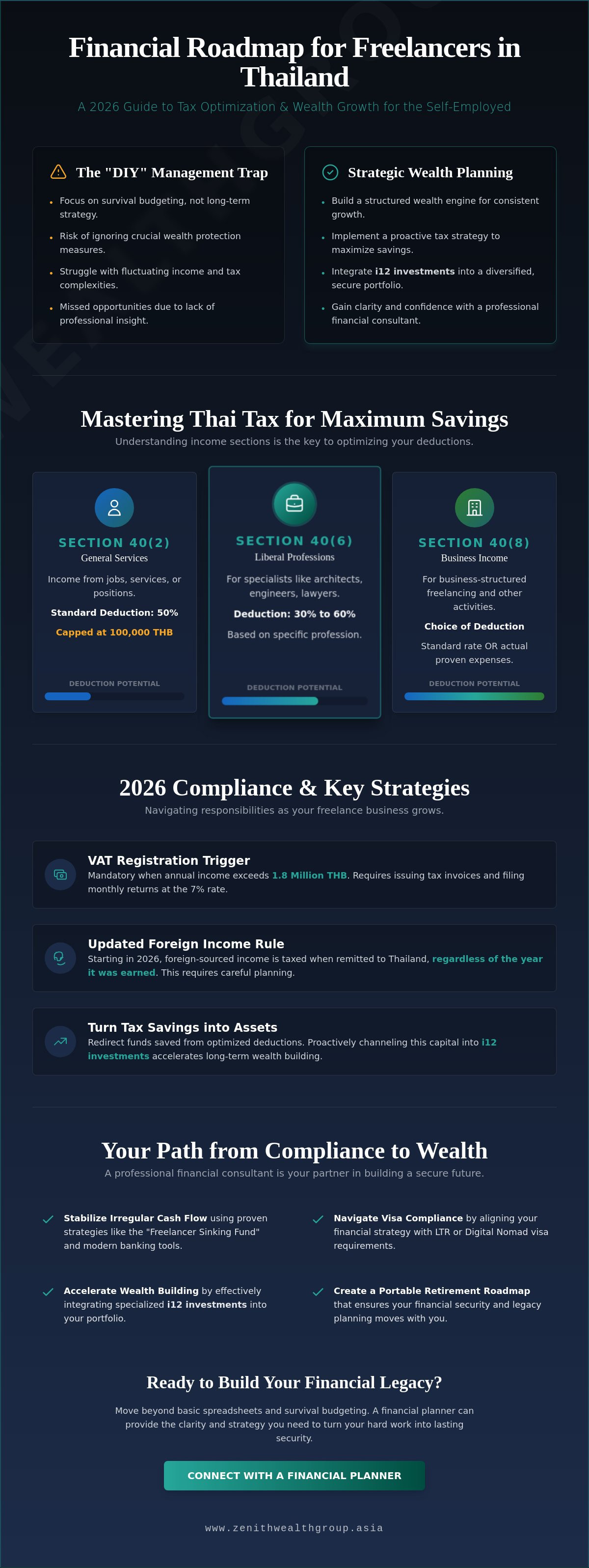
Tax compliance shouldn't be a source of dread. It's actually a vital part of financial planning for freelancers in Thailand. How you categorize your income determines how much of your hard-earned money you actually keep. Most general service providers fall under Section 40(2). This section allows a standard deduction of 50%, but it's capped at 100,000 THB. If you're a high-earning professional, this cap can feel quite restrictive. You need to know if your work qualifies for more favorable tax categories.
Specialists like architects, lawyers, or engineers often fall under Section 40(6). This category offers higher deduction percentages, ranging from 30% to 60% depending on the specific profession. For those with significant overheads or those running a business-like operation, Section 40(8) is often the most efficient path. It covers business-structured freelancing and any activity not specified in other sections. You can choose between standard deductions or actual proven expenses. This flexibility is key to lowering your taxable base and freeing up capital for long-term growth.
Maximizing Deductions in 2026
Choosing between standard and actual expense deductions is a strategic decision. If your business costs exceed the standard 100,000 THB cap, keeping meticulous records is essential. A financial planner can help you identify which path yields the most savings. Those saved funds shouldn't sit idle. Redirecting tax savings into i12 investments can accelerate your wealth building. It turns a mandatory expense into a future asset. This proactive approach ensures your tax strategy supports your investment goals rather than hindering them.
VAT and Social Security for Freelancers
Success brings new responsibilities. Once your annual income hits 1.8 million THB, VAT registration is mandatory. The current 7% rate applies until at least September 30, 2026. You must issue tax invoices and file monthly returns. This adds a layer of complexity, especially when dealing with international clients. In 2026, reporting requirements for foreign income are stricter. You're now taxed on foreign-sourced income when it's remitted to Thailand, regardless of the year it was earned.
You should also consider your social security options. While Section 40 offers basic health benefits and a small pension, it rarely suffices for comprehensive wealth protection. Balancing these government schemes with private investment strategies ensures you're covered from every angle. If you're unsure where you stand with these evolving rules, reach out to a financial consultant to review your current tax structure. They'll help you stay compliant while maximizing your take-home pay.
Cash Flow Management and the i12 Investments Framework
Managing irregular income is the biggest hurdle in financial planning for freelancers in Thailand. You don't have a steady paycheck. Instead, you have project cycles. The "Freelancer Sinking Fund" strategy solves this dilemma. It's a separate account where you park a set percentage of every invoice you receive. This fund covers your lean months and upcoming tax bills. It ensures you never have to dip into your long-term investments just to pay for your daily life. It's about creating your own version of corporate stability while maintaining your professional freedom.
In 2026, relying on a single-currency bank account is a significant risk. You need a multi-currency infrastructure to handle international clients effectively. This allows you to hold USD, SGD, or EUR when the Thai Baht fluctuates. It keeps your purchasing power stable and reduces unnecessary conversion fees. This isn't just for convenience; it's a defensive financial move that protects your margins. Balancing this immediate liquidity with your long-term growth goals is what separates a successful freelancer from one who is just getting by.
Building the "Engine": i12 Investments for Freelancers
i12 investments offer a structured way to handle market swings. They focus on rules-based strategies that remove emotion from the investment process. This is vital when your monthly income is already unpredictable. You need your assets to grow steadily without the need for constant micro-management. A financial planner can help match your investment risk to your specific professional niche. A tech freelancer might have different liquidity needs than a creative consultant. Managing global assets from a Thai base requires deep expertise in cross-border regulations. We ensure your portfolio remains diversified and compliant. It's about building a wealth engine that runs efficiently while you focus on your craft.
Emergency Funds in a Post-Inflation World
The old advice of keeping a three-month emergency fund is outdated. In a post-inflation world, self-employed professionals need a larger cushion. Aim for six to nine months of expenses. But don't just let that capital sit in a low-interest savings account where it loses value. Use investment management strategies to keep your cash ahead of rising costs. Hedged savings are also critical. Protecting your funds against currency fluctuations prevents sudden market drops from eroding your safety net. If you're ready to stabilize your cash flow and protect your future, let's talk about your strategy. We can help you build a plan that protects your lifestyle today and your wealth tomorrow.
Retirement and Legacy Planning: The Freelancer’s Long Game
Freelancing offers unmatched freedom, but it demands a high level of personal accountability. You don't have a corporate HR department managing your pension or matching your retirement contributions. This reality means you must start retirement planning much earlier than your employed peers. Every month you delay is a missed opportunity for compounding growth. In the 2026 landscape, financial planning for freelancers in Thailand is about more than just surviving the next tax season. It's about ensuring your future self is well-funded and secure.
Portable wealth is the ultimate goal for the location-independent professional. If you decide to move your base of operations to another country, your retirement fund should follow you without friction or heavy penalties. By utilizing frameworks like i12 investments, you create a growth engine that isn't tied to a single employer or a specific local scheme. This flexibility is vital. You need a strategy that adapts as your life and career evolve. A financial planner helps you build this foundation, ensuring your assets remain accessible and productive regardless of where you call home.
Creating a Portable Retirement Roadmap
Your "Freedom Number" is the cornerstone of a successful roadmap. This is the specific amount you need to stop working while maintaining your desired lifestyle in Thailand or abroad. A financial planner helps you calculate this by accounting for Thai living costs and global inflation trends. We compare private annuities against flexible investment portfolios to see what fits your risk profile. Remember, your legacy planning starts with today's cash flow. Every dollar you invest now is a building block for your eventual independence.
Estate Planning for the Location-Independent
Legacy planning is often ignored by freelancers until it's too late. If you hold assets in Thailand, such as local bank accounts or property, a Thai-specific will is non-negotiable. Without one, your estate could be tied up in local probate for years. This becomes even more complex when international estate laws overlap with Thai residency rules. You need to protect both your physical assets and your digital ones, including client lists and intellectual property. A financial planner coordinates with legal experts to ensure your cross-border wealth is secure. Don't leave your family to deal with jurisdictional red tape. You can schedule a legacy review with us today to ensure your assets are fully protected according to 2026 standards.
Partnering with a Financial Consultant in 2026
A tax preparer tells you what you owed last year. A financial consultant tells you how to build wealth for the next decade. While filing returns is necessary, it's only one small piece of financial planning for freelancers in Thailand. You need a partner who understands that your income isn't just a number on a form; it's the fuel for your future independence. A comprehensive roadmap goes beyond compliance. It integrates your tax strategy with your long-term investment goals and lifestyle aspirations. This ensures every baht you earn is working toward a specific, measurable outcome.
At Zenith Wealth, we specialize in the unique needs of regional professionals. We don't offer generic advice or institutional coldness. Instead, we look at your entire financial ecosystem. This includes how your Thai-based activities interact with global markets and specialized frameworks like i12 investments. Our goal is to move you from a state of reactive budgeting to proactive wealth management. We're here to start a conversation that grows alongside your career, providing the steady guidance you need in an ever-changing digital economy.
Why Specialized Advice Matters
The financial corridor between Singapore and Thailand is increasingly complex. Many freelancers move capital between these jurisdictions, triggering specific reporting and tax requirements that can be difficult to manage alone. Having oversight ensures your wealth protection strategy is robust enough to handle these cross-border shifts. We provide periodic "Strategic Wealth Analysis" reviews to keep your plan on track. These aren't just check-ins; they're deep dives into your portfolio's performance and risk exposure. It's about staying ahead of market changes rather than just reacting to them. You gain a level of security that "DIY" methods simply cannot provide.
Take Control of Your Financial Future
Moving from reading to execution is the most important step you'll take. It's the difference between having an idea and having a future. Ask yourself these questions to see if you're ready for a professional plan:
- Do you have a clear strategy for managing 2026's stricter foreign income rules?
- Is your investment portfolio diversified across multiple currencies and asset classes?
- Does your current plan include a portable retirement roadmap that moves with you?
- Are your Thai and international assets protected by a coordinated estate plan?
If you answered "no" to any of these, it's time to formalize your strategy. A financial planner can help you fill these gaps with precision and clarity. Financial planning for freelancers in Thailand doesn't have to be overwhelming. With the right guide, it becomes a clear path to the life you've worked so hard to build. We're ready to help you initiate this change and secure your legacy. Connect with a financial planner at Zenith Wealth today to begin your tailored wealth journey.
Take the Next Step Toward Wealth Security
Your professional journey in Thailand is unique. You've navigated the shift toward long-term residency and explored the power of optimizing your tax deductions. Now, it's time to solidify that progress. Integrating i12 investments and securing your legacy ensures your hard work today builds a lasting foundation for tomorrow. Effective financial planning for freelancers in Thailand transforms uncertainty into a clear, actionable roadmap.
At Zenith Wealth, we don't just provide advice; we build partnerships. As authorized representatives of finexis advisory, we're specialists in regional wealth management and experts in cross-border retirement and legacy planning. We're here to help you navigate the complexities of international assets with confidence. Your future deserves the attention of a dedicated financial planner who understands your specific lifestyle.
Secure your freelance future with a tailored financial plan from Zenith Wealth. We're ready to help you turn your success into long-term wealth.
Frequently Asked Questions
Do I need to pay tax in Thailand if my freelance clients are all overseas?
Yes, you generally do if you're a Thai tax resident. You're considered a resident if you spend 180 days or more in Thailand during a calendar year. Under the 2026 rules, any foreign-sourced income you bring into the country is taxable, regardless of when you earned it. Staying compliant requires careful tracking of your remittances to avoid unexpected penalties from the Revenue Department.
Can freelancers in Thailand open a business bank account in 2026?
You can, but it usually requires a registered business entity like a limited company. Most individual freelancers use personal accounts with multi-currency features to manage international payments from overseas clients. If you've registered as a sole proprietorship, some banks may allow a business-related account. Using a financial consultant can help you determine which banking structure best supports your specific cash flow needs.
What is the best retirement plan for an expat freelancer in Thailand?
A combination of local tax-advantaged funds and portable international portfolios is often best. You can utilize Retirement Mutual Funds (RMFs) to reduce your Thai tax liability by up to 500,000 THB annually. However, since you may not stay in Thailand forever, you also need wealth that moves with you. This dual approach is a cornerstone of effective financial planning for freelancers in Thailand.
How does i12 investments benefit a self-employed person with irregular income?
These investments use a structured, rule-based approach to manage market volatility without requiring your constant input. Because your income isn't fixed, you need a strategy that can handle both surplus months and leaner periods. This framework helps you stay disciplined and ensures your capital continues to grow steadily. It's about building a wealth engine that operates independently of your daily workload.
Is it better to file taxes as an individual or a company as a freelancer?
The choice depends on your total annual income and your business expenses. Filing as an individual is often simpler for those earning below the 1.8 million THB VAT threshold. However, once your revenue grows, incorporating as a company can offer significant tax savings through more flexible expense deductions. For entrepreneurs considering international options, business setup in Dubai can provide additional tax advantages and global networking opportunities. A financial planner can help you run the numbers to find the most cost-effective path for your situation.
What happens to my Thai investments if I move to another country?
Your assets remain yours, but you must consider the tax implications of your new residency. Some local tax-saving funds have specific holding periods that you must respect to keep your tax benefits. We prioritize building portable portfolios that remain accessible regardless of your location. This ensures that your financial planning for freelancers in Thailand provides long-term value even if your journey takes you elsewhere.
How much does a financial consultant cost for a freelancer?
Costs typically depend on the specific services you need and the complexity of your financial situation. Some planners work on a flat-fee basis for a specific roadmap, while others use a percentage of assets under management. We recommend starting with an introductory conversation to discuss your goals. This allows us to provide a transparent view of how we can help you grow before you commit to a full plan.
Can I use the SRS account if I am freelancing in Thailand but am a Singaporean PR?
You can maintain your Supplementary Retirement Scheme (SRS) account, but you won't receive tax deductions without Singapore-sourced income. If you aren't paying taxes in Singapore, new contributions won't lower your tax bill there. However, your existing funds can stay invested and continue to grow tax-free within the account. It remains a valuable component of a regional wealth strategy for those with ties to both countries.


