

What if the law decided who inherits your home, regardless of what's written in your will? In Indonesia, the Civil Code often dictates inheritance through forced heirship. This can create unintended friction in a modern household. You want to ensure your biological children receive their fair share while also providing a comfortable life for your current spouse. It's a delicate balance. Finding the right path for estate planning for blended families in Indonesia means navigating complex local regulations and avoiding potential disputes between different family branches.
We understand the pressure of getting this right. You'll learn how to build a legally robust plan that prevents litigation and secures financial stability for everyone you care about. We'll look at how a financial planner can help you use i12 investments and smart offshore structures to manage assets in Singapore and beyond. This guide previews the strategic steps needed for a tax-efficient transfer of wealth. It's about honoring your personal wishes over rigid legal defaults and ensuring your legacy remains exactly as you intended.
Key Takeaways
- Understand why standard Indonesian wills often fail and how to avoid the "remarriage trap" that can lead to the accidental disinheritance of biological children.
- Discover how to integrate offshore trusts in Singapore with local structures to master estate planning for blended families in Indonesia while protecting global assets.
- Learn how to utilize life insurance as a strategic liquidity tool to provide for your spouse without compromising the inheritance of your biological heirs.
- Explore the benefits of including i12 investments in your wealth protection strategy to ensure a tax-efficient and seamless transfer of wealth across family branches.
- Identify the five essential steps to inventory your estate and define clear legacy goals with the guidance of a professional financial planner.
The Challenge of Estate Planning for Blended Families in Indonesia
Managing a household with children from different marriages is a rewarding yet complex journey. In Indonesia, this dynamic often clashes with traditional social norms and rigid legal structures. Most people assume a simple will covers their needs. It doesn't. Standard documents often fail to protect stepchildren or secure a surviving spouse's long-term residency. As we move through 2026, shifting economic trends in Southeast Asia mean your assets are likely more diverse than ever. This makes legacy planning an immediate priority. You're not just managing money; you're balancing deep emotional commitments to every branch of your family tree. Effective estate planning for blended families in Indonesia requires a strategy that looks beyond the surface of basic inheritance.
Indonesian Inheritance Law: KUHPer vs. Sharia
Indonesia uses a pluralistic legal system. If you're non-Muslim, the Civil Code (KUHPer) applies. For Muslims, Sharia law dictates the distribution. Both systems prioritize biological lineage above all else. The most significant hurdle is the Legitime Portie. This is a forced heirship rule. It mandates that a specific portion of your estate must go to your "legal heirs," usually biological children and parents. You can't simply "will away" these portions to a new spouse or stepchildren. This legal floor often limits your freedom to distribute wealth as you see fit. It creates a rigid framework that can feel restrictive when you want to provide for a partner who isn't the biological parent of your children.
The Risk of Intestacy in Blended Families
What happens if you die without a plan? The state decides. Under Indonesian law, if you die intestate, your estate is divided among your surviving spouse and biological children in equal shares. Stepchildren are typically excluded entirely. This "default" division rarely aligns with the human reality of a modern family. It can leave a second spouse with insufficient funds or biological children feeling sidelined by a new partner's presence. Understanding estate planning fundamentals is the first step toward avoiding these conflicts. Without a clear path, legal battles between different family branches become almost inevitable.
A skilled financial planner can help you look beyond these rigid defaults. By incorporating tools like i12 investments, you can create a more flexible strategy that respects local laws while achieving your personal goals. You don't have to let the law dictate your family's future. It's about being proactive. If you're ready to start this conversation and protect your legacy, feel free to reach out to us today. We're here to help you navigate estate planning for blended families in Indonesia with confidence and clarity.
Common Pitfalls: Why Blended Family Plans Fail
Good intentions aren't enough to secure a legacy. Most estate planning for blended families in Indonesia fails because it relies on trust rather than legal structure. You might leave everything to your current spouse. You assume they'll provide for your biological children from a previous marriage. But life is unpredictable. If that spouse faces financial trouble or remarries, your children's inheritance could vanish instantly. This "accidental disinheritance" is a frequent reality in Indonesian courts.
Property ownership presents another hurdle. Many couples hold assets in joint names without considering the long-term impact. In Indonesia, the surviving owner often gains significant control over the property. They may not share your vision for the family's future. Additionally, ignoring age gaps among heirs is a major mistake. A young child needs long-term education funding. An adult child might need immediate capital. A rigid, one-size-fits-all will doesn't account for these varied timelines. Integrating i12 investments into your strategy can provide the necessary growth and liquidity to meet these diverse financial needs over several decades.
The Remarriage Trap and Bloodline Protection
What happens if your surviving spouse finds a new partner? Without a proactive plan, your assets could eventually support a completely different family. This is the remarriage trap. You need legal mechanisms to ring-fence your estate. Bloodline protection is a strategy to keep wealth within your direct descendants. By using specific trust structures or tiered inheritance clauses, you ensure that your assets stay with your biological children. It's about creating a safety net that survives even if your spouse's marital status changes later in life.
Communication Gaps and Family Litigation
Silence is the biggest threat to your estate. If your heirs are surprised by your decisions after you're gone, they're likely to sue. Legal battles in Indonesia are notoriously slow and expensive. They drain your estate's value and destroy family bonds. Consider the baseline costs. A property transfer deed in Bali already costs between IDR 8 million and IDR 12 million in 2026. Litigation adds layers of complexity and massive legal fees to these standard costs.
Holding a "Family Talk" is essential. It sets clear expectations and allows you to explain your logic. Transparency reduces the urge for stepchildren or surviving spouses to challenge a will. If you're feeling overwhelmed by these dynamics, a financial planner can help facilitate these sensitive conversations. We're here to help you build a plan that's both legally sound and emotionally intelligent.
Strategic Frameworks: Beyond the Basic Will
A basic will is often just the beginning. For many, it's not enough to handle the friction of multiple family branches. Effective estate planning for blended families in Indonesia requires a more dynamic framework. You need tools that provide both protection and growth. A skilled financial planner can help you integrate these elements into a cohesive strategy. This ensures your legacy isn't just a static pot of money, but a growing resource for your heirs. It's about moving from simple distribution to active wealth management.
Life insurance serves as a vital "liquidity creator" in this context. Imagine your estate is heavily tied up in Indonesian real estate. Forced heirship rules might require a payout to biological children that your surviving spouse can't afford without selling the family home. Life insurance provides the cash needed to satisfy those legal requirements immediately. It keeps the peace. It protects your spouse's residency while honoring your children's inheritance. This liquidity also covers essential costs like the BPHTB property transfer duty, which can reach 5% of the property value in 2026.
Offshore Advantages: The Singapore-Indonesia Connection
Singapore remains a premier hub for wealth protection in the region. Singapore-based structures offer a level of flexibility that local Indonesian options often lack. You can establish trusts that clearly define how and when assets are distributed. This is particularly useful for managing age gaps between children from different marriages. These structures operate under strict MAS regulations, providing a layer of security and transparency for your global assets. For a deeper look at these regional tools, see our guide on Legacy Planning in Singapore. It's about building a bridge between your Indonesian life and global financial security.
Growth Strategies with i12 investments
A successful estate plan must grow faster than it is divided. This is where i12 investments become essential. These investments provide the underlying growth engine for your multi-generational plan. You need to balance the immediate income needs of a surviving spouse with the long-term capital growth expected by your biological children. By focusing on i12 investments, your financial planner can structure a portfolio that targets these dual goals while maintaining high levels of tax efficiency.
Your legacy should be active. It shouldn't just sit there. By using i12 investments, you ensure the "pie" gets bigger over time. This reduces the risk of conflict between heirs. If there's enough growth, everyone can feel secure in their portion. It transforms your estate from a source of potential dispute into a lasting foundation for your family's future. We're ready to help you explore how these tools fit your specific family dynamic.
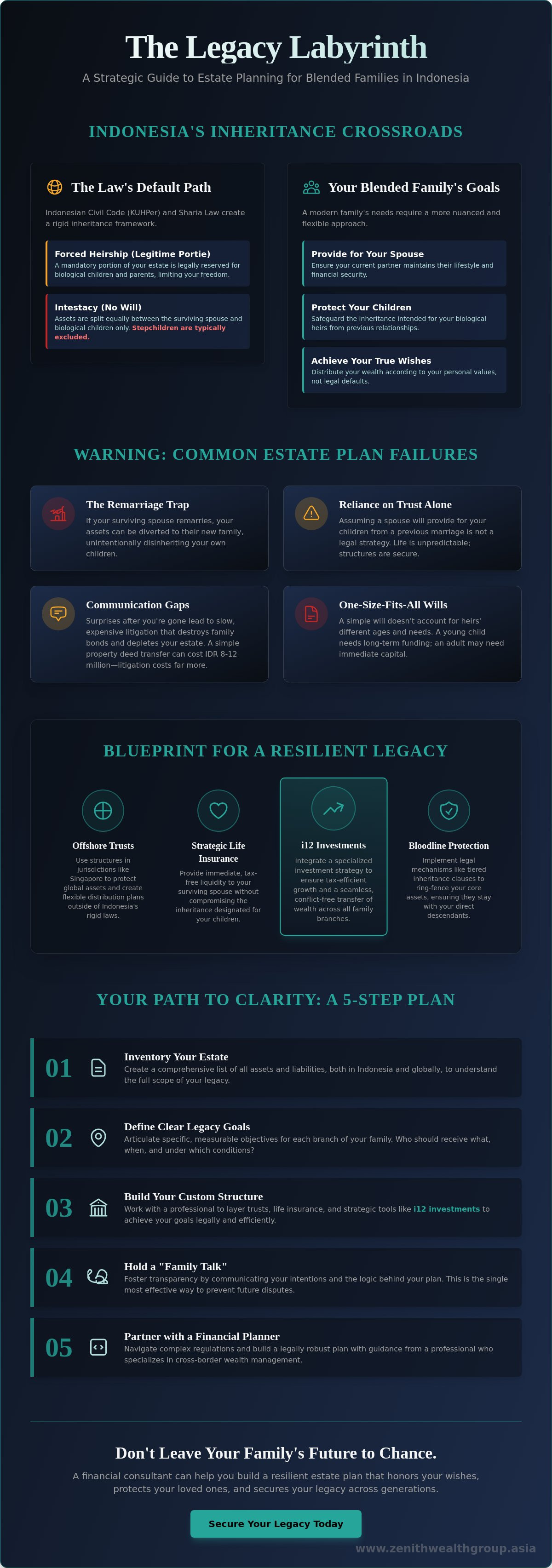
5 Essential Steps for Blended Family Estate Planning
Building a legacy is a deliberate process. It requires more than just picking the right financial products. For estate planning for blended families in Indonesia, you need a clear, repeatable roadmap. This ensures that no asset is overlooked and no heir is forgotten. Following these five steps will help you move from a state of uncertainty to total legal and financial clarity. It's about taking control of your family's future before the law does it for you.
Step 1: The Cross-Border Asset Inventory
Accurate estate planning for blended families in Indonesia begins with a thorough inventory. You can't protect what you haven't counted. Start by listing every asset you own across all jurisdictions. In Indonesia, you must distinguish between movable property, like bank accounts or vehicles, and immovable property, such as land or villas. Remember that inheriting property in Indonesia involves a BPHTB duty of up to 5% in 2026. You also need to account for your Singaporean holdings. This includes your CPF, SRS accounts, and private Strategic Investment Management portfolios. A complete list prevents the "lost asset" syndrome that often plagues cross-border estates.
Step 2: Define Your Legacy Goals. Be specific about what you want for each person. Does your spouse need a lifetime right to live in the family home? Should your biological children receive their inheritance in stages to protect against the "remarriage trap"? Defining these goals early prevents friction later. It allows you to build a plan based on human needs rather than just tax codes.
Step 3: Finding the Right Financial Consultant
Legacy planning is too complex for generalists. You need a financial planner who understands the nuances of Southeast Asian regulations. Look for a professional who is an authorised representative of finexis advisory. They have the expertise to bridge the gap between Indonesian local laws and Singaporean financial tools. This specialized knowledge ensures your i12 investments are structured for maximum tax efficiency and growth. Standard advice often misses the forced heirship traps unique to the region. You need a partner who knows how to navigate both KUHPer and Mas regulations simultaneously.
Step 4: Coordinate Your Documents. Your Indonesian will and your offshore trust must work together. If they contradict each other, you're inviting a lawsuit. Coordinate these documents so they form a single, cohesive shield around your wealth. This ensures that your wishes in Singapore don't accidentally trigger a legal challenge in an Indonesian court.
Step 5: Schedule an Annual Review. Life changes fast. New marriages, births, or changes in tax residency can render an old plan obsolete. Schedule a review every year. It's a small time investment that protects your family's future. If you haven't reviewed your plan in the last twelve months, it's time to schedule a consultation with our team to ensure your legacy remains secure and your family is fully protected.
How Zenith Wealth Secures Your Blended Family Legacy
Protecting a multi-generational legacy requires more than just technical precision. It takes a partner who understands the emotional landscape of your household. At Zenith Wealth, we focus on estate planning for blended families in Indonesia by creating a bridge between your local needs and international financial security. We know that every family branch has its own story. Our role is to ensure those stories continue without legal conflict. We don't believe in generic solutions. We build strategies that honor your specific intentions while keeping your wealth safe from rigid legal defaults.
We act as your Modern Professional Guide through the complexities of cross-border wealth. By integrating the i12 investments framework, we help you maintain the growth necessary to support a surviving spouse and biological heirs simultaneously. We manage the intricate details of your global portfolio so you don't have to. Our approach ensures that your assets are positioned for maximum efficiency and long-term stability. You get a plan that's both legally robust and financially sound.
The Zenith Approach to Human-Centric Advisory
We value personal connection over institutional coldness. Traditional financial services often feel distant and cluttered with jargon. We choose a different path. Our team prioritizes welcoming accessibility and clear communication. We simplify the complex syntax of wealth protection. We want you to feel empowered by your strategy, not confused by it. This is an invitation to a conversation about your family’s future. We listen to your concerns and provide clear, action-oriented advice that fits your life in 2026.
Your peace of mind is built on a foundation of professional integrity. As an authorized representative of finexis advisory, Zenith Wealth operates with a commitment to safety and transparency. We combine this institutional strength with a boutique, localized focus. This allows us to offer specialized expertise in the SE Asia market while remaining attentive to your personal goals. We're here to grow alongside you and your family.
Ready to Protect Your Loved Ones?
Don't leave your family's harmony to chance. The risks of disinheritance and legal battles are real, but they are also preventable. Taking action now ensures that your biological children are protected and your spouse is secure. A tailored financial roadmap is the first step toward true legacy protection. Our financial planners are ready to help you navigate these sensitive dynamics with expertise and care. Contact our financial consultants today to start securing the future your family deserves.
Build a Legacy That Lasts Across Every Branch
Your family deserves a plan that accounts for its unique complexity. We've explored how forced heirship can disrupt your intentions and why cross-border structures are essential for wealth protection. By choosing proactive estate planning for blended families in Indonesia, you can bridge the gap between local legal requirements and your personal legacy goals. Our expertise in the i12 investments framework ensures your wealth continues to grow while remaining accessible to those who need it most. It's about creating a foundation that supports your spouse and your biological children equally.
As an authorized representative of finexis advisory, our financial planners specialize in cross-border SE Asia legacy planning. We move beyond standard templates to provide human-centric advisory that puts your family first. Don't let the legal defaults of the state decide your children's future. It's time to gain total clarity and peace of mind for everyone you love. Secure your family’s future with a tailored consultation today. We're ready to help you navigate this journey with confidence and care.
Frequently Asked Questions
Does Indonesian law allow me to leave everything to my spouse?
No, you generally cannot leave your entire estate solely to your spouse if you have biological children. The Indonesian Civil Code (KUHPer) enforces "Legitime Portie," which is a mandatory portion for legal heirs. This forced heirship rule ensures that biological children receive a specific percentage of your assets. Attempting to bypass this through a simple will often leads to successful legal challenges in court.
Can I use a Singapore trust for my assets located in Indonesia?
You cannot directly hold Indonesian real estate, such as Hak Milik titles, within a Singapore trust. However, you can use these trusts to manage movable assets or the proceeds from property sales. This creates a flexible layer of protection. It allows you to distribute wealth to your blended family without the rigid constraints of local forced heirship laws for those specific funds.
How does i12 investments fit into my estate plan?
i12 investments act as the growth engine for your legacy. In a blended family, you often need to provide for a surviving spouse's immediate needs while preserving capital for biological children. These investments target the growth required to satisfy both parties. By using this framework, your financial planner ensures the total estate value keeps pace with your family's long-term financial requirements.
What is the difference between a financial consultant and a lawyer for estate planning?
A lawyer focuses on the legal drafting of wills and navigating Indonesian court procedures or notary requirements. A financial consultant builds the overarching strategy. We coordinate your global assets, manage tax efficiency, and select the right investment tools. We ensure your plan is financially sustainable. Both professionals are necessary to build a truly robust path for estate planning for blended families in Indonesia.
How often should I update my estate plan in a blended family?
Update your plan at least once a year or whenever a significant life event occurs. This includes births, marriages, or changes in your tax residency status. Laws also change. For example, the new VAT rate of 12% in 2025 and updated Criminal Code regulations in 2026 can impact your strategy. Regular reviews with your financial planner keep your legacy secure and compliant.
Are stepchildren entitled to inheritance under Indonesian Civil Code?
Stepchildren have no automatic inheritance rights under the Indonesian Civil Code. The law only recognizes biological children and legally adopted children as mandatory heirs. If you wish to provide for stepchildren, you must proactively use a will or an offshore trust. Without these specific legal instructions, they will likely be excluded from the asset distribution entirely by the state.
How can life insurance help avoid conflicts between my spouse and children?
Life insurance acts as a "liquidity creator" to satisfy mandatory heirship claims. If your wealth is tied up in Indonesian property, your children may be entitled to a share your spouse cannot afford to pay out. Life insurance provides the necessary cash to pay the children their portion. This prevents the need to sell the family home and reduces friction between family branches.
What happens to my Singapore assets if I am an expat living in Indonesia?
Your Singapore assets are governed by Singapore law, but you must still account for them in your global estate strategy. Being an expat in Indonesia means you face dual-jurisdiction complexities. A Singapore trust can help shield these assets from Indonesian forced heirship rules. This gives you more freedom to decide exactly how that wealth is shared among your spouse and children.


