

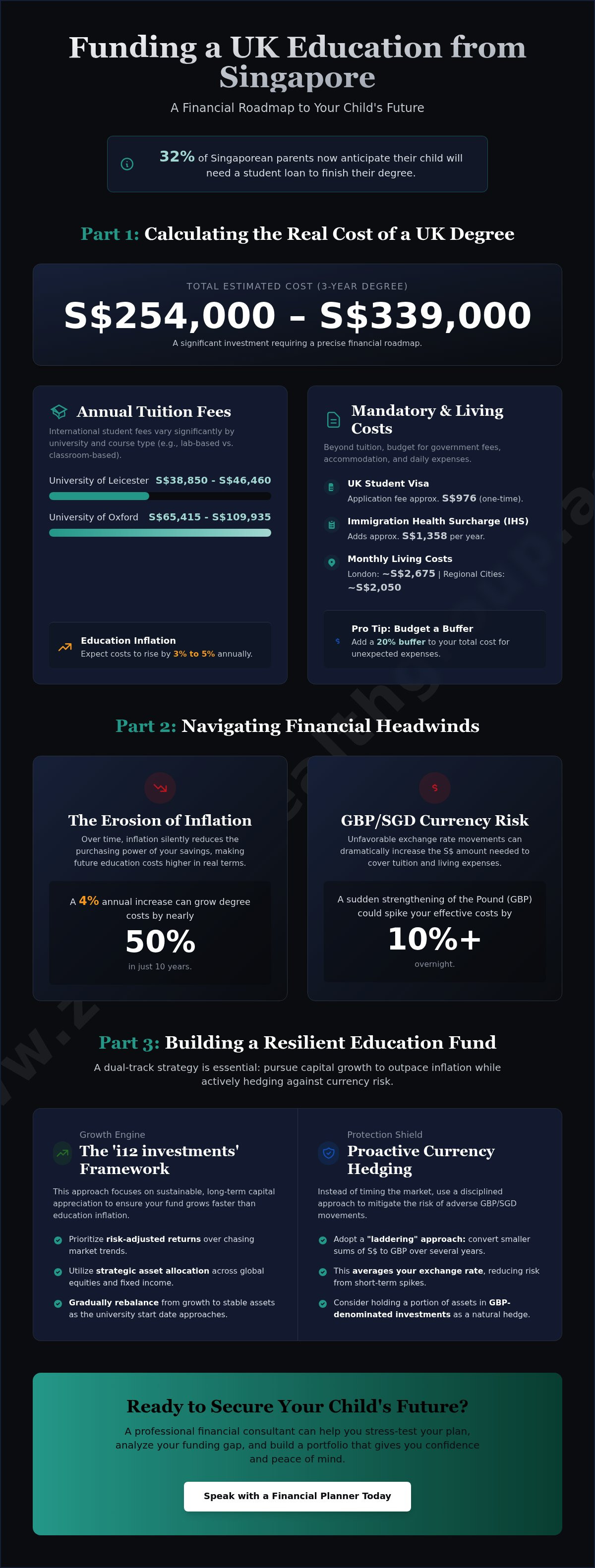
Did you know that 32% of Singaporean parents now anticipate their child will need a student loan to finish their degree? With the total cost of a UK education reaching up to S$339,000 per child, finding the best way to save for child's university education UK from Singapore is more critical than ever. You've likely watched the GBP/SGD exchange rate fluctuate and felt the pressure of inflation eroding your hard-earned savings. It's a common worry, but you don't have to face it alone.
This article outlines how to fund a UK degree while managing currency risks and rising costs. You'll learn to set a clear S$ savings target and build a strategy that outpaces inflation. We'll also preview how "i12 investments" can play a role in your diversified portfolio. Our goal is to ensure you can talk to a financial planner with confidence, knowing your child's education is fully funded. Let's start building that path to peace of mind together.
Key Takeaways
- Master the true cost of a UK degree in 2026, including tuition, visa fees, and the mandatory NHS surcharge.
- Explore the best way to save for child's university education UK from Singapore using a dual-track strategy for growth and currency protection.
- Discover how the "i12 investments" framework helps manage GBP/SGD volatility to maintain your future purchasing power.
- Evaluate whether an education endowment or a managed portfolio offers the right balance of security and growth for your family.
- Use our 5-step roadmap to calculate your funding gap and stress-test your plan with a professional financial consultant.
Calculating the Real Cost of UK Higher Education in 2026
Sending your child to the UK is a major milestone, but the price tag is significant. Total costs for a three-year degree now frequently land between S$254,000 and S$339,000. Planning early is the best way to save for child's university education UK from Singapore, especially as tuition and living expenses continue to climb. You aren't just paying for a degree; you're funding a global future that requires a precise financial roadmap.
Tuition Fees: The International Student Premium
International fees for the 2026/27 academic year show a wide range based on the institution's prestige and the course type. At the University of Leicester, full-time international students pay between S$38,850 and S$46,460 annually. If your child eyes the University of Oxford, expect tuition to range from S$65,415 to S$109,935 per year. Lab-based courses like medicine or engineering sit at the higher end of these scales, while classroom-based humanities are generally more affordable. Some universities offer 'fixed-fee' guarantees. These plans lock in your tuition rate for the duration of the degree, protecting you from the annual 3% to 5% education inflation. While universities often rely on a financial endowment to maintain their facilities, parents must build their own private funding pool to manage these rising premiums.
The Hidden Costs: Maintenance and Travel
Tuition is only part of the story. You must also account for mandatory government fees and daily survival. The UK student visa application currently costs approximately S$976, while the mandatory Immigration Health Surcharge (IHS) adds another S$1,358 per year. Living expenses vary wildly by location. London is the most expensive, with visa requirements suggesting at least S$2,675 per month for living costs. Regional cities like Manchester, Edinburgh, or Bristol are slightly more accessible, requiring roughly S$2,050 monthly. Don't forget to budget for at least two return flights to Singapore annually and a 16-25 Railcard for discounted local travel. The Total Cost of Attendance should include a 20% buffer to account for unexpected inflation and emergency travel needs.
The impact of inflation is a silent threat to your savings. If you're looking ten years ahead, a 4% annual increase means the cost of that degree could grow by nearly 50% before your child even sets foot on campus. Managing this requires more than just a standard savings account. Integrating strategies like "i12 investments" can help your capital grow at a rate that actually competes with UK education inflation. A dedicated financial planner can help you run these numbers to see if your current trajectory meets the 2026 reality. Start your gap analysis now to ensure your child has the best way to save for child's university education UK from Singapore without compromising your own financial security.
Managing Currency Risk and the 'i12 investments' Strategy
Saving for a UK degree requires more than just a disciplined savings habit. You must actively manage the relationship between the Singapore Dollar (S$) and the British Pound (GBP). Currency volatility can quietly dismantle even the most robust education fund. If the Pound strengthens significantly against the S$ just as your child starts university, your effective costs could spike by 10% or more overnight. Relying solely on a standard cash savings account in Singapore often fails to beat the 3% to 5% education inflation mentioned previously. To stay ahead, you need a strategy that prioritizes both growth and purchasing power protection.
The best way to save for child's university education UK from Singapore involves a dual-track approach. This means seeking capital growth while simultaneously hedging against currency swings. Strategic asset allocation is your primary tool here. By balancing global equities for long-term appreciation with fixed-income assets for stability, you create a portfolio that can weather market cycles. This isn't about chasing the latest trend; it's about building a reliable engine for your child's future.
The i12 investments Approach to Education Funding
Within our framework, "i12 investments" focuses on achieving sustainable, long-term capital appreciation. We prioritize risk-adjusted returns because "chasing winners" is a dangerous game when you have a fixed deadline. Your child's university start date won't wait for a market recovery. As that date nears, professional oversight becomes vital. A financial planner can help you rebalance your "i12 investments" portfolio, gradually shifting from aggressive growth to more stable, liquid assets. This ensures the funds are there when the first tuition bill arrives.
Hedging Against the Great British Pound
Timing the currency market is notoriously difficult, so we favor a "laddering" approach. Instead of converting a massive lump sum of S$ to GBP at the last minute, you convert smaller amounts over several years. This averages your exchange rate and reduces the risk of trading during a period of extreme GBP strength. You might consider using multi-currency accounts or holding a portion of your portfolio in GBP-denominated investment assets. This natural hedge means that if the Pound rises, the value of your education fund rises along with it. If you're unsure how to start this process, you can speak with a financial planner to map out a conversion schedule that fits your timeline.
A professional financial consultant provides a layer of expertise that a standard bank teller cannot match. They help you stress-test your plan against various currency and market scenarios. By integrating "i12 investments" with a proactive currency strategy, you ensure that your S$ savings translate into the required GBP precisely when it matters most. This proactive stance is the hallmark of a modern education funding plan.
Comparing Education Savings Vehicles: Endowments vs. Managed Portfolios
Choosing where to store your capital is just as vital as the amount you set aside each month. In Singapore, parents typically weigh the structured safety of insurance-linked products against the higher growth potential of the open market. Finding the best way to save for child's university education UK from Singapore often means deciding which vehicle can best outpace the 4% education inflation we identified earlier. Your choice will dictate not just your final balance, but also how much flexibility you have if your child's plans change.
Tax efficiency is a significant advantage for Singapore residents. Since Singapore doesn't tax capital gains, your investment growth remains largely untouched while it's inside your portfolio. However, you must consider how these funds are remitted to the UK. A hybrid approach often works best. This involves using a core layer of "i12 investments" for aggressive growth, supplemented by more stable assets as the matriculation date approaches. This strategy ensures you aren't forced to sell equities during a market downturn just because a tuition bill is due.
Endowment Plans: Forced Savings with a Safety Net
Endowment plans are popular because they provide a "forced savings" element with a mix of guaranteed and non-guaranteed returns. Most policies require a 10-year to 15-year commitment, which aligns well with a child's growth. You should pay close attention to the "effect of deduction" in the policy illustration. This figure shows how much the plan's expenses and commissions reduce your total yield. While these plans offer a safety net, their lower returns might not fully cover the rising costs of an Oxford or Cambridge degree. You can explore more plan types in our Education Funding in 2026 guide.
Investment Portfolios: The Power of Compound Growth
Many parents now prefer direct investment portfolios using ETFs or unit trusts. A financial consultant might recommend this path for its superior liquidity and transparency. If your child decides to study locally at NUS or NTU instead of heading to London, you can easily pivot your funds without facing the heavy surrender penalties common in insurance plans. Within a managed portfolio, "i12 investments" can target the capital appreciation needed to meet high-tier UK tuition goals.
The primary risk with managed portfolios is the 'Sequence of Returns'. If the market dips in the final three years before university, it can significantly impact your total fund. To mitigate this, a financial planner will typically shift your allocations toward fixed-income stability as your child enters their teenage years. This proactive management protects your gains while keeping your education goal on track. Balancing these vehicles correctly is the best way to save for child's university education UK from Singapore while maintaining your family's financial agility.
A 5-Step Roadmap to Funding a UK Degree from Singapore
Transforming a high-level goal into a funded reality requires a structured process. You've already seen the potential costs and the impact of currency risk. Now, it's time to assemble these pieces into a functional plan. Following a clear roadmap is the best way to save for child's university education UK from Singapore while maintaining your current lifestyle. Here is how you can build that foundation step by step.
- Step 1: Define the target. Decide if you're aiming for an Oxbridge tier or a regional university. Course type matters too; a lab-based engineering degree will require more capital than a humanities track.
- Step 2: Conduct a gap analysis. Look at your current savings and projected growth. A financial planner can help you determine exactly how much more you need to set aside to meet the S$339,000 upper-limit target.
- Step 3: Select your vehicle. This is the best way to save for child's university education UK from Singapore. Mix "i12 investments" for growth with stable endowments or SRS contributions for tax efficiency.
- Step 4: Automate and escalate. Set up automatic transfers to your education fund. As your career progresses and your salary grows, increase these contributions to outpace education inflation.
- Step 5: Execute the Glide Path. Three to five years before your child leaves, start de-risking. Shift capital from volatile equities into liquid, stable assets to ensure the money is ready for the first semester.
If you're ready to move from theory to action, you can start your personalized gap analysis with our team today.
Setting Realistic Milestones
Success is easier to track when you have clear checkpoints. By the time your child is 6, aim to have 25% of the projected costs secured. By age 12, target 50%. If you have multiple children, your strategy must account for overlapping tuition years. This might require a more aggressive growth phase early on. To keep these funds safe from life's uncertainties, read more about Wealth Protection in Singapore to ensure your education fund remains untouched.
The Role of the Supplementary Retirement Scheme (SRS)
Many parents wonder if they can use their SRS account for education. While primarily for retirement, the tax savings you gain now can free up cash flow for other "i12 investments." Foreigners and locals alike can benefit from the immediate tax relief, but you must be mindful of withdrawal rules and potential penalties. A financial consultant can compare SRS returns against dedicated education funds to see which fits your specific tax bracket. You can learn more about these nuances by Mastering the SRS Account in our strategic guide.
Partnering with a Financial Consultant for Long-Term Success
A roadmap is a great start, but consistent execution is where the real work begins. Partnering with a dedicated financial planner ensures your strategy remains resilient against life's unpredictable turns. This collaboration is arguably the best way to save for child's university education UK from Singapore because it looks beyond simple math. We focus on the human side of your financial goals, ensuring your strategy adapts as your family's needs evolve.
A bank teller often sees a transaction, but a financial consultant sees your family's future. We don't just provide accounts; we manage outcomes. This includes stress-testing your education plan against potential market crashes. If a downturn occurs in the year your child applies to a UK university, do you have a contingency? We help you build one. By integrating "i12 investments" with robust wealth protection, Zenith Wealth aims to keep your child's seat at a UK university secure regardless of market volatility.
Legacy planning is another critical pillar of our approach. We ensure the fund completes even if the breadwinner cannot. This is a vital step many DIY investors overlook. At Zenith Wealth, we tailor UK-specific funding strategies that account for your specific tax bracket and residency status in Singapore. We don't believe in one-size-fits-all solutions for such a personal milestone, especially when dealing with international tuition premiums.
Beyond the Numbers: Emotional and Strategic Support
The journey to the UK involves more than just tuition payments. You'll face UCAS application timelines and strict financial deadlines for the new digital e-visa system. We provide an objective 'second opinion' on popular investment trends that might distract you from your long-term goal. Our focus remains on Investment Management that prioritizes your child's specific university timeline and your family's risk tolerance.
Get Started Today
Time is your most valuable asset. The cost of delay is real and measurable. Research indicates that waiting just two years to start can increase your monthly savings requirement by 15% to reach the same target. Don't let inertia dictate your child's academic future. The best way to save for child's university education UK from Singapore is to start with a clear, professional assessment of your current standing.
Ready to secure that future? Contact our team to build your child's education roadmap. Book a discovery session with a Zenith Wealth financial consultant to see how we can tailor a plan for your family's unique needs.
Secure Their Academic Future Today
Navigating the path to a UK university from Singapore requires more than just good intentions. It demands a strategy that accounts for rising international tuition and the ever-shifting GBP exchange rate. You've seen how the right mix of endowments and managed portfolios can create a resilient fund. Implementing these steps now is the best way to save for child's university education UK from Singapore while protecting your own long-term wealth.
Zenith Wealth offers the professional guidance you need to move forward with confidence. As authorised representatives of finexis advisory, our team delivers specialised funding roadmaps and deep expertise in i12 investments strategies. We're ready to help you stress-test your plan and bridge the gap between your current savings and your child's future dreams. Secure your child's future; speak with a financial planner at Zenith Wealth. Let's start this conversation today and build a legacy that lasts.
Frequently Asked Questions
Is it better to save in GBP or SGD for a UK university education?
Maintaining a diversified approach is usually the most effective strategy. Saving in SGD allows you to benefit from Singapore's investment environment, but you should start converting to GBP via a laddering strategy as the university start date nears. This protects your purchasing power against sudden Pound strength. A financial planner can help you time these conversions based on market conditions and your specific funding timeline.
Can I use my CPF Ordinary Account (OA) to pay for a UK degree?
No, you cannot use your CPF Ordinary Account funds to pay for overseas tuition. The CPF Education Loan Scheme is strictly limited to full-time subsidised undergraduate courses at approved local institutions like NUS, NTU, or SMU. For a UK degree, you must rely on private savings, "i12 investments" portfolios, or other cash-based funding strategies. This makes early planning for international costs even more critical for Singaporean families.
How much does a 3-year degree in the UK cost for international students in 2026?
A three-year degree typically costs between S$254,000 and S$339,000 for international students in 2026. This estimate includes tuition fees, which range from S$38,850 to over S$100,000 annually at top-tier universities, alongside living expenses and mandatory visa surcharges. Because these costs are substantial, finding the best way to save for child's university education UK from Singapore is essential to ensure your family's financial stability isn't compromised by rising inflation.
Should I buy a property in the UK for my child to live in while studying?
Buying a UK property can serve as a hedge against rising rental costs, but it requires careful consideration of Stamp Duty and management fees. For many parents, the capital required for a down payment might be better utilised in a diversified "i12 investments" strategy. A property is a significant commitment that lacks the liquidity of managed portfolios. Consult a financial planner to see if property fits your total wealth protection plan.
What happens to the education fund if my child gets a scholarship?
If your child secures a scholarship, your education fund becomes a flexible asset for their future. You might repurpose the capital for postgraduate studies, a first home down payment, or even your own retirement planning. Because managed portfolios offer high liquidity, you aren't trapped by the original intent of the fund. This flexibility is a key reason why many see managed investments as the best way to save for child's university education UK from Singapore.
Are there any tax benefits for saving for education in Singapore?
Singapore does not offer a specific tax relief category for education savings. However, you can gain indirect benefits by using the Supplementary Retirement Scheme (SRS) to reduce your taxable income. The tax savings from SRS can then be redirected into your child's education fund. This strategic move allows you to grow your wealth more efficiently while meeting multiple long-term financial milestones simultaneously without increasing your out-of-pocket expenses.
How do I protect the education fund if something happens to me?
Protecting the fund requires a robust legacy planning strategy. By incorporating wealth protection tools like term insurance or payor premium waivers into your plan, you ensure that contributions continue even if the breadwinner can no longer provide. This safety net guarantees that your child's seat at a UK university remains funded regardless of life's uncertainties. It's a vital component that converts a simple savings plan into a complete, secure financial roadmap.
What is the 'i12 investments' philosophy for education funding?
The "i12 investments" philosophy focuses on achieving sustainable, long-term capital appreciation through strategic asset allocation. We prioritize risk-adjusted returns to ensure your capital grows at a rate that outpaces UK education inflation. This approach avoids the dangers of short-term market speculation. Instead, it builds a reliable engine for wealth growth that aligns perfectly with the fixed timelines of a child's academic journey and your family's specific risk tolerance.


