

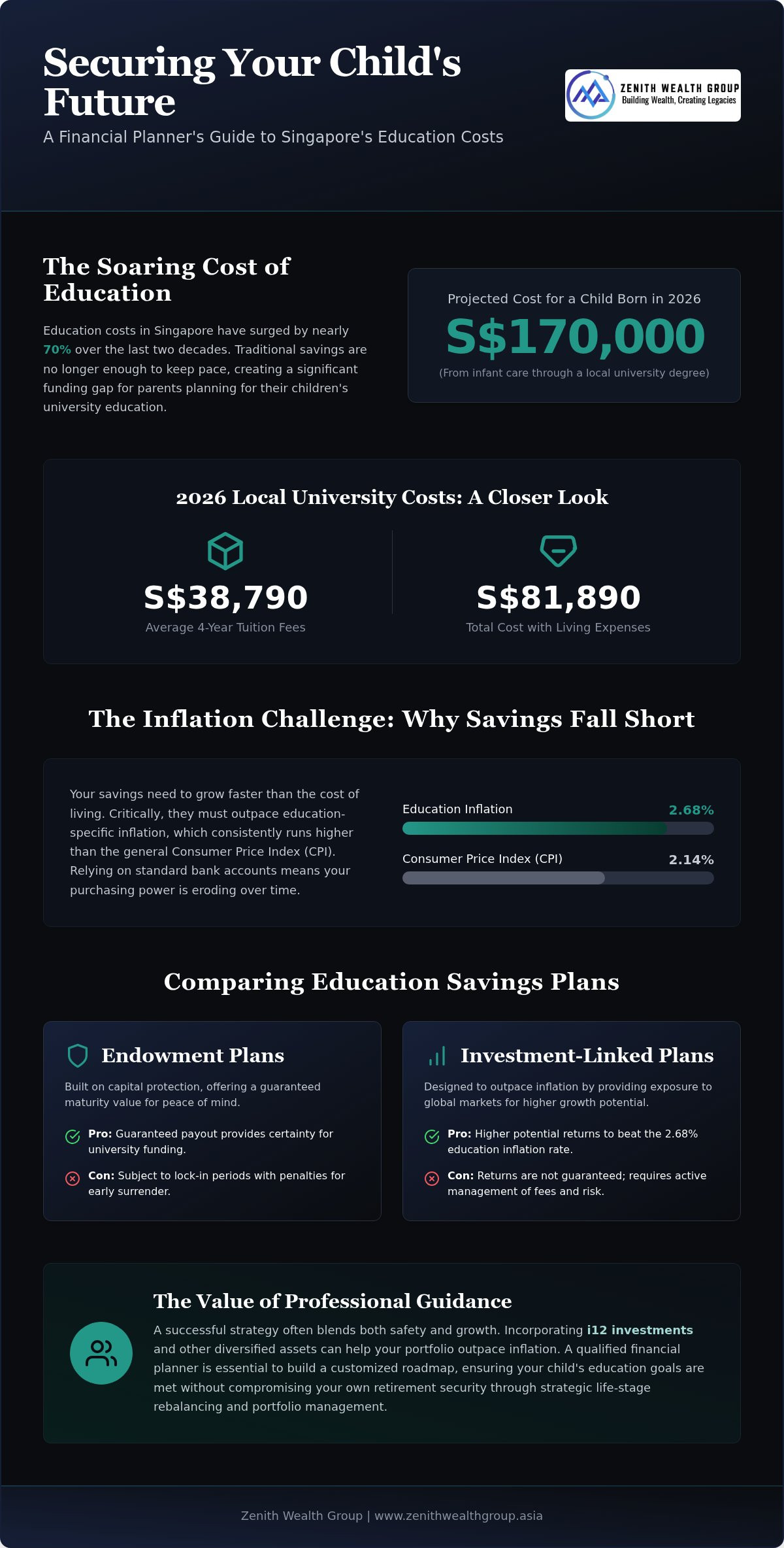
Did you know that education costs in Singapore surged by nearly 70 percent over the last two decades? For a child born in 2026, the journey from infant care to a local university degree is projected to cost around S$170,000. It is a daunting figure that makes traditional bank accounts feel insufficient. You likely worry that inflation is quietly eroding your hard-earned savings while you try to balance future school fees with your own retirement security.
This guide helps you identify the best education savings plan Singapore has to offer in this high-cost environment. We'll show you how to secure your child's university path without sacrificing your financial peace of mind. You will discover how a professional financial planner can help you build a robust strategy that actually outpaces rising tuition. Our goal is to move you from uncertainty to a position of quiet confidence.
We provide a clear target for 2026 university costs and compare structured endowment plans against growth-oriented i12 investments. You'll learn how to build a diversified portfolio that balances safety with the returns needed for long-term success. Let's start building a roadmap that protects your family and your future.
Key Takeaways
- Identify realistic savings targets by reviewing projected 2026 tuition fees for local universities like NUS, NTU, and SMU.
- Compare the pros and cons of guaranteed endowment plans versus flexible policies to choose the best education savings plan Singapore has for your child’s needs.
- Explore how incorporating i12 investments into your portfolio can help your savings outpace high education inflation rates.
- Learn how to audit your current cash flow and CPF balances to create a structured, step-by-step roadmap for university funding.
- Understand the value of working with a financial planner to build a customized strategy that balances education goals with your long-term legacy planning.
The Rising Cost of Degree Programs in Singapore for 2026
Tuition fees at NUS, NTU, and SMU are no longer just a minor line item in a family budget. For a Singapore citizen entering university in 2026, a four-year degree averages S$38,790 in tuition alone. When you add living expenses and textbooks, that figure climbs to approximately S$81,890. This reality is a central part of Singapore's education system, which remains world-class but increasingly expensive for parents to navigate.
Why do these costs keep climbing? Education inflation in Singapore has averaged 2.68 percent annually over the last two decades. This consistently outpaces the standard Consumer Price Index (CPI) of 2.14 percent. It means the price of a degree grows faster than your daily expenses. Selecting the best education savings plan Singapore offers involves more than just picking a product; it requires a strategy that specifically addresses this persistent inflation.
Local vs. Overseas: Calculating the 2026 Funding Gap
Local degrees are subsidized, but the gap between different fields of study is wide. A four-year medicine degree costs significantly more than an arts or social sciences program. If your child dreams of studying in Australia, the UK, or the US, the financial hurdle jumps even higher. A UK undergraduate program can cost up to S$180,000 in tuition alone, while a US degree can reach S$350,000 including all costs. You must also account for currency fluctuations. A shift in the exchange rate can instantly add thousands to your bill. Don't forget "hidden" costs like high-end technology, student housing, and rising airfare prices.
Why 'Safe' Savings Accounts May Fall Short
Standard bank accounts rarely keep pace with 2.68 percent education inflation. Over an 18-year horizon, the purchasing power of your cash erodes if it stays in a low-interest environment. If your money earns less than the inflation rate, you are effectively losing wealth every year. The Education Funding Gap is the specific shortfall between your current savings trajectory and the actual future cost of university tuition and living expenses.
Many parents feel forced to choose between their child's dreams and their own retirement security. This is a dangerous trade-off that can be avoided with proactive planning. Instead of relying on cash alone, modern strategies often incorporate i12 investments to capture higher growth potential. A qualified financial planner can help you balance these competing priorities. They ensure you build a fund that is robust enough for university without compromising your own financial freedom in the future.
Comparing the Best Education Savings Plan Categories
Finding the best education savings plan Singapore has for your family isn't about finding a magic product. It's about matching the right financial vehicle to your specific goals. While the Edusave scheme helps with primary and secondary costs, the heavy lifting for university requires a more robust approach. You have several paths to choose from, each with distinct trade-offs between safety and growth.
Traditional endowment plans remain a staple for many parents because they offer a guaranteed maturity value. If you prefer higher growth, Investment-Linked Policies (ILPs), Unit Trusts, and Exchange Traded Funds (ETFs) provide exposure to global markets. For busy parents who want professional oversight, managed portfolios and i12 investments offer a way to tap into expert strategies without needing to be a full-time trader. This professional guidance ensures your portfolio stays aligned with your child's university timeline.
Endowment Plans: Pros and Cons for 2026
Endowments are built on the promise of capital protection. The "guaranteed" portion of these plans means you know exactly what the minimum payout will be when your child reaches university age. This provides immense peace of mind in a volatile market. However, these plans come with a "lock-in" period. If you try to surrender the policy early, you will likely face significant penalties. We always recommend including premium waivers in these plans. This safety net ensures that if anything happens to you, the plan remains active and your child's education fund stays on track.
Investment-Linked Options: When Growth is the Priority
If your child is still young, you have over a decade to let your money grow. ILPs can be an effective tool to beat the 2.68 percent education inflation rate. They offer the potential for much higher returns than standard savings. The key is "life stage" rebalancing. As your child gets closer to age 18, your financial planner will help shift assets from aggressive growth into safer buckets. You should also keep an eye on the Cost of Insurance (COI). Because ILPs combine insurance and investment, these internal fees can rise over time. Managing these costs is essential to ensuring your "best education savings plan Singapore" strategy actually delivers the expected results.
A balanced portfolio often mixes these categories to provide both safety and growth. If you want to see how these options fit your specific budget, speak with a financial planner to start your roadmap today.
Maximizing Growth with i12 Investments and Strategic Diversification
Generic bank plans often struggle to keep pace with the 2.68 percent education inflation we discussed earlier. To truly secure your child's future, you need a strategy that prioritizes growth without reckless risk. This is where i12 investments come into play. As a core pillar of modern funding, this framework moves beyond "off-the-shelf" products to create a customized engine for wealth. It represents a shift toward the proactive asset-building approach that defines Singapore's economic resilience. By working with a financial consultant, you can build a portfolio that doesn't just save money but actually compounds it effectively.
The best education savings plan Singapore parents can implement today is one that uses strategic asset allocation. This isn't about chasing the latest hot stock. Instead, it's about building a risk-mitigated portfolio that balances different asset classes to ensure steady progress. We also look for tax-efficient ways to boost your results. For example, integrating the Supplementary Retirement Scheme (SRS) can provide tax relief today while contributing to your family's long-term goals. It's a sophisticated way to ensure every dollar works as hard as possible.
The i12 Investment Framework Explained
The i12 investment framework provides a unique edge in the 2026 market by focusing on high-quality, resilient assets. It's designed to balance short-term volatility with the power of long-term compounding. This is essential when you have a fixed 10 to 18-year horizon for university fees. Because the framework is forward-looking, i12 investments utilize dynamic rebalancing to stay resilient against global market shifts and geopolitical changes. This adaptability ensures your child's fund isn't left behind when the global economy evolves.
Diversification Beyond the Endowment
While guaranteed endowments provide a safety net, growth-oriented equities provide the fuel. A diversified strategy combines these elements to protect your principal while capturing market upside. We often utilize dollar-cost averaging over a 10-15 year period to smooth out market entry points. This discipline removes the emotional stress of "timing the market." For a deeper look at how this works, read our guide on Strategic Investment Management in 2026. Building this blend of safety and growth is the most reliable way to ensure the best education savings plan Singapore offers is the one you've built for your family.
Step-by-Step Roadmap to Starting Your Savings Plan
Building the best education savings plan Singapore offers requires a logical, phased approach. It's not just about picking a fund; it's about creating a system that works even when life gets busy. Follow these five steps to move from uncertainty to a concrete funding strategy.
- Step 1: Define the target. Decide if you are funding a local degree at NUS or NTU, or if you want the flexibility of an overseas education. This choice dictates whether you need S$80,000 or S$350,000.
- Step 2: Audit your current resources. Look at your monthly cash flow and your CPF Ordinary Account balances. Remember that the CPF Education Scheme can be a useful tool, but it requires repayment with interest.
- Step 3: Select your asset mix. Balance guaranteed endowments with growth-focused i12 investments to ensure your fund outpaces inflation without excessive risk.
- Step 4: Automate your contributions. Set up a recurring transfer or GIRO arrangement. Automation removes the emotional bias of trying to time the market.
- Step 5: Conduct an annual review. Meet with your financial planner once a year. Life changes, such as a new job or another child, will require adjustments to your roadmap.
Starting at Age 0: The Power of Time
When you start at birth, you have 18 years of compounding interest on your side. This long horizon allows for a higher equity tilt in your portfolio. You can afford to ride out short-term market dips in exchange for the higher returns needed to beat education inflation. During this phase, focus on wealth protection too. Ensure you have robust life and critical illness coverage so the education fund remains intact even if the unexpected happens. It's the foundation of a truly resilient plan.
Starting Late: Catch-up Strategies for 2026
If your child is already in secondary school, your strategy must pivot. You have less time for compounding, so you might need to consider lump-sum investments to accelerate growth. While you should still maintain some exposure to i12 investments for growth, your "safety" bucket should be larger to protect the principal you've already gathered. Use our investment calculator singapore to determine the exact monthly top-up required to hit your target before the first tuition bill arrives.
Every family starts from a different position, but the goal is always the same: a debt-free start for your child. To see how these steps apply to your specific financial situation, connect with a financial consultant and start your personalized roadmap today.
Why Consult a Financial Planner for Education Funding?
Many parents find it easy to click "buy" on a banking app. However, selecting a product isn't the same as building a financial roadmap. The best education savings plan Singapore families can rely on is one that looks at the big picture. It shouldn't just be an isolated account. It needs to work in harmony with your retirement, your mortgage, and your lifestyle. A financial planner helps you avoid the common trap of over-insuring while under-investing. We ensure your money is actually growing, not just sitting in a "safe" plan that loses value to inflation every year.
At Zenith Wealth, we don't just sell policies. We partner with you to create a strategy that evolves as your career and family grow. Our team, as authorized representatives of finexis advisory, specializes in integrating education funding with wealth protection and legacy planning. We use sophisticated frameworks like i12 investments to give your portfolio the growth engine it needs. This holistic view ensures that your child’s university fund is protected against market crashes and unforeseen life events alike.
A Personalized Approach to Wealth Management
Every family has "hidden" savings. A financial consultant analyzes your current cash flow and debt to find capital you didn't know you could invest. We look at your total wealth portfolio to ensure your asset allocation is efficient. This personalized touch is something a self-service portal simply cannot provide. For a deeper dive into these strategies, read our Education Funding in 2026 guide. We help you move from guesswork to a data-driven plan that hits your targets.
Securing Your Legacy with Zenith Wealth
True success means your child’s education is secure even if you aren't around to fund it. We integrate legacy planning into every roadmap. This ensures that your wealth survives and transfers smoothly to the next generation. We want to help you build a foundation that lasts. Let's start a conversation about your family's future. Speak with a financial consultant at Zenith Wealth today to book your personalized strategy session. We are ready to help you grow.
Start Your Child’s Journey with Confidence
The path to a university degree in 2026 requires more than just a traditional savings account. You now understand that education inflation consistently outpaces standard bank rates. You've also seen how the best education savings plan Singapore families can implement relies on a strategic blend of safety and growth. By combining guaranteed endowments with our specialized i12 investment framework, you can build a fund that stays ahead of rising tuition costs.
Zenith Wealth Group, as authorized representatives of finexis advisory, focuses on holistic family wealth protection. We don't just look at one account; we look at your entire legacy. This approach ensures your child’s education is funded without compromising your own retirement security. It’s about building a roadmap that adapts as your life changes and your career progresses. You don't have to navigate these complex financial decisions alone.
Ready to define your target and start saving? Book a Strategy Session with a Zenith Financial Consultant today. Let's turn these insights into a concrete plan for your child's future success. We are excited to help you take this important next step.
Frequently Asked Questions
What is the average cost of a university degree in Singapore in 2026?
A four-year local university degree in 2026 is projected to cost S$38,790 in tuition fees for Singapore citizens. If you include living expenses and textbooks, the total cost rises to approximately S$81,890. These figures reflect a steady increase in education costs that typically outpace general inflation. Starting early helps you manage these substantial fees without straining your daily household budget or sacrificing your lifestyle.
Is an endowment plan better than an ILP for my child's education?
The answer depends on your risk tolerance and time horizon. Endowment plans offer guaranteed maturity values, which provide a safe "floor" for your savings. Investment-Linked Policies (ILPs) offer higher growth potential but carry market risks. Many parents find the best education savings plan Singapore offers is actually a combination of both. A financial planner can help you balance these tools to ensure both safety and growth for the long term.
Can I use my CPF Ordinary Account (OA) to pay for my child's university fees?
Yes, you can use the CPF Education Scheme to pay for tuition fees at approved local institutions. You can use up to 40 percent of your OA investible savings for this purpose. However, the student must repay the principal amount plus the accrued interest that would have been earned in the OA. This interest rate is currently 2.5 percent per annum. It's a useful backup but requires careful long-term planning with a professional.
What happens to the education savings plan if my child decides not to go to university?
Most plans are flexible enough to serve other purposes. Endowment plans pay out a cash lump sum at maturity, which can be used for a house downpayment or a business startup. ILPs and i12 investments can be kept as long-term wealth or redirected toward your own retirement. Your financial consultant will help you structure the plan so the capital remains a valuable asset regardless of your child's specific career path or educational choices.
How much should I save monthly for my child's education in Singapore?
Saving approximately S$200 monthly from birth with a 4 percent annual return can accumulate over S$65,000 by age 18. If you start later or target an overseas degree, your monthly contribution will need to be significantly higher. We recommend auditing your cash flow with a financial planner to set a realistic target. This ensures you meet the S$81,890 local university goal without overextending your current finances or compromising your retirement fund.
Is it possible to fund education and retirement at the same time?
It's entirely possible with a holistic financial roadmap. The key is to avoid "over-saving" for education at the expense of your retirement "bucket." By using diversified i12 investments, you can capture market growth that serves both goals. A structured approach ensures you aren't forced to choose between your child's degree and your own financial freedom. Strategic asset allocation makes this dual-track planning much more manageable for modern Singaporean families.
How do i12 investments help in beating education inflation?
i12 investments focus on high-quality, resilient assets designed to outperform the 2.68 percent annual education inflation rate. Traditional bank accounts often fall short of this growth target. By utilizing this framework, your portfolio can capture global market upside while managing downside risks. This proactive approach ensures your child’s fund grows in real terms. It prevents the purchasing power of your savings from being eroded by rising tuition costs over an 18-year horizon.
What are the best tax-efficient ways to save for education in SG?
Utilizing the Supplementary Retirement Scheme (SRS) can provide immediate tax relief while you build wealth for family goals. You should also maximize government grants like the Child Development Account (CDA) First Step Grant, which is S$5,000 for children born after February 2025. The government also matches CDA deposits dollar-for-dollar up to S$4,000 for the first child. These schemes provide a "head start" before you layer on your own private savings plans.


