

What if a 3.8% price surge halfway across the world is the silent thief currently draining your savings? With us inflation hitting its highest level since May 2023, the ripple effects are reaching Southeast Asian shores faster than many expected. You might feel the sting at the petrol pump or see it in your rising utility bills; however, the real concern is how these global shifts devalue your long-term wealth.
It's natural to feel uneasy when energy costs jump by nearly 18% and the Federal Reserve keeps interest rates high. We understand the confusion of watching US policy dictate your local interest rates. At i12 investments, we believe clarity is the first step toward security. This article explains the 2026 oil shock and the new tariff regime, providing a clear roadmap to protect your purchasing power. You'll learn how a financial planner can help you hedge against volatility and ensure your retirement planning stays on track despite a turbulent global market.
Key Takeaways
- Identify the specific geopolitical triggers behind the 2026 energy spike and how they affect global shipping costs.
- Analyze the direct link between us inflation and the Singapore Dollar to better anticipate local price changes.
- Explore how i12 investments can help you shift from passive saving to proactive wealth protection.
- Learn why a human financial planner is essential for navigating black-swan events that automated tools often miss.
Understanding US Inflation in 2026: The Current Economic Landscape
US inflation is a measure of how quickly the purchasing power of the American dollar declines. While it sounds like a local American issue, it acts as the world's economic thermometer. When prices rise in the US, the heat is felt across global markets, affecting everything from interest rates in Singapore to the cost of imported goods in Manila. Understanding US Inflation is the first step in protecting your wealth from these international shifts.
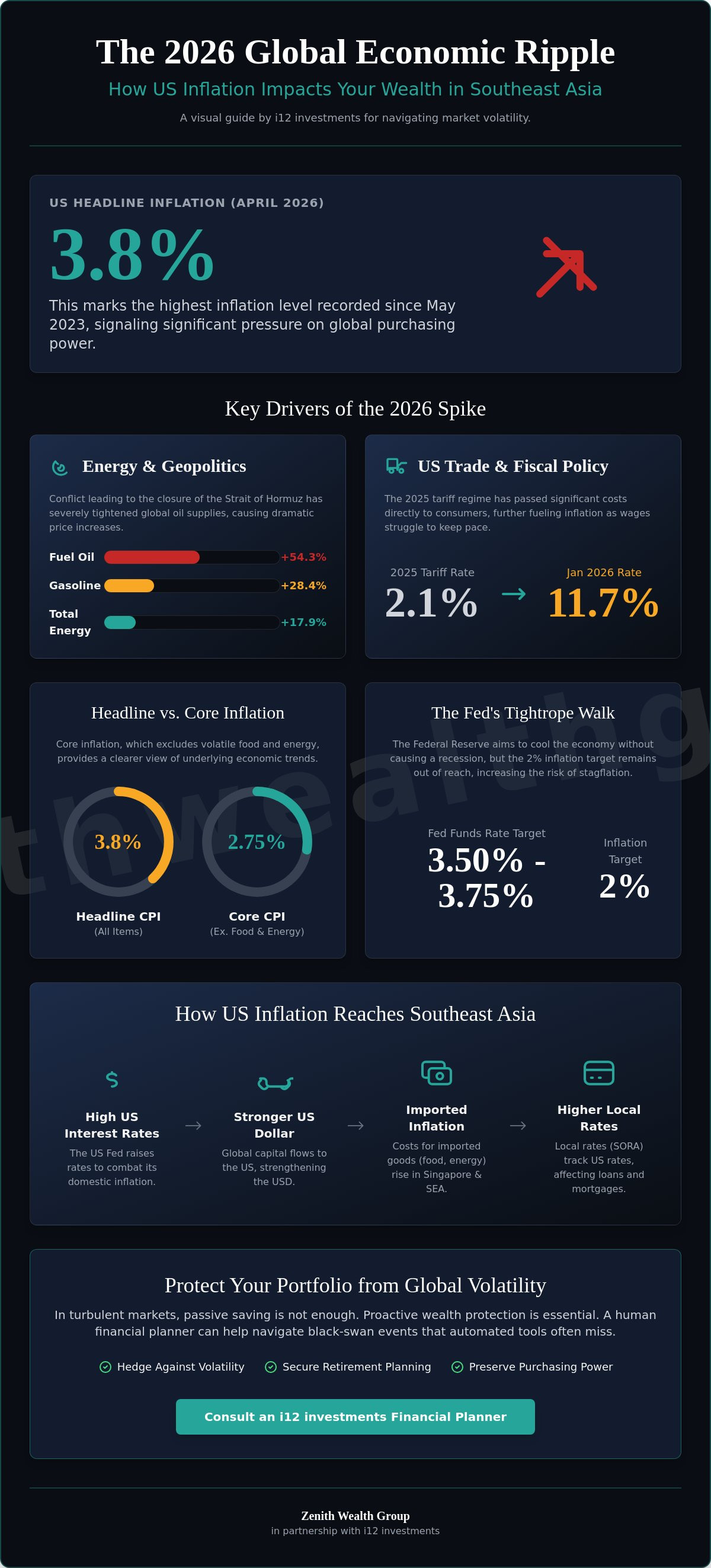
In April 2026, the U.S. Labor Department reported a headline inflation rate of 3.8%. This represents the highest level since May 2023. For families in Southeast Asia, this isn't just a headline; it's a signal that the global cost of living is shifting again. High prices in the West often lead to "imported inflation" here, as the goods and services we rely on become more expensive to source.
Breaking Down the 2026 CPI Numbers
The Consumer Price Index (CPI) tells a story of two different economies. The most striking figure is the 17.9% jump in energy costs over the past year. This spike in gasoline and fuel oil prices has a "leaking" effect. High transport costs eventually make your groceries and household essentials more expensive, even if they are produced locally.
While energy grabs the headlines, your financial planner will likely point you toward the core inflation rate. Currently sitting at 2.75%, core inflation excludes volatile food and energy prices. It provides a clearer view of the underlying economic trend. If core inflation remains sticky, it suggests that price hikes are becoming embedded in the broader economy. This makes long-term wealth protection and strategic investment management even more critical for your portfolio.
Why 2026 Differs from Previous Inflation Cycles
The current climate feels different from the post-pandemic surge of 2021 and 2022. Back then, inflation was driven by clogged ports and a sudden rush of consumer spending. Today, the drivers are more complex. We aren't just dealing with supply chain hiccups; we're facing significant geopolitical shocks that have restricted global oil supplies and driven up the cost of electricity.
While the earlier cycles were about a world trying to restart, the 2026 landscape is defined by regional instability and new trade barriers. At i12 investments, we see this as a shift from temporary price spikes to a more persistent volatility. The 2026 us inflation cycle is primarily a product of energy-driven volatility and strategic shifts in global trade policy.
The Drivers Behind the 2026 Spike: Energy and Geopolitics
The surge in us inflation didn't happen in a vacuum. It's largely the result of a perfect storm where energy prices and geopolitics collided. Specifically, the conflict with Iran has led to a de facto closure of the Strait of Hormuz. This closure severely tightened global oil supplies, causing energy prices to climb by 17.87% between April 2025 and April 2026. When a primary global artery for oil is constricted, the price of everything else starts to move.
These costs don't stay at the petrol station. They leak into manufacturing and shipping. When fuel is expensive, every item on a container ship becomes more costly to move. Additionally, US fiscal policy remains a significant factor. The 2025 tariff regime saw effective rates jump from 2.1% to an estimated 11.7% by January 2026. These taxes on imports are being passed directly to consumers. Meanwhile, US wages are fighting an uphill battle to keep pace with the 3.8% headline rate, creating a tense economic environment that ripples across the Pacific.
The Energy Crisis and Global Logistics
Gasoline prices have surged by 28.4%, while fuel oil has jumped a staggering 54.3%. These figures have a direct impact on the US trade balance and global shipping rates. For residents in Singapore and Manila, this translates to "imported inflation." Because Southeast Asia relies on global trade routes, these logistics costs eventually arrive at our local supermarkets. If you're concerned about how these rising costs affect your long-term goals, a financial planner can help you stress-test your wealth protection strategy against these global shifts.
Monetary Policy: The Fed's Tightrope Walk
The Federal Reserve is currently walking a narrow path. With the federal funds rate targeted at 3.50% to 3.75%, they're trying to cool the economy without triggering a deep recession. However, the 2% inflation target remains out of reach. The risk of stagflation is growing. This is a difficult environment where prices stay high while economic growth begins to stall. Within the i12 investments framework, we prioritize portfolio resilience. It's about ensuring your retirement planning remains robust even if the Fed's target remains elusive for the remainder of the year. We focus on proactive management rather than simply waiting for the market to settle.
How US Inflation Impacts Singapore and Southeast Asian Portfolios
US inflation doesn't stay within American borders. It travels through currency markets and interest rate channels, affecting your wealth right here in Southeast Asia. Because the Singapore Dollar is managed against a basket of currencies, a surge in us inflation often forces the Monetary Authority of Singapore (MAS) to act. This is vital because Singapore imports nearly all its food and energy. When the US Dollar strengthens due to high rates, your daily expenses in Singapore inevitably climb. This is the reality of imported inflation.
The ripple effect extends directly to your home loan. Local interest rates, specifically SORA, track the US Federal Funds Rate closely. With the Fed maintaining a target range of 3.50% to 3.75%, mortgage payments in Singapore are likely to remain elevated throughout 2026. This environment requires a strategic shift in how you view regional equity markets. While Indonesia and the Philippines show resilience with an 8% rise in foreign direct investment, capital often flows toward the safety of US Treasuries when yields hit 5.20%. Balancing these regional growth opportunities against global interest rate pressure is a key part of modern investment management.
Currency Volatility and Your Purchasing Power
A strong US Dollar can make your American investments look impressive on your monthly statement. If you hold assets in the States, their value in SGD terms increases. However, this is often a "paper gain" that masks a deeper problem. The hidden cost appears when your local expenses rise faster than your portfolio grows. Managing this balance is a core focus at i12 investments. We help you look past the surface numbers to see if your real purchasing power is actually increasing or simply treading water against rising costs.
Asian Central Bank Responses
The MAS has already raised its core inflation forecast to 1.5–2.5% for 2026. This suggests they may tighten monetary policy further to strengthen the SGD and blunt the impact of imported price hikes. Across the region, the picture is mixed. The Philippines faces higher inflationary pressure than Thailand, requiring different tactical shifts for each market. For a deeper look at managing these local risks, see our guide on Wealth Protection in Singapore. A professional financial planner can help you navigate these regional differences to ensure your retirement roadmap remains secure.
Strategic Wealth Protection: Hedging Against Global Price Volatility
Holding large amounts of cash during a period of 3.8% us inflation is a guaranteed way to lose purchasing power. If your savings account interest doesn't beat the rising cost of living, your hard-earned money is effectively shrinking every month. This makes wealth protection more than just a buzzword; it's a survival strategy for your long-term goals. While high yields on US Treasuries, which approached 5.20% in mid-May 2026, look attractive, they're only one piece of a much larger puzzle.
Finding the right balance between real assets and paper assets is essential. Real assets, like commodities, tend to hold their value when prices rise because they're the very things becoming more expensive. Paper assets, like bonds or fixed deposits, can struggle if inflation outpaces their yields. At i12 investments, we help clients look beyond simple savings to build a portfolio that can withstand these global pressures. It's about moving from a defensive posture to a proactive one.
Asset Classes That Historically Outperform Inflation
Gold remains a cornerstone for many investors in Singapore, especially as global uncertainty persists. It often acts as a hedge when currencies fluctuate. Additionally, inflation-linked bonds provide a structured way to ensure your returns keep pace with rising costs. If you're looking for stability, you might want to explore Investing for the Risk Averse to see how to secure your future without unnecessary stress.
The 'i12 investments' Approach
We don't believe in chasing speculative trends or volatile "meme" stocks. Instead, the i12 investments philosophy focuses on high-quality assets that generate consistent value even in a high-interest-rate environment. By prioritizing quality over speculation, we help ensure your portfolio isn't just growing, but staying resilient. Specifically, i12 investments prioritize resilient cash flow to help you meet your commitments regardless of market swings.
This is also the time to revisit your retirement planning assumptions. If your roadmap was built on a 2% inflation world, the 2026 reality of energy shocks and 5% electricity price hikes requires a fresh look. A professional financial planner can help you recalibrate your strategy to ensure your lifestyle remains protected. Don't wait for us inflation to eat into your legacy before taking action.
Navigating Economic Uncertainty with a Professional Financial Consultant
Automated robo-advisors are useful for steady markets with low volatility. They struggle, however, when the world faces a black-swan event like the 2026 oil shock. Algorithms follow historical patterns. They don't understand the nuances of a de facto closure of the Strait of Hormuz or how us inflation affects local SGD interest rates in real-time. This is where a human financial planner provides indispensable value. We offer the context that data alone cannot provide.
At Zenith Wealth Group, we lead with quiet confidence. Our approach isn't about panicking when headlines turn red. Instead, we focus on strategic anticipation. By incorporating i12 investments into our broader strategy, we help you build a portfolio designed to withstand the heat of us inflation. We believe in being proactive. It's about stress-testing your retirement plan now so you don't have to worry later. We're here to start a conversation, not just manage an account.
Beyond the Headlines: Personalized Financial Roadmaps
It's easy to get caught in a cycle of reacting to the daily news. One day it's the 3.8% inflation rate; the next, it's a new tariff regime. A professional financial consultant helps you move from reacting to executing. We look for the blind spots that automated platforms miss. This includes ensuring your insurance coverage keeps pace with rising costs and that your legacy planning remains intact. For a deeper dive into these strategies, read more about Retirement Planning in Singapore.
Take Control of Your Financial Future
We operate with a friendly, open-door policy. We aren't a distant corporate institution. We're an attentive team that values human interaction and personal growth. Your financial journey is unique. It deserves more than a generic digital template. The first step to securing your wealth is a thorough audit of your current portfolio. We'll identify where you're most sensitive to price volatility and suggest practical hedges to protect your purchasing power.
Don't let global uncertainty dictate your quality of life. Start a conversation today to see how we can align your wealth with your 2026 goals. Our team is ready to help you navigate this complex landscape with clarity and purpose. Connect with a Zenith financial consultant today to begin your journey toward a more resilient future.
Securing Your Future Against Global Shifts
The economic landscape of 2026 is complex, but it doesn't have to be overwhelming. You've seen how energy-driven volatility and rising interest rates create pressure on your purchasing power. Understanding us inflation is the first step toward building a more resilient portfolio. Passive saving is no longer enough when global forces directly impact your local mortgage and grocery bills. It's time to shift from observing the news to executing a strategy that protects your hard-earned wealth.
At Zenith Wealth Group, our authorized representatives of finexis advisory specialize in global wealth protection and i12 investments. We provide personalized financial planning for Singaporean families who want to move beyond the noise. By focusing on quality assets and strategic anticipation, we help ensure your long-term goals remain on track despite international market swings. We value human connection and are ready to listen to your specific concerns.
Don't let market uncertainty dictate your retirement roadmap. Take a proactive step today to audit your portfolio for inflation sensitivity. Secure your retirement from global volatility; speak with a Zenith financial consultant today. We're here to help you navigate these changes with confidence and clarity.
Frequently Asked Questions
How does US inflation specifically affect my Singapore bank savings?
High inflation in the US often leads to a stronger US Dollar, which makes imports more expensive for Singapore. Since we import most of our food and energy, your local savings effectively buy less at the supermarket. While your bank balance stays the same, its real-world purchasing power drops as "imported inflation" raises the cost of living in Singapore.
Is 3.8% inflation considered high for the US in 2026?
Yes, the 3.8% figure recorded in April 2026 is the highest level since May 2023. It significantly exceeds the Federal Reserve's long-term target of 2%. This overshoot suggests that price pressures are becoming persistent, rather than temporary, which often forces central banks to keep interest rates higher for longer periods.
Should I move my investments to gold if US inflation keeps rising?
Gold is a traditional hedge against rising prices, but it shouldn't be your only strategy. A balanced portfolio that incorporates i12 investments can provide more comprehensive protection through diversification. While gold often maintains value when currencies fluctuate, combining it with other real assets helps ensure your wealth stays resilient across different economic scenarios.
Can a financial consultant help me hedge against currency fluctuations?
A financial consultant can identify specific assets that tend to perform well when the USD/SGD exchange rate shifts. They look for blind spots in your portfolio where you might be over-exposed to a single currency. By diversifying your holdings, a financial planner helps protect your purchasing power from being eroded by sudden moves in the foreign exchange market.
What is the relationship between US inflation and Singapore mortgage rates?
When us inflation stays high, the Federal Reserve keeps interest rates elevated to cool the economy. These US rates directly influence SORA, which is the benchmark used for most home loans in Singapore. As a result, when the Fed raises or maintains high rates, your monthly mortgage repayments are likely to increase as well.
Does US inflation impact the CPF interest rates in Singapore?
There isn't a direct link, but an indirect connection exists through global bond yields. CPF interest rates are partly based on the yields of Singapore Government Securities. Since global yields often rise in response to inflationary pressure in the US, these shifts can eventually influence the formulas used to determine CPF interest rates over the long term.
Is it better to invest in US or Asian markets during an inflation spike?
Both markets offer unique advantages depending on the sector. US markets provide access to global real assets and commodities that hedge against inflation. Conversely, Southeast Asian markets like Indonesia and the Philippines are seeing resilient growth through supply chain diversification. A financial planner can help you find the right balance between these regions based on your goals.
How often should I review my retirement plan during periods of high inflation?
You should review your roadmap at least once a year or whenever a major geopolitical shock occurs. High inflation changes the "real" value of your future income, meaning your original assumptions may no longer be accurate. Regular stress-testing ensures your retirement planning stays ahead of rising costs and maintains your desired lifestyle.


