

What if your child's first S$20,000 was already working for them before they even left the hospital? Effective financial planning for new parents Singapore is no longer just about saving for a rainy day. It's about shifting from individual wealth to a multi-generational security framework. You likely feel the weight of rising living costs and the complexity of government grants like the S$11,000 Baby Bonus Cash Gift for your first child. It's a lot to manage while you're also losing sleep over diaper changes.
We're here to help you find clarity. This roadmap ensures you don't miss out on the S$5,000 CDA First Step Grant or the S$5,000 MediSave Grant for newborns born after 1 April 2025. We'll also cover the critical April 2026 changes to Integrated Shield Plan riders, where co-payment caps have moved to a minimum of S$6,000. You'll get a step-by-step checklist to optimize your CDA, protect your income, and build a solid education fund. Let's turn that confusion into a confident plan for your family's future.
Key Takeaways
- Unlock the full potential of your child’s CDA and Baby Bonus by mastering the 2026 dollar-for-dollar matching limits.
- Protect your household from rising healthcare costs by reviewing the latest April 2026 Integrated Shield Plan rider updates.
- Master financial planning for new parents Singapore to balance your child's future education needs with your own retirement security.
- Evaluate the pros and cons of endowment plans versus ILPs to find the right investment vehicle for university fees in 2044.
- Establish a lasting legacy through proactive estate planning, including guardian appointments and critical CPF nominations.
Maximising Government Support: Your Baby Bonus and CDA Checklist
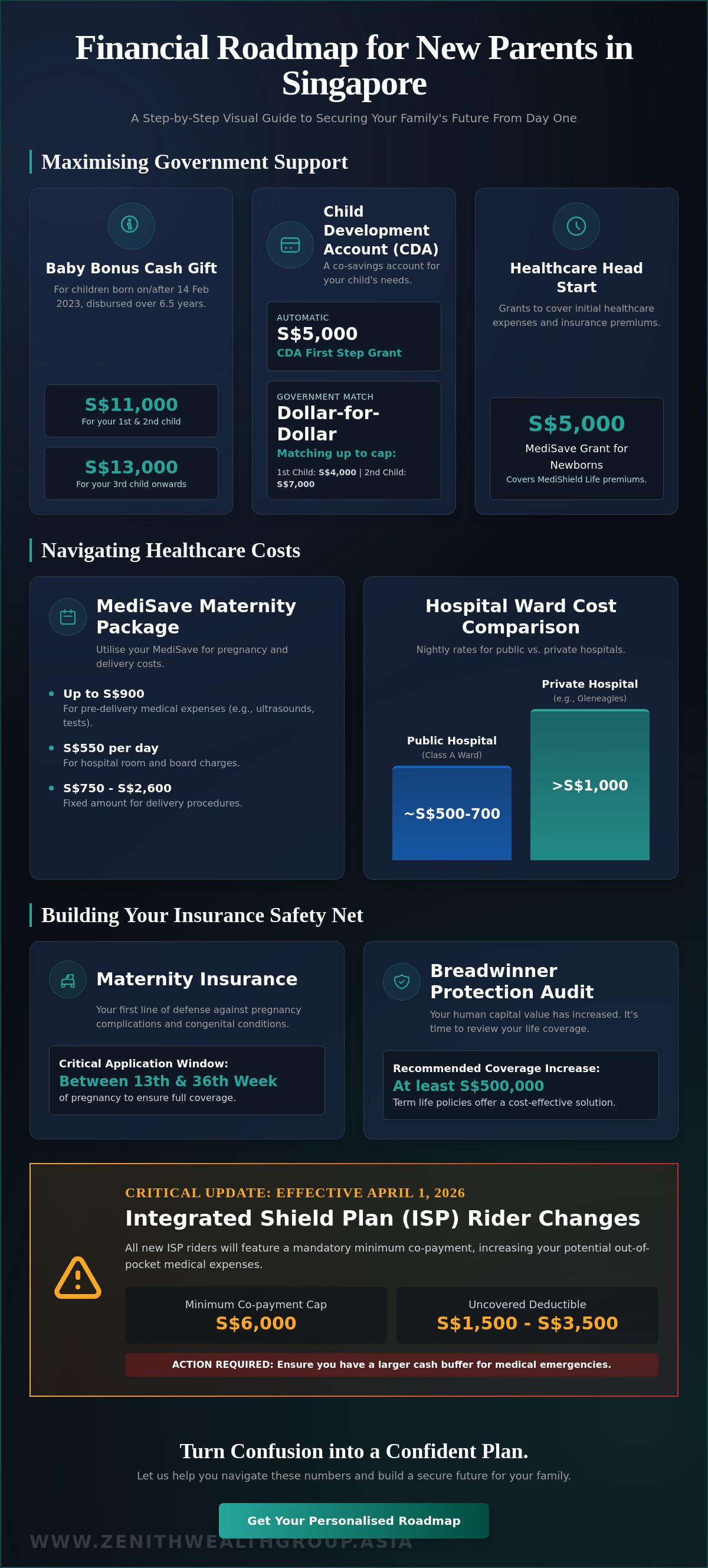
The Singapore government provides a significant head start for your growing family. For children born on or after 14 February 2023, the Baby Bonus Scheme offers a Cash Gift of S$11,000 for your first and second child. If you're welcoming your third, this amount increases to S$13,000. These funds aren't a lump sum; they're disbursed over the first 6.5 years of your child's life to support ongoing costs. This structured support is a cornerstone of financial planning for new parents Singapore.
The CDA Strategy: More Than Just a Savings Account
Your Child Development Account (CDA) is a special co-savings account that works hard for you. The government automatically deposits a S$5,000 First Step Grant for your first child. For children born on or after 18 February 2025, the grant for a third child or subsequent children jumps to S$10,000. You should also maximize the dollar-for-dollar matching. This matching is capped at S$4,000 for your first child and S$7,000 for your second child.
Don't let these funds sit idle. You can use CDA money for childcare fees, medical expenses, and even MediShield Life premiums at approved institutions. In 2026, local banks like OCBC, DBS, and UOB continue to offer competitive interest rates on these accounts. Choosing the right bank ensures your child's savings grow even faster while you wait to spend them. It's a simple way to boost your family's liquidity from day one.
MediSave maternity limits and 2026 hospital costs
Managing hospital bills is easier when you understand the MediSave Maternity Package. You can withdraw up to S$900 for pre-delivery medical expenses, such as ultrasounds and prenatal tests. For the actual hospital stay, you can use S$550 per day for hospital charges. There's also a fixed amount for surgical procedures, which typically ranges from S$750 to S$2,600 depending on the delivery type.
There's a clear cost gap between public and private institutions. A Class A ward in a public hospital might cost around S$500 to S$700 per night. In contrast, private rooms at institutions like Gleneagles can exceed S$1,000. Your MediSave limits remain the same regardless of where you choose to deliver. To claim these expenses, simply present your prenatal bills to the hospital's business office during admission. They'll handle the paperwork for you.
Every Singapore Citizen newborn is automatically covered by MediShield Life from birth. You'll also receive a S$5,000 MediSave Grant for Newborns to help cover these premiums. If you want a more tailored strategy for your family's growth, drop us a line! We're ready to help you navigate these numbers and build a secure future.
Building the Safety Net: Essential Insurance for New Parents
Insurance isn't just a monthly expense. It's the foundation of robust financial planning for new parents Singapore. Your priorities shift the moment you see that first ultrasound. You're no longer just protecting your own lifestyle. You're safeguarding a twenty-year future. Starting early ensures you lock in coverage before any health complications arise.
Maternity insurance is your first line of defense. Most insurers require you to apply between the 13th and 36th week of pregnancy. This 13-week mark is critical. Signing up early ensures coverage for pregnancy complications and congenital conditions that standard health plans often exclude. It provides a lump sum benefit that helps manage unexpected neonatal costs or extended hospital stays for the mother. Beyond financial protection, focusing on holistic well-being is essential; practitioners like Dr. Tiffany Yeo-Reddy offer integrative support to help mothers maintain their health and vitality throughout pregnancy.
Maternity Insurance vs. Personal Health Plans
Your existing hospital plan covers general medical needs. It rarely covers pregnancy-specific risks. Top Singaporean providers now cover up to 25 congenital conditions, including Spina Bifida and Cleft Palate. Once your baby arrives, you have a small window-usually 14 to 90 days-to transition them to a standalone Integrated Shield Plan. This guarantees they're covered regardless of their health status at birth. While you focus on immediate health, it's also wise to keep an eye on long-term Education Savings goals.
The Breadwinner Protection Audit
Your "Human Capital" value increases significantly when you become a parent. You're now responsible for two decades of a child's food, housing, and tuition. This is the time to review your sum assured. Many parents find they need to increase their life coverage by at least S$500,000 to account for these new liabilities. Term life policies offer a cost-effective way to get high coverage during these high-dependency years.
Regulatory changes are also shifting the landscape. Effective April 1, 2026, all new Integrated Shield Plan riders in Singapore feature a minimum co-payment cap of S$6,000. These riders no longer cover the initial deductible, which ranges from S$1,500 to S$3,500. This means your financial planning for new parents Singapore must include a larger cash buffer for medical out-of-pocket costs. Read our full breakdown on Wealth Protection in Singapore to see how these 2026 rules affect your family's safety net.
Securing your family's future shouldn't be stressful. If you want to ensure your current policies are up to the task, drop us a line! We'll help you audit your coverage and fill the gaps.
Funding the Future: A Checklist for Education Savings
Eighteen years feels like a lifetime away. In the world of financial planning for new parents Singapore, it is your most valuable asset. Time allows the power of compounding to turn modest monthly contributions into a substantial tuition fund. Starting a dedicated savings plan now prevents a frantic scramble when your child receives their university acceptance letter. It's about building a foundation that grows as they do.
Estimating the Cost of a Degree in 2026 and Beyond
Tuition fees at local institutions like NUS or NTU currently range from S$30,000 to S$50,000 for most four-year courses. By the year 2044, these costs could easily double if we factor in a conservative 3% annual inflation rate. Sending your child to the UK or Australia is an even bigger commitment. Those paths often require upwards of S$250,000 today when including room and board. The "Education Gap" is the stark difference between your current savings and the projected S$100,000 plus needed for a local degree in 2044.
Choosing Your Investment Vehicle
Conservative parents often prefer capital-guaranteed endowment plans. These policies ensure your principal is safe and provide a predictable payout upon maturity. They offer peace of mind but may struggle to significantly outperform education inflation. If you have a higher risk tolerance, consider diversified portfolios or Investment-Linked Policies (ILPs). These vehicles target higher returns over a long timeframe by investing in global markets. You can use our investment calculator to see which path gets you to your goal faster.
Don't overlook the Supplementary Retirement Scheme (SRS). While primarily for retirement, the immediate tax relief you gain can be redirected into your child's education fund. This effectively boosts your savings capacity without increasing your out-of-pocket expenses. Automate your contributions to ensure consistency. A monthly investment of S$500, compounded at a 5% annual return, could grow to over S$170,000 by the time your child turns 18. This disciplined approach removes the guesswork from your family's future.
Every family has a unique risk profile and set of goals. If you want to build a customized savings roadmap that balances growth and security, drop us a line! We're here to help you bridge the gap.
Estate Planning: Securing Your Child’s Legacy
Estate planning is the final, vital piece of financial planning for new parents Singapore. While previous steps covered growth and protection, this is about control. If you haven't written a Will yet, the Intestate Succession Act dictates how your assets are split. This often results in your spouse receiving only half of your estate, with the other half held in trust for your minor children until they turn 21. This can create immediate cash flow issues for the surviving parent during an already difficult time.
Appointing Legal Guardians
Choosing a guardian is a deeply personal decision. You need to name someone who shares your values and can provide a stable home. Naming a guardian in your Will ensures the state doesn't have to decide who raises your child. You can also separate physical care from financial management. One person can raise your child, while another manages the inheritance as an executor. This adds a layer of accountability and ensures your child's needs are met from every angle. Always ask your candidates if they're ready for the commitment before finalizing your documents.
Managing the CPF Transition
Many parents don't realize that a Will does not cover CPF savings. These funds are distributed according to your CPF nomination. If you haven't made one, the Public Trustee’s Office handles the distribution. This process involves administrative fees and can take several months to resolve. You can make your nomination online via Singpass in under 10 minutes. It's a quick win for your family's security. This is also a good time to review The Complete Guide to Retirement Planning in Singapore to ensure your long-term assets are aligned with your new family goals.
Consider a Trust if you're worried about a young adult inheriting a large sum of money all at once. A Trust lets you specify milestones, such as releasing funds only for university fees or a first home purchase. It prevents the risk of an inheritance being spent poorly. Alongside this, every parent needs a Lasting Power of Attorney (LPA). Without an LPA, your family might need a court order to manage your bank accounts or pay bills if you lose mental capacity. It's a simple legal document that saves your family from immense stress. Ready to build a legacy that lasts? Book an estate planning consultation with our team today.
The Zenith Approach: Holistic Planning for Growing Families
Effective financial planning for new parents Singapore requires more than just picking the right products. It requires a cohesive strategy. Many parents fall into the trap of buying disjointed policies from various single-provider agents. This often leads to overlapping coverage or expensive gaps. At Zenith Wealth, we believe in independent financial advice. We don't represent just one insurance company. We represent you.
Our "Zenith Wealth Roadmap" is designed to bring all the pieces together. We look at your family's cash flow, government grants, and protection needs as one ecosystem. Our partnership with finexis advisory Pte Ltd supports this approach. It gives us access to a vast range of institutional solutions while we maintain our boutique, personal connection with you. We focus on efficiency. We ensure every dollar you save works toward multiple goals simultaneously.
Balancing Parenthood with Retirement
The "Sandwich Generation" trap is a common risk in Singapore. This happens when parents prioritize their children's education so heavily that they neglect their own retirement. You can take a loan for university, but you can't take a loan for your retirement. We help you build a plan where education funding and retirement planning work in tandem. This ensures you remain financially independent in your silver years, which is the greatest gift you can give your child. Establish a liquid emergency fund covering at least six months of household expenses before you start your investment journey. This cash buffer protects your long-term plans from being derailed by short-term emergencies.
Drop us a line for a Personalised Consultation
A generic template won't cut it for your family's future. Every household has different income levels, risk tolerances, and aspirations. Your first session with a Zenith Wealth consultant is about listening. We'll conduct a 2026 family financial health check to see where you stand. We'll review your current policies, analyze your CDA strategy, and project your future needs. You'll walk away with a clear, actionable checklist tailored to your specific situation.
Don't wait for the "perfect time" to start. The best time was yesterday; the second best time is now. We're ready to help you navigate the complexities of parenthood with quiet confidence. Book your family financial consultation today and let's start a conversation. Drop us a line!
Start Your Family's Financial Journey Today
You now have the roadmap for the S$11,000 Baby Bonus, the new S$6,000 IP rider co-payment caps, and the projected S$100,000 tuition fees for 2044. These figures are more than just data points. They are the building blocks of your child's future. Comprehensive financial planning for new parents Singapore ensures that these shifting regulations and rising costs never catch you off guard. It's about turning anticipation into a solid, actionable strategy.
As authorized representatives of finexis advisory Pte Ltd, Zenith Wealth offers independent advice across multiple insurance and investment providers. We specialize in multi-generational wealth preservation and focus on your family's unique needs. You don't have to manage these complex government schemes and market changes alone. We're here to provide the clarity and personal connection you deserve.
Secure your child’s financial future; drop us a line today! We're ready to help you reach your family's zenith. Let's start the conversation. We look forward to growing alongside you.
Frequently Asked Questions
How much does it cost to raise a child in Singapore in 2026?
Raising a child to age 21 in Singapore typically costs between S$280,000 and S$560,000 for a middle-income household. This estimate includes healthcare, food, and enrichment activities—to ensure your family has access to premium, hand-selected seasonal produce, you can discover Tai Kang Healthy Fruits. You must also factor in a 3% annual inflation rate, which significantly increases the cost of big-ticket items like university tuition by the time your child is ready to enroll.
Can I use my CDA funds to pay for my child’s insurance premiums?
You can use Child Development Account (CDA) funds to pay premiums for MediShield Life and MediSave-approved Integrated Shield Plans. This is a smart way to utilize the government's dollar-for-dollar matching. It effectively halves your out-of-pocket costs for your child's medical coverage. Simply register your child's CDA as the payment mode with your chosen insurer at an Approved Institution.
Is maternity insurance worth it if I have a good corporate health plan?
Maternity insurance is vital because most corporate plans only cover standard inpatient treatments and exclude pregnancy complications or congenital illnesses. A dedicated maternity policy provides a lump sum benefit if your child is born with one of the 25 covered conditions. It protects your family from high neonatal intensive care costs that corporate plans often don't fully reimburse.
When should I start an education savings plan for my newborn?
You should start an education plan immediately after birth to maximize the 18-year compounding window. This is a critical step in financial planning for new parents Singapore. Starting at age 0 rather than waiting until age 5 can reduce your required monthly savings by nearly 30% while still reaching the same target for university fees in 2044.
What happens to my child’s finances if I pass away without a Will in Singapore?
If you die without a Will, the Intestate Succession Act splits your assets 50% to your spouse and 50% to your children. The Public Trustee’s Office will hold your child's share in trust until they turn 21. This can create cash flow problems for the surviving parent and involves administrative fees. A Will allows you to choose guardians and manage how funds are released.
Can foreigners or expats in Singapore access the Baby Bonus scheme?
The Baby Bonus scheme is only available if your child is a Singapore Citizen. Eligibility depends on the child's citizenship status, not the parents' residency or pass type. Expats who don't qualify should focus on private financial planning for new parents Singapore. This involves using global investment platforms and maternity insurance that specifically caters to the international community.
How do I choose between a Whole Life and Term Life policy as a new parent?
Choose Term Life if you need a high sum assured, such as S$1 million, at an affordable price during your child's dependency years. It provides pure protection for a set period. Whole Life is better if you want lifelong coverage and a cash value component for legacy planning. Many parents use a combination to ensure they have maximum protection while their children are young.
What is the best way to invest the Baby Bonus cash gift for long-term growth?
The most effective strategy is to redirect the S$11,000 cash gift into a diversified investment portfolio or a child-specific endowment. Don't let it sit in a low-interest savings account. By investing the gift early, you can take advantage of long-term market growth to help cover future education costs. This turns a one-time government grant into a substantial foundation for your child's wealth.


