

A recent Harris Poll revealed that 60% of people don't know exactly what they're paying in fees or how those charges are calculated. It's a common source of anxiety. You might feel like you're paying for a service that's difficult to track, especially when you're focused solely on monthly portfolio returns. We agree that it's frustrating to feel uncertain about your progress. However, measuring the ROI of financial advice involves much more than just a single percentage on a statement. It's about the total value added to your life and your net worth.
At i12 investments, we want to help you see the full picture. This guide will show you how to accurately quantify the value of your financial consultant through tax alpha, behavioral coaching, and strategic wealth growth. We'll provide a clear framework to track your long-term progress and prove how professional planning leads to better retirement outcomes. You'll gain the confidence to know your chosen financial planner is helping you build a secure future. Let's look at how to move beyond the percentage and start seeing real results.
Key Takeaways
- Learn why judging a financial consultant on annual returns alone is a misleading metric for your long-term success.
- Discover how i12 investments help build diversified portfolios focused on sustainable, disciplined wealth growth.
- Understand how behavioral coaching prevents costly emotional mistakes during periods of market volatility.
- Apply a clear 4-step framework for measuring the ROI of financial advice to track your true net progress.
- See the tangible impact that professional planning has on your retirement outcomes and legacy goals.
What is the ROI of Financial Advice? Moving Beyond Portfolio Returns
Most investors look at their quarterly statement, check the percentage gain, and assume they have the full story. They don't. If your portfolio grew by 7% but you missed out on key tax deductions or panicked during a market dip, your actual progress might be lower than you think. In a personal finance context, the true Return on investment (ROI) is the total net benefit of professional guidance minus the cost of that service. It is a multi-dimensional metric that accounts for growth, protection, and peace of mind.
The 2026 financial environment has made this calculation more complex. With the top marginal tax rate reaching 37% for single filers earning over $640,600, simple growth isn't enough. You need to know how much of that growth you actually keep. Measuring the ROI of financial advice is about identifying the specific value a financial consultant adds across your entire balance sheet. It moves the conversation away from chasing "hot" stocks and toward sustainable, long-term wealth preservation.
The Three Pillars of Advisory Value
- Investment Alpha: This is the traditional measure. It involves outperforming a standard benchmark through strategic asset allocation. We focus on using robust structures like i12 investments to build diversified portfolios that aim for consistent growth without unnecessary risk.
- Tax Alpha: This is often the most overlooked component. A skilled financial planner helps you minimize "leakage" through smart use of SRS, CPF, and legacy structures. In 2026, where the standard deduction for married couples is $32,200, every strategic move counts toward your bottom line.
- Behavioral Alpha: This is the measurable gain from staying invested during market downturns. A financial consultant acts as a shield against emotional decisions. Avoiding a single "panic sell" during a correction can save years of future growth.
Why Traditional ROI Calculations Often Fail
Short-term benchmarking is a major trap in retirement planning. Judging a decades-long strategy based on a single year of performance is misleading. Many investors also ignore the "hidden" costs of DIY investing. Think about the hours spent researching, the stress of managing volatility, and the potential for expensive errors. These are real costs that a professional helps eliminate. Additionally, regional factors like inflation and shifting exchange rates can silently erode your wealth. A comprehensive plan accounts for these variables, ensuring your purchasing power remains intact as you move toward your goals.
Quantifying the Alpha: How a Financial Planner Adds Tangible Value
Tangible value often gets lost in the noise of market headlines. While we defined the broad pillars of value earlier, quantifying them requires a look at the specific tools used to build your wealth. When you are measuring the ROI of financial advice, you should look closely at how your assets are structured. A skilled financial planner doesn't just pick funds; they build a system designed to capture growth while minimizing unnecessary costs. They don't just watch the market. They manage your strategy.
The i12 Investments Advantage
Institutional-grade asset selection was once reserved for the ultra-wealthy. Today, i12 investments serve as a core component of strategic wealth growth for our clients. By utilizing these structures, we reduce portfolio drag caused by high internal fund expenses and inefficient trading. This structured philosophy ensures your money works harder for you. Research into The Value of Financial Advice suggests that these technical adjustments can lead to significantly better outcomes over a multi-decade horizon. A disciplined asset selection process removes the guesswork and replaces it with evidence-based growth.
Your choice of fee structure also dictates your long-term ROI. In 2026, we see a clear shift toward planning-led, fee-based models rather than traditional commission-based products. Current data shows that AUM fees typically range from 0.50% to 1.25% annually. While these costs are visible, the value provided through comprehensive planning often outweighs them. Commissions can create a conflict of interest and hidden costs that erode your capital over time. A fee-based financial consultant aligns their success with yours. This transparency is vital for accurately measuring the ROI of financial advice.
Tax Efficiency and SRS Optimization
Tax optimization is the closest thing to a "free lunch" in finance. For those in Singapore, the Supplementary Retirement Scheme (SRS) is a powerful tool. Contributing to your SRS provides immediate tax relief, which is a guaranteed return on your investment. You can find more tactical details in our guide on Mastering the SRS Account. Beyond SRS, effective legacy planning ensures your wealth isn't eroded by legal complexities or unnecessary taxes during a transfer.
Regular portfolio rebalancing is another critical task. Without a professional to manage this, portfolios often drift into higher-risk territory. If a specific sector performs well, it takes up a larger portion of your pie. A financial planner corrects this drift, locking in gains and maintaining your intended risk level. If you're wondering how these strategies apply to your specific situation, you can speak with a financial planner to review your current portfolio structure today.
The Intangible ROI: Behavioral Coaching and Risk Mitigation
Many investors believe a robo-advisor is enough for their needs. They think low cost automation can replace professional wisdom. It doesn't. While an algorithm can rebalance a portfolio, it cannot talk you off a ledge when the market tumbles. This human element is a critical factor when measuring the ROI of financial advice. A financial planner acts as your emotional circuit breaker. They provide a level of perspective that software simply cannot replicate.
Think back to the market volatility of 2020 or 2022. Investors who panicked and sold during those dips locked in their losses. They missed the subsequent recoveries that followed. Missing just a few of the market's best days can cut your long-term returns in half. By preventing a single panic sell, a financial consultant provides an "intangible" ROI that translates into very tangible dollars. This behavioral alpha is often the difference between reaching your retirement goals and falling short.
The Cost of the "DIY Gap"
There is a documented gap between average market returns and what the average investor actually keeps. This "DIY Gap" exists because individuals often let emotions drive their timing. They buy when they feel confident and sell when they feel afraid. We close this gap through disciplined strategy and the use of i12 investments to maintain a steady course. By delegating your wealth management, you also reclaim your most valuable asset: time. Calculating the hours you would otherwise spend researching 2026 tax codes or monitoring global shifts often reveals that professional help pays for itself through efficiency alone. This logic of professional delegation is universal; for example, many high-performers close their own 'fitness gap' by partnering with 6X Training to achieve peak physical results through expert-led personal training.
Wealth Protection as ROI
ROI isn't just about growth. It is about what you keep when things go wrong. Having the right critical illness or life insurance is a form of risk mitigation that offers massive ROI when disaster strikes. Without it, a single medical emergency could wipe out decades of savings. You can explore these security frameworks further in our guide on Wealth Protection in Singapore. Professional guidance ensures your plan is robust enough to survive the unexpected.
For pre-retirees, risk-adjusted returns are more important than raw performance. A financial planner ensures your portfolio isn't overly exposed to volatility as you approach your target date. This protection ensures your legacy planning remains intact. It guarantees your hard-earned wealth benefits your children rather than being lost to market timing errors. When measuring the ROI of financial advice, the peace of mind that comes from a protected legacy is invaluable.
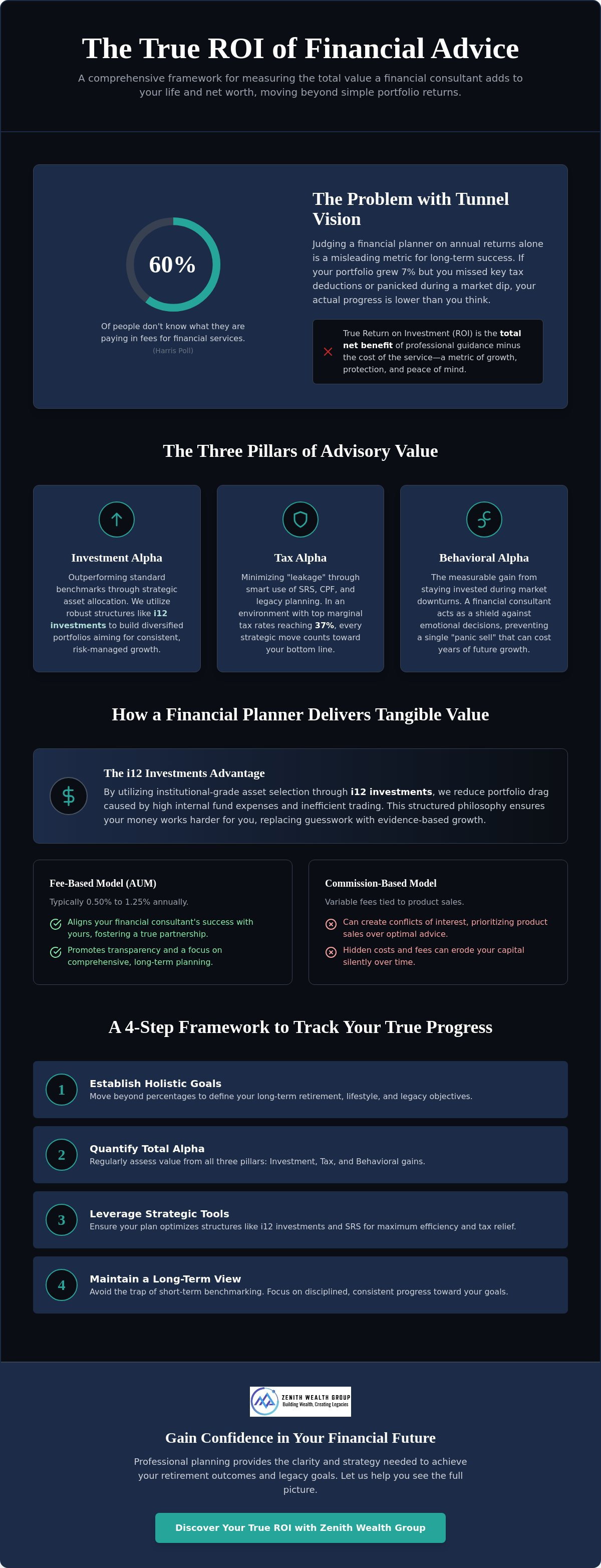
A 4-Step Framework for Measuring Your Advisory ROI in 2026
Quantifying value shouldn't feel like a mystery. While emotional peace of mind is vital, your financial progress must also show up on your balance sheet. When you begin measuring the ROI of financial advice, start with a cold look at the numbers. This framework simplifies the process by focusing on what actually impacts your net worth over time. Follow these four steps to get an accurate picture of the value you are receiving.
- Step 1: Establish a Baseline. Document your current net worth and your projected trajectory if you changed nothing. You need a starting point to see how much "extra" growth your strategy provides.
- Step 2: Calculate Net Performance. Gross returns are just a headline. Subtract all advisory fees, fund expenses, and commissions to find your net return. Data from a Harris Poll shows that 60% of people don't know their fee amounts. Don't be part of that group.
- Step 3: Add the "Alpha" Factors. Quantify your tax savings from SRS contributions or CPF top-ups. Include the measurable increase in your savings rate that comes from a disciplined plan. We use i12 investments to ensure these factors are optimized within your portfolio.
- Step 4: Assess Goal Attainment. ROI is ultimately about reaching milestones. Are you closer to funding your child's education? Is your retirement date moving forward or backward?
Benchmarking Against Goals, Not Just Indices
Comparing your portfolio to the S&P 500 is often irrelevant to your personal life. Your true ROI should be measured by your personal "funded ratio" for retirement. This ratio compares your current assets against the future cost of your lifestyle. If your funded ratio is improving, your plan is working. You can define these specific milestones by exploring The Complete Guide to Retirement Planning. Using a retirement planning calculator allows you to track the ROI of early intervention and strategic adjustments in real time.
Reviewing Your Financial Planner Performance
Your annual review is the perfect time to audit the value of the relationship. Ask your financial planner how they have specifically lowered your tax bill or improved your risk-adjusted returns this year. You should schedule a value-assessment meeting at least once a year to ensure your strategy remains aligned with your 2026 goals. Look for a consultant who provides holistic advice across estate planning and wealth protection rather than someone just focused on product sales. If you want a clear audit of your current progress, book a portfolio review with a financial planner today.
Optimizing Your Wealth Journey with Zenith Wealth
Your wealth journey deserves a partner who values transparency as much as you do. At Zenith Wealth, we believe that measuring the ROI of financial advice should be a straightforward process, not a complex riddle. We focus on high-ROI financial planning that looks at your entire life, from retirement readiness to the legacy you leave behind. By moving beyond simple portfolio percentages, we help you capture the true value of professional guidance.
Our strategy is built on the disciplined integration of i12 investments. These structures are designed to provide the robust, institutional-grade growth necessary for long-term success while keeping your risk profile in check. We don't just manage assets; we manage outcomes. This proactive approach ensures that every decision made is one that moves you closer to your specific financial milestones.
The Zenith Difference: Holistic Advisory
We believe in human interaction over institutional coldness. Our financial planners prioritize personal connection, acting as your modern professional guide in an increasingly complex market. As authorized representatives of finexis advisory, we provide access to a wide range of solutions that allow for a truly personalized strategy. This flexibility is vital for Southeast Asian families who require sophisticated legacy planning and wealth protection across different jurisdictions. We help you build a plan that is as unique as your family's story.
To see how professional expertise and personal stories are being brought to life through modern media, many forward-thinking advisors explore Video Podcasts to connect with their clients on a deeper level.
Next Steps: Audit Your Current Plan
If you are unsure about the value your current arrangement provides, it might be time for a second opinion. We invite you to audit your advisory ROI using the principles we've discussed. Before your next financial review, prepare a checklist to ensure your consultant is delivering holistic value. Check your net returns after all fees. Quantify your tax alpha from SRS or CPF strategies. Most importantly, assess if your current plan has successfully prevented emotional "panic" decisions during recent market shifts.
Don't leave your financial future to chance or vague promises. If your current plan feels like a collection of products rather than a cohesive strategy, we're ready to start a conversation. Measuring the ROI of financial advice starts with having a clear baseline and a path forward. We can help you identify the gaps in your current strategy and optimize your path toward retirement and beyond. Our team is expectant and ready to help you grow.
Ready to see the real ROI of your wealth plan? Contact a Zenith Wealth financial consultant today.
Secure Your Financial Future with Clarity
You now have the tools to look past the noise of monthly statements. By measuring the ROI of financial advice through the lens of tax efficiency and behavioral discipline, you can see how each decision impacts your long-term security. It's about ensuring your wealth serves your life goals rather than just filling a spreadsheet.
At Zenith Wealth, we're dedicated to this level of transparency. As authorized representatives of finexis advisory, we combine the resources of a large firm with the attentive care of a boutique team. Our focus on i12 investments and comprehensive legacy planning ensures your strategy is built for generational growth. We're here to provide the proactive guidance you need to navigate a complex financial landscape.
Take the next step toward a more confident financial future. Book a consultation with a Zenith Wealth financial consultant to review your current trajectory. We're ready to help you grow.
Frequently Asked Questions
How much value does a financial consultant actually add to my portfolio?
A financial consultant adds value through a combination of asset allocation, tax optimization, and behavioral coaching. A Vanguard study found that clients working with a professional had a net return that was 3% higher, on average, than those who didn't. This value is reflected in the disciplined use of i12 investments to reduce portfolio drag. It's not just about beating an index. It's about reaching your personal milestones more efficiently.
Is it worth paying a fee for financial planning if I only have a small investment?
Yes, because the right strategy at the start of your journey significantly impacts long-term compounding. A financial planner helps you establish a baseline and avoid expensive early mistakes in wealth protection or education funding. Even with a smaller portfolio, the ROI of professional planning is seen in a higher savings rate and optimized tax structures. Starting early ensures your trajectory is set toward your future retirement goals.
What is the "Alpha of Advice" and how is it calculated?
The Alpha of Advice is the total measurable benefit provided by a professional beyond raw investment returns. It includes Investment Alpha, Tax Alpha, and Behavioral Alpha. When you are measuring the ROI of financial advice, you calculate this by adding up your tax savings, the avoidance of emotional trading losses, and the performance of strategic assets like i12 investments. It provides a multi-dimensional view of your actual wealth growth.
Can I achieve a higher ROI by using a robo-advisor instead of a financial planner?
While robo-advisors offer lower fees, they often lack the behavioral coaching and holistic planning necessary for complex wealth management. A robo-advisor cannot prevent a panic sell during a market correction or build a comprehensive legacy plan. A financial planner provides a human circuit breaker that software cannot replicate. This human element often leads to higher risk-adjusted returns and better long-term outcomes for families with complex needs.
How do I know if my financial planner is charging too much for the value provided?
You should compare your total costs against industry averages and the breadth of services provided. Current research shows that the average AUM fee is 0.96%, with median rates for portfolios up to $1 million at 1%. If your fees are significantly higher without additional services like estate planning or business succession planning, you should ask for a review. A transparent financial consultant will clearly explain their fee structure and the specific value added.
Does the SRS account really provide a measurable ROI for Singaporean taxpayers?
Yes, the Supplementary Retirement Scheme (SRS) provides an immediate ROI through tax relief based on your marginal income tax bracket. For high earners in the 2026 24% or 32% brackets, this relief is a significant guaranteed return on the contribution. A financial planner can help you optimize these contributions alongside other wealth protection strategies. It is one of the most effective ways to reduce tax leakage for professionals in Singapore.
What are the hidden costs of not having a professional financial plan?
The hidden costs include tax leakage, inadequate insurance coverage, and the DIY gap caused by emotional market timing. Research shows that 60% of people don't know their fee amounts, but the cost of a single panic sell can be even higher. Without a plan, you also lose valuable time researching 2026 regulations and managing volatility. Professional guidance ensures your i12 investments are managed efficiently while you focus on your career; for those managing a brand, ZeroClick.sg offers similar peace of mind by handling AI visibility and citation strategy.
How often should I measure the ROI of my financial advice?
You should conduct a formal review of your progress at least once a year. Measuring the ROI of financial advice annually allows you to track your funded ratio and milestone progress without being distracted by short-term market noise. Your annual review is the best time to audit your tax savings and rebalance your portfolio. This consistent check-in ensures your strategy remains aligned with your long-term legacy and retirement goals.


