

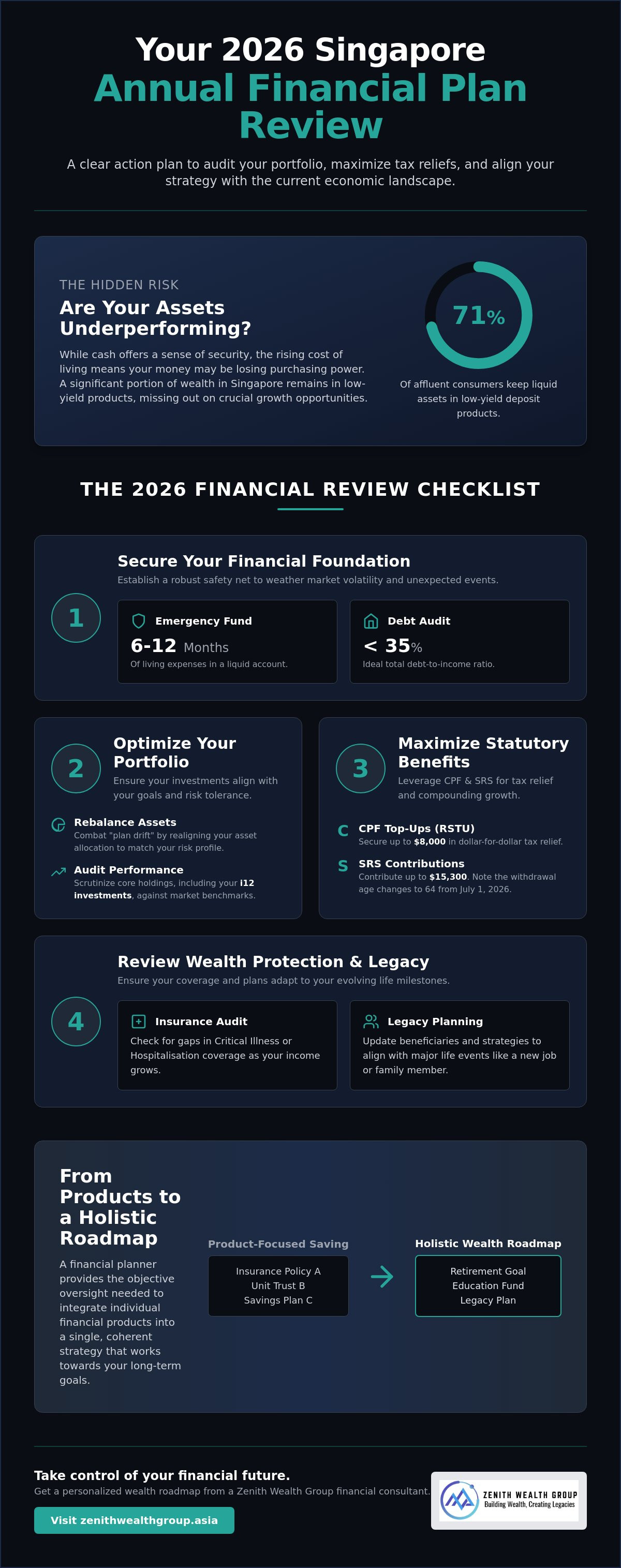
Did you know that 71% of affluent consumers in Singapore still keep their liquid assets in low-yield deposit products? While cash offers a sense of security, the rising cost of living means your money might actually be losing its edge. It's time to move beyond passive saving and take control of your wealth. This annual financial plan review checklist Singapore serves as your essential guide to auditing your portfolio and aligning your 2026 goals with the current economic landscape.
We know that keeping up with the complexity of CPF Ordinary Wage ceilings and SRS withdrawal age changes feels overwhelming. You want to be sure your retirement and legacy plans are secure without getting lost in technical jargon. This guide promises a clear action plan to maximize your tax reliefs and optimize your wealth. We'll preview how to navigate the new $8,000 CPF ceiling, leverage SRS contributions before the July age hike, and integrate i12 investments into a robust strategy. Whether you're working with a financial planner or managing your own path, these insights will help you build a resilient and confident future.
Key Takeaways
- Adapt to 2026 economic shifts by understanding how inflation and MAS policies affect your household's purchasing power.
- Secure your foundation using our annual financial plan review checklist Singapore to audit debt ratios and ensure your emergency funds are ready for 2026.
- Maximise your 2026 tax savings by optimising CPF Special Account top-ups and timing your SRS contributions effectively.
- Audit your core portfolio performance, including your i12 investments, to maintain the right balance between risk and reward.
- Learn how a professional financial planner provides the objectivity needed to move from product-focused saving to a holistic wealth roadmap.
Why an Annual Financial Review is Critical in 2026 Singapore
The 2026 economic environment isn't one for the faint of heart. With headline inflation projected at 2.3%, your purchasing power is under constant pressure. A Financial plan acts as your GPS through these shifts. It's not just about how much you save; it's about how that capital works against rising costs. If you haven't looked at your portfolio since last year, you're likely experiencing "plan drift." This happens when market volatility pushes your asset allocation out of balance without you noticing.
Using a comprehensive annual financial plan review checklist Singapore helps you spot these gaps early. For instance, the Monetary Authority of Singapore (MAS) continues to use the exchange rate as its primary tool. This directly impacts your global investment holdings. A stronger SGD might dampen your overseas returns, while a weaker one could boost them. You need to know exactly where you stand. Your i12 investments should be scrutinized to ensure they still fit your risk profile amidst these global swings. Standing still is effectively moving backward in this climate.
Navigating the 2026 Economic Landscape
Interest rates remain a critical factor for Singaporean homeowners. Whether you're servicing a private property loan or an HDB loan, your debt-to-income ratio needs a fresh look. With core inflation at 2.0%, the real return on your cash reserves might be lower than you think. Holding too much cash is a common trap that limits your long term growth. A "set and forget" mentality is dangerous when the market is this dynamic. It's time to be proactive with your wealth.
Aligning Life Milestones with Financial Reality
Life changes faster than we realize. Perhaps you've moved into a new role or you're welcoming a new family member. These milestones require an immediate update to your education funding and wealth protection strategies. Healthcare costs in Singapore continue to climb, making it vital to review your insurance coverage. Beyond standard medical expenses, many are also investing in holistic well-being; you can click here to explore how Zhong Centre offers specialized acupuncture and TCM. If you're nearing retirement, the July 1, 2026, shift in the SRS withdrawal age to 64 is a major deadline. Your financial planner can help you navigate these statutory changes to ensure your legacy planning remains intact. It's about making sure your money is ready for your life, not the other way around.
The 2026 Singapore Financial Plan Review Checklist
Your annual financial plan review checklist Singapore begins with a pulse check on your safety net. Given the current economic climate, verify that your emergency fund covers 6 to 12 months of local living expenses. This buffer is your first line of defense against market swings. Next, audit your total debt-to-income ratio. This includes your HDB or private property loans. High interest debt should be your priority for restructuring as rates fluctuate. Finally, execute your statutory top-ups for CPF and SRS before the December deadline to secure your tax reliefs.
Rebalancing your investment portfolio is equally vital. Ensure your asset allocation still reflects your risk tolerance. This is a prime time to evaluate the performance of your i12 investments and see if they need adjustment. If the numbers feel complex, reaching out to a financial planner can provide the clarity you need to stay on track.
Cash Flow and Debt Management
Analyze your 2025 spending patterns to set realistic budget caps for the coming year. Look for areas where lifestyle inflation might be quietly eating into your savings. For Singapore professionals, a total debt-to-income ratio should ideally remain below 35% to maintain long term financial flexibility. Focus on paying down high cost credit before the year ends to free up more capital for growth, such as reinvesting in your business's market position through Phoenix Design.
Insurance and Wealth Protection Audit
Check for gaps in your Critical Illness or Hospitalisation coverage. As your income grows, your death and disability protection must keep pace. Evaluate the necessity of riders in your Integrated Shield Plan to ensure you aren't overpaying for redundant coverage. For a detailed breakdown of these strategies, read our guide on Wealth Protection in Singapore.
Don't overlook the Supplementary Retirement Scheme (SRS) as a tax deferral tool. According to Singapore's Ministry of Finance, the scheme is a key pillar of national retirement strategy. For 2026, the contribution limit is $15,300 for residents. Ensuring these funds are actively invested is essential for long term growth and success.
Optimising Statutory Benefits: CPF and SRS Strategies
Statutory benefits are the backbone of wealth management for any Singapore resident. They offer a rare combination of tax relief and guaranteed growth. As part of your annual financial plan review checklist Singapore, you must evaluate your CPF Special Account (SA) top-ups. Topping up via the Retirement Sum Topping-Up (RSTU) scheme provides a dollar-for-dollar tax relief up to $8,000. However, remember the trade-off. These funds are locked until retirement. You're trading immediate liquidity for a 4% floor interest rate and a more secure CPF LIFE payout later.
Reviewing your CPF LIFE projections is equally vital. Your desired lifestyle in 2026 and beyond should dictate whether you aim for the Basic, Full, or Enhanced Retirement Sum. If your Ordinary Account (OA) is sitting idle at 2.5%, consider if those funds could be better utilised. A financial planner can help you model these scenarios to see if moving OA funds to SA or investing them makes sense for your long term roadmap. Don't let your statutory accounts sit on autopilot while the rules evolve around you.
The SRS Advantage for Tax Residents
The Supplementary Retirement Scheme (SRS) remains a premier tool for lowering your IRAS chargeable income. For 2026, Singapore Citizens and Permanent Residents can contribute up to $15,300 to enjoy significant tax savings. Avoid the common mistake of "cash-drag" by letting these funds sit in the account at 0.05%. Instead, use your SRS funds for i12 investments to capture market growth while maintaining your tax benefits. If you haven't made your first contribution yet, do so before June 30, 2026. This allows you to lock in the statutory withdrawal age of 63 before it increases to 64 on July 1. For a deeper dive, see our guide on Mastering the SRS Account.
CPF Retirement Planning Check
Staying on track for your retirement sum requires constant monitoring. The 2026 landscape includes significant changes, such as the CPF Ordinary Wage (OW) ceiling increasing to $8,000 per month effective from January 1, 2026. This means more of your monthly salary is directed into your CPF accounts, potentially shifting your voluntary top-up strategy. Check your current balances against the 2026 Retirement Sums to ensure your trajectory is sound. Whether you're aiming for the Enhanced Retirement Sum or just starting out, these small adjustments today define your freedom tomorrow. Every dollar saved in tax is an extra dollar that can be reinvested into your future.
Investment Portfolio Analysis and i12 Investments
Reviewing your investments is the heart of any annual financial plan review checklist Singapore. It's where you see if your capital is actually keeping pace with your ambitions. Start by assessing the performance of your i12 investments within your core portfolio. These holdings should serve as a stable engine for growth. If certain assets have outperformed, your risk profile might have shifted without you noticing. Rebalancing ensures you don't wake up with a portfolio that's riskier than you intended. It's about maintaining discipline in a market that often lacks it.
Geographic diversification is another pillar of a resilient 2026 plan. While local growth remains steady, relying solely on Singapore assets limits your potential. Balance your Singapore REITs or blue-chip stocks with global exposure to hedge against regional downturns. Don't let high investment fees erode your compounding power over time. Even a small difference in annual fees can significantly impact your wealth over two decades. Audit every fund and platform to ensure you're getting true value for your money. This process is increasingly streamlined by open banking innovations, where companies like Wealthreader provide the underlying technology to aggregate complex financial data into a single, clear interface.
Reviewing Risk Tolerance and Asset Allocation
Market conditions in 2026 are different from those in 2025. You must test if your current risk appetite still holds. Identifying over-concentration is vital. Many portfolios become unintentionally heavy in US Tech or local property sectors. If your life circumstances have changed, your allocation should reflect that. For a deeper look at these mechanics, explore our guide on Strategic Investment Management in 2026. It's time to ensure your strategy matches your reality.
The Role of i12 Investments in Wealth Growth
i12 investments are designed to align with your long term retirement goals. When reviewing these, compare active versus passive management strategies. Active management can help navigate the volatility expected in the 2026 Asia-Pacific region. However, ensure that your plan maintains sufficient liquidity for major upcoming purchases or lifestyle changes. A robust portfolio is one that grows while staying accessible when you need it most. If you're ready to refine your strategy, speak with a financial planner today to align your assets with your 2026 roadmap.
Partnering with a Financial Planner for Your 2026 Roadmap
Self-audits are a great start. However, we often miss our own biases when looking at our money. A professional financial planner brings a level of objectivity that's hard to achieve alone. Much like how you would check out Benchmark Physio for specialized clinical care instead of relying on guesswork for physical recovery, an expert advisor ensures your financial health is managed with evidence-based precision. They don't just look at numbers; they look at the narrative of your life. This isn't about being sold a product. It's about holistic financial consultancy. You want a partner who prioritizes your human story alongside technical advisory. Traditional services often feel cold and institutional. We prefer an open-door policy that encourages immediate connection and honest dialogue. Our focus is on efficiency and clarity, ensuring your path is unobstructed by jargon.
Zenith Wealth Group understands the unique pressures on Singaporean families. From the rising cost of living to the shift in CPF ceilings, we tailor the annual financial plan review checklist Singapore to your specific household needs. We look at how your i12 investments integrate with your legacy planning and retirement goals. Setting actionable KPIs is the final step of a successful review. These might include hitting a specific tax relief target, maximizing your SRS contributions before the July 2026 age hike, or reducing your debt-to-income ratio by a set percentage. Clear metrics turn a vague plan into a concrete roadmap for the year ahead.
The Value of Expert Financial Consultancy
A skilled financial consultant identifies blind spots you might overlook. This often includes missed opportunities in estate planning or tax optimization via the latest IRAS brackets. For example, you might not realize how the 2026 CPF contribution changes affect your take-home pay or your ability to top up your Special Account. There's a profound peace of mind that comes from a professionally audited legacy plan. You'll know that your wealth protection is robust and your family is secure. If you're ready for that level of clarity, contact a Zenith Wealth Group financial planner today.
Your Next Steps for 2026
Don't wait for the year-end rush. Start gathering your 2025 statements, insurance policies, and your latest IRAS notices now. Having these documents ready makes your review session much more efficient. We recommend scheduling your session before the Q2 rush. This gives you ample time to implement changes before statutory deadlines hit. It's about being proactive rather than reactive. Your future self will thank you for the foresight. Success in 2026 starts with a single conversation. Book your 2026 financial review today and let's start building your legacy together.
Take Charge of Your 2026 Wealth Journey
A resilient financial strategy isn't built on guesswork. It's the result of consistent, intentional audits. You now have the tools to adapt to the $8,000 CPF ceiling and time your SRS contributions to lower your tax burden. Rebalancing your portfolio, specifically your i12 investments, ensures you stay on track despite global market shifts. This annual financial plan review checklist Singapore provides the framework you need to move from passive saving to active wealth building.
At Zenith Wealth Group, we pride ourselves on a boutique, client-first approach to wealth management. As authorised representatives of finexis advisory Pte Ltd, we're specialists in retirement planning and i12 investments. We're here to help you turn these insights into a personalized roadmap. Don't let your financial health drift in a changing economy. Secure your 2026 financial future with a Zenith Wealth Group financial consultant. Your legacy is waiting to be built. Let's start the conversation today.
Frequently Asked Questions
How often should I conduct a financial plan review in Singapore?
You should conduct a review at least once a year. It's best to schedule this before the Q2 rush to ensure you have time to implement changes before statutory deadlines. Major life events like marriage, new parenthood, or career moves also trigger the need for an immediate update to your strategy.
What documents do I need for my 2026 annual financial review?
You need your 2025 year-end bank statements, latest IRAS tax notices, and CPF contribution history. Also gather your current insurance policy schedules and investment performance reports. Having these ready makes your annual financial plan review checklist Singapore much more effective and helps you spot gaps in your wealth protection quickly.
Can I perform a financial review without a financial consultant?
You can perform a self-audit, but a professional financial planner provides necessary objectivity. They help identify blind spots in tax optimization or estate planning that you might miss. Partnering with a professional ensures your legacy plan is audited against the latest 2026 regulations and that your risk appetite matches your actual portfolio.
How do CPF changes in 2026 affect my retirement plan?
The CPF Ordinary Wage (OW) ceiling increases to $8,000 per month on January 1, 2026. This change means more of your monthly salary is directed into your CPF accounts. While this boosts your long term retirement sum, it may impact your immediate monthly cash flow. You should review your budget to accommodate these higher contribution rates.
What is the maximum SRS contribution for tax relief in 2026?
The maximum SRS contribution for Singapore Citizens and Permanent Residents in 2026 is $15,300. Foreigners can contribute up to $35,700. Making these contributions before the December 31 deadline is a key step in lowering your chargeable income. Remember to invest these funds rather than leaving them in cash to avoid losing value to inflation.
How do i12 investments fit into a standard Singaporean portfolio?
i12 investments act as a strategic growth engine within your core portfolio. They are specifically designed to align with long term retirement and legacy goals. A financial planner can help you integrate these assets to ensure you have the right balance of geographic diversification and managed risk across your local and global holdings.
Is estate planning part of an annual financial review?
Yes, estate planning is a critical component of any holistic review. It ensures your assets are distributed according to your wishes and that your family is protected. You should update your will and CPF nominations whenever your family dynamics change or when your asset valuations shift significantly to keep your legacy plan current.
What should I do if my 2025 investments underperformed?
Don't panic or make emotional decisions. Start by auditing the underlying reasons for the underperformance and check if your original investment thesis still holds. Rebalancing your asset classes helps maintain your intended risk profile. This is a good time to see if your i12 investments need adjustment to better capture 2026 market opportunities.


